Can Social Security Disability Be Garnished for a Lawsuit? 2026 Rules and Protections
Quick Answer
- Private creditors and debt collectors cannot garnish SSDI or SSI benefits, even with a court judgment.
- Only specific federal obligations like child support, alimony, back taxes, and defaulted student loans can trigger withholding.
- Banks must protect two months of directly deposited federal benefits from garnishment orders.
Can Social Security disability be garnished for a lawsuit? The short answer is no, not for most private debts. If a credit card company, medical provider, or personal lender sues you and wins a judgment, that creditor cannot take money directly from your Social Security Disability Insurance (SSDI) benefits. Federal law protects those funds from most legal process.
But the protection is not absolute. Certain federal obligations can still trigger withholding. Child support and alimony orders, federal tax debts, and defaulted federal student loans are the main exceptions. The Social Security Administration can also recover overpayments through benefit reductions.
This article breaks down exactly when SSDI and SSI can be garnished, how bank account protections work, and what you can do if a creditor tries to take your benefits. One detail that matters: if your benefits are deposited directly into your bank account, federal rules require the bank to protect up to two months of those payments from most garnishment orders.
The Facts
| Case | Garnishment of Social Security Disability Benefits (federal law) |
|---|---|
| Status | Active federal protections under 42 U.S.C. § 407 and related statutes |
| Fund Size | Not applicable |
| Est. Per Person | Not applicable |
| Claim Deadline | Not applicable |
| Administrator | Social Security Administration and Treasury Offset Program |
| Proof Needed | Direct deposit records, benefit award letter, bank statements |
Is Garnishing Social Security Disability Benefits Legit or a Scam Risk?
Attempts to garnish Social Security disability benefits are governed by real federal law, but scams around this issue are common. Debt collectors sometimes threaten to garnish benefits even when they cannot legally do so. That is a violation of the Fair Debt Collection Practices Act.
The Consumer Financial Protection Bureau has warned that over one-third of complaints from older consumers involve debt collectors making threats about garnishing SSI, SSDI, or VA benefits. Those threats are often empty. Private collectors cannot touch Social Security benefits.
The real scam risk comes from two directions. Some collectors lie about their authority to garnish. Others use confusing legal language to pressure you into paying debts you may not owe, or paying more than you can afford.
If you receive SSDI or SSI and a collector threatens garnishment, you should not panic. You should ask for written proof of the debt and their legal authority to collect it. If they cannot provide it, they cannot garnish your benefits.
Key Takeaway: Federal law protects Social Security disability benefits from most private creditors. Collector threats about garnishment are often illegal scare tactics.
How Much of Your Social Security Disability Can Be Garnished?
The amount that can be withheld from Social Security disability benefits depends entirely on the type of debt. Private creditors can take nothing. Federal obligations have specific limits.
Here is the verified withholding breakdown:
| Debt Type | Maximum Withholding | Applies to SSDI? | Applies to SSI? |
|---|---|---|---|
| Private debt (credit cards, medical) | 0% | No | No |
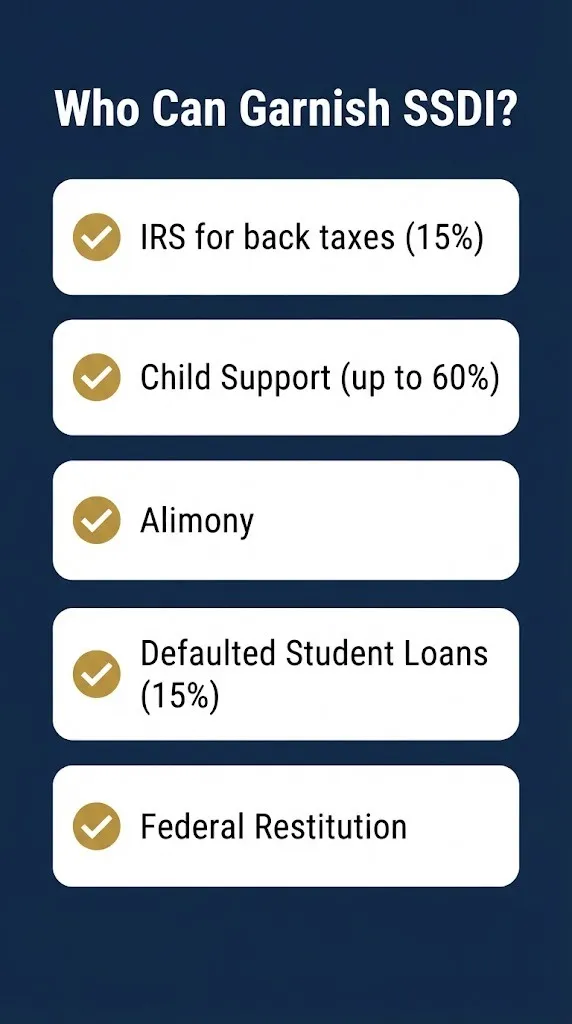
| Child support / alimony | Up to 60% | Yes | No |
| Federal tax debt (IRS levy) | Up to 15% | Yes | No |
| Defaulted federal student loans | Up to 15% | Yes | No |
| Federal restitution | Varies by order | Yes | No |
The IRS can levy up to 15% of each Social Security payment for overdue federal tax debts. The Treasury Offset Program handles delinquent non-tax federal debts, including defaulted student loans, under the Debt Collection Improvement Act of 1996.
Child support and alimony are different. Section 459 of the Social Security Act permits the SSA to withhold current and continuing Social Security payments to enforce legal obligations for child support, alimony, or court-ordered victim restitution. The withholding limit for child support can reach 60% of benefits if you are not supporting another family.
Not yet determined: The exact amount withheld in your case depends on the specific court order, the type of debt, and your state’s rules.
Key Takeaway: Private creditors get zero. Federal obligations can take up to 15% for taxes and student loans, or up to 60% for child support.
Can Debt Collectors Take Social Security Disability From Your Bank Account?
Debt collectors cannot take Social Security disability benefits from your bank account if the funds are directly deposited and properly protected. Federal law requires banks to review the last two months of deposit history when they receive a garnishment order. If they identify federal benefit payments, they must protect up to two months’ worth of those benefits.
The protection works like this. If you receive $1,500 per month in SSDI benefits by direct deposit, your protected amount is $3,000. If a creditor obtains a garnishment order against your account, the bank must leave $3,000 available for you to use. Only amounts above that protected threshold can be frozen or turned over.
But this protection comes with conditions. If you deposit other money into the same account, or if your balance exceeds two months of benefits, the excess may be subject to garnishment. Commingling federal benefits with other funds can complicate the protection.
The CFPB recommends using direct deposit and keeping your federal benefits in a separate account that receives no other deposits. That makes it easier for the bank to identify and protect your money.
What Is the Difference Between SSDI and SSI Garnishment?
SSDI and SSI have different protection levels, and the distinction matters enormously. SSDI is considered earned benefit income, similar to wages. SSI is a need-based program. That difference changes what creditors can take.
SSDI can be garnished for certain federal obligations: unpaid federal taxes, defaulted federal student loans, child support, alimony, and court-ordered restitution. The government can withhold a portion of your monthly benefits through the Treasury Offset Program.
SSI cannot be garnished for any debt, including federal taxes. The government protects SSI funds completely because they are intended to cover basic needs for people with limited income and resources.
If you are not sure which benefit you receive, check your award letter or your online My Social Security account. The protections you have depend entirely on that answer.
How Do You Protect Your Social Security Disability From Garnishment?
You can protect your Social Security disability benefits by using direct deposit, keeping benefits in a separate bank account, and responding immediately to any garnishment notice. The steps are simple, but they require attention.
Here is what to do:
- Set up direct deposit. Have your SSDI or SSI benefits deposited directly into your bank account.
- Use a dedicated account. Keep federal benefits in an account that receives no other deposits.
- Keep your balance below the protected amount. The protected amount is two months of benefits.
- Notify your bank. Tell them the funds in the account are federal benefits.
- Respond to garnishment notices immediately. Do not ignore court or bank notices about frozen funds.
- File a claim of exemption if funds are frozen. You may need to go to court to prove the money is protected.
- Contact a legal aid attorney if needed. Free help is available if collectors are violating your rights.
If your bank freezes funds that came from Social Security, you may need to go to court to get them released. The judge will review the source of the funds and apply federal exemption rules.
What Happens If Your SSDI Is Garnished for Federal Debt?
If your SSDI is garnished for federal debt, the government withholds a portion of your monthly payment before it reaches you. The Treasury Offset Program handles most non-tax federal debts, while the IRS handles tax levies.
You will receive notice before any offset begins. The notice explains the debt, the amount to be withheld, and your right to request a review or set up a payment plan. If you believe the debt is wrong or the withholding is too high, you can challenge it.
The IRS can take up to 15% of your monthly Social Security payment for overdue tax debts. The Treasury Offset Program can take a similar amount for defaulted student loans and other federal debts. These offsets continue until the debt is paid or you successfully challenge the withholding.
If you are facing a federal offset, you may be able to negotiate a lower monthly payment or request a hardship waiver. The SSA and Treasury both have procedures for requesting relief.
Key Takeaway: Federal debts can trigger withholding of up to 15% from SSDI. SSI is fully protected. You can challenge offsets and request payment plans.
Reality Check: A private creditor cannot garnish your Social Security disability benefits, even if they sue you and win a judgment. If a collector tells you otherwise, they are either mistaken or violating federal law. Ask for proof in writing and contact a legal aid attorney if they keep calling.
What Happens Next
Immediately: If you receive a garnishment notice, respond in writing within the deadline stated in the notice. Do not ignore it.
Within days: Contact your bank if funds are frozen. Ask them to identify which funds are protected federal benefits.
If funds are frozen: File a claim of exemption with the court. You may need to attend a hearing.
If federal debt is the cause: Contact the agency collecting the debt. Ask about payment plans, hardship waivers, or review procedures.
Ongoing: Keep your federal benefits in a separate account and monitor your balance to stay below the protected amount.
Frequently Asked Questions
Can a private creditor garnish SSDI?
No. Private creditors like credit card companies and medical debt collectors cannot garnish SSDI benefits. Federal law protects Social Security benefits from most private legal process.
Can SSDI be garnished for child support?
Yes. SSDI can be garnished for child support and alimony under Section 459 of the Social Security Act. The withholding can reach up to 60% of benefits.
Can SSI be garnished?
No. SSI cannot be garnished for any debt, including federal taxes, child support, or private debts. It is fully protected.
Can the IRS take my Social Security disability?
Yes. The IRS can levy up to 15% of each Social Security payment for overdue federal tax debts.
How much of my bank account is protected from garnishment?
Banks must protect up to two months of directly deposited federal benefits from garnishment. If you receive $1,500 per month, $3,000 is protected.
What happens if my bank account is frozen?
If your account is frozen, contact your bank immediately. You may need to file a claim of exemption in court to prove the funds are protected federal benefits.
Can debt collectors threaten to garnish my Social Security?
Debt collectors who threaten to garnish Social Security benefits may be violating the Fair Debt Collection Practices Act. You can report them to the CFPB or your state attorney general.
Does a lawsuit judgment allow a creditor to take my SSDI?
No. A court judgment does not give a private creditor the right to garnish SSDI benefits. Federal law prohibits that.