Workers Compensation Attorney Florida 2026: Costs, Deadlines, and When You Actually Need One
Quick Answer
- Florida workers’ comp attorneys work on contingency, so you pay no upfront fees and owe nothing unless benefits are recovered.
- Attorney fees are capped by Florida law at 20% of the first $5,000, 15% of the next $5,000, and 10% of the rest.
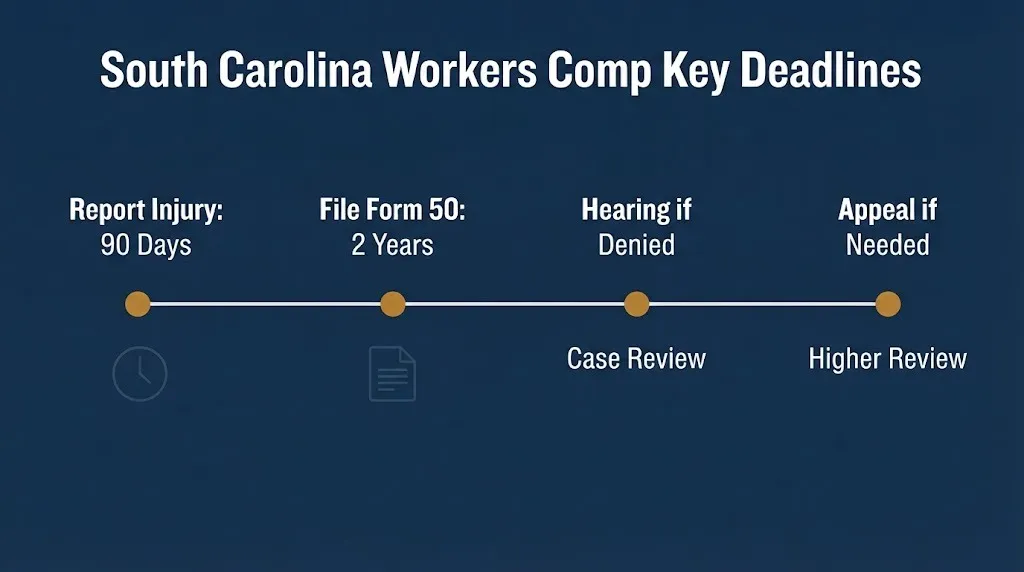
- The most important deadline: report your injury within 30 days and file your Petition for Benefits within two years.
If you were hurt on the job in Florida, you already know the system feels stacked against you. The insurance company has lawyers. You probably don’t. That imbalance is exactly why Florida regulates what workers’ comp attorneys can charge. The state wants representation to be affordable for injured workers, and the fee structure reflects that goal.
But hiring a lawyer isn’t automatic. Many claims get paid without one. The question is when the system stops working and you need someone who knows the rules better than the adjuster on the other end of the phone. This guide breaks down the real costs, the hard deadlines, and the situations where going alone costs you more than a lawyer ever would.
The Facts
System | Florida Workers’ Compensation System
Benefit Rate | 66.67% of average weekly wage (TTD)
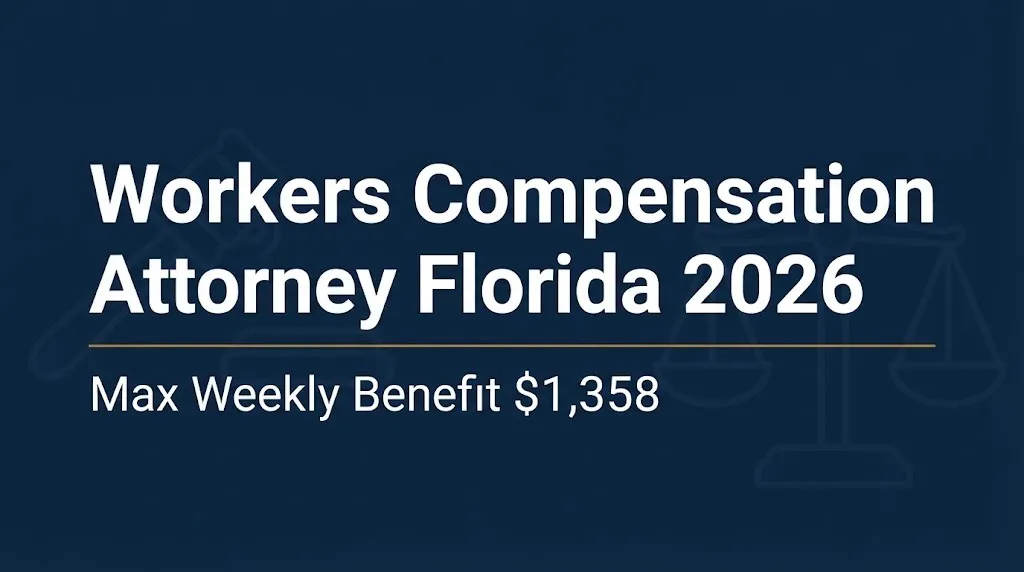
2026 Max Weekly Benefit | $1,358 for injuries in 2026
Reporting Deadline | 30 days to notify employer
Filing Deadline | 2 years to file Petition for Benefits
Attorney Fees | Contingency only, capped by Fla. Stat. 440.34
Proof Needed | Medical records, accident report, wage statements
How much does a workers compensation attorney in Florida cost?
A workers compensation attorney in Florida costs you nothing upfront and typically no fee unless benefits are recovered, because Florida law requires contingency fee arrangements in these cases. The fee is a percentage of what you recover, and the Florida Legislature set the ceiling.
Under Florida Statute 440.34, attorney fees for benefits secured on behalf of a claimant are capped at:
- 20% of the first $5,000 of benefits secured
- 15% of the next $5,000
- 10% of remaining benefits provided during the first 10 years after the claim is filed
- 5% of benefits secured after 10 years
The fee must be approved by a Judge of Compensation Claims (JCC) . That approval process protects you from being overcharged.
What does “benefits secured” mean? It’s the value of what your attorney actually obtained for you. If your attorney gets the carrier to pay for surgery it denied, the cost of that surgery counts toward the fee calculation. If your attorney recovers nothing, you owe nothing .
Some firms front all case costs, including medical records requests and expert fees, and only seek reimbursement if you win . Always confirm this before signing.
Key Takeaway: Florida workers’ comp attorney fees are capped by statute and paid only from recovered benefits, so you can hire representation without paying out of pocket upfront.
What are the deadlines to file a workers compensation claim in Florida?
You have 30 days to report your injury to your employer and two years to file a Petition for Benefits with the Florida Division of Workers’ Compensation. Missing either deadline can end your claim.
The 30-day reporting rule is strict. For sudden injuries, the clock starts the day of the accident. For conditions that develop over time, like carpal tunnel or hearing loss, the clock starts when you learn or should have learned the condition is work-related .
The two-year filing deadline is set by Florida Statute 440.19. The clock runs from the date you knew or should have known the injury arose out of work . Paying you indemnity benefits or providing medical treatment tolls the deadline for one year from the date of that payment, but only for certain issues .
| Deadline | What It Applies To | Consequence of Missing |
|---|---|---|
| 30 days | Reporting injury to employer | Possible loss of benefits |
| 2 years | Filing Petition for Benefits | Claim barred by statute of limitations |
| 1 year | Seeking additional benefits after last payment | Claim may be barred |
There are exceptions for minors and mentally incompetent workers. The statute of limitations is paused while they have no guardian, and begins running when a guardian is appointed or the minor turns 18 .
What benefits does Florida workers compensation cover?
Florida workers compensation covers medical treatment, wage replacement, and permanent impairment benefits, but it does not pay for pain and suffering. The system is no-fault, meaning you do not have to prove your employer was negligent .
Medical benefits cover all reasonable and necessary treatment for your work injury with no copays or deductibles. This includes emergency care, doctor visits, surgery, prescriptions, physical therapy, and medical equipment . The insurance carrier chooses your authorized treating physician. You generally cannot pick your own doctor and expect the carrier to pay .
Temporary Total Disability (TTD) pays 66.67% of your average weekly wage if you cannot work at all while recovering. The 2026 maximum is $1,358 per week . Benefits continue until you reach Maximum Medical Improvement (MMI) or return to work.
Temporary Partial Disability (TPD) applies if you return to light duty but earn less than 80% of your pre-injury wages. The benefit makes up a portion of the difference .
Permanent Impairment Benefits (PIB) are paid once you reach MMI and a doctor assigns an impairment rating. The rating determines how many weeks of benefits you receive .
How is a workers comp settlement calculated in Florida?
A Florida workers comp settlement is calculated by combining the value of future medical care, lost wages, and permanent impairment benefits into a lump sum. There is no single formula because every injury is different.
Permanent impairment benefits follow a statutory schedule. For a 10% impairment rating, you receive 20 weeks of benefits paid at 75% of your TTD rate . Higher ratings get more weeks per point.
The table below shows typical settlement ranges by injury severity, based on general patterns. These are illustrative, not guarantees.
| Injury Type | Typical Settlement Range |
|---|---|
| Minor soft tissue (sprains, strains) | $5,000 to $25,000 |
| Moderate orthopedic (fractures, disc injuries) | $25,000 to $100,000 |
| Serious orthopedic (surgery required) | $75,000 to $250,000 |
| Spinal cord injury (partial paralysis) | $250,000 to $750,000 |
| Catastrophic / total disability | $500,000 to $1,000,000+ |
These ranges come from a Florida workers’ comp law firm’s published analysis . They are not official state figures and not every case fits these brackets.
Future medical costs are often the biggest driver of settlement value. If you might need surgery years from now, settling for a lump sum that only covers current bills can leave you paying out of pocket later .
Reality Check: No one calls you offering to “release” workers’ comp money for a fee. Filing a Petition for Benefits with the Florida Division of Workers’ Compensation is free. If a company asks for payment to process your claim or guarantees a specific settlement, that is a red flag.
When should you hire a workers compensation attorney in Florida?
You should hire a workers compensation attorney in Florida when your claim is denied, your benefits are delayed or cut off, or your injury is serious enough to involve permanent impairment. You do not legally need a lawyer for every claim, but the insurance company always has one.
Florida’s system is designed to be self-administering. Benefits are supposed to flow automatically when a legitimate injury occurs . That works for simple claims. It breaks down when the carrier disputes causation, undervalues your impairment, or stops paying before you’re ready to return.
Situations where hiring an attorney moves from optional to necessary:
- Your claim was denied. The denial letter will state a reason. You can appeal, but the process runs through formal legal proceedings .
- Your benefits were cut off. If the carrier files a Form 15 to stop benefits, you have the right to dispute it .
- You disagree with your impairment rating. The carrier’s doctor may assign a low rating that undervalues your permanent disability .
- You need a second opinion. You can request a change of physician, but the procedures must be followed carefully .
- Your injury is catastrophic. Spinal cord injuries, brain trauma, and amputations involve complex calculations and lifetime care costs.
The insurance carrier has a team of adjusters, nurse case managers, and defense attorneys working on your claim . Going alone puts you at a disadvantage.
How do you choose the right workers compensation attorney in Florida?
Choose a workers compensation attorney in Florida who focuses exclusively on workers’ comp, has experience before the Office of the Judges of Compensation Claims in your area, and offers a free consultation. Workers’ comp is a specialized area, not a side practice.
Questions to ask before hiring:
- What percentage of your practice is workers’ compensation? You want a specialist, not a generalist .
- How many cases have you taken to hearing before a JCC? Experience matters in this system.
- Who handles my case day to day? Some firms assign paralegals to routine tasks.
- How will you communicate with me? Set expectations for updates and response times.
- What costs will I be responsible for? Confirm the firm fronts case costs and only seeks reimbursement from recovery.
Florida’s workers’ comp system is different from personal injury. The statutes, procedures, and strategies are specific . An attorney who handles workers’ comp occasionally is not the same as one who has spent years in this field.
Avvo’s legal community recommends checking attorney profiles, reviews, and ratings on Martindale, Super Lawyers, and Best Lawyers to identify respected practitioners . A free consultation costs nothing and gives you a clear picture of where you stand.
What happens next in your Florida workers comp case?
The next stages of your case depend on whether your claim is accepted or disputed.
Immediately: Report your injury to your employer within 30 days. Seek authorized medical care.
Within two years: File a Petition for Benefits with the Florida Division of Workers’ Compensation to formally protect your claim .
If benefits are paid: Continue treatment and follow restrictions. The carrier may stop benefits with a Form 15 when your doctor says you’re at MMI.
If benefits are denied or cut off: You can request a hearing before a Judge of Compensation Claims. You have the right to present evidence and testimony.
If you reach MMI: You may receive a permanent impairment rating. That rating determines your permanent impairment benefits .
If you settle: A lump sum settlement ends the case but also ends future medical coverage for that injury. Never settle without understanding the long-term consequences.
Frequently Asked Questions
Do I need a lawyer for a workers comp claim in Florida?
Not always. Simple claims with accepted injuries may not require one. But if your claim is denied, disputed, or involves serious injury, a lawyer can protect your rights.
How much does a Florida workers comp attorney cost?
Most work on contingency. You pay nothing upfront, and fees come from your recovery. Florida law caps fees at 20% of the first $5,000, 15% of the next $5,000, and 10% of the rest .
What is the deadline to file a workers comp claim in Florida?
You have 30 days to report the injury to your employer and two years to file a Petition for Benefits with the Division of Workers’ Compensation .
Can I choose my own doctor for a workers comp injury in Florida?
No. The insurance carrier chooses your authorized treating physician. You can request a change, but the procedures must be followed .
What if my workers comp claim was denied in Florida?
You can appeal by filing a Petition for Benefits and requesting a hearing before a Judge of Compensation Claims. A denial is not final .
How much is my workers comp case worth in Florida?
The value depends on your average weekly wage, impairment rating, future medical needs, and the body part injured. The 2026 maximum weekly benefit is $1,358 .
Does workers comp cover pain and suffering in Florida?
No. Florida workers’ compensation does not pay for pain and suffering. It covers medical care, lost wages, and permanent impairment .
Can I sue my employer for a work injury in Florida?
Generally, no. Workers’ compensation is the exclusive remedy against your employer. But if a third party caused your injury, you may have a separate personal injury claim .
The Bottom Line
A Florida workers compensation attorney costs you nothing upfront and only gets paid from what you recover. The fee is capped by state law, and the system is designed so cost is never a barrier to representation. If your claim is denied, your benefits are cut off, or your injury is serious, hiring a specialist changes the outcome. Report your injury within 30 days. File your Petition for Benefits within two years. Do not let the deadline pass while you wait to see if the system works on its own.