Colorado Workers Compensation Attorney 2026: Costs, Deadlines, Maximum Benefits, and When You Actually Need One
Quick Answer
- Is it legit? Yes. Colorado workers’ comp is a no-fault system run by the state Division of Workers’ Compensation. You do not need a lawyer to file, but you may want one if your claim is disputed .
- How much could you get? Not yet determined for any individual case. Payouts depend on your average weekly wage, impairment rating, and whether you settle with open medical or full and final .
- Most important deadline: Report your injury to your employer in writing within 10 working days of the accident or knowledge of a occupational disease .
If you were hurt on the job in Colorado, the system is not designed to hand you a check. It is designed to deliver medical treatment and wage replacement benefits quickly, at a reasonable cost to employers, without litigation if possible. That is the stated purpose of the Colorado Workers’ Compensation Act.
But “quickly” does not always mean fair. And “without litigation” does not mean you will not need help.
This article covers what Colorado workers’ compensation actually pays in 2026, when a attorney changes the outcome, what the Division approval process looks like, and the one deadline that kills more claims than any other.
One surprising number: the maximum weekly benefit for temporary total disability is $1,396.85 in the current fiscal year, but the cap for permanent partial disability jumps from $192,996.79 to $312,967.77 once your impairment rating hits 20 percent . That single percentage point can mean the difference between a modest settlement and a six-figure one.
The Facts
| Case Type | Workers’ compensation claim under Colorado Workers’ Compensation Act, C.R.S. 8-40-101 et seq. |
|---|---|
| Governing Agency | Colorado Division of Workers’ Compensation, Department of Labor and Employment |
| Current Max TTD Rate | $1,396.85 per week (FY July 1, 2025 to June 30, 2026) |
| PPD Cap (under 20% impairment) | $192,996.79 |
| PPD Cap (20%+ impairment) | $312,967.77 |
| Reporting Deadline | 10 working days from injury or knowledge of occupational disease |
| Attorney Fees | Contingency, typically 20 percent of disputed benefits or settlement |
| Division Approval Required | Yes, settlements must be approved under C.R.S. 8-43-204 |
| Proof Needed | Medical records establishing work-related injury and impairment rating |
Is a Colorado workers compensation attorney really necessary for your claim?
A Colorado workers compensation attorney is not required by law. But you may need one if your claim is denied, if you disagree with your impairment rating, or if you are considering a settlement that closes your future medical benefits.
The honest answer is: most simple claims do not need a lawyer. If you slipped, went to the doctor, got a few weeks of physical therapy, and returned to work without permanent problems, the system probably works for you.
Where it breaks down is when there is a dispute. The insurance company has lawyers. They have doctors who evaluate impairment ratings. They know how to write a Final Admission of Liability that looks generous but leaves out future medical exposure.
The Division’s own administrative law judges rule on cases where unrepresented workers try to challenge denials or low ratings. The statute says facts “shall be decided on the merits” and interpreted neutrally, neither for the claimant nor the employer . But neutral is not the same as equal. One side has professional representation and years of practice in that specific venue. The other side may have a folder of medical records and no idea how to cross-examine a doctor.
You may want an attorney if any of these apply: your claim was denied, your impairment rating feels low compared to what your doctor said, you are considering a full and final settlement, or you are Medicare-eligible and a Medicare Set-Aside is in play .
Key Takeaway: You can file a Colorado workers’ comp claim without a lawyer. You probably should not settle one without one if your injury is permanent or your benefits were disputed.
How much does a Colorado workers compensation attorney cost in 2026?
Colorado workers comp attorneys work on contingency. You typically pay nothing up front. Fees come out of the benefits or settlement they recover for you, subject to statutory caps and Division oversight.
This is not like paying a retainer for a business lawyer. The fee structure aligns the attorney’s incentive with your outcome. If they do not recover additional benefits, you typically do not owe a fee.
In practice, the contingency fee is usually around 20 percent of the disputed or settled amount. The exact percentage can vary by case, and any settlement agreement that includes attorney fees is subject to review by the Division of Workers’ Compensation.
One thing to watch: attorney fees are deducted from your settlement before you receive the check. So a $50,000 settlement with a 20 percent fee yields $40,000 before any other liens are resolved. Subrogation liens from Medicare, private health insurance, or third-party claims can further reduce your net recovery .
The Colorado Trial Lawyers Association and the Colorado Bar Association both maintain directories of workers’ compensation attorneys who represent claimants, not employers or insurers. The distinction matters. A defense firm like Hall and Evans represents businesses and insurers . A claimants’ firm represents workers.
Key Takeaway: No upfront cost. Fees are contingent and paid from your recovery. Ask any attorney you speak with to put the fee arrangement in writing before you hire them.
What is the maximum workers comp benefit in Colorado for 2026?
The maximum weekly Temporary Total Disability benefit is $1,396.85 for the fiscal year that began July 1, 2025 and runs through June 30, 2026. The maximum Permanent Partial Disability cap depends on your impairment rating.
That TTD number is the baseline for wage replacement while you cannot work. If your average weekly wage is high enough, TTD pays two-thirds of that wage, up to the maximum .
For permanent injuries, Colorado uses a “whole person” rating for back injuries and many other conditions. The payout formula multiplies your impairment rating by age factors and statutory multipliers, then applies a cap.
Here is where it gets interesting, and where insurers fight hardest:
| Impairment Rating | Maximum PPD Payout (2026) |
|---|---|
| 1% to 19% | $192,996.79 |
| 20% or higher | $312,967.77 |
That cliff at 20 percent is not a rounding error. It is a $120,000 jump. An insurer that can keep your rating at 19 percent instead of 20 percent saves itself more than $100,000 .
This is the single most common dispute in Colorado workers’ compensation. Your treating physician assigns one rating. The insurer’s physician assigns another. The gap between them can be tens of thousands of dollars.
Key Takeaway: The 20 percent impairment threshold in Colorado triggers a six-figure difference in payout. If your rating lands at 18 or 19 percent, that is not a coincidence worth ignoring.
How much can you get for a Colorado workers comp settlement in 2026?
Settlement amounts depend on your specific injury, wage history, impairment rating, and whether you settle with open medical or full and final. There are no fixed tiers or published ranges.
Anyone who tells you “back injuries are worth $X” is guessing or selling something. The Colorado Division of Workers’ Compensation does not publish average settlement amounts by injury type because the variables are too individualized.
What can be estimated is the framework. A minor strain with no surgery and a quick return to work might resolve for a few thousand dollars in wage differential or a small impairment rating. A surgical back injury with permanent restrictions, future medical needs, and a 20 percent impairment rating could be worth six figures.
The key structural choice is between two types of settlement:
Settlement with open medical: The lump sum is smaller, but workers’ comp remains responsible for future medical treatment related to the injury. This is valuable if you might need surgery, ongoing prescriptions, or specialist care years from now.
Full and final settlement: The lump sum is larger because you are giving up all future rights to medical and indemnity benefits. Once approved, the case is closed. No reopening, even if your condition gets worse .
An attorney’s job in a settlement negotiation is to value the future medical exposure accurately. Insurers routinely undervalue it because they want to close the file. You cannot get that valuation right without medical records, a firm impairment rating, and an understanding of Medicare’s future interests.
Key Takeaway: “Full and final” pays more now but closes the door forever. “Open medical” pays less but keeps treatment covered. The right choice depends on whether your condition is stable or could need future surgery.
How long does it take to get paid from a Colorado workers comp settlement?
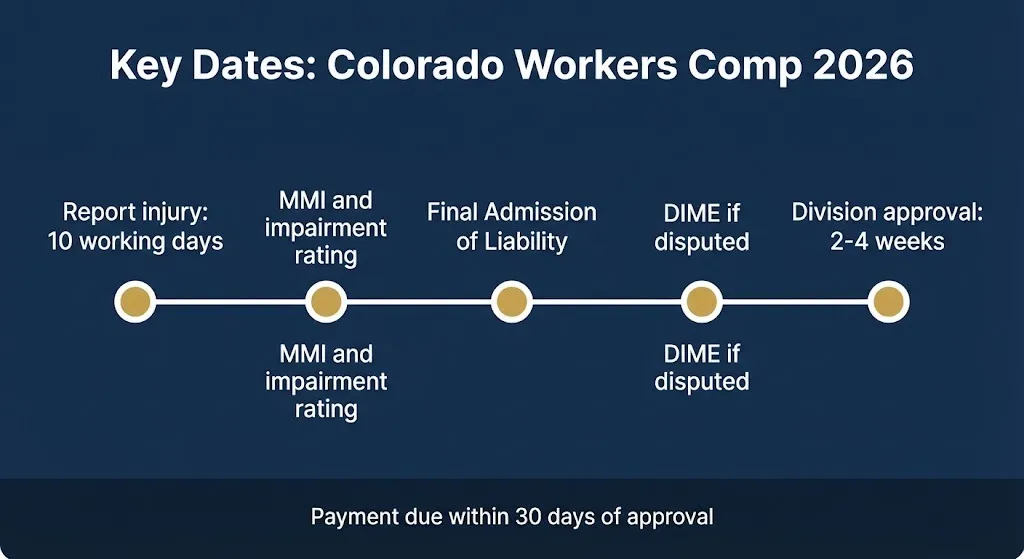
From settlement negotiation to payment, plan on at least two to six months. The Division approval process alone takes two to four weeks, and payment is required within 30 days of approval.
Here is the realistic timeline, stage by stage :
- Injury and reporting: You report to your employer within 10 working days.
- Medical treatment and MMI: You treat until a doctor declares Maximum Medical Improvement and assigns an impairment rating. This can take weeks or years depending on the injury.
- Final Admission of Liability: The insurer files its formal position on benefits, including the impairment rating it accepts.
- Settlement negotiation: If you dispute the rating or want to settle, negotiation begins. This can take two weeks or several months.
- Division approval: The settlement agreement goes to the Division of Workers’ Compensation for review. Approval typically takes two to four weeks. The Division reviews for adequacy, especially if you are unrepresented .
- Payment: Once approved, the insurer must pay within 30 days. Structured settlements may have the first payment within 30 to 60 days.
The biggest variable is the DIME, or Division-sponsored Independent Medical Examination. If you and the insurer disagree on your impairment rating, either side can request a DIME. The DIME physician’s rating is presumptively binding, and overturning it at a hearing requires “clear and convincing evidence” . The DIME process alone can add three to six months.
Key Takeaway: A contested rating adds months. An uncontested settlement with prompt Division approval can pay within 60 to 90 days. Delays are usually not accidents.
What are the red flags that an insurer is deliberately delaying your claim?
Late TTD payments, repeated “pending review” responses to treatment requests, sudden claims of pre-existing conditions, and lowball settlement offers with tight deadlines are all delay tactics. Colorado law penalizes willful late payment at up to $1,000 per day.
Insurers have a financial incentive to delay. Every month they hold your money is a month it earns interest or funds other operations. The Division of Workers’ Compensation knows this, which is why C.R.S. 8-43-401(2) allows penalties for late payment .
The red flags to document:
- TTD checks arriving late or short, repeatedly
- Treatment authorization requests stuck in “pending review”
- Independent Medical Examinations scheduled unusually late or repeated without new evidence
- A sudden assertion that a pre-existing condition explains your symptoms, with no new medical evidence
- Settlement offers with “accept by Friday” pressure and no substantive movement in negotiation
If you see these patterns, the claim has shifted from administrative processing to adversarial positioning. That is the point where having an attorney on your side stops being optional.
Key Takeaway: Document every late payment, every denied authorization, every shifting explanation. That documentation becomes evidence if you need a hearing.
What changed in Colorado workers compensation law in 2026?
Colorado enacted SB 26-186, which updates the Workers’ Compensation Act to allow electronic filing of claims and documents. The law took effect August 12, 2026.
The bill does not change benefit amounts or eligibility rules. What it changes is the plumbing. The Division of Workers’ Compensation upgraded its electronic data filing system, and the statute needed to catch up so that “mailed” and “served” include electronic filing .
The practical effect for you: fewer paper forms, faster claim processing, and electronic records that are easier to track. Your employer or its insurer can file the First Report of Injury electronically. Notices and documents can be served by email or through the Division’s portal.
One other change: penalties and death benefits that previously went to the Subsequent Injury Fund now go to the Colorado Uninsured Employer Fund . That fund exists to pay benefits when an employer illegally failed to carry workers’ compensation insurance .
The EDI Claims Release 3.1 system went live July 30, 2026, and all trading partners were required to complete testing by July 29, 2026 . If you filed a claim before that date, it may still be processed through legacy systems.
Key Takeaway: The 2026 changes are procedural, not substantive. Benefits and deadlines remain the same. Electronic filing should speed up some administrative steps, but it does not change the 10-day reporting requirement.
Frequently Asked Questions
Do I need a lawyer for a workers comp claim in Colorado?
No, not for a simple claim that is accepted and paid without dispute. Yes, if your claim is denied, your impairment rating is disputed, or you are considering a full and final settlement.
How much does a Colorado workers compensation attorney cost?
Most work on contingency, meaning no upfront fee. They take a percentage, often around 20 percent, out of the benefits or settlement they recover. Any fee in a settlement is subject to Division review.
What is the deadline to report a work injury in Colorado?
You must report the injury to your employer in writing within 10 working days of the accident or within 10 working days of knowing you have an occupational disease .
How much is my Colorado workers comp settlement worth?
There is no fixed formula that applies to all cases. The value depends on your average weekly wage, your impairment rating, future medical needs, and whether you settle with open medical or full and final.
What is the 20 percent impairment cliff in Colorado?
If your whole-person impairment rating is under 20 percent, the maximum permanent partial disability payout is $192,996.79. At 20 percent or higher, the cap jumps to $312,967.77 .
How long does the Division of Workers’ Compensation take to approve a settlement?
Approval typically takes two to four weeks after the settlement agreement is submitted. If the Division has questions, it takes longer .
Can I reopen my workers comp claim after settlement in Colorado?
Only if you settled with open medical. A full and final settlement closes the claim permanently, including future medical benefits.
What is a DIME in Colorado workers compensation?
A Division-sponsored Independent Medical Examination. It is requested when you and the insurer disagree on your impairment rating. The DIME physician’s rating is presumptively binding .
Reality Check: No one from the Division of Workers’ Compensation will text you asking for a processing fee to release your settlement. No legitimate attorney guarantees a payout amount before reviewing your medical records and wage history. If someone promises you a specific dollar figure before seeing your file, walk away.
What Happens Next
October 2026: SB 26-186 electronic filing rules are in effect. New claims filed from this date forward go through the EDI Claims Release 3.1 system.
Expected late 2026: DOWC Rule 1 updates, published in April 2026, continue to be implemented. These rules govern electronic reporting and document service .
Ongoing: The 10-day reporting deadline applies to every new injury. Calendar it the day you tell your supervisor.
Expected mid-2027: New maximum TTD and PPD rates will be announced for the fiscal year beginning July 1, 2027.