Lung Cancer Lawsuit 2026: Settlements, Verdicts, and How to File a Claim
Quick Answer
- What it is: A lung cancer lawsuit claims a product, chemical, or workplace exposure caused your cancer, seeking compensation for medical bills and suffering.
- How much can you get? Verdicts range from $803,000 to $21.8 million. Asbestos settlements often exceed $1 million. Amounts depend on exposure proof.
- Key deadline: Statutes of limitations vary by state, often 2 to 3 years from diagnosis. Missing the deadline bars your claim permanently.
What Is a Lung Cancer Lawsuit?
A lung cancer lawsuit is a personal injury or product liability claim that a specific exposure, such as asbestos, talc, diesel exhaust, or Roundup, caused or contributed to your lung cancer diagnosis. These cases differ from smoking-related claims because they target companies that manufactured or used carcinogenic products without adequate warnings.
The legal landscape in 2026 includes several active categories. Asbestos cases remain the most established, with decades of verdicts and settlements. Talc powder litigation reached a proposed $5.5 billion settlement in July 2026 covering ovarian cancer claims, though that case focuses on a different cancer type. Roundup cases reached a $7.25 billion proposed settlement in February 2026 for non-Hodgkin lymphoma claims. Diesel exhaust cases continue producing verdicts, including a $21.8 million FELA award for a railroad worker’s leukemia death in January 2026.
What ties these cases together is causation proof. You must show that your exposure was sufficient to cause your cancer, and that the defendant knew or should have known about the risk. That is harder than it sounds, and it is why expert testimony and medical records matter more than almost anything else.
This article breaks down the active case types, verified payout ranges, how to file, and the deadlines you cannot miss.
The Facts
| Case Detail | Information |
|---|---|
| Case Types | Asbestos, talc, diesel exhaust, Roundup, Camp Lejeune water |
| Recent Verdict Range | $803,000 to $21.8 million |
| Asbestos Settlement Range | $1 million or more for many claims |
| Roundup Settlement Offer | $10,000 to $165,000 for non-Hodgkin lymphoma |
| Camp Lejeune Payouts | $827 million paid, $1 billion in offers as of August 2026 |
| Filing Deadline | Varies by state, typically 2 to 3 years from diagnosis |
| Proof Required | Medical records, exposure history, expert testimony |
How Much Can You Get From a Lung Cancer Lawsuit?
Lung cancer lawsuit payouts vary widely based on the exposure type, your diagnosis, and the evidence you can produce. There is no standard amount. Recent verdicts and settlements show the range.
Here are verified examples from 2025 and 2026:
| Case Type | Amount | Details |
|---|---|---|
| FELA diesel exhaust | $21.8 million | Railroad worker leukemia death, 48% fault allocated to employer |
| Massachusetts tobacco | $803,000 | Smoker’s estate awarded medical expenses only, no punitive damages |
| Asbestos (typical range) | $1 million or more | Various workers with documented occupational exposure |
| Roundup settlement | $10,000 to $165,000 | Non-Hodgkin lymphoma, severity and age adjusted |
Asbestos cases often produce the largest awards because the link between asbestos and lung cancer is well-established. A Missouri woman received $3 million. A New York railroad worker received $2 million. A Tennessee pipefitter received $2.77 million. These are individual results, not averages, and past outcomes do not guarantee future ones.
Roundup cases use a different structure. The proposed $7.25 billion settlement pays $10,000 to $165,000 per claimant, depending on cancer severity, age at diagnosis, and whether exposure was occupational or residential. That settlement still requires court approval.
Key Takeaway: Lung cancer lawsuit payouts range from under $1 million to over $20 million. Your recovery depends on the specific exposure, your medical proof, and whether the case settles or goes to trial.
What Types of Lung Cancer Lawsuits Are Active in 2026?
Several distinct lung cancer lawsuit categories are active in 2026, each targeting different products and exposure sources. Knowing which category applies to your situation determines which law firm to contact and what evidence you need.
The main categories are:
- Asbestos exposure: The most established category, covering occupational exposure in shipyards, construction, manufacturing, and railroad work. Asbestos is a known carcinogen linked to lung cancer and mesothelioma.
- Diesel exhaust: Railroad workers and others exposed to diesel fumes have won verdicts under FELA. A Virginia jury awarded $21.8 million in January 2026 for a railroad worker’s leukemia death.
- Talc powder: A $5.5 billion proposed settlement announced July 2026 covers ovarian cancer claims, not lung cancer. Talc lung cancer claims are not part of that deal.
- Roundup/glyphosate: A $7.25 billion proposed settlement covers non-Hodgkin lymphoma, not lung cancer. Roundup lung cancer claims are not included.
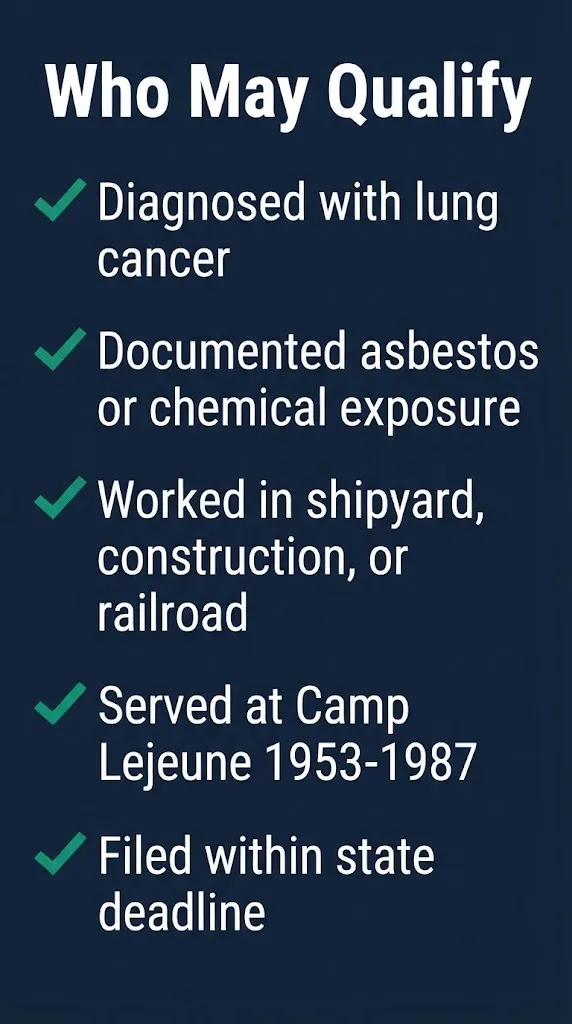
- Camp Lejeune water: Veterans and family members exposed to contaminated water at the North Carolina base between 1953 and 1987 can file claims. Payouts exceeded $827 million as of August 2026.
If your lung cancer came from a different source, such as occupational chemical exposure or a defective product, you may still have a claim. An attorney can evaluate your specific facts.
What Is the Camp Lejeune Lung Cancer Lawsuit?
Camp Lejeune lawsuits are claims filed under the Camp Lejeune Justice Act of 2022 by veterans, family members, and civilians exposed to contaminated water at the North Carolina Marine Corps base between August 1953 and December 1987. The contamination included industrial solvents TCE and PCE, which are linked to cancers including lung cancer.
As of August 2026, the Department of Justice reported settlement offers exceeding $1 billion and payouts exceeding $827 million . A $100,000 offer was accepted for a Track 1 plaintiff with multiple forms of cancer . The DOJ has prioritized settlements, paying more than $421 million to a group of claimants since mid-January 2026 .
The “elective option” provides a faster path to payment but covers only about 12% of the more than 400,000 filed claims . The Congressional Budget Office has estimated total payouts could reach $21 billion, but no global settlement has been reached .
If you served or lived at Camp Lejeune during the covered period and later developed lung cancer or another qualifying condition, you may be eligible to file a claim. The deadline for administrative claims under the CLJA has not been extended.
How Do You File a Lung Cancer Lawsuit?
Filing a lung cancer lawsuit requires documenting your exposure and your diagnosis, then meeting your state’s filing deadline. The steps vary by case type, but the general process is similar.
Here is what the process looks like:
- Gather medical records. Diagnosis, pathology reports, CT scans, and treatment history.
- Document your exposure history. Job records, military service records, product receipts, or testimony about product use.
- Request a free case review. Most lung cancer attorneys offer this at no cost.
- Sign medical authorizations. This lets your lawyer request records from employers and doctors.
- File the complaint before the deadline. Your state’s statute of limitations controls.
- Complete discovery. Both sides exchange documents and expert reports.
- Consider settlement or trial. Most cases settle, but some go to verdict.
The statute of limitations varies by state. For asbestos cases in Pennsylvania, for example, the general limitations window for injury claims is as short as two years, and the period generally begins when you knew or should have known about the injury . Other states allow longer. Missing the deadline is fatal to your claim.
What Proof Do You Need to File a Lung Cancer Lawsuit?
Proof in a lung cancer lawsuit means connecting your specific exposure to your specific cancer. That requires medical evidence, exposure evidence, and often expert testimony.
The key proof elements are:
- Medical records confirming your lung cancer diagnosis, type, and stage.
- Pathology reports identifying the cancer subtype.
- Exposure documentation showing you worked with or around the hazardous substance.
- Product identification if the claim targets a specific product like Roundup or talc.
- Expert testimony linking the exposure to your cancer under accepted scientific methods.
The expert testimony piece is often the hardest. In a Washington diesel exhaust case, an appellate court affirmed summary judgment for BNSF Railway because the plaintiff’s expert erred in applying accepted methodologies . Without reliable expert testimony on causation, the case collapses.
For asbestos cases, the science is largely settled. For newer claims like Roundup or diesel exhaust, courts scrutinize causation experts more closely. That is why choosing experienced counsel matters.
How Long Does a Lung Cancer Lawsuit Take?
A lung cancer lawsuit typically takes one to three years from filing to resolution, though asbestos cases sometimes move faster due to established legal frameworks and expedited dockets for terminally ill plaintiffs.
Many asbestos cases settle within months because the link to cancer is well-documented and defendants prefer to avoid trial. Roundup cases have moved slowly, with the proposed $7.25 billion settlement still awaiting court approval after being announced in February 2026. The settlement would pay out over 17 to 21 years.
Camp Lejeune administrative claims can move faster if you qualify for the elective option, but the backlog remains large. More than 3,700 lawsuits have been filed in the Eastern District of North Carolina .
If your case goes to trial, expect additional time for appeals. The $21.8 million FELA verdict was entered after trial and could face post-trial motions.
What Happens Next in Lung Cancer Litigation
Late 2026: EPA expected to finalize updated glyphosate human health risk assessment, which could affect Roundup litigation.
2026-2027: Court ruling expected on Bayer’s proposed $7.25 billion Roundup settlement.
2026-2027: J&J’s $5.5 billion talc settlement faces approval process, requiring 95% acceptance by ovarian cancer claimants.
Ongoing: Camp Lejeune administrative claims continue processing, with more than 400,000 filed and $827 million paid to date.
Expected 2028: Suboxone bellwether trials begin, not lung cancer but a parallel mass tort model for pharmaceutical injury claims.
Frequently Asked Questions
Can I sue for lung cancer if I never smoked?
Yes. Lung cancer lawsuits target exposures like asbestos, diesel exhaust, and contaminated water, not smoking. Smoking does not bar your claim, though it may reduce damages.
How much is a lung cancer lawsuit worth?
Verdicts range from $803,000 to $21.8 million. Asbestos settlements often exceed $1 million. Your recovery depends on exposure proof, cancer severity, and the defendant’s conduct.
Do I need a lawyer to file a lung cancer lawsuit?
Most people do. Causation proof requires expert testimony and complex medical evidence. Contingency fee arrangements mean you pay nothing unless you recover.
What is the deadline to file a lung cancer lawsuit?
It varies by state, typically 2 to 3 years from diagnosis. Some states use a discovery rule that starts the clock when you knew or should have known about the link between exposure and cancer.
Is the Camp Lejeune lung cancer claim still open?
Yes, but the administrative process is slow. More than 400,000 claims were filed and $827 million paid as of August 2026. The elective option covers only about 12% of claimants.
Can I file a Roundup lawsuit for lung cancer?
No. The proposed $7.25 billion Roundup settlement covers non-Hodgkin lymphoma, not lung cancer. Roundup lung cancer claims are not part of that deal.
What if I was exposed to asbestos decades ago?
You may still have a claim. Many asbestos cases involve exposure that occurred 20 to 50 years before diagnosis. The statute of limitations usually starts at diagnosis, not exposure.
How do I know if my lung cancer was caused by a specific product?
An attorney can evaluate your exposure history against the known science. For asbestos and Camp Lejeune water, the link is established. For other products, causation may be disputed.