Tubal Ligation Lawsuits 2026: Filshie Clip Claims, Payouts, and Deadlines
Quick Answer
- Is it legit? Yes. Filshie Clip lawsuits are real product liability cases filed in state and federal courts, not scams.
- How much can you get? Not yet determined. No settlement fund has been approved, and no payout tiers exist.
- Most important deadline: No claim deadline has been set. Consult an attorney promptly if you believe you were injured.
Filshie Clip lawsuits are real product liability cases, but as of October 2026 no global settlement has been announced and no claim deadline exists for women to file. The litigation targets CooperSurgical Inc., Femcare Ltd., and Utah Medical Products, alleging the titanium clips used in tubal ligation procedures migrate from the fallopian tubes and cause severe complications.
If you had a tubal ligation using Filshie Clips and later experienced device migration, chronic pelvic pain, or required removal surgery, you may have a legal claim. But you must act on your own timeline, because there is no court-approved claim form or settlement administrator accepting filings right now. A Connecticut consolidated action involving 57 plaintiffs remains active in state court.
This article covers what the court records actually show, which injuries plaintiffs are alleging, how prior Essure litigation compared, and what steps you can take if you believe you were harmed. One surprising fact from the docket: a Virginia judge entered a fraud sanction against a doctor who produced manufacturer marketing images as evidence of proper clip placement.
The Facts
| Case | Filshie Clip product liability litigation (consolidated Connecticut actions, plus individual state and federal cases) |
| Status | Active litigation. No global settlement announced. Summary judgment granted against 49 plaintiffs on res judicata grounds, December 2025 |
| Fund Size | Not yet confirmed. No settlement fund exists. |
| Est. Per Person | Not yet determined. No payout tiers announced. |
| Claim Deadline | TBD. No court-approved claim process. Watch the official court dockets. |
| Administrator | Not yet appointed. |
| Proof Needed | Medical records documenting Filshie Clip implantation and subsequent complications, plus surgical reports if removal occurred. |
Is the Filshie Clip Lawsuit Legitimate or a Scam?
The Filshie Clip lawsuit is legitimate: it is a real product liability action filed in Connecticut Superior Court and other jurisdictions against CooperSurgical Inc., Femcare Ltd., and Utah Medical Products Inc. The case number for the consolidated Connecticut action is X10-UWY-CV-23-6073495 S, and Judge Pierson issued a memorandum of decision on December 10, 2025.
Scam risk exists anytime a mass tort gets headlines. The pattern is predictable: third-party “claim processors” contact women by text or social media, promise a payout, and charge an upfront fee. No legitimate settlement administrator does that. No one sends you settlement money before you file a claim. And filing a claim is always free.
The Filshie Clip cases are being handled by individual attorneys and law firms, similar to how Essure litigation operated. There is no single class action website where every affected woman can file a claim right now. If someone tells you otherwise and asks for payment first, that is a red flag.
Key Takeaway: The Filshie Clip litigation is real and active in court, but there is no settlement fund and no claim deadline, so any upfront-fee “claim helper” is a scam.
How Much Could You Get from a Filshie Clip Lawsuit?
No per-person payout has been determined for Filshie Clip lawsuits because no settlement fund has been approved and no claims process exists. Any dollar figure circulating online is speculation, not a court-verified number.
Here is what is confirmed: The litigation is in the pre-trial phase. A Connecticut court granted summary judgment against 49 of 57 plaintiffs in December 2025 on res judicata grounds, meaning those specific claims were dismissed because a Utah court had already ruled on them. The remaining claims continue, and the plaintiffs have appealed aspects of that ruling.
For comparison, the Essure birth control litigation (a different device, also marketed for permanent sterilization) produced a $1.6 billion settlement in 2020 covering about 39,000 claims. But that fund was distributed through individual attorney negotiations, not a uniform class action payout. Average awards were reported around $45,600, with tiers ranging from roughly $10,000 to over $400,000 depending on injury severity. The highest tier went to women who underwent hysterectomy or had multiple severe complications.
Filshie Clip cases have not reached that stage. Anyone who tells you a specific Filshie Clip payout amount is guessing.
| Injury Type | Potential Claim Strength |
|---|---|
| Device migration requiring surgical removal | Strong. Migration is the core allegation in the Connecticut complaint |
| Chronic pelvic pain with documented clip displacement | Strong if imaging or surgical notes confirm displacement |
| Organ perforation or adhesion requiring hysterectomy | Strongest. Most severe documented outcome |
| Unintended pregnancy after clip placement | Varies. Depends on whether clip failure or surgical error caused it |
Who May Qualify for a Filshie Clip Claim?
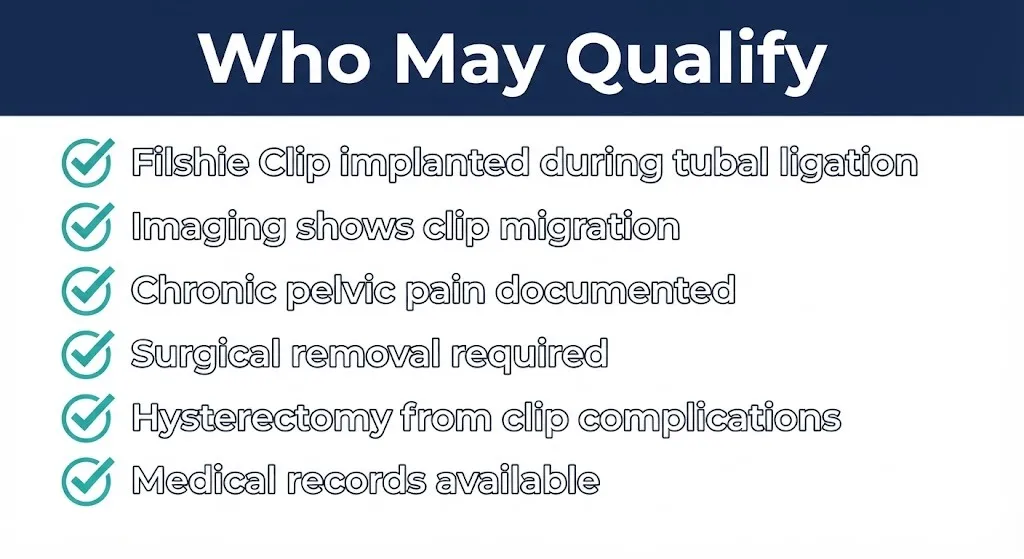
You may qualify if you underwent a tubal ligation in which Filshie Clips were used and later experienced device migration, chronic pelvic pain, or required surgery to remove the clips. The Connecticut plaintiffs allege the clips migrate from their intended position on the fallopian tubes into the abdomen, pelvis, or other organs.
The specific criteria that courts and attorneys look at include:
- Documented Filshie Clip implantation during a tubal ligation procedure
- Imaging or surgical evidence showing clip migration from the fallopian tube
- Medical records documenting complications such as chronic pelvic pain, internal scarring, endometriosis, or inflammation
- Surgical removal of the clips, especially if hysterectomy was required
- Timing: Jurisdictions have different statutes of limitation, so when you discovered the injury matters
Not every woman who had Filshie Clips will have a claim. The device was FDA-approved in 1996, and some women have had them for years without complications. The legal question is whether the manufacturer failed to warn about migration risks and whether that failure caused your specific injury.
Reality Check: No one will text you a settlement offer. No legitimate claims administrator charges a fee to file. If you receive a message promising Filshie Clip money for an upfront payment, it is a scam. The only way to pursue a claim is through a licensed attorney representing you on contingency.
How Do You File a Filshie Clip Claim?
You cannot file a Filshie Clip claim through a central settlement website because no settlement exists. The process works differently: you contact a product liability attorney who evaluates your medical records and files an individual lawsuit on your behalf.
Here are the practical steps:
- Gather your medical records showing the tubal ligation procedure, including the operative report and device name.
- Collect imaging reports (CT, MRI, or ultrasound) documenting clip position or migration.
- Document your symptoms with dates: when pain started, when complications were diagnosed, what treatments you received.
- Consult a product liability attorney who handles Filshie Clip or similar device cases. Most offer free initial evaluations.
- Provide your records for review. The attorney will assess whether you have a viable claim.
- File the lawsuit in the appropriate jurisdiction if the attorney accepts your case.
- Keep your own timeline of deadlines your attorney identifies. No court-imposed deadline exists yet.
The attorney works on contingency, meaning you pay nothing unless there is a recovery. If a settlement is later reached, the court will appoint a claims administrator and publish a claim deadline.
What Injuries Are Linked to Filshie Clips?
The central injury allegation in Filshie Clip litigation is device migration: the clips move from the fallopian tubes to other parts of the body, causing pain and requiring surgery. The Connecticut complaint states that “Filshie Clips have a propensity to migrate after being placed in the fallopian tubes”.
Documented complications from court filings include:
- Chronic pelvic pain that persists after implantation and may not resolve until removal
- Internal scarring and adhesions around the clips
- Endometriosis and inflammation triggered by displaced clips
- Organ perforation in severe cases
- Need for revision surgery to locate and remove migrated clips
- Hysterectomy in cases where clips cannot be safely removed without removing the uterus
One plaintiff, Christina Williamson, alleged her clips migrated to her posterior cul-de-sac and caused stabbing sensations, painful bowel movements, and pain during intercourse. Another plaintiff had two clips migrate out of position and required revision surgery to remove them.
The failure rate is also disputed. When the clips were first approved, manufacturers cited a 0.13% failure rate. Post-marketing data suggests the actual migration rate is higher, but no court has issued a binding finding on the true rate yet.
Why Are Women Suing Over Filshie Clips?
Women are suing because they allege the manufacturers knew or should have known about the migration risk and failed to warn patients and doctors adequately. The legal theory is product liability: defective design and failure to warn.
The Filshie Clip is a Class III medical device, the highest risk category, which means it went through the FDA’s premarket approval process. That approval normally shields manufacturers from many state-law claims under federal preemption. But the plaintiffs argue their claims survive because the manufacturer allegedly failed to report adverse events to the FDA, which is a violation of federal requirements.
The Connecticut complaint alleges the defendant “failed to adhere to federal reporting obligations” despite knowing about a “two-hundred-fold increased risk of migration over the reported percentage”. If a manufacturer fails to meet federal reporting duties, preemption may not protect it.
A separate Virginia case illustrates how serious the allegations can get. In Patton v. Cook, a woman won an $871,298.90 judgment after her doctor misapplied Filshie Clips and then produced manufacturer marketing images as supposed evidence of proper placement. The court sanctioned the doctor for attempted fraud.
Key Takeaway: The core legal claim is that Filshie Clip makers knew about migration risks and failed to warn women or their doctors, which if proven could bypass federal preemption defenses.
What Happens Next in the Filshie Clip Litigation?
The next stage in the Connecticut consolidated action is appellate review of the December 2025 summary judgment ruling, which dismissed 49 plaintiffs on res judicata grounds. That ruling is being challenged, and the outcome will affect whether those claims can proceed.
Here is the expected timeline based on court records:
- October 2026 to early 2027: Appellate briefs and argument on the res judicata ruling in the Connecticut consolidated action.
- Ongoing: Individual Filshie Clip lawsuits continue to be filed in state courts, particularly Connecticut and other jurisdictions.
- No settlement talks announced: No global mediation or settlement conference has been publicly disclosed.
- TBD: A global settlement, if one occurs, would require court approval and appointment of a claims administrator before any payout process begins.
For comparison, the Essure settlement took years from the first filings to a final resolution. Filshie Clip litigation is following a similar pattern: early procedural battles, preemption fights, and no near-term payout.
| Stage | Status | Expected Timing |
|---|---|---|
| Consolidated litigation active | Confirmed | Ongoing |
| Summary judgment appeal | Pending | Late 2026 to 2027 |
| Settlement fund established | Not confirmed | Unknown |
| Claims administrator appointed | Not confirmed | Unknown |
| Claim deadline published | Not confirmed | Unknown |
Frequently Asked Questions
Is the Filshie Clip lawsuit a class action?
No, it is not a single class action. The cases are individual product liability lawsuits consolidated in Connecticut state court for pretrial purposes, similar to how Essure litigation was structured. Each plaintiff has their own claim and must prove their own injuries.
Can I join the Filshie Clip lawsuit if I had the clips removed years ago?
Possibly. Statutes of limitation vary by state, and the clock may start when you discovered the injury, not when the clips were implanted. Consult an attorney promptly because delay can bar your claim.
How much does it cost to file a Filshie Clip claim?
Nothing upfront. Product liability attorneys handle these cases on contingency, meaning they get paid a percentage of any recovery. If there is no recovery, you owe nothing. Beware of anyone asking for payment before filing.
What proof do I need for a Filshie Clip claim?
You need medical records showing the tubal ligation with Filshie Clips, imaging or surgical reports documenting migration or complications, and records of any removal surgery. An attorney can help you gather these.
Is there a Filshie Clip settlement deadline in 2026?
No. No court-approved settlement exists, so no claim deadline has been set. If a settlement is reached in the future, the court will publish a deadline through an official claims administrator.
Does the Essure settlement affect Filshie Clip cases?
No. Essure and Filshie Clips are different devices made by different companies. The Essure settlement is closed and has its own eligibility rules. Filshie Clip litigation is separate and unresolved.
What if my doctor never told me which sterilization device was used?
You can request your operative report from the hospital or surgical center. The report should name the device. If you cannot determine which device was used, an attorney can help investigate.
Can I sue if I got pregnant after tubal ligation with Filshie Clips?
Possibly, but the legal theory differs. If the pregnancy resulted from clip migration or failure, that may support a product liability claim. If the doctor failed to perform the procedure correctly, that is a medical malpractice claim. Outcomes vary by state.
What Happens Next
- Late 2026 to early 2027: Connecticut appellate court reviews the res judicata summary judgment ruling affecting 49 plaintiffs.
- Ongoing: New Filshie Clip lawsuits continue to be filed in state courts.
- TBD: Any global settlement would require court approval, appointment of a claims administrator, and a published claim deadline.
- TBD: Payment distribution would follow only after a settlement is finalized and claims are processed.
If you had Filshie Clips and experienced complications, gather your operative report and imaging records now. Consult a product liability attorney for a free case evaluation. There is no claim deadline to miss today, but statutes of limitation apply, and delay only hurts your position.