Ohio Workers Compensation Coverage 2026: Who Is Required and What It Pays
Quick Answer
- Who’s required: Any Ohio employer with one or more employees, including part-time and corporate officers.
- Where to buy: Ohio is a monopolistic state, meaning coverage comes only through the Ohio Bureau of Workers’ Compensation.
- Key deadline: Injury claims must be filed within one year of the injury or death.
Ohio workers compensation coverage is mandatory for nearly every employer in the state. But Ohio does not work like most states. You cannot call a private insurer like The Hartford or Travelers to buy a policy. Ohio is one of four monopolistic workers compensation states, which means the Bureau of Workers’ Compensation is your only source for coverage.
That single-fund structure has produced something unusual: rates have fallen for seventeen of the past eighteen years. Ohio’s average premium index rate dropped to 68 cents per $100 of payroll, ranking fifth-lowest nationally. The state that ranked third-highest in 2008 is now one of the cheapest places to insure a workforce.
This article explains who must carry coverage, what triggers elective coverage, how rates are calculated, and the steps to get a policy. You will also find the deadlines that matter and what happens if you ignore them.
The Facts
| Item | Detail |
|---|---|
| Coverage Requirement | Employers with one or more employees |
| Coverage Provider | Ohio Bureau of Workers’ Compensation (exclusive) |
| Application Fee | $120 non-refundable |
| 2026 Private Rate Cut | 1% effective July 1, 2026 |
| 2026 Public Rate Cut | 1% effective January 1, 2026 |
| Average Premium Index | 68 cents per $100 of payroll |
| Injury Claim Deadline | One year from date of injury or death |
| Domestic Worker Threshold | $160 or more in any calendar quarter |
Who is required to have workers compensation insurance in Ohio?
Any employer with one or more employees must carry Ohio workers compensation coverage, regardless of whether those employees are full-time, part-time, or seasonal. The law is broader than most employers assume, and it reaches independent contractors, domestic workers, and out-of-state companies with Ohio operations.
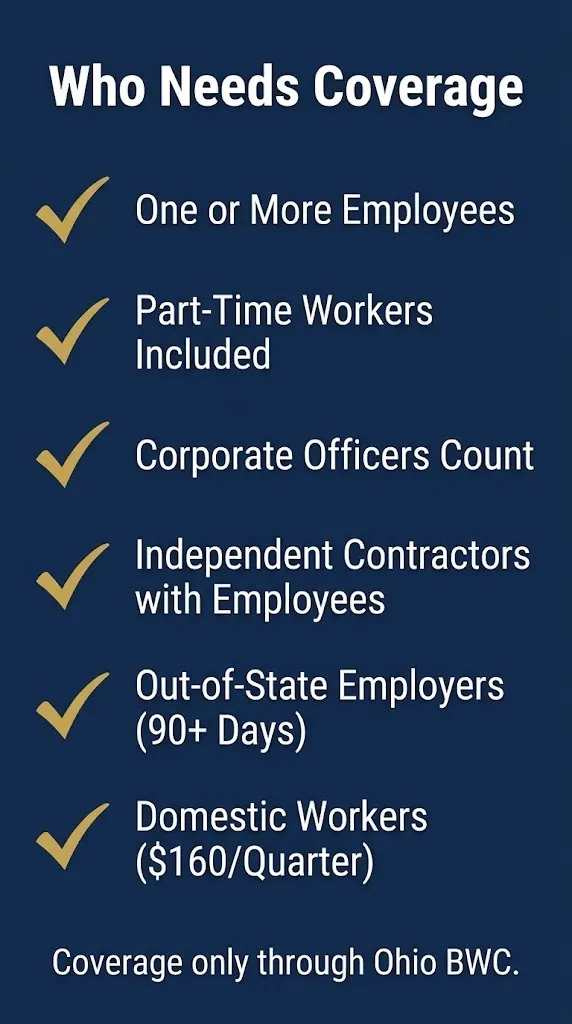
The Bureau of Workers’ Compensation lists specific categories that trigger a coverage requirement.
Employers required to obtain coverage:
- Employers with one or more full or part-time employees, including corporate officers.
- Independent contractors and subcontractors who have their own employees.
- Corporations with multiple owners or officers, who are all considered employees.
- Out-of-state employers bringing workers into Ohio for 90 consecutive days or more.
- Domestic household employers who pay workers $160 or more in any calendar quarter.
Domestic workers include babysitters, housekeepers, lawn-care workers, and gardeners. If you pay a nanny $160 in a thirteen-week period, you need coverage. That threshold is low enough that many households qualify without realizing it.
Corporate officers are employees for workers compensation purposes. A two-owner Ohio corporation cannot opt out of covering the owners. The law requires coverage for all personnel associated with the corporation, including every officer.
Key Takeaway: The one-employee threshold means almost every Ohio business needs coverage, including many households that hire domestic help.
Is Ohio workers compensation coverage mandatory or elective?
Ohio workers compensation coverage is mandatory for employers with employees, but elective for certain categories of owners and self-employed individuals. The distinction matters because elective coverage requires a separate application and an affirmative choice to participate.
Categories that may elect coverage:
- Sole proprietors with no employees.
- Partnerships with no employees.
- Limited liability companies acting as sole proprietors or partnerships.
- Family farm corporate officers.
- Ordained or associate ministers of religious organizations.
- Individuals incorporated as a corporation with no employees.
If you fall into one of these categories and choose not to elect coverage, you are not covered. If you are injured at work, BWC will not pay your medical bills or lost wages. Your personal health insurance may not cover work-related injuries either.
For corporations with more than one owner, or a single owner with employees, coverage is not optional. The law requires it for all personnel. The same applies to LLCs acting as corporations.
Elective coverage requires completing the Application for Elective Coverage (U-3S) after your policy is established. Ministers covered under a religious organization’s policy report actual earnings, which are not subject to minimum or maximum payroll thresholds.
Key Takeaway: If you are a sole proprietor with no employees, coverage is your choice. For everyone else, it is the law.
Reality Check
Ohio’s monopolistic system means there is no shopping around for a better rate. You cannot get a quote from a private carrier, and you cannot buy a ghost policy or pay-as-you-go coverage. Every employer pays into the same state fund. The trade-off is that rates are low and falling. If someone offers to sell you private workers compensation coverage in Ohio, they are either mistaken or running a scam.
How much does Ohio workers compensation coverage cost in 2026?
Ohio workers compensation costs average about $646 per year, or $54 per month, for small businesses, based on policy data from Insureon customers. But that average spans every industry, from clerical offices to roofing crews, and the actual premium depends on payroll, classification, and claims history.
Ohio uses a formula to calculate premiums.
The premium formula: Classification Rate × Experience Modification Rate × (Annual Payroll ÷ $100).
The classification rate reflects the risk of the work your employees do. Clerical workers cost less to insure than carpenters or tree trimmers. Ohio relies on its own BWC bureau to set rates, not the National Council on Compensation Insurance used by most states.
The experience modification rate (EMR) reflects your claims history. An EMR of 1.0 means your risk is average for your classification. An EMR above 1.0 means you pay more. The EMR only applies when your annual premium reaches $5,000, so many small employers never see it.
Ohio’s 2026 rate changes continue a long decline.
| Rate Change | Effective Date | Savings |
|---|---|---|
| Private employers: 1% cut | July 1, 2026 | $10 million |
| Public employers: 1% cut | January 1, 2026 | $1.8 million |
| Private employers: 6% cut | July 1, 2025 | $60 million |
The private employer rate cut effective July 1, 2026, saved employers approximately $10 million compared to 2025 premiums . Since 2019, private employer rates have dropped by 50%.
Key Takeaway: Ohio’s rates are among the lowest in the country, and the state fund structure means every employer gets the benefit of those reductions.
How do you apply for Ohio workers compensation coverage?
You apply for Ohio workers compensation coverage by submitting a completed Application for Ohio Workers’ Compensation Coverage (U-3) and paying a $120 non-refundable fee. The application is available online through the BWC website or by mail.
Steps to obtain coverage:
- Complete the U-3 application with your legal business name, federal identification number, and description of operations.
- Provide ownership details including names, ownership percentages, and demographics for all owners.
- Describe your operations including tools, raw materials, and primary job duties of employees.
- Estimate 12-month payroll for all employees and officers who will be covered.
- Submit the application online for fastest processing, or mail it to the BWC office in Columbus.
- Pay the $120 application fee, which is not refundable.
- Receive confirmation of coverage status and your policy information.
- Post your Certificate of Premium Payment at each work site or on an intranet accessible to all employees.
Coverage is not in effect until BWC receives both the application and the fee. Do not wait until after your first employee starts work to apply.
For businesses acquiring an existing operation, you may be able to continue the former owner’s policy using the Request to Transfer Existing Coverage to Succeeding Employer (U-115). If that policy was cancelled, you must file a new U-3.
Key Takeaway: Apply before your first employee starts. Coverage does not begin until BWC processes your application and fee.
What does Ohio workers compensation coverage pay for?
Ohio workers compensation coverage pays for medical care, wage replacement, and death benefits for work-related injuries and occupational diseases. Benefits flow through the BWC state fund for most employers, or directly from self-insuring employers.
Medical benefits: Doctor visits, hospital care, surgery, prescriptions, and rehabilitation. Injured workers can see any doctor for their first visit, then must choose a BWC-certified provider.
Wage replacement benefits:
- Temporary Total Disability (TTD): 66 2/3% of average weekly wage for workers who cannot work at all.
- Temporary Partial Disability (TPD): Partial wage replacement for workers on limited duty at reduced pay.
- Permanent Partial Disability (PPD): Compensation based on a percentage impairment rating.
- Permanent Total Disability (PTD): Ongoing benefits for workers permanently unable to work.
Death benefits: Weekly benefits for qualifying dependents, plus funeral expenses.
Ohio’s workers compensation system also provides Disabled Workers’ Relief Fund (DWRF) payments for permanently and totally disabled workers whose benefits have not kept pace with inflation . The DWRF amount is based on the difference between Social Security disability benefits and the workers compensation rate.
Injured workers must report the injury to their employer and file a claim within one year of the injury or death for claims occurring on or after September 29, 2017 .
Key Takeaway: Ohio’s system covers medical care and wage replacement, and the DWRF provides an extra layer for the most severely injured workers.
What are the penalties for not having Ohio workers compensation coverage?
Employers without required Ohio workers compensation coverage face fines, assessment liens, and personal liability for workplace injuries. The BWC can file liens for nonpayment of premiums when coverage lapses .
Failing to file a payroll report on time triggers a penalty of 1% of the premium due, with a minimum of $3 and a maximum of $15. Failure to pay premium on time results in a $30 fee plus an additional charge of up to 15% of the premium, depending on how late it is received.
More serious consequences follow a workplace injury. If an employer lacks coverage, the injured worker can sue for all damages related to the injury, not just workers compensation benefits. The employer loses the immunity from tort liability that coverage provides.
The BWC can also file assessment liens against the business for unpaid premiums. These liens attach to business assets and must be resolved before the employer can obtain coverage or resolve other business matters.
Key Takeaway: Going without coverage exposes you to lawsuits and liens that far exceed the cost of a premium. The BWC has collection tools and uses them.
What happens next in the Ohio workers compensation process?
Ohio’s workers compensation process moves from coverage application to payroll reporting to potential injury claims, with specific deadlines at each stage. Understanding the timeline helps employers stay compliant.
Expected stages:
- Before first hire: Submit U-3 application and $120 fee. Post Certificate of Premium Payment at work sites.
- Annually: File payroll true-up report. Private employers must file by August 31; public employers by February 28 .
- If injury occurs: Employee reports injury to employer. Employer assists with First Report of Injury (FROI) filing.
- Within one year: Injured worker must file a claim with BWC or the Industrial Commission.
- Within 30 days of claim: BWC approves or denies the claim. Employer has opportunity to certify or deny the claim’s validity.
There is no grace period for true-up filings as of July 1, 2025, for private employers and January 1, 2026, for public employers . Late true-up filings trigger penalties.
For self-insuring employers, annual renewal applications are due 90 days before the renewal date, and semiannual assessments are billed in January and July.
Key Takeaway: The August 31 true-up deadline is the one most employers miss. Mark it on your calendar.
Frequently Asked Questions
Who is required to have workers compensation insurance in Ohio?
Any employer with one or more employees, including part-time workers, corporate officers, and most domestic workers earning $160 or more per quarter.
Is Ohio a monopolistic workers compensation state?
Yes. Ohio is one of four states where workers compensation coverage can only be purchased through a state-operated fund, the Ohio Bureau of Workers’ Compensation.
Can I buy Ohio workers compensation from a private insurer?
No. Private carriers like The Hartford and Travelers do not sell workers compensation policies in Ohio. Coverage comes only through the BWC state fund or self-insurance.
How much does Ohio workers compensation coverage cost?
Average cost is about $646 per year for small businesses, or $54 per month. Actual premiums depend on payroll, classification, and claims history.
Do sole proprietors need workers compensation in Ohio?
No, unless they have employees. Sole proprietors with no employees may elect coverage but are not required to carry it.
What happens if an Ohio employer does not have workers compensation coverage?
The employer faces fines, assessment liens, and personal liability for workplace injuries. The injured worker can sue for full damages, and the BWC can file liens for unpaid premiums.
What is the deadline to file an Ohio workers compensation claim?
Injured workers must file a claim within one year of the injury or death for injuries occurring on or after September 29, 2017.
Can corporate officers opt out of Ohio workers compensation?
No. Corporate officers are considered employees, and coverage is required for all officers of a corporation with more than one owner or a single owner with employees.
Your Next Step
If you are an Ohio employer without coverage, apply today through the BWC website. The $120 application fee is the cheapest insurance decision you will ever make.
If you already have coverage, calendar the August 31 true-up deadline and confirm your Certificate of Premium Payment is posted at every work site. The single most important number for injured workers is one year: the deadline to file a claim from the date of injury.