Coinbase Lawsuit 2026: Every Active Case, Settlement Status and What You Can Do
Quick Answer
- Coinbase faces many real lawsuits, but none has a settlement fund or claim form yet.
- Payout: not yet determined. No class settlement, per-person amount, or administrator exists in any active case.
- Claim deadline: none exists in any case we checked as of October 11, 2026.
The Coinbase lawsuit you keep hearing about is really a dozen separate cases. None pays you today. The closest customer case is the data breach class action, now in Manhattan federal court.
Who’s affected? Customers whose data was exposed in the 2025 breach. Coinbase’s notice to the Maine Attorney General listed 69,461 people. No class has been certified, and no claim deadline exists.
This guide sorts every active case and shows what you can do next. One surprise: in several state prediction-market fights, Coinbase is the one that sued first.
The Facts
| Item | Detail |
|---|---|
| Case | No single case. Customer-facing lead case: In re Coinbase Customer Data Security Breach Litigation, MDL No. 3153 (S.D.N.Y.) |
| Status | Active litigation across several courts, no settlement |
| Fund Size | Not yet confirmed (no settlement fund exists) |
| Est. Per Person | Not yet determined |
| Claim Deadline | None. No claim form exists |
| Administrator | Not yet appointed |
| Proof Needed | Check claim form if one is ever issued |
Is there a Coinbase settlement you can claim right now?
No. As of October 11, 2026, no Coinbase case has a court-approved settlement fund or claim form.
Three litigation and settlement trackers list no fund, claim form, administrator, or deadline. Their pages were updated as recently as September 30, 2026.
A claim form with no settlement is a refund line for a sale that never happened. If someone sends you one, treat it with suspicion.
Here’s what does exist today:
- Coinbase pledged to reimburse customers tricked into sending crypto to scammers after the breach.
- Coinbase offered 12 months of free credit monitoring.
- Neither one is a court-approved settlement.
A real settlement leaves a paper trail. You’d see a case number, a named administrator, and a court-set hearing date.
How many Coinbase lawsuits are active in 2026?
About a dozen Coinbase matters are active in 2026, and only a few touch everyday customers. The table below sorts the ones with verified court details.
| Case | Court | Who sued | Pays you cash? | Status |
|---|---|---|---|---|
| In re Coinbase Customer Data Security Breach Litigation, MDL No. 3153 | S.D.N.Y., Judge Edgardo Ramos | Affected customers | No settlement yet | Consolidated December 12, 2025; early stage |
| TaskUs breach suit (Coinbase’s support contractor) | Court not confirmed | Customers | No settlement yet | TaskUs must defend negligence claims (July 29, 2026) |
| Underwood v. Coinbase Global, No. 21 Civ. 8353 | S.D.N.Y., Judge Paul Engelmayer | Token buyers | No settlement yet | Most claims dismissed July 30, 2026; some continue |
| Shareholder securities class action | D.N.J., Judge Brian Martinotti | Investors (lead plaintiff AP7) | No settlement yet | Dismissal bid denied August 18, 2026 |
| Insider-trading shareholder suit | Court not named in source | An investor | Not to customers | Filed 2023; ruling January 30, 2026 |
| New York v. Coinbase Financial Markets, No. 1:26-cv-03300 | S.D.N.Y., Judge Schofield | New York Attorney General | Restitution sought, no fund | Remand motion undecided |
| Coinbase v. Nessel (Michigan), No. 4:25-cv-14092 | E.D. Mich. | Coinbase | No | Injunction denied; on appeal |
| Coinbase v. Tong (Connecticut), No. 3:25-cv-02121 | D. Conn. | Coinbase | No | Injunction denied; on appeal |
| Coinbase v. Ford (Nevada), No. 2:26-cv-00256 | D. Nev. | Coinbase | No | Federal case dismissed; state injunction granted |
| Coinbase v. Raoul (Illinois), No. 1:25-cv-15406 | N.D. Ill., Judge Pacold | Coinbase | No | Injunction motion undecided |
| Oregon securities case | Court not named in source | Oregon Attorney General | No | Filed April 18, 2025; status not yet confirmed |
Coinbase is the plaintiff in four of these. Those are the state prediction-market fights in Michigan, Connecticut, Nevada, and Illinois.
Kentucky has a pending action tied to prediction markets. Sources conflict on whether Coinbase is named, so check that docket yourself.
Is the Coinbase data breach lawsuit real?
Yes. The data breach class action is real and pending in federal court as MDL No. 3153.
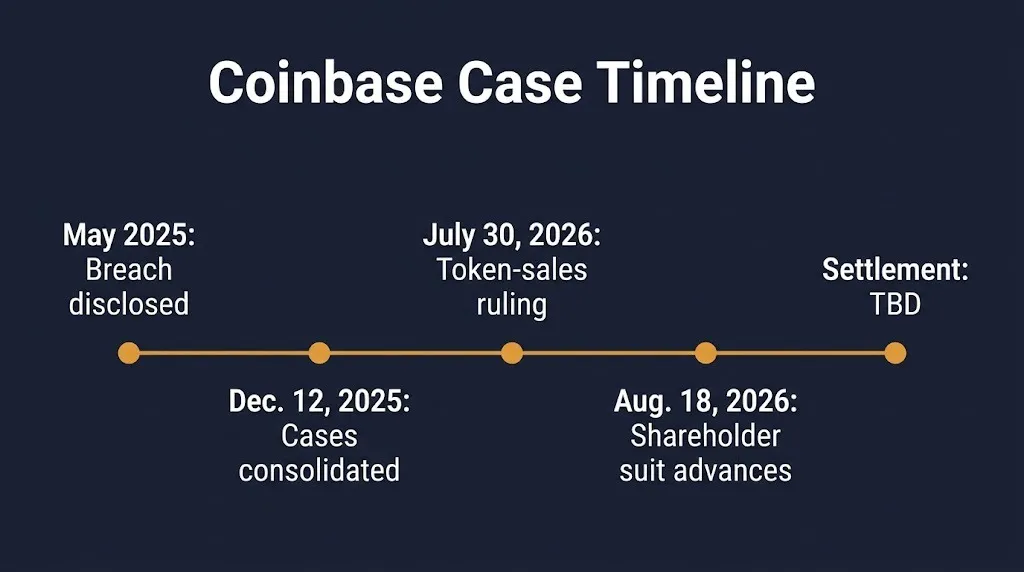
The Judicial Panel on Multidistrict Litigation consolidated the cases on December 12, 2025. They sit in the Southern District of New York before Judge Edgardo Ramos. The first complaint was reported May 15, 2025.
No class has been certified. No court has ruled that Coinbase is liable.
Coinbase says the breach hit under 1% of its monthly transacting users. The Maine Attorney General notice listed 69,461 people. Coinbase estimated its own costs at $180 million to $400 million, which isn’t small.
Per Coinbase, the stolen data included:
- Names, addresses, phone numbers, and emails
- The last four digits of Social Security numbers
- Masked bank account information
- Government ID images
- Account balances and transaction history
Coinbase says passwords, private keys, full Social Security numbers, and customer funds weren’t accessed.
Key Takeaway: The breach case is real, but it has no settlement, class, or claim form.
Can you get money from the Coinbase data breach lawsuit?
Not yet determined. No settlement fund exists, so no per-person amount can be calculated.
A payout would appear only after a court-approved settlement or a judgment. Neither exists today.
| Benefit | Court-approved? | What it is |
|---|---|---|
| Class action settlement | None exists | No fund, no class, no administrator |
| Scam reimbursement | No | A voluntary Coinbase pledge to reimburse customers tricked into sending crypto to scammers |
| Credit monitoring | No | A Coinbase offer of 12 months free |
Coinbase is expected to ask for individual arbitration under its user agreement. That step isn’t confirmed. If a court grants it, a class case could shrink or end.
Any amounts would depend on the class definition, legal fees, and claims filed.
Reality Check: No court-approved Coinbase payout exists, so no one can legitimately text you a claim number. Real class settlements never charge filing fees, and “claim helpers” asking for money are unnecessary. Stolen names and phone numbers are exactly what impersonation scammers use.
Has Coinbase paid out a class settlement before?
Yes, once that we verified: a $2.25 million Dogecoin sweepstakes settlement got final approval on November 10, 2025.
U.S. Magistrate Judge Sallie Kim approved it in San Francisco. The suit said Coinbase didn’t adequately advertise a mail-in entry option for its 2021 Dogecoin sweepstakes.
| Term | Detail |
|---|---|
| Class | U.S. individuals who entered the sweepstakes and traded at least $100 in Dogecoin between June 3 and June 10, 2021 |
| Claim needed? | No |
| Payment | Fees and spreads paid on the first $100 of Dogecoin trades |
| Delivery | Into existing Coinbase accounts, or a mailed check if the account closed |
| People contacted | Over 400,000 (one exclusion, no objections) |
| Fee requests | $750,000 in fees, $75,000 in costs, $7,000 per lead plaintiff |
Those fee figures were requests. Final amounts weren’t confirmed in the report we checked. Payment dates aren’t confirmed either.
This is what a real Coinbase settlement looks like: a defined class, a court order, and clear terms.
What should you do if your data was exposed in the Coinbase breach?
You have several options, and none requires paying anyone. Treat these as steps to consider, not legal advice.
- Find Coinbase’s breach notification email and save it.
- Take the free credit monitoring if you’re offered it.
- Treat unexpected calls, texts, or emails claiming to be Coinbase as suspect.
- Contact support only through the official app or website.
- Ask Coinbase about reimbursement if you lost crypto to a scam.
- Keep screenshots and records of any suspicious contact.
- Ask a licensed attorney about your individual options.
- Watch the MDL No. 3153 docket for court notices.
Coinbase says it sent affected customers an email from a no-reply address at 7:20 a.m. Eastern on May 15, 2025. Check your spam folder.
Key Takeaway: You can’t claim money from any Coinbase case today, but you can prepare.
How do you join the Coinbase class action?
You can’t join yet, because no class has been certified and no settlement notice exists. In most class actions, members are included automatically and get a court notice later.
Here’s how to stay ready:
- Write down the case name: In re Coinbase Customer Data Security Breach Litigation.
- Note the number: MDL No. 3153, Southern District of New York.
- Watch your email for a court-authorized notice.
- Read every deadline in that notice: claim, opt-out, and objection.
- Confirm the named administrator before entering any personal details.
- Keep records of your account and any losses.
One catch: Coinbase’s user agreement may push disputes toward individual arbitration. In the sweepstakes case, the U.S. Supreme Court held that a court decides who decides arbitration.
What is the latest in the Coinbase data breach case?
The breach case is at the early pleading stage. No trial date or settlement talks are confirmed. That was the status on a page updated July 14, 2026.
Coinbase is expected to move to compel individual arbitration. As of our check, no ruling on that has been confirmed.
A related fight is moving faster. Bloomberg Law reported on July 29, 2026 that TaskUs must defend negligence claims. Unfair and deceptive practices claims survive too.
TaskUs is Coinbase’s customer service contractor. The court found the lead plaintiffs plausibly alleged it owed them a duty of care.
An earlier filing alleged TaskUs employees were behind the breach. Whether that suit sits inside the MDL isn’t confirmed.
Coinbase says the breach came from bribed overseas contractors. A court hasn’t decided who is legally responsible.
What happened in the Coinbase token sales lawsuit?
A federal judge tossed most of the customer token-sales suit on July 30, 2026. One slice survives. The case is Underwood v. Coinbase Global, No. 21 Civ. 8353, before Judge Paul Engelmayer.
Customers alleged Coinbase illegally sold unregistered securities, covering more than 60 tokens including XRP and dogecoin. They sought unspecified damages. Court records describe cross-motions for summary judgment.
| Type of trade | Share of volume | Ruling |
|---|---|---|
| “Matched” trades (Coinbase pairs buyers and sellers) | About 99.97% | Dismissed |
| “Inventory” trades (Coinbase sells tokens it owns) | About 0.03% (at least $178 million) | Claims survive |
Think of a flea market organizer versus a shop selling its own stock. The judge said Coinbase wasn’t a statutory seller in the first case. In the second, it passed title to buyers.
Coinbase says it will keep defending the inventory claims. No schedule or appeal plan has been confirmed.
Key Takeaway: Most token-sales claims are gone, and the surviving slice is a tiny share of trading volume.
What is the New York attorney general lawsuit against Coinbase?
The New York attorney general sued Coinbase Financial Markets, Inc. on April 21, 2026, alleging an unlicensed gambling operation. She sued Gemini Titan, LLC the same day.
The complaint says Coinbase’s prediction markets on sports, entertainment, and elections meet New York’s gambling definition. It says users aged 18 to 20 can join. New York requires mobile sports bettors to be 21.
The state also says Coinbase lacks a New York State Gaming Commission license. It seeks forfeited profits, restitution for harmed customers, and fines of three times profits.
Restitution is requested, not awarded. Consumers have nothing to file.
The case was removed to federal court as No. 1:26-cv-03300 before Judge Schofield. Remand briefing has been complete since June 2026. A ruling is not yet confirmed.
Why are states fighting Coinbase over prediction markets?
Several states say Coinbase’s sports, election, and entertainment contracts break state gambling law. Coinbase has sued first in four states.
| State | What happened |
|---|---|
| Michigan | Injunction denied in August 2026. A September 23 order has Coinbase stop Michigan sports contracts and close positions by October 10, 2026 |
| Connecticut | Injunction denied in August 2026. Cease-and-desist orders went to nine platforms on September 10, 2026 |
| Nevada | Federal case dismissed in February 2026. State court granted an injunction March 26, 2026 |
| Illinois | Injunction motion fully briefed since February 2026, still undecided |
| Kentucky | Action filed June 2026; remand briefing finished August 31 |
A Michigan status report is due around October 16. These cases don’t create a customer payout.
Most of these are Coinbase-versus-regulator disputes. That’s why “Coinbase lawsuit” searches mix up customer suits and government fights.
Are shareholders suing Coinbase too?
Yes. Investors are suing Coinbase and its leaders in two separate shareholder cases.
The first is a New Jersey securities class action led by Swedish pension fund AP7. It alleges Coinbase failed to disclose regulatory risks, including a likely SEC action over unregistered assets. Judge Brian Martinotti denied Coinbase’s third dismissal bid on August 18, 2026. The case now moves to discovery.
The second is a 2023 insider-trading suit against directors, including CEO Brian Armstrong and Marc Andreessen. It alleges they sold over $2.9 billion in stock near the 2021 listing. That avoided more than $1 billion in losses.
On January 30, 2026, Judge Kathaleen McCormick rejected a committee’s dismissal motion over a member’s conflict. She suggested the defendants may ultimately prevail. The directors deny wrongdoing.
Recovery in a derivative suit typically goes to the company, not to individual shareholders.
Key Takeaway: Shareholder cases and state regulator cases don’t pay Coinbase customers.
Do Coinbase’s public statements match the court record?
Not always, and four examples show the gap. Treat company statements as positions, not findings.
| Coinbase’s framing | What the record shows |
|---|---|
| The breach hit a small subset, under 1% of monthly transacting users | A Maine Attorney General notice listed 69,461 people, and Coinbase put its costs at $180 million to $400 million |
| It will keep defending the token-sales claims | The court let claims tied to at least $178 million in inventory sales survive |
| Oregon’s suit is obstruction for its own sake | Headlines show a venue fight, and no ruling on the merits is confirmed |
| The SEC dropped its case | The SEC said the dismissal wasn’t based on any assessment of the merits |
The record isn’t one-sided. Coinbase won most of the token-sales case by volume, and the SEC dropped its suit. It lost injunction bids in Michigan and Connecticut, and its New Jersey dismissal bid failed.
These are allegations and early rulings, not final verdicts.
What happened to the SEC lawsuit against Coinbase?
The SEC dropped its Coinbase case on February 27, 2025. No customer money came out of it. The agency sued in June 2023 in the Southern District of New York.
The case ended through a joint stipulation, dismissed with prejudice. The SEC said the decision wasn’t based on any assessment of the merits.
A dismissal isn’t a settlement. It’s like a landlord dropping an eviction: nobody owes anyone money.
There’s no fund and no claim process. Anyone advertising an “SEC Coinbase payout” is selling something unverified.
The dismissal didn’t end the pressure. Oregon sued weeks later, echoing the SEC’s theory.
What is Oregon’s lawsuit against Coinbase?
Oregon Attorney General Dan Rayfield sued Coinbase on April 18, 2025. The state alleges Coinbase helped residents buy unregistered cryptocurrencies.
It says those assets were exposed to pump-and-dump schemes and fraud. The action echoes the federal charges the SEC dropped.
Coinbase’s chief legal officer, Paul Grewal, called the suit obstruction for its own sake. He argued federal legislation is the right route, not state enforcement.
Headlines show a fight over whether the case stays in state court. The current status, court, and relief sought are not yet confirmed.
Oregon residents who lost money don’t have a claim form today.
Key Takeaway: Neither the SEC dismissal nor the Oregon case has created a customer payout fund.
How did the Coinbase data breach happen?
Attackers bribed overseas customer support contractors to pull customer data from Coinbase’s internal systems. Coinbase disclosed it in mid-May 2025.
On May 11, 2025, an unknown actor demanded about $20 million to stay quiet. Coinbase refused. Coinbase offered a $20 million reward for tips leading to arrests and convictions.
Coinbase called it limited data for a small subset of customers. A 69,461-person notice isn’t small to those people.
The company estimated $180 million to $400 million in remediation and reimbursement costs. It planned to tighten data management and move some support operations.
Coinbase says passwords, private keys, funds, and Coinbase Prime accounts weren’t affected.
What happens next in the Coinbase cases?
No settlement date exists, but several court dates and decisions are coming.
October 10, 2026: Michigan stop date for Coinbase’s sports contracts under the stipulated order.
About October 16, 2026: Michigan status report due.
Expected, date not confirmed: Ruling on New York’s remand motion, fully briefed since June 2026.
Expected, date not confirmed: Discovery begins in the New Jersey shareholder case.
Not yet confirmed: Any arbitration ruling, class certification, settlement, or claim deadline.
Frequently Asked Questions
Is there a Coinbase class action settlement I can claim?
No, no Coinbase case has a court-approved fund or claim form as of October 11, 2026.
Check the court docket before trusting any claim offer.
Is the Coinbase data breach lawsuit real?
Yes, it’s pending as MDL No. 3153 in the Southern District of New York.
Judge Edgardo Ramos presides.
No class has been certified.
How many people were affected by the Coinbase data breach?
A Maine Attorney General notice listed 69,461 people.
Coinbase says that’s under 1% of monthly transacting users.
Will Coinbase try to force arbitration in the data breach case?
Coinbase is expected to move for individual arbitration under its user agreement.
That motion and any ruling aren’t confirmed.
Did the SEC settle with Coinbase?
No, the SEC dismissed its case on February 27, 2025.
It was a dismissal, so no fund or claim process exists.
Has Coinbase paid a class settlement before?
Yes, a $2.25 million Dogecoin sweepstakes settlement got final approval on November 10, 2025.
Class members didn’t have to file a claim.
Is New York suing Coinbase?
Yes, the New York attorney general sued on April 21, 2026.
It targets Coinbase’s prediction markets and seeks restitution and fines.
When will there be a Coinbase settlement payout?
No date exists, because no settlement exists.
A payout would follow a court-approved deal.
Save your Coinbase breach notice email and the case number: MDL No. 3153. The case name is In re Coinbase Customer Data Security Breach Litigation. If a settlement appears, it will come as a court-authorized notice with deadlines.
Until then, no claim deadline exists, and that holds true as of October 11, 2026.