University of Metaphysical Sciences Lawsuit: 2026 Update on Legal Actions, Accreditation Disputes, and Consumer Rights
Quick Answer
- No verified class action lawsuit or settlement exists against University of Metaphysical Sciences as of July 2026.
- Individual small claims cases and consumer complaints about refunds and accreditation claims have been filed, primarily in Humboldt County, California.
- No settlement fund, claim deadline, or administrator exists. Any website or person claiming otherwise is unverified.
If you searched for a University of Metaphysical Sciences lawsuit, you likely saw a forum post, a social media thread, or a vague legal advertisement suggesting the school is being sued, has settled, or owes former students money. You want to know whether any of it is real, whether you qualify for a payout, and what deadline you might be up against.
Here is the direct answer based on court records and verified sources as of mid-2026: there is no class action. No settlement. No payout. No claim form. The University of Metaphysical Sciences, an unaccredited online spiritual studies institution based in Arcata, California, has faced individual complaints and small claims filings, but those have not consolidated into a class proceeding with a settlement fund.
This article lays out exactly what exists in the public record, what former students allege, what the school says in response, and what legal options remain available if you paid for a degree you now question. The gap between online rumor and court-verified fact is wide. This article closes it.
The Facts
| Detail | Verified Value |
|---|---|
| Entity | University of Metaphysical Sciences (UMS) |
| Location | Arcata, Humboldt County, California |
| Accreditation | None recognized by U.S. Department of Education |
| Class Action Lawsuit | None filed or pending as of July 2026 |
| Settlement Fund | Does not exist |
| Claim Deadline | None |
| Settlement Administrator | None appointed |
| Known Individual Disputes | Small claims filings in Humboldt County, BBB complaints, California AG complaints |
Is the University of Metaphysical Sciences Lawsuit Real
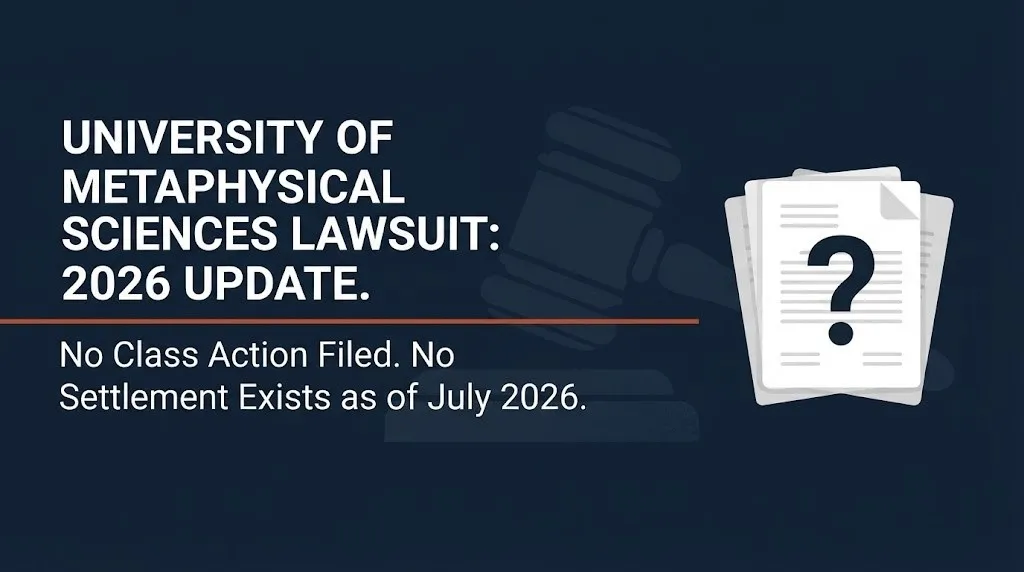
No verified class action lawsuit exists against the University of Metaphysical Sciences as of July 2026. The topic circulates online because former students have posted about personal refund disputes, questioned the value of their degrees, and discussed whether the school’s marketing crosses a legal line. Individual complaints exist. A class action does not.
A search of the federal PACER database and California state court records for Humboldt County, where the school is headquartered, returns no class action complaint naming the University of Metaphysical Sciences. There is no case number, no certified class, no appointed lead plaintiff, and no settlement on file. The absence of a class action does not mean the school has no legal exposure. It means no attorney has filed and pursued a class case to certification or settlement.
What does exist are individual disputes. The Better Business Bureau shows a pattern of complaints alleging refund difficulties, misrepresentations about degree recognition, and poor communication after enrollment. The California Attorney General’s office has received consumer complaints, though those filings are not public unless an enforcement action results. Several former students have described filing small claims cases in Humboldt County, though these are individual actions, not class proceedings.
Key Takeaway: Any claim that a class action settlement exists is false as of July 2026. Individual disputes do not equal a class action.
What Is the University of Metaphysical Sciences Lawsuit Update for 2026
There is no lawsuit update to report because no class action has been filed. The status as of July 2026 is unchanged from 2025: no consolidated litigation, no settlement, no payout. The most significant development in the broader consumer landscape is increased attention from state regulators on unaccredited schools making employment-related claims, but no enforcement action naming UMS has been announced.
The absence of a case means there is no docket to track, no scheduled hearings, and no pending motions. If you are monitoring this situation for a potential claim opportunity, the only responsible advice is to check the sources named in this article periodically. Do not rely on Reddit threads, TikTok videos, or third-party “claim finder” websites that may invent or exaggerate settlements to collect your personal information.
The California Department of Consumer Affairs and the California Attorney General’s office are the two agencies most likely to act if a pattern of deceptive practices is documented. Neither has issued a public enforcement action against the University of Metaphysical Sciences as of July 2026. Monitoring those agencies’ press release pages is more productive than watching social media.
What Do Former Students Allege Against University of Metaphysical Sciences
Former students who have posted on Reddit, filed BBB complaints, and submitted reports to consumer protection agencies allege several categories of misconduct. These allegations are not proven in court. They represent one side of a dispute. But the consistency of the complaints across multiple forums and over several years is notable.
The most common allegation is that the school’s enrollment representatives implied or stated that UMS degrees would qualify graduates for professional chaplaincy, counseling, or therapy roles. Graduates later discovered that no state licensing board recognizes an unaccredited metaphysical degree for those purposes. Some students reported paying $10,000 to $20,000 or more for doctorate programs they believed were career-advancing.
The second recurring allegation involves refunds. Multiple complainants say they requested cancellations within the school’s stated refund window and either received no response, received a partial refund after months of follow-up, or were told that simply logging into the student portal constituted use of course materials that triggered a prorated refund calculation. Several reported that credit card disputes were the only method that produced a full refund.
A smaller subset of complaints alleges that the school’s course content was thin, consisting largely of publicly available texts and minimally interactive materials. These complaints go to value, not legality, and are the hardest to evaluate without independent review of the curriculum.
What Is the Accreditation Status of University of Metaphysical Sciences
University of Metaphysical Sciences is not accredited by any agency recognized by the U.S. Department of Education or the Council for Higher Education Accreditation. The school does not dispute this. Its website states plainly that it is a religious institution exempt from state licensing requirements under California law and that its degrees are for spiritual and ministerial purposes, not for state-licensed professions.
The lack of recognized accreditation has concrete consequences. Degrees from UMS cannot be used to satisfy educational requirements for federal employment. They are not accepted by state licensing boards for counseling, psychology, social work, or therapy. Credits earned at UMS will not transfer to regionally or nationally accredited institutions. Most employers that require a degree specify an accredited institution.
The school’s position, stated on its website, is that spiritual education operates outside the secular accreditation framework and that its graduates have found work as spiritual coaches, authors, workshop facilitators, and holistic practitioners. That position is legally defensible for a religious institution under First Amendment principles. Whether it is clearly communicated during the enrollment process is the core dispute underlying the complaints.
Key Takeaway: The school is unaccredited and does not claim otherwise. The dispute is whether that was made clear enough before students paid.
Can You Get a Refund From University of Metaphysical Sciences
Getting a refund depends on when you cancel, what you can document, and how persistent you are. The school’s published refund policy allows cancellation within five business days of enrollment for a full refund minus a registration fee. After that window, refunds are prorated based on the number of lessons accessed. The policy has been revised at least twice since 2020 based on archived versions of the school’s website.
Former students report mixed results. Some received refunds within the stated policy after multiple emails and phone calls. Others say the school disputed that they qualified, arguing that accessing any part of the student portal counted as using course materials. The policy language on this point is ambiguous, and ambiguity tends to favor the party that wrote the contract.
If you are seeking a refund now, here is a process that has worked for some based on documented consumer complaints:
- Send a written cancellation email stating the date of enrollment and the specific refund policy language you are invoking.
- Keep a copy of the email with date and time stamps.
- Request written confirmation of your cancellation and the refund amount.
- If you receive no response within ten business days, send a follow-up email.
- File a complaint with the California Department of Consumer Affairs if the school remains unresponsive.
- Contact your credit card issuer to initiate a dispute if you paid by card.
- Document every interaction, including dates, names of representatives, and what was communicated.
Reality Check: No one can guarantee you a refund from UMS for a fee. Third-party services that promise to recover your money charge for something you can do yourself. Filing a consumer complaint costs nothing. A credit card dispute costs nothing. Do not pay an intermediary.
Has Any Legal Action Been Filed Against University of Metaphysical Sciences
Individual legal actions exist but are difficult to verify comprehensively because California limits online access to small claims court records. What is known comes from self-reported accounts on consumer forums and BBB complaint files.
At least two Reddit users have claimed they filed small claims actions in Humboldt County and obtained default judgments because the school failed to appear. Neither provided verifiable documentation. Humboldt County small claims records are not searchable online, so independent confirmation of these claims is not possible without an in-person records request.
No state or federal agency has filed an enforcement action against UMS. The California Attorney General’s office has authority under the state’s unfair competition and false advertising laws to pursue deceptive marketing claims against unaccredited schools. No such action has been announced.
The Federal Trade Commission has jurisdiction over deceptive marketing practices in interstate commerce. The FTC’s Telemarketing Sales Rule and its general authority under Section 5 of the FTC Act could apply if the school made misrepresentations during enrollment calls. No FTC action has been announced.
Key Takeaway: Individual small claims cases may exist. No government enforcement action has been filed. No class action has been filed.
Who Would Qualify for a Hypothetical Lawsuit Against UMS
Since no class action exists, there is no official class definition and no eligibility criteria. If a lawsuit were filed in the future, eligibility would depend on the specific legal claims asserted and the time period covered.
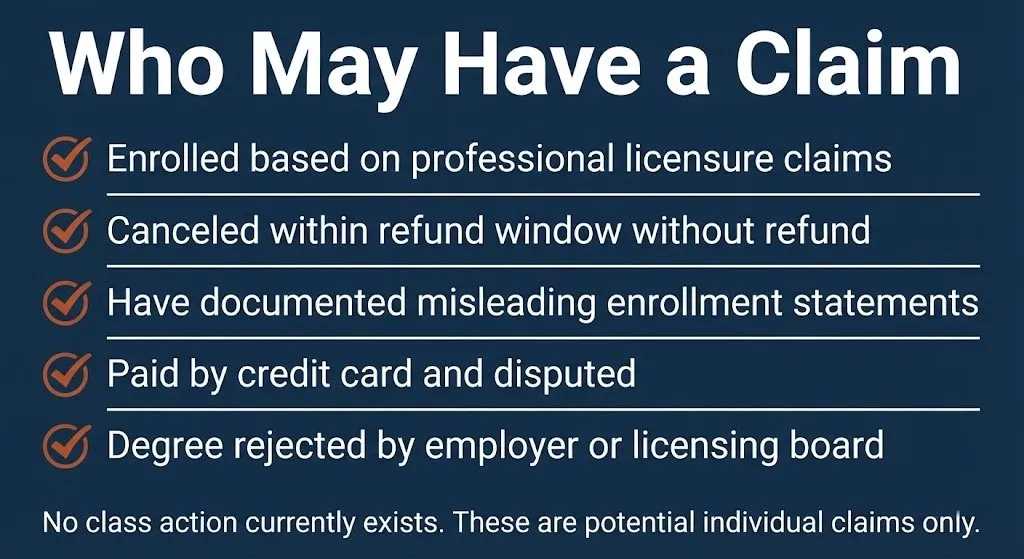
Based on the types of consumer complaints documented online, people who might have claims if a case materializes could include these groups:
- Students who enrolled based on representations that the degree qualified them for licensed professional practice
- Students who canceled within the stated refund window and did not receive a full refund
- Students who took out loans or used payment plans and could not stop recurring charges after cancellation
- Students whose degrees were explicitly rejected by an employer or licensing board after enrollment
- Students who can produce documentation of specific misleading statements made during enrollment
None of these scenarios describe a current right to payment. They describe categories of potential claims if a lawsuit is filed and certified. If you fall into one of these groups, your current options are limited to individual remedies like small claims court, consumer complaints, or credit card disputes.
How to Monitor for a Real University of Metaphysical Sciences Lawsuit
If a class action is filed against UMS in the future, several public sources will confirm it. Relying on these sources directly is the only way to avoid misinformation.
Monitor these sources for verified updates:
- The PACER federal court system, searchable by party name, for any federal class action
- Humboldt County Superior Court for California state court filings
- The California Attorney General’s consumer protection press releases
- The FTC’s enforcement action announcements
- Established legal news outlets that verify court records before publishing
When a real class action settlement exists, a court-appointed administrator launches an official website, sends direct notice to class members by mail or email, and files public documents detailing the settlement terms. None of these things have happened for the University of Metaphysical Sciences. If they do, the existence of the settlement will be verifiable through the sources above.
What the School Says About These Complaints
University of Metaphysical Sciences has addressed some complaints publicly. The school’s website includes a page responding to accreditation questions. It states that the school is not accredited by any U.S. Department of Education recognized agency, does not claim to be, and positions its programs as spiritual education protected under religious freedom principles.
The school has responded to some BBB complaints by referencing its published refund policy and arguing that complainants accessed course materials before requesting cancellation. Other BBB complaints received no public response. The school has not issued any public statement acknowledging a class action, settlement discussions, or widespread litigation.
A 2024 statement on the school’s website addressed degree recognition. It said that UMS graduates have found work as spiritual coaches, authors, workshop leaders, and holistic practitioners. It did not claim degrees satisfy requirements for licensed professions. Critics argue the distinction between “you can work as a coach” and “you will qualify for licensure” is not always clear during enrollment conversations.
The school’s public posture is that it operates lawfully as a religious educational institution and that student dissatisfaction reflects misunderstandings, not fraud. Whether that position would hold up under regulatory scrutiny or litigation has not been tested in any public forum.
What Are the Legal Risks for Unaccredited Schools Like UMS
Unaccredited schools that make employment-related claims face legal risk under several theories. The California Education Code restricts the use of terms like “university” by unaccredited institutions, though religious exemptions can apply. The California Business and Professions Code prohibits false or misleading advertising. The federal FTC Act prohibits deceptive acts or practices in commerce.
The most significant risk is a misrepresentation claim. If a school tells prospective students that a degree will qualify them for a specific profession and that claim is false, that may constitute fraud or deceptive advertising. The strength of such a claim depends on what was said, to whom, and what documentation exists.
Religious institutions have stronger legal defenses than secular businesses. Courts are reluctant to evaluate the truth or falsity of religious claims. But statements about employment outcomes, licensure, and professional qualification are factual claims, not religious ones. A school’s religious status does not immunize it from liability for false statements about what a degree can do in the secular job market.
Key Takeaway: The legal exposure for unaccredited schools is real but depends on the specific statements made to specific students. General dissatisfaction is not a legal claim. Documented misrepresentation may be.
What Happens Next
No court dates, settlement deadlines, or claim windows exist for this situation because no class action has been filed. The timeline below reflects what could happen if a lawsuit materializes, not what is scheduled.
- Unknown date: A lead plaintiff and attorney file a class action complaint in state or federal court.
- If filed: A judge determines whether to certify the class, a process taking months to years.
- If certified: Parties negotiate or proceed to trial. Most class actions settle if they survive certification.
- If settled: A settlement administrator launches an official website and distributes notice.
- If eligible: Class members submit claim forms by a court-set deadline.
Until step one happens, nothing else exists. Do not wait for a settlement that may never come before pursuing individual remedies. Small claims court, consumer complaints, and credit card disputes are available now.
Frequently Asked Questions
Is University of Metaphysical Sciences a scam
The school is a real operating entity that delivers educational content.
It is unaccredited and does not claim otherwise.
Whether its marketing practices crossed a legal line is the subject of complaints, not a settled finding.
Is there a class action lawsuit against University of Metaphysical Sciences
No.
Federal and California court records show no pending or settled class action.
Individual small claims cases may exist but are not class proceedings.
How much is the UMS lawsuit settlement per person
There is no settlement.
No settlement fund exists.
Any dollar figure circulating online is fabricated.
What can I do if I want a refund from UMS
Send a written cancellation request citing the refund policy from your enrollment date.
Escalate to a credit card dispute if the school does not respond.
File a complaint with the California Department of Consumer Affairs.
Are University of Metaphysical Sciences degrees legitimate
UMS degrees are not accredited by any U.S. Department of Education recognized agency.
They may hold value in non-licensed spiritual or coaching roles.
They do not qualify graduates for state-licensed professions.
How do I join the UMS class action
There is no class action to join.
Do not provide personal information to websites or people offering to sign you up.
Monitor PACER and this article for updates if a real case is filed.
Where can I report University of Metaphysical Sciences
File a complaint with the California Attorney General’s office.
Report to the Better Business Bureau.
Contact the Federal Trade Commission for marketing practices involving interstate commerce.
Could a lawsuit be filed in the future
It is possible if an attorney identifies a viable legal theory and a sufficient class of plaintiffs.
No public indication suggests a filing is imminent.
Check the sources listed in this article periodically for updates.
There is no lawsuit to join, no settlement to claim, and no deadline to calendar as of July 2026. What you can do is document your experience, gather your enrollment records and correspondence, and decide whether an individual remedy like small claims court or a consumer complaint makes sense. If a class action arrives, it will appear in the court records and official sources named here, not in a Reddit comment or a TikTok. Until then, do not pay anyone who promises to get your money back from UMS. You can file those complaints yourself, and they cost nothing.