Workers Compensation Taxable 2026: What You Actually Owe on Benefits and Settlements
Quick Answer
- Workers’ compensation benefits and settlements are generally not taxable under federal law and most state laws, including Michigan .
- The main exception is when you also receive Social Security Disability Insurance (SSDI); the offset portion can become taxable as Social Security income .
- Interest on delayed payments and punitive damages are taxable, but the core wage replacement and medical benefits are not .
Is Workers Compensation Taxable in 2026?
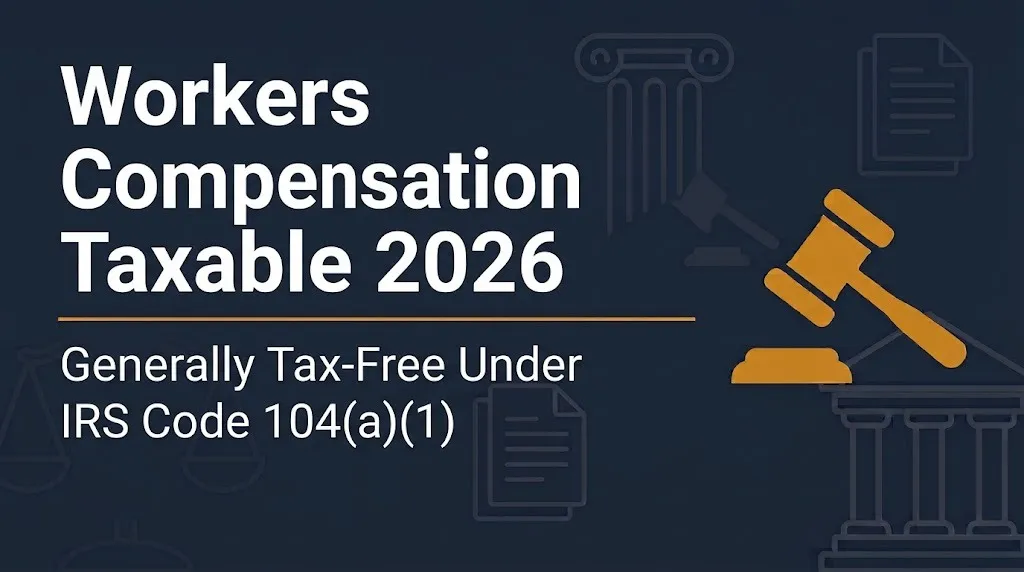
Workers’ compensation is not taxable in 2026 for the vast majority of injured workers. Federal law excludes these benefits from gross income under 26 U.S.C. § 104(a)(1), which covers amounts received under a workers’ compensation act for work-related injuries or illness .
That exclusion applies to:
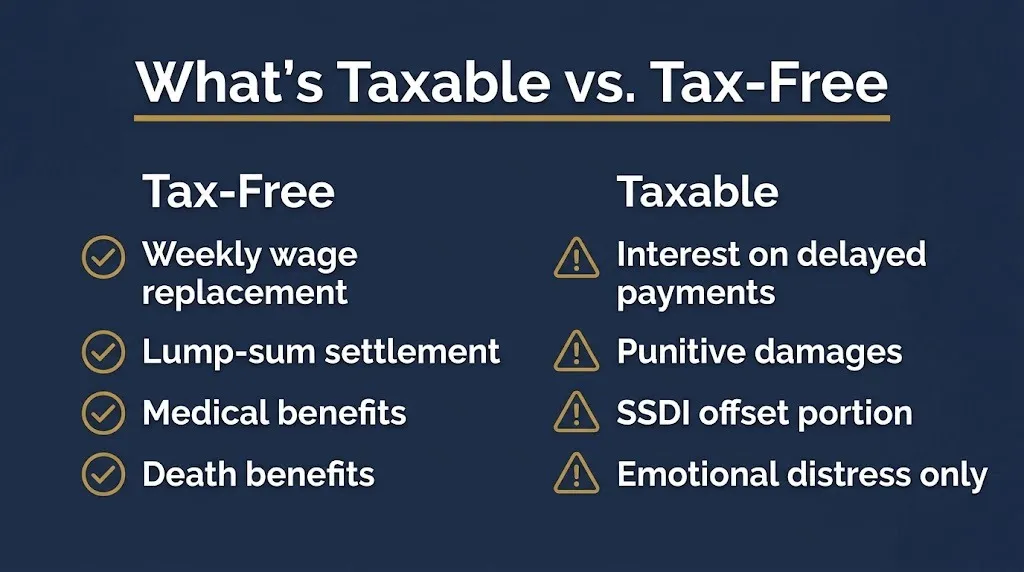
- Weekly or biweekly wage replacement during recovery
- Lump-sum settlements that resolve the claim entirely
- Scheduled loss awards for permanent injuries to specific body parts
- Death benefits paid to surviving family members
Most injured workers will not receive a W-2 or 1099 for workers’ comp benefits, and there is generally nothing to report on a tax return . Michigan law specifically confirms that “workmen’s compensation or similar payments from whatever source derived” are not subject to state income tax .
Key Takeaway: If your only income is workers’ compensation benefits, you likely owe no federal or state tax on that money.
How Much Tax Do You Owe on a Workers Compensation Settlement?
You generally owe nothing on a workers’ compensation settlement, as long as the settlement is paid under a state workers’ compensation act for a work-related injury. The entire lump sum, including amounts for lost wages, medical expenses, and pain and suffering, is excluded from gross income .
However, a few specific components can create tax liability:
| Settlement Component | Taxable? | Why |
|---|---|---|
| Wage replacement (TTD, TPD, PPD) | No | Excluded under § 104(a)(1) |
| Medical expense reimbursement | No | Excluded under § 104(a)(1) |
| Interest on delayed payments | Yes | Taxed as interest income |
| Punitive damages | Yes | § 104(a)(2) excludes only non-punitive damages |
| Settlement for a non-physical injury claim | Yes | Emotional distress alone is not physical injury |
If your settlement agreement does not allocate amounts between taxable and non-taxable components, the IRS may treat the entire payment according to its source. Having your attorney specify allocations in the settlement document can prevent unexpected tax bills.
What Is the SSDI Workers Compensation Offset and Why Does It Create Tax?
The SSDI workers’ compensation offset is a rule that reduces your Social Security disability benefits when you also receive workers’ comp. The offset is designed to prevent combined benefits from exceeding 80% of your average pre-injury earnings .
Here is the tax trap. When workers’ comp reduces your SSDI payment, the offset amount is treated as if it were Social Security benefits for tax purposes. Social Security benefits can be taxable depending on your total income .
So a worker receiving both SSDI and workers’ comp may owe tax on part of what they assumed was tax-free. The IRS treats the offset portion as Social Security income, not workers’ comp income .
This is a planning issue, not an accident. If you receive both benefits, the structure of your workers’ compensation settlement can affect the size of the offset and your resulting tax liability. Raise this with a tax professional before signing any settlement .
What Workers Compensation Benefits Are Taxable in Michigan?
Michigan workers’ compensation benefits are not subject to Michigan state income tax. The Michigan City Income Tax Act explicitly excludes “workmen’s compensation or similar payments from whatever source derived” from taxable income .
Michigan workers’ comp wage loss benefits are described as “non-taxable income” by the Michigan Township Mutual Insurance Company. Taxes are not deducted, and the money is not claimed at the end of the year .
The same federal rules apply. The SSDI offset can still create federal tax liability for Michigan workers who receive both benefits.
How Do You Report Workers Compensation on Your Tax Return?
You generally do not report workers’ compensation benefits on your tax return. The IRS does not require you to include these amounts as income, and you typically will not receive a Form 1099 or W-2 for workers’ comp payments .
If you receive a Form 1099 for any portion of your settlement, do not ignore it. The form may reflect taxable components like interest or punitive damages. Consult a tax professional to determine what portion, if any, must be reported.
If you return to light-duty or part-time work while receiving partial workers’ comp benefits, the wages from that work are taxable like any other income. The workers’ comp portion itself remains tax-free .
Reality Check: No one texts or emails you demanding payment to “release” tax-free workers’ comp funds. Workers’ compensation is not a settlement program with a claim process. If you receive an unsolicited message offering to help you claim workers’ comp money for a fee, it is a scam.
What Is the Tax Treatment of Third-Party Settlements?
Third-party settlements in workplace injury cases follow different tax rules than workers’ compensation. If you were injured by a third party (not your employer) and received a personal injury settlement, the tax treatment depends on what the damages compensate .
Damages for physical injury or physical sickness are excluded from income under § 104(a)(2). This includes lost wages in a physical injury case .
But these components are taxable:
- Punitive damages are always taxable, even in physical injury cases
- Interest on the settlement is taxed as interest income
- Emotional distress damages without an underlying physical injury are taxable
- Lost wages in employment cases (discrimination, wrongful termination) are taxable as ordinary income
Starting with tax year 2026, the deduction for miscellaneous itemized expenses is gone, so attorney fees cannot be written off against the taxable portion of a recovery .
What Happens Next for Workers Compensation Tax Rules in 2026?
Here is the expected timeline for workers’ comp tax rules:
Ongoing 2026: Workers’ compensation benefits remain tax-free under § 104(a)(1). No changes to the federal exclusion are expected .
Ongoing 2026: The SSDI offset rules remain in effect. Workers receiving both benefits should plan for potential tax on the offset portion .
Late 2026: IRS announces 2027 inflation adjustments. Workers’ comp tax treatment is not affected by these changes.
January 2027: New tax year begins. Workers’ comp benefits remain excluded from income.
Frequently Asked Questions
Is workers compensation taxable in 2026?
No. Workers’ compensation benefits and settlements are excluded from gross income under Internal Revenue Code § 104(a)(1) for work-related injuries or illness .
Do I have to report workers comp on my taxes?
Generally no. You do not report workers’ comp benefits as income, and you typically will not receive a W-2 or 1099 for them .
Is a workers comp settlement taxable?
The core settlement is not taxable if paid under a workers’ compensation act. Interest on delayed payments and punitive damages are taxable .
Why do I owe taxes on workers comp if it’s supposed to be tax-free?
The most common reason is the SSDI offset. When workers’ comp reduces your Social Security disability benefits, the offset amount is treated as Social Security income for tax purposes, which can be taxable .
Is workers compensation taxable in Michigan?
No. Michigan law explicitly excludes workers’ compensation payments from state income tax . Federal law also excludes them .
What part of a workers comp settlement is taxable?
Interest on delayed payments, punitive damages, and settlements for emotional distress without physical injury are taxable. Wage replacement and medical benefits are not .
Do I need to report a workers comp settlement to the IRS?
You do not report non-taxable workers’ comp benefits. If your settlement includes taxable components, those portions should be reported. Consult a tax professional if your settlement includes interest or punitive damages .
Can I deduct attorney fees from my workers comp settlement on my taxes?
Starting in tax year 2026, the miscellaneous itemized deduction is gone, so you cannot deduct attorney fees against taxable portions of a recovery .
Know Your Tax-Free Benefits and Watch the SSDI Offset
Workers’ compensation is designed to be a tax-free safety net for injured workers. Your weekly benefits and settlement should not be taxed. But if you receive SSDI alongside workers’ comp, the offset can create a hidden tax bill you did not expect.
If your settlement includes interest or punitive damages, set aside money for taxes on those portions. And always raise the SSDI offset with a tax professional before you sign a settlement agreement, because how the settlement is structured can affect your tax liability.