Who Does a Life Settlement Broker Represent? The 2026 Fiduciary Duty Explained
Quick Answer
- A life settlement broker represents you, the policy owner, not the insurance company or the provider buying your policy .
- The broker owes you a fiduciary duty to follow your instructions and seek the best deal .
- Compensation comes from the sale proceeds, and the broker must disclose exactly how much .
A life settlement broker represents the person selling a life insurance policy, not the company buying it. That single fact changes everything about how the transaction works, who gets paid, and whether you walk away with a fair price .
The confusion is understandable. When you sell a house, the listing agent technically works for you, but the buyer’s agent works for the buyer. Life settlements work differently. State insurance laws draw a hard line: the broker is your representative, full stop .
This article breaks down who the broker actually works for, what that fiduciary duty means in practice, how brokers get paid, and what red flags to watch for if someone approaches you about selling your policy in 2026.
The Facts
| Role | Who They Represent | Fiduciary Duty |
|---|---|---|
| Life Settlement Broker | Policy owner (you) | Yes, to the owner |
| Life Settlement Provider | The buyer/investors | No duty to you |
| Insurance Company | The insurer | No duty to you |
| Detail | Verified Status |
|---|---|
| Standard broker compensation | Disclosed from sale proceeds |
| Typical compensation range | Up to 6% of net death benefit or 30% of created value |
| Licensing requirement | Most states require a life settlement broker license |
| Fiduciary standard | Enacted in state insurance codes |
| Key disclosure | All offers, counteroffers, and broker compensation |
Who does a life settlement broker represent?
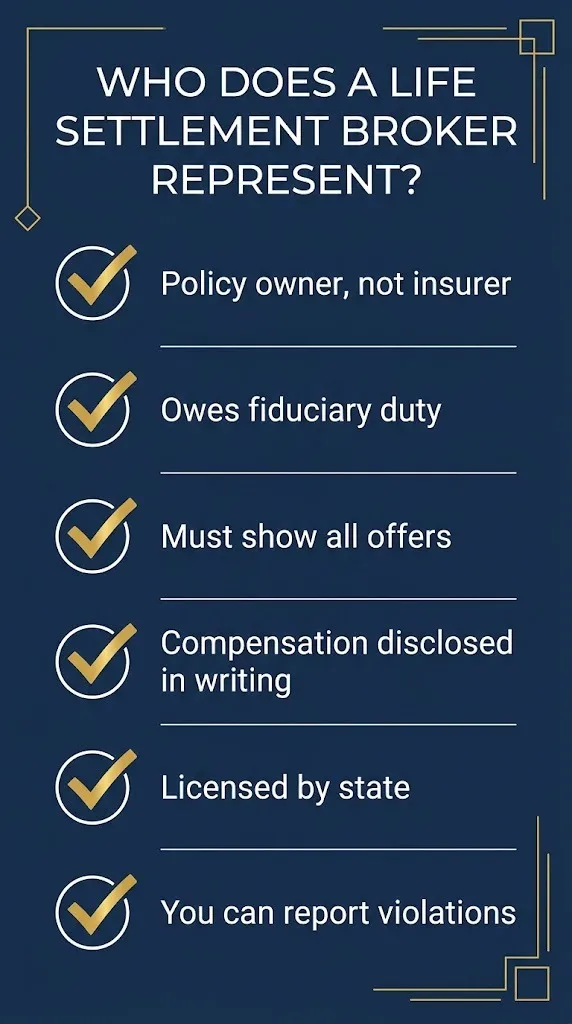
A life settlement broker represents only the policy owner in a life settlement transaction . Idaho insurance code states the broker is “deemed to represent only the owner, and not the insurer or the life settlement provider” . The Washington State Office of the Insurance Commissioner confirms brokers “represent only the owner and owes a fiduciary duty to the owner” .
This isn’t a marketing slogan. It’s written into state insurance regulations across the country. The Kentucky Department of Insurance consumer guide explains the broker “has a legal obligation to find the best deal for the owner of the life insurance policy” .
That means when a broker markets your policy to multiple buyers, they’re legally required to work for your interests. Not the provider’s. Not the investor’s. Yours .
Is a life settlement broker on your side or the buyer’s side?
The broker is on your side, legally and financially. The Financial Industry Regulatory Authority (FINRA) tells investors to ask a simple question when approached: is this person a broker who represents you, or are they affiliated with a specific life settlement company ?
If they’re affiliated with one provider, they can only get you that company’s offer. No competition, no leverage, and likely a lower price. A true broker shops your policy to a network of licensed providers to create competitive bidding .
A provider, by contrast, represents the investors funding the purchase. The provider wants to pay the lowest amount possible. That’s not a criticism, it’s just their role in the transaction .
What does fiduciary duty mean for a life settlement broker?
Fiduciary duty means the broker must act according to your instructions and in your best interest . The Idaho Department of Insurance spells it out in the broker license application: the broker owes “a fiduciary duty to the owner to act according to the owner’s instructions and in the best interest of the owner” .
In practical terms, that duty creates specific obligations. The broker must present you with a full description of “all offers, counteroffers, acceptances and rejections” related to your policy . They can’t cherry-pick the best offer for their commission and hide the rest.
The broker must also disclose any affiliation or contractual arrangement with anyone making an offer . If your broker has a side deal with a particular provider, you’re entitled to know before you sign anything.
How does a life settlement broker get paid?
A life settlement broker gets paid from the sale proceeds once the transaction closes . The broker’s compensation must be disclosed in writing, including “the amount, method of calculation and the party who is responsible for paying” the fee .
Welcome Life Securities, a licensed broker, discloses its maximum compensation as “the lesser amount of six percent (6%) of the net death benefit of the life insurance policy or thirty percent (30%) of the created value negotiated” . “Created value” means the gross purchase price minus the policy’s cash surrender value .
Here’s the key point: the broker only gets paid if the sale closes . And because the broker’s fee is often a percentage of the sale price, the broker’s incentive aligns with yours, at least partially. A higher sale price means a higher commission .
Key Takeaway: A life settlement broker’s fiduciary duty means they must present every offer, disclose their compensation, and act in your best interest, not the buyer’s .
Can a life settlement provider claim to represent you?
No. A life settlement provider cannot claim to represent you, because providers represent the buyers and investors funding the purchase . The provider’s job is to acquire your policy at a price that works for their investment portfolio .
Some providers market directly to policyholders by emphasizing that they charge no broker commission . That’s technically true, but it misses the bigger picture. Without a broker running a competitive auction, you’re negotiating with one buyer who has no obligation to offer you a fair market price .
The Insurance Journal puts it plainly: providers “do not represent the insured in any capacity. They actually represent the investors who are funding the transaction. That means the provider will typically offer the lowest amount possible” .
How does a broker’s fiduciary duty differ from a provider’s role?
The difference is structural, not just ethical. A broker’s fiduciary duty requires them to maximize your sale price. A provider’s business model requires them to minimize acquisition costs .
| Factor | Broker | Provider |
|---|---|---|
| Represents | You (the owner) | Buyers/investors |
| Fiduciary duty to you | Yes | No |
| Creates competition | Yes, auctions policy | No, makes one offer |
| Charged to you | Commission from proceeds | No commission |
| Likely outcome | Higher gross price | Lower gross price |
The commission question cuts both ways. A broker takes a percentage, which reduces your net proceeds. But the competitive bidding the broker generates can raise the gross price enough to more than cover that fee .
What disclosures must a life settlement broker provide to you?
A life settlement broker must provide written disclosures before you sign any contract. State insurance codes require specific information, and failing to provide it can cost the broker their license .
The mandatory disclosures include:
- The broker’s name, business address, and telephone number
- A full description of all offers, counteroffers, and rejections
- Any affiliation between the broker and anyone making an offer
- The amount and method of calculating the broker’s compensation
- The percentage of the offer consumed by the broker’s fee
- A statement of your right to rescind the contract
The National Association of Insurance Commissioners (NAIC) model regulation also requires a 15-day absolute right of rescission, meaning you can change your mind within that window .
Reality Check
No legitimate life settlement broker will ever ask you to pay an upfront fee to “qualify” for a settlement. The broker gets paid from the sale proceeds, not from your pocket . If someone demands money before your policy is even evaluated, that’s a scam. Also, brokers are only licensed in specific states, so verify their license with your state insurance department before sharing medical records or policy details.
How can you tell if a broker is actually representing you?
You can tell by asking directly and checking the paperwork. FINRA’s investor guidance recommends asking the person soliciting you: “Are you a life settlement broker who represents me, or are you affiliated with a particular life settlement company?” .
If the answer is the latter, they can only obtain an offer from that company. You won’t know if you’re getting a competitive price .
A legitimate broker should have no problem putting their fiduciary duty in writing. The Idaho disclosure form, for example, states clearly: “The life settlement broker is representing you in this transaction and has a duty to act in your best interest” .
You should also check the broker’s license with your state department of insurance. Most states require life settlement brokers to hold a specific license, pass an exam, and complete continuing education .
What happens if a broker violates their fiduciary duty?
If a broker violates their fiduciary duty, you can file a complaint with your state insurance commissioner. State insurance codes give regulators authority to suspend or revoke a broker’s license for failing to provide required disclosures .
In California, a violation of the disclosure requirements is a misdemeanor . The commissioner can consider “any failure to provide the disclosures or rights described in this section as a basis for suspending or revoking a broker’s or provider’s license” .
The NAIC model also allows license revocation for “a pattern of unreasonable compensation to the viators” . If a broker is taking an excessive cut that leaves you with an unfairly low payout, that can be grounds for regulatory action.
Key Takeaway: The broker’s fiduciary duty is enforceable. If they hide offers, fail to disclose compensation, or put their interests ahead of yours, you can report them to your state insurance department .
How does state law enforce the broker’s duty to represent you?
State law enforces the broker’s duty through licensing requirements, mandatory disclosures, and the threat of license revocation. Nearly all states have adopted some version of the NAIC Viatical Settlements Model Act, which requires licensing of brokers and providers .
The model act includes contract disclosure rules, advertising restrictions, and mandatory disclosures to policy owners . Commissions must be disclosed. The identity of all parties must be disclosed. Deceptive practices are prohibited .
The law also requires that the policy owner’s insurance company receive 20 days’ notice before the sale, giving the insurer time to investigate whether the policy is contestable .
What questions should you ask a life settlement broker before signing?
Before signing anything, ask these questions and get the answers in writing:
- Are you licensed as a life settlement broker in my state?
- Who do you represent in this transaction, me or the buyer?
- How many providers will you solicit offers from?
- What is your total compensation, and who pays it?
- Will you show me every offer you receive?
- Do you have any financial relationship with any provider bidding on my policy?
- What happens if I change my mind after signing?
FINRA specifically recommends asking how the person is compensated and evaluating critically whether the product is the best option for you . A broker with nothing to hide will answer all seven questions without hesitation.
What happens next
Expected Q4 2026: State insurance departments continue licensing reviews and consumer complaint investigations.
Expected 2027: NAIC may update model regulations based on consumer protection data.
Ongoing: Policy owners can file complaints with state insurance commissioners at any time.
TBD: Federal legislative activity on life settlement tax treatment remains pending.
Frequently Asked Questions
Does a life settlement broker represent the insurance company?
No. A life settlement broker represents only the policy owner and owes a fiduciary duty to that owner, not the insurance company .
Can a broker also work for a life settlement provider?
No. A broker’s fiduciary duty to the owner conflicts with representing a provider. If a broker has any affiliation with a provider making an offer, they must disclose it .
Who pays the life settlement broker’s commission?
The broker’s commission is paid from the sale proceeds of your policy. It’s deducted from the amount the provider pays, not billed to you separately .
How much can a life settlement broker charge?
Compensation varies by state and transaction. One broker discloses a maximum of 6% of the net death benefit or 30% of the created value, whichever is less . The exact amount must be disclosed to you in writing .
Is a life settlement broker required to show me all offers?
Yes. State disclosure requirements mandate a “full, complete and accurate description of all offers, counteroffers, acceptances and rejections” related to your policy .
Can I sell my life insurance policy without a broker?
Yes, you can sell directly to a provider. But without a broker running a competitive auction, you’re relying on one buyer’s offer with no way to know if it’s fair .
What happens if I change my mind after signing?
You generally have a 15-day right of rescission under NAIC model regulations, allowing you to cancel the settlement within that window .
How do I verify a life settlement broker’s license?
Contact your state department of insurance and ask for the broker’s license status. Most states require a specific life settlement broker license and continuing education .
Selling a life insurance policy is a significant financial decision. The broker’s job, legally, is to make sure you get the best deal possible. If the person sitting across from you can’t explain who they represent in plain language, walk away and call your state insurance department instead.
The single most important thing to remember: your broker works for you, and if they don’t act like it, you have recourse through your state insurance commissioner .