Student Loan Settlement 2026: Navient Checks, $23 Billion Forgiveness, and Who Qualifies
Quick Answer
- Navient borrowers placed in forbearance before 2018 are receiving automatic checks up to $2,000 from the CFPB.
- The Sweet settlement erases federal loans for 450,000 borrowers defrauded by predatory schools.
- No new claims are being accepted for either settlement; both are government enforcement actions, not open class actions.
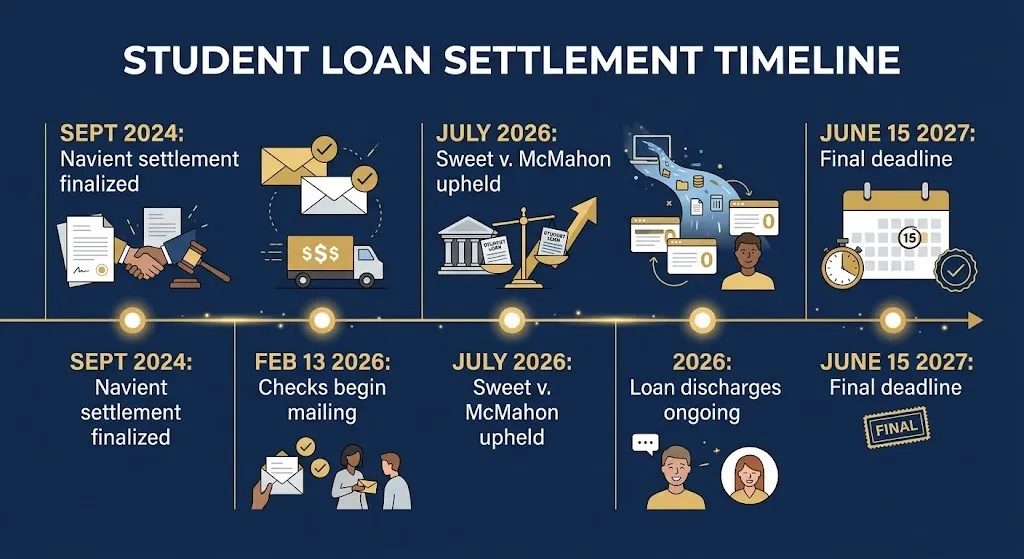
Student loan settlement money is actually moving in 2026. The CFPB started mailing Navient restitution checks on February 13, 2026, and a federal appeals court cleared the way for the Sweet v. McMahon settlement to erase debts for hundreds of thousands of borrowers .
But here’s what most headlines miss: neither of these is a traditional class action you can join. They’re government enforcement actions with automatic payouts. If you didn’t already qualify, you can’t sign up now.
This article breaks down exactly who gets paid, how much, when checks arrive, and how to tell legitimate settlement notices from the scams that always follow free money headlines.
The Facts
| Settlement | Navient CFPB Restitution | Sweet v. McMahon |
|---|---|---|
| Status | Checks mailing since Feb 13, 2026 | Loan discharges ongoing |
| Fund Size | $100 million restitution | $23 billion in loan relief |
| Per-Person Payout | $50 to $2,000 | Average $48,000 in cleared debt |
| Eligibility | Forbearance before 2018 | Borrower defense claims |
| Claim Deadline | None, automatic | June 15, 2027 final deadline |
| Administrator | Rust Consulting | Dept. of Education |
| Proof Needed | None | Already on file |
Is the student loan settlement real or a scam?
Both settlements are real and verified by federal agencies. The Navient settlement came from a CFPB enforcement action finalized in September 2024 . The Sweet settlement is a class action against the U.S. Department of Education that’s been litigated for seven years .
The confusion is understandable. When checks show up out of nowhere with no warning, skepticism is healthy. But these payments aren’t random. The CFPB identified Navient borrowers from servicing records. The Education Department identified Sweet borrowers from their own borrower defense applications .
Key Takeaway: Both settlements are government-backed and legitimate. The Navient checks require no action. The Sweet discharges happen automatically for verified borrowers.
How much money will you get from the Navient settlement?
Navient settlement checks range from $50 to $2,000, with most borrowers receiving several hundred dollars . The CFPB hasn’t published a formal payout table, and amounts vary based on your specific loan history .
Reddit users have reported checks at the high end of that range, around $2,000 . Higher payments went to borrowers who stayed in forbearance longest or had the largest interest accumulation .
The $100 million restitution fund is separate from the $20 million civil penalty Navient paid to the CFPB’s victims’ relief fund . Only the $100 million is earmarked for direct borrower payments.
Not yet determined: The CFPB hasn’t disclosed exactly how many borrowers qualify. Higher education expert Mark Kantrowitz estimates at least 100,000 people based on historical Navient forbearance data .
Reality Check
If someone asks you to pay a fee to “claim” your Navient settlement money, that’s a scam. The CFPB doesn’t charge for restitution. Rust Consulting, the administrator, mails checks automatically based on Navient’s records . You don’t file anything, you don’t register anywhere, and you don’t need a middleman. The only legitimate phone number for questions is 1-800-711-8418 .
How do you claim your Navient settlement payment?
You don’t file a claim. The CFPB contracted Rust Consulting to administer automatic payments based on Navient’s servicing records .
Here’s what happened:
- CFPB identified eligible borrowers from Navient’s data.
- Rust Consulting prepared checks based on forbearance history.
- Checks started mailing February 13, 2026 .
- No claim form, no registration, no deadline .
If you moved since Navient serviced your loans, contact Rust Consulting to update your address. Checks mailed to old addresses may be returned. You can reach them at [email protected] or by mail at CFPB v Navient, P.O. Box 2561, Faribault, MN 55021-9561 .
Who qualifies for the Navient settlement payment?
You may qualify if Navient placed your federal student loans in forbearance in 2017 or earlier . The CFPB alleged Navient steered borrowers into forbearance instead of income-driven repayment plans, costing them years of qualifying payments toward forgiveness .
The class includes borrowers whose loans were serviced by Navient or Sallie Mae before 2018. Navient’s federal loan accounts were transferred to MOHELA, and may have moved again to Aidvantage, Nelnet, or EdFinancial . Check Studentaid.gov to see your servicing history.
The settlement also covers borrowers who received inaccurate credit reporting through Pioneer Credit Recovery, a Navient subsidiary .
What is the Sweet v. McMahon settlement?
Sweet v. McMahon is a $23 billion class action settlement against the U.S. Department of Education for failing to process borrower defense claims . It’s the largest class action settlement against the federal government in American history .
The case started as Sweet v. DeVos in 2019. Borrowers who attended predatory for-profit schools applied for loan forgiveness under the Borrower Defense rule. The Education Department under Betsy DeVos stopped processing claims and denied others without review .
The Biden administration settled the case in 2022, agreeing to automatic relief for borrowers who attended specific schools. The Trump administration delayed processing remaining claims, but a July 17, 2026, Ninth Circuit ruling rejected that delay .
The Education Department’s final deadline to clear all eligible debts is June 15, 2027 .
How much will Sweet v. McMahon borrowers get?
The average federal student loan balance cleared under the Sweet settlement exceeded $48,000 . Individual amounts vary widely based on how much debt each borrower carried .
Borrowers may also receive refunds for payments made on their loans while waiting for relief. The typical refund for eligible borrowers is over $15,000, according to the Project on Predatory Student Lending .
Here’s the breakdown:
| Relief Type | Average Amount | Source |
|---|---|---|
| Loan cancellation | $48,000+ | Eileen Connor, PPSL |
| Payment refunds | $15,000+ | Eileen Connor, PPSL |
| Total relief (combined) | $23 billion | Court records |
Not yet determined: Exact per-borrower amounts depend on individual loan balances and payment history. The Education Department hasn’t published individual figures .
Who qualifies for the Sweet v. McMahon settlement?
You may qualify if you filed a borrower defense application and attended a school on the approved list . The settlement covers two groups of borrowers .
Group 1: Borrowers who attended one of more than 150 listed schools and had a pending borrower defense application on November 16, 2022 . These borrowers get automatic full relief.
Group 2: Borrowers who filed applications during a brief post-settlement window in 2022. The Education Department had to process these claims by a court deadline or discharge the loans automatically . About 170,000 borrowers in this group are now getting relief.
You can’t newly qualify today. The settlement “is not something one can newly qualify for,” according to Eileen Connor of PPSL .
How do you check if your student loans are affected?
You can’t file anything for either settlement. But you can verify your status through official channels.
For the Navient settlement:
- Call Rust Consulting at 1-800-711-8418.
- Check your mail for a check from the CFPB settlement fund.
- Verify your address on file with Navient, MOHELA, or your current servicer.
For the Sweet settlement:
- Log into Studentaid.gov and check your borrower defense application status.
- Watch for notices from the Education Department.
- Contact PPSL if you believe you should be in the class but haven’t received relief.
The CFPB’s automated phone line was initially accepting calls only from borrowers who received checks. Eligibility checks opened March 30, 2026 .
What happens next
Ongoing: Navient restitution checks continue mailing on a rolling basis .
Ongoing: Sweet settlement loan discharges process through June 15, 2027 .
TBD: Final number of Navient borrowers who receive checks.
TBD: Complete refund processing for Sweet settlement borrowers who made payments while waiting.
June 15, 2027: Final deadline for Education Department to clear all Sweet settlement debts .
Frequently Asked Questions
Is the Navient settlement check real?
Yes. The CFPB started mailing checks on February 13, 2026, from a $100 million restitution fund .
How much is the Navient settlement payment?
Checks range from $50 to $2,000, with most borrowers receiving several hundred dollars .
Do I need to file a claim for the Navient settlement?
No. Payments are automatic based on Navient’s servicing records. No claim form exists .
Who qualifies for Navient settlement checks?
Borrowers whose federal loans were placed in forbearance by Navient in 2017 or earlier .
What is the Sweet v. McMahon settlement?
A $23 billion class action settlement that erases federal student loans for borrowers defrauded by predatory schools .
Can I still join the Sweet settlement?
No. Eligibility is closed. The settlement covers borrowers who filed borrower defense applications before specific deadlines .
How much debt is being erased in the Sweet settlement?
The average cleared balance exceeds $48,000 per borrower, with total relief around $23 billion .
When is the final deadline for the Sweet settlement?
The Education Department must clear all eligible debts by June 15, 2027 .
Two settlements, two different timelines. Navient checks are in the mail now. Sweet discharges continue through June 2027.
The single most important action: check your mail for a Navient check, and log into Studentaid.gov to verify your borrower defense status .