NYT Lawsuit 2026: EEOC Discrimination Case, Counterclaim, Status and Your Options
Quick Answer
- The EEOC sued The New York Times on May 5, 2026, alleging race and sex bias in a promotion.
- No payout is open to join, and any damages are not yet determined.
- The Times countersued July 10, 2026. No ruling or trial date is confirmed.
The NYT lawsuit tied to employment law is the EEOC’s Title VII case, filed May 5, 2026 in federal court in Manhattan. It accuses The New York Times of passing over a white male editor for a promotion because of his race and sex.
This case involves one named editor, not a class of workers. You can’t join it or file for a payment, and the next date to watch is a court ruling that isn’t scheduled yet.
This guide covers the allegations, the Times’ counterclaim, the money, and your own options if you face similar bias. One surprise: the Times says the EEOC’s own eight-month investigation found no evidence that race or sex mattered.
The Facts
| Case | EEOC v. The New York Times Company (Title VII), U.S. District Court, Southern District of New York (case number not yet confirmed) |
| Status | Times filed an answer and counterclaim July 10, 2026. No ruling or trial date confirmed |
| Fund Size | Not applicable. No class settlement fund |
| Est. Per Person | Not yet determined. Relief sought not confirmed |
| Claim Deadline | None to join. For your own claim, generally 180 days to file an EEOC charge, or 300 days in some places |
| Administrator | None. The EEOC and the federal court handle the case |
| Proof Needed | Not applicable to join. For your own claim, records of the decision and your qualifications |
Is the NYT lawsuit real, and which one are people searching for?
The NYT lawsuit is real, but the phrase covers several separate cases, and only one is an employment case. Readers often mix them up.
| Case | Court | Key date |
|---|---|---|
| EEOC v. New York Times (employment) | Southern District of New York | Filed May 5, 2026 |
| New York Times v. OpenAI and Microsoft (copyright) | Southern District of New York | Filed December 27, 2023 |
| Shareholder records suit (Florida pension fund) | New York County Supreme Court | Filed September 23, 2026 |
| Trump defamation suit against the Times | Federal court | Filed September 2025 |
The copyright case is the one most people mean when they say “NYT lawsuit.” It isn’t about workers, and no payout is open to readers.
Employment is the angle here. We lead with the EEOC case because it’s the only one where a person’s job and pay are at issue.
Who is suing The New York Times in the EEOC case?
The U.S. Equal Employment Opportunity Commission is the plaintiff, acting for a Times editor named Bryant Rousseau. He’s a senior staff editor who has worked at the Times since 2014, mostly on the international desk.
The EEOC first filed without naming him. Rousseau later joined the lawsuit in May, according to CNN.
The case grew out of a charge an employee filed with the EEOC in 2025. The agency investigated for months before suing.
Here’s the key fact for readers: this is not a class action. The suit covers one promotion decision for one editor. The Times says that decision was one of more than 100 deputy positions across its newsroom.
What does the New York Times discrimination lawsuit allege?
The EEOC alleges the Times violated Title VII of the Civil Rights Act by denying Rousseau a promotion because of his race and sex. The job was deputy real estate editor, filled in 2025.
These are allegations, not findings. The Times denies them.
Here’s what the EEOC claims:
- Rousseau applied for the deputy real estate editor role in early 2025.
- He was left out of the final panel interviews despite real estate experience.
- No white male candidate reached the final interview stage.
- The job went to an external multiracial woman who allegedly lacked real estate journalism experience.
- A final panel interviewer allegedly described her as inexperienced overall.
The EEOC also points to the Times’ 2021 “Call to Action” on diversity. It says the Times met its goal in 2022 but kept pushing diversity policies.
Key Takeaway: The employment NYT lawsuit is an EEOC Title VII case over one 2025 promotion, filed May 5, 2026, and the Times denies it.
How much money is at stake in the NYT lawsuit?
The amount at stake is not yet determined, and the EEOC’s requested relief is not confirmed in the reporting we checked. The case is early, and no court has ruled on liability.
There is no settlement fund. Nothing has been announced publicly.
| Item | Status |
|---|---|
| EEOC damages sought | Not yet confirmed |
| Settlement | None announced |
| Times’ requested relief | Dismissal with prejudice, legal fees and costs, and an order stopping the suit |
| Trial date | Not yet confirmed |
Discrimination cases can end with job-related remedies, money, or policy changes. None of that has been decided here.
Be careful with any number you see online. If a page quotes a damages figure for this case, ask where it came from. We found no verified figure.
Can you get paid or join the New York Times lawsuit?
No, you can’t join this lawsuit or file a claim for payment from it. The EEOC brought it for one charging party, so there’s no claim form, class, or administrator.
It works like a warranty dispute over one product, not a recall. Only the named customer is in the case.
If a message says you can “claim” money from an NYT settlement, treat it as a red flag. No such program exists for this case.
The shareholder suit doesn’t pay individuals either. Shareholders there are asking a judge to force the board to hand over internal records. It seeks documents, not damages for workers.
Your own options exist if you faced similar bias at work. We cover them next.
Reality Check: No one legitimate texts you first about an NYT lawsuit payout. Filing an EEOC charge is free, and anyone charging a fee to “register” you for this case is not connected to it. Use the EEOC directly.
How do you file an EEOC charge if you faced job discrimination?
You file a charge with the EEOC online, by phone, or at an office, and you must do it before the deadline. Federal laws enforced by the EEOC, except the Equal Pay Act, require a charge before a private lawsuit.
- Write down the date of the decision you believe was discriminatory.
- Gather the job posting, your reviews, and any messages about the decision.
- Start with the EEOC Public Portal or call 1-800-669-4000.
- File before your time limit runs out.
- Expect the EEOC to notify your employer within about 10 days.
- Consider voluntary mediation if offered.
- Watch for a notice of right to sue if the EEOC doesn’t sue for you.
The EEOC says the final decision to file is yours.
A charge isn’t a lawsuit. It’s the required first step.
How long do you have to file an EEOC charge?
You generally have 180 calendar days to file an EEOC charge, extended to 300 days if a state or local agency enforces a similar law. The clock starts on the day of the discriminatory act.
| Situation | Time limit |
|---|---|
| Standard federal deadline | 180 calendar days |
| State or local law covers the same bias | 300 calendar days |
| Harassment | 180 or 300 days from the last incident |
| After a right-to-sue notice | 90 days to sue in federal court |
The EEOC’s New York office lists 300 days for race and sex claims against employers with 15 or more employees. That matches the location of this case.
Waiting won’t help. Internal grievances, union complaints, arbitration, and mediation generally don’t pause the deadline.
The Equal Pay Act is an exception, since it doesn’t require a charge first.
What evidence helps in a promotion discrimination claim?
Evidence that compares your qualifications with the person chosen helps most in a promotion claim. The EEOC built its Times complaint on exactly that kind of comparison.
Think of it like a store return. Without the receipt, the clerk relies on memory. Documents settle the question.
Build your file with this checklist:
- The job posting and its stated requirements.
- Your résumé, reviews, and awards.
- The interview schedule and who advanced.
- Messages or notes about the hiring decision.
- Public statements about hiring or diversity goals.
- Names of witnesses who saw the process.
In the Times case, the EEOC leaned on job posting criteria, experience gaps, panel comments, and public diversity goals. The Times says it has evidence the EEOC left out, including candidates of color who had more real estate experience and weren’t advanced.
Key Takeaway: You can’t join the Times case, but you may be able to file your own EEOC charge, and the 180 or 300 day clock starts at the discriminatory act.
What’s the latest in the EEOC v. New York Times lawsuit?
The latest verified step is the Times’ July 10, 2026 answer and counterclaim. No ruling on the counterclaim, no dismissal, and no trial date is confirmed in the sources we checked.
| Date | Event |
|---|---|
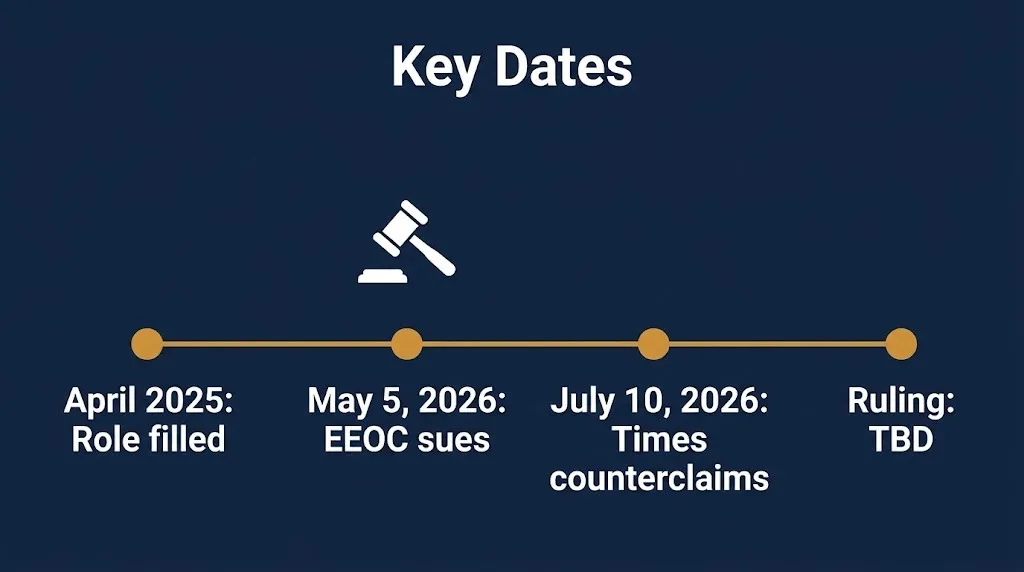
| April 2025 | Deputy real estate editor role filled, per the Times |
| May 5, 2026 | EEOC files suit in the Southern District of New York |
| May 2026 | Rousseau joins the case |
| July 10, 2026 | Times files counterclaim |
| Not yet confirmed | Court ruling or trial date |
The EEOC declined to comment on the counterclaim, citing the ongoing case. We found no reported settlement.
Check the court docket for anything newer. Court cases move fast, and filings can appear after press coverage.
What did the Times say in its counterclaim?
The Times argues the EEOC sued in retaliation for its reporting, and it asks the court to dismiss the case. The July 10 filing seeks dismissal with prejudice, an order stopping the suit, and legal costs.
The Times raises three counterclaims, per legal analysis of the filing:
| Claim | What the Times argues |
|---|---|
| First Amendment | The suit targets a news organization over its journalism |
| Fifth Amendment due process | The EEOC didn’t give fair notice |
| Administrative Procedure Act | Ending conciliation was arbitrary and capricious |
The Times says the EEOC’s eight-month probe found no evidence race or sex was considered. It also says the EEOC sued less than two weeks after a Times article about pressure inside the agency to pursue cases matching the president’s agenda.
The Times adds that Rousseau was offered at least two other roles in 2024. That’s the Times’ account, and the EEOC hasn’t been reported as conceding it.
What’s happening in the other NYT lawsuits in October 2026?
The biggest other NYT lawsuit is the copyright case against OpenAI and Microsoft, and it’s in summary judgment briefing with no trial date. Cross-motions were filed September 4, 2026.
| Case | Latest verified step |
|---|---|
| NYT v. OpenAI and Microsoft | Cross-motions filed September 4, 2026 |
| Same case, public brief | Redacted version filed September 17, 2026 |
| Same case, defendants’ responses | Due October 23, 2026 |
| Same case, briefing ends | November 20, 2026 |
| Trump defamation suit | Dismissed, with permission to amend the complaint |
Since April 2025, the OpenAI case has been coordinated with other suits in a multidistrict litigation before Judge Stein. A separate coalition of nearly 400 local newspapers sued OpenAI and Microsoft on June 24, 2026.
The Times also sued the Department of Defense in December over press access restrictions, according to CNN.
None of these cases pays workers or readers.
Key Takeaway: The employment NYT lawsuit and the OpenAI copyright case are separate, and only the copyright case has dates through November 20, 2026.
Why did the EEOC sue The New York Times?
The EEOC says the Times denied a promotion because of race and sex, while the Times calls the suit politically motivated. Both positions are on the record.
The agency’s current priorities matter here. Under Chair Andrea Lucas, the EEOC has made opposition to what she calls unlawful DEI practices a central enforcement focus.
Lucas has said anti-discrimination law protects all workers equally, including white and male employees. The EEOC’s line in this case was that there’s no diversity exception to the rule.
The Times replies that its hiring is merit-based. It says the role wasn’t part of its diversity goals for leadership and that the chosen candidate had strong service journalism experience.
Whose account wins is for the court. No judge has ruled on the facts.
What is the shareholder lawsuit that cites a former Times employee?
The shareholder suit is a records demand filed September 23, 2026, and it cites a former Times employee’s complaints. The State Board of Administration of Florida and the National Center for Public Policy Research filed it in New York County Supreme Court.
The suit asks a judge to force the Times board to hand over internal records. It isn’t an employment claim by the former worker.
The petition says she worked on the video desk for nearly a decade. She allegedly raised concerns at least 15 times between 2019 and her March 2026 departure, to managers, the standards desk, and human resources.
She stays anonymous, citing concerns for her family’s safety. The Times’ response to this suit is not yet confirmed.
What does Title VII say about promotions and diversity goals?
Title VII bars employment discrimination based on race, color, national origin, religion, or sex, including in promotion decisions. The EEOC’s Times case rests on that law.
The legal question is narrow. Did race or sex play a part in this one decision?
The EEOC points to the Times’ public diversity goals as context. The Times says goals didn’t drive this hire.
Courts look at facts. They weigh qualifications, interview records, and the employer’s stated reasons.
If you think a similar thing happened to you, the same questions apply. Document your qualifications, the process, and who advanced, then file within your deadline.
What Happens Next
Expected, date not confirmed: The EEOC responds to the Times’ counterclaims.
Expected, date not confirmed: The court rules on motions, including any request to dismiss.
October 23, 2026: OpenAI and Microsoft responses are due in the copyright case.
November 20, 2026: Summary judgment briefing ends in the copyright case.
Not yet confirmed: A trial date in the EEOC employment case.
Frequently Asked Questions
What is the NYT lawsuit about?
The employment NYT lawsuit alleges the Times denied a promotion because of race and sex.
The EEOC filed it May 5, 2026.
The Times denies the claim.
Who is suing The New York Times?
The EEOC is suing on behalf of editor Bryant Rousseau.
He joined the case in May 2026.
It isn’t a class action.
Can I join the New York Times lawsuit?
No, there is no way to join the EEOC case.
It covers one editor and one promotion.
No claim form exists.
How much could the New York Times lawsuit pay?
The amount is not yet determined.
The EEOC’s requested relief isn’t confirmed.
No settlement has been announced.
Did The New York Times countersue the EEOC?
Yes, the Times filed a counterclaim on July 10, 2026.
It asks the court to dismiss the suit.
It cites the First and Fifth Amendments and the Administrative Procedure Act.
Is the NYT OpenAI lawsuit the same case?
No, the OpenAI case is a separate copyright suit.
It was filed December 27, 2023.
Responses are due October 23, 2026.
How long do I have to file an EEOC charge?
Generally 180 calendar days, or 300 days if a state or local law applies.
The clock starts at the discriminatory act.
Start early.
Closing
If you’ve faced similar bias, write down the decision date today and gather your documents. File an EEOC charge before your 180 or 300 day deadline expires.
Watch the Southern District of New York for the next ruling in the Times case. The date to know for your own claim is the one on your calendar, 180 days from the act.