L4-L5-S1 Workers Comp Settlement in 2026: What the Numbers Show and What Insurers Won’t Tell You
Quick Answer
- L4-L5-S1 settlements vary widely by state and severity, with single-level fusion cases often landing between $90,000 and $185,000 nationally.
- The final number depends on your permanent disability rating, lost wages, future medical needs, and whether you had surgery.
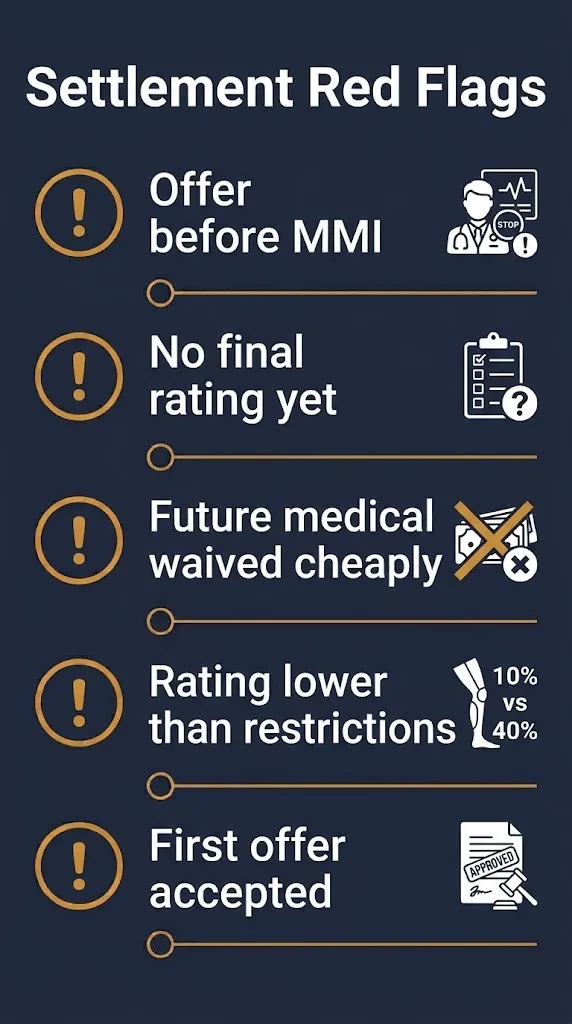
- Your first settlement offer will almost certainly be too low, and accepting it before reaching Maximum Medical Improvement can permanently limit your recovery.
You are searching this because you have a back injury at the L4-L5-S1 levels and you want to know what it is worth. The honest answer is that no single number fits all cases, but the published data gives you a real range to work from. A construction laborer with a two-level L4-S1 fusion in Illinois settled for $225,000 . A California worker with an L5-S1 fusion and a 32% disability rating recovered $365,000 . A warehouse worker with a single-level L4-L5 fusion in Illinois settled for $135,000 .
What separates those outcomes from the low offers you may have already received is not luck. It is timing, documentation, and whether a lawyer negotiated on your behalf. Insurers typically try to settle these claims at 50 to 70 percent of their true value, and unrepresented workers historically recover far less than those with counsel .
This article breaks down the verified settlement ranges for L4-L5-S1 injuries, the factors that drive the number up or down, how the process works step by step, and the specific red flags that signal a lowball offer. One detail that surprises many injured workers: a fusion surgery is not just a medical event, it is the single biggest lever on your settlement value, because it creates permanent restrictions that insurers cannot argue away .
The Facts
| Item | Verified Detail |
|---|---|
| Injury Type | Lumbar disc injury or fusion at L4-L5 and/or L5-S1 levels |
| National Fusion Range | $90,000 to $185,000 for single-level lumbar; $225,000 to $500,000+ for multi-level or revision |
| Illinois Fusion Range | $75,000 to $350,000, with multi-level cases averaging $275,000 or more |
| California Back Surgery Range | $100,000 to $450,000 or more, depending on rating and future medical |
| Key Driver | Permanent impairment rating assigned after Maximum Medical Improvement |
| Critical Timing | Do not settle before your post-surgical QME is complete |
| Common Insurer Tactic | Early offers before MMI that waive future medical rights |
Is an L4-L5-S1 workers comp settlement real or just lawyer marketing?
An L4-L5-S1 workers comp settlement is real, but the numbers you see online are not guarantees. They are ranges drawn from actual case outcomes and state rate schedules, and they vary enormously by jurisdiction.
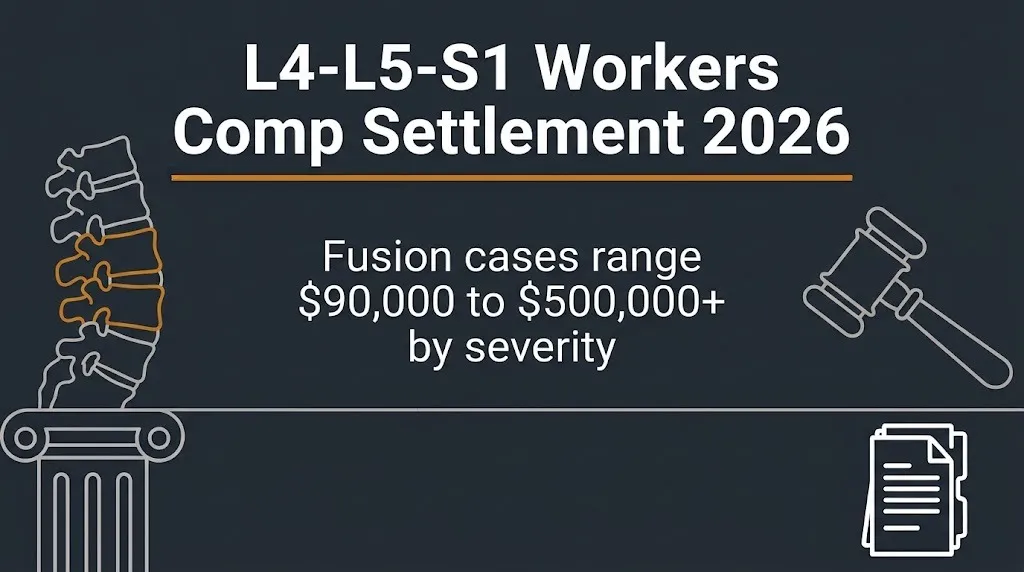
The L4-L5-S1 levels are the lowest part of the lumbar spine and bear much of the body’s weight. Injuries here are common in workers who lift, twist, or suffer a fall, and they often produce radiculopathy, the nerve pain that shoots down the leg . Because the injury affects mobility and work capacity, it produces higher impairment ratings than many other back injuries.
The settlement is not a lottery ticket. It is compensation for a permanent loss of function, and the formula is public. What is not public is how aggressively your employer’s insurer will fight the rating, which is why two workers with identical MRIs can receive very different offers.
How much is an L4-L5-S1 workers comp settlement worth in 2026?
An L4-L5-S1 workers comp settlement in 2026 is worth anywhere from under $50,000 for a conservatively treated disc injury to over $500,000 for a multi-level fusion with permanent work restrictions, depending on your state and your rating. The national average for spinal fusion settlements sits around $185,000 .
Here is the published range by severity, drawn from national settlement data and state-specific guides:
| Severity Level | National Range (2026) |
|---|---|
| Single-level lumbar fusion (L4-L5 or L5-S1) | $90,000 to $185,000 |
| Single-level cervical fusion | $110,000 to $220,000 |
| Two-level fusion (L4-S1) | $150,000 to $300,000 |
| Three or more levels | $225,000 to $450,000 |
| Revision fusion or hardware failure | $250,000 to $500,000 |
Those ranges are national. Your state’s rate schedule and your pre-injury wage will move you within or outside them. A California worker with a 32% rating and an L5-S1 fusion recovered $365,000 in one reported case study . An Illinois construction laborer with a two-level fusion and a wage differential settled for $225,000 .
Key Takeaway: The L4-L5-S1 level matters because it bears load and controls leg function, and fusion at that level creates permanent restrictions that anchor the settlement value.
What factors increase or decrease an L4-L5-S1 settlement?
The factors that increase an L4-L5-S1 settlement are surgery, permanent work restrictions, a high impairment rating, future medical needs, and lost earning capacity. The factors that decrease it are conservative treatment, a low rating, pre-existing degeneration, and a quick return to light duty.
Number of levels fused is the first driver. A single-level fusion rates lower than a two-level L4-S1 fusion, which rates lower than a three-level construct . Whether surgery happened at all is the second. A herniated disc treated with physical therapy and injections settles far lower than one that required a fusion .
Future medical care is the third. Fusing one level puts stress on adjacent segments, often requiring additional surgery years later. Insurers know this, and a well-documented future medical projection can add six figures to a settlement .
Your age and occupation matter because they affect how long the restrictions will impact your earning capacity. A 38-year-old construction worker with a 40-pound lifting restriction has a longer damaged career than a 60-year-old office worker with the same restriction.
What is a Compromise and Release and how does it affect my L4-L5-S1 case?
A Compromise and Release, or C&R, is a lump-sum settlement that closes your case and typically waives your right to future medical care for the injury. It is the most common way L4-L5-S1 cases resolve in states like California, and it is the most consequential decision you will make.
The alternative is a Stipulated Award, which pays benefits over time and keeps future medical care open. For a fusion patient who may need adjacent-segment surgery in 10 to 15 years, the choice between a C&R and a stip is not just about cash flow. It is about who pays for the next surgery .
A California workers comp attorney outlined a real scenario: a worker with a 30% rating and $25,000 in agreed future medical settled for a $150,000 gross C&R. After deducting temporary disability already paid, medical liens, and the 15% attorney fee, the net was about $110,150. Without representation, the same worker likely would have accepted the initial $88,000 PD-only offer and paid full lien value, netting roughly $76,000 .
Reality Check: A C&R is not free money. It is a trade: you give up future medical rights in exchange for a lump sum today. For a fusion patient, that trade can be catastrophic if the settlement does not realistically value the surgery you may need a decade from now. Do not sign a C&R before your post-surgical rating is final, and do not accept a future medical allocation that assumes you will never need care again.
How do you file an L4-L5-S1 workers comp claim?
You file an L4-L5-S1 workers comp claim by reporting the injury to your employer, seeking authorized medical care, and following your state’s claim process. The steps below are general, but the sequence is consistent across most states.
- Report the injury in writing to your supervisor immediately, within your state’s deadline.
- Get medical care from an authorized provider and document every symptom, including radiating leg pain.
- Complete your state’s claim form and keep a copy of everything you submit.
- Follow treatment recommendations, including surgery if your doctor recommends it and the carrier authorizes it.
- Attend the QME or impairment evaluation after you reach Maximum Medical Improvement.
- Review the rating with an attorney before accepting any settlement offer.
- Negotiate or file for a hearing if the offer does not reflect the rating and future medical needs.
The most common mistake is accepting an offer before the rating is final. An insurer may approach you during recovery with a number that looks generous compared to your current income. It rarely is .
How long does an L4-L5-S1 settlement take?
An L4-L5-S1 settlement typically takes 12 to 24 months from injury to resolution, and fusion cases often sit at the longer end because recovery before Maximum Medical Improvement can take a year or more .
The timeline breaks down roughly like this:
- First 30 days: Report, file, and begin treatment.
- Months 2 to 12: Medical development, including surgery and post-operative recovery.
- Months 12 to 18: MMI declaration, QME evaluation, and impairment rating.
- Months 12 to 24: Negotiation, settlement conference, or hearing.
- After approval: Payment, which may take another 30 to 60 days depending on your state .
A California lumbar fusion patient should expect 12 to 18 months of temporary disability payments before MMI is reached . Settling before that point is almost always a mistake, because the final rating is not yet known.
What happens next in your L4-L5-S1 case?
The next stages in your case depend on where you are in treatment. Here is the verified sequence most fusion cases follow:
If you are still treating: Continue treatment and follow your surgeon’s instructions. MMI comes when your condition stabilizes, often 12 to 18 months after fusion.
After MMI: Your QME or treating doctor assigns a whole-person impairment rating. This rating drives the math.
After the rating: Negotiation begins. An attorney can challenge a low rating and document future medical needs.
If no agreement: A hearing before your state’s workers comp board can produce an award.
After settlement approval: Payment typically arrives within 30 to 60 days, though state rules vary.
The one date that matters most is not a settlement date. It is your MMI date, because nothing can be valued accurately until your condition is permanent and stable.
Frequently Asked Questions
How much is an L4-L5-S1 workers comp settlement worth?
National ranges for single-level lumbar fusion settlements run from about $90,000 to $185,000, with multi-level cases reaching $225,000 to $500,000 or more depending on state and severity.
Is L4-L5-S1 fusion a permanent disability?
Yes, fusion at these levels typically produces permanent work restrictions and an impairment rating. The exact rating depends on the number of levels fused and your post-surgical condition.
Should I accept the first settlement offer for my back injury?
No. Insurers typically offer 50 to 70 percent of a claim’s true value initially. Do not accept before you reach Maximum Medical Improvement and have a final rating.
What is the difference between a C&R and a stip in a back injury case?
A Compromise and Release pays a lump sum and usually closes future medical care. A Stipulated Award pays over time and keeps future medical open.
How long does it take to settle a lumbar fusion workers comp case?
Most fusion cases take 12 to 24 months from injury to settlement, with some taking longer if the rating is disputed or the case goes to hearing.
Can I get workers comp for an L4-L5-S1 injury without surgery?
Yes. Conservative treatment cases can settle, but the value is lower because the impairment rating and future medical needs are smaller.
What if my employer’s doctor gives a lower rating than my doctor?
You can challenge the rating through your state’s dispute process, often by requesting a QME or presenting competing medical evidence. A five-point rating difference can mean tens of thousands of dollars.
Your next step is to gather your MRI reports, surgical records if you have had surgery, and your wage stubs, then consult a workers comp attorney in your state before accepting any offer. Do not sign a settlement before your post-surgical rating is final. The rating, not the offer, is the number that determines what your L4-L5-S1 injury is actually worth.