How to File a Lawsuit With No Money in 2026: Fee Waivers and Free Options
Quick Answer
- Yes, you may ask the court to waive filing fees if you can’t afford them.
- Cost: the federal civil filing fee is $405, and a judge decides whether to excuse it.
- Deadline: your claim’s filing deadline varies by state and claim type, so check yours first.
You can file a lawsuit with no money by asking the court to waive the fee. In federal court that fee is $405. A judge decides whether to excuse it.
This affects anyone who can’t pay court costs upfront. The date that matters most is your claim’s filing deadline. It varies by state and claim type, and court rules differ by court.
This guide covers fee waivers, free legal help, and contingency lawyers. Surprising detail: a waiver covers filing and service costs, not most later litigation expenses. You’ll see where applications go wrong.
The Facts
| Item | Verified detail |
|---|---|
| Case | General guide, not a single case; your court’s rules apply |
| Status | Federal and sample state rules checked October 17, 2026 |
| Fund Size | Not applicable |
| Est. Per Person | Not applicable |
| Claim Deadline | Varies by state and claim type, not yet confirmed here |
| Administrator | The clerk of the court where you file |
| Proof Needed | Sworn financial statement or your court’s fee waiver form |
Can you file a lawsuit with no money?
Yes, you may file without paying upfront if the court grants a fee waiver.
Courts let people who can’t afford fees ask for an exception. In federal court this is called proceeding in forma pauperis, or IFP. State courts use their own fee waiver forms.
A judge decides. The court can deny your request, or it can reject a complaint that has defects. You may get a chance to fix the problem.
One district court’s guidance says a waiver can excuse two things in federal court:
- The filing fee
- The cost of serving the complaint on defendants
“No money” rarely means no costs forever. Other expenses can show up later in the case.
You may hear about small claims court. It’s built for lower-dollar disputes, and fees there can be much lower. California’s fee table later in this guide shows the gap.
Whichever court you choose, the first step is the same. Contact the clerk and ask for the fee waiver form.
Does a fee waiver mean the whole lawsuit is free?
No, a fee waiver covers filing fees and service costs, not every cost of a lawsuit.
The District of Minnesota says IFP status excuses filing fees and the cost of serving the complaint. It says most other litigation costs that arise later aren’t waived. That’s the detail many guides skip.
Think of it like a bus pass. It gets you onto the bus. It doesn’t pay for everything you buy at your destination.
| Cost | Does a fee waiver cover it? |
|---|---|
| Court filing fee | May be waived if a judge grants it |
| Serving the complaint (federal IFP) | May be excused |
| Most later litigation costs | Not waived in most cases |
| A lawyer’s fee | A separate question, see contingency fees below |
How much does it cost to file a lawsuit in 2026?
Filing a civil case in federal court costs $405, according to two federal district court pages.
State and local fees vary by court. California’s small claims fees show how steep the range can be. They depend on the amount you’re suing for.
| Court | Fee | Source |
|---|---|---|
| Federal civil case | $405 | District of Rhode Island, District of Minnesota |
| California small claims, under $1,500 | $30 | California Courts self-help |
| California small claims, $1,500 to $5,000 | $50 | California Courts self-help |
| California small claims, $5,000 to $12,650 | $75 | California Courts self-help |
| California small claims, frequent filers | $100 | California Courts self-help |
California applies a $100 fee to people who filed over 12 cases in 12 months. Fees in other states are not yet confirmed here. Check your court clerk’s page.
Fees can change. Confirm the current amount with your clerk before you file. A short phone call can save a rejected filing.
The District of Kansas says filing a case involves no other fees beyond the filing fee. Later costs are a different matter.
Key Takeaway: Federal filing costs $405, but a judge can excuse it if you apply and qualify.
What costs can show up after you file?
Costs after filing can include expert witnesses, administrative charges, and more court fees.
A lawyer-information site lists case expenses as court filing fees, expert witness costs, and administrative charges. These are separate from a lawyer’s percentage. They can still matter if you lose.
Federal law adds one more cost rule. If the government pays for a transcript for the winner, the loser can be charged. That applies in IFP cases too.
- Ask in advance what each step will cost.
- Ask who pays expenses if you lose.
- Keep a running list of every bill.
Costs are like closing fees on a house. The sticker price isn’t the whole price.
Ask the clerk what other charges might apply to your type of case. Ask about copies and later motions too. Write the answers down.
Can a lawyer take your case with no money upfront?
Yes, some lawyers take cases on contingency, meaning you pay a percentage only if you win.
One legal information site says contingency fees typically range from 25% to 40%. The range depends on case complexity and firm policy. Lawyers decide case by case which claims they’ll take.
The site says that if you lose, you owe no fee. It warns that you may still owe certain case expenses. The agreement should say who pays them.
Ask these four questions before you sign:
- What percentage will you take?
- Are expenses deducted before or after that percentage?
- Who pays expenses if we lose?
- Is anything due before the case ends?
Reality Check: Applying for a fee waiver goes through the court clerk, not a middleman. No real court program asks you to pay a stranger to unlock it. Be wary of anyone who guarantees a payout in exchange for upfront fees.
How do you file a federal lawsuit without paying the fee?
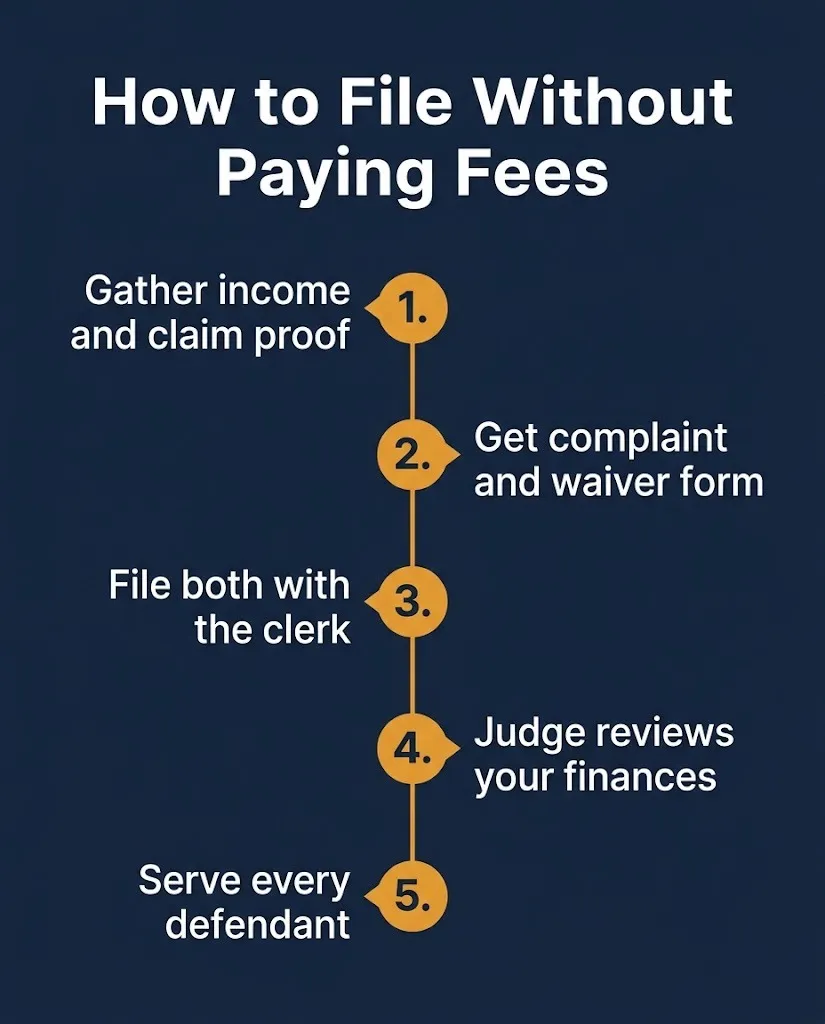
You file the complaint with a fee waiver application at the clerk’s office.
- Pick the right court and confirm it can hear your claim.
- Get the complaint form, civil cover sheet, and summons from the court or its website.
- Complete the court’s fee waiver application.
- Sign it. File one application per plaintiff.
- File the complaint and the application together with the clerk.
- Wait for a judge to rule on the application.
- Serve every defendant after the clerk issues the summons.
Form names vary by court. Rhode Island’s federal court calls it an Application to Proceed in District Court without Prepaying Fees or Costs. Kansas wants a Motion to Proceed Without Prepayment of Fees and an Affidavit of Financial Status.
Rhode Island’s court says spouses can share one application. So can a parent and minor child in one household.
Key Takeaway: Filing for free means filing a complaint and waiver application together, then awaiting a ruling.
How do you ask for a fee waiver in state court?
You ask the court clerk for a fee waiver form, and each state sets its own rules.
California’s court self-help page offers one example. You may qualify if you get public benefits. You may qualify if your income is below a set amount. You may qualify if paying would leave you short on basic needs. Other states use different tests.
- Find your state court’s website or visit the clerk.
- Look for a form called fee waiver or similar.
- Check the eligibility tests on the form.
- Gather proof, such as benefit letters or pay stubs.
- File the form with your case papers.
If your state isn’t California, don’t assume the same income test applies. Read your own court’s instructions.
What does a fee waiver application ask for?
A federal application asks for a sworn statement of your assets.
Under federal law, the statement must describe the case. It must say you believe in good faith that you’re entitled to relief. A judge then reviews your finances.
Rhode Island’s court warns that false or misleading information can bring sanctions or a monetary penalty. Don’t guess. Don’t round down your income.
- Your income and sources
- Your assets and savings
- Your regular expenses
- Who lives in your household
- A short description of your claim
Forms differ, so expect your court’s version to ask other questions. Answer each one fully.
Treat it like a mortgage application. Every number must match your papers.
Who qualifies for free legal aid?
You may qualify for free legal aid if your income falls at or below your program’s limit.
The Legal Services Corporation set 2026 income levels at 125% of the federal poverty guidelines. The rule took effect January 26, 2026. For a one-person household in the 48 states and D.C., the level is $19,950.
That works out to about $1,663 a month when divided by 12. Your program may count income and assets differently. Ask how it counts yours.
| Household size | 2026 LSC income level (48 states and D.C.) |
|---|---|
| 1 | $19,950 |
| 2 | $27,050 |
| 3 | $34,150 |
| 4 | $41,250 |
Figures for Alaska and Hawaii aren’t shown here. Programs may set other rules or limit case types. Amounts and eligibility depend on the program, so ask the program directly.
Key Takeaway: In the 48 states and D.C., the 2026 legal aid level for one person is $19,950.
What documents should you gather before you file?
Gather proof of your income, your expenses, and your claim before you go to the clerk.
Good records speed up a fee waiver application. They help prove your case if the defendant disputes it. Gather them while your memory is fresh.
- Photo ID
- Pay stubs, benefit letters, or tax records
- A list of monthly expenses
- Contracts, receipts, emails, and photos tied to your claim
- A dated timeline of what happened
- Names and addresses of the people or companies you’re suing
Make two copies of everything. Keep one set at home.
Think of it like returning an item without a receipt. You can still try. Proof makes it much easier.
What happens after you apply for a fee waiver?
After you apply, a judge reviews your finances, then checks your complaint.
Rhode Island’s federal court describes the process. A magistrate judge decides whether you can afford the fee and service costs. If you can, you must amend the application or pay.
If you can’t, the judge checks whether the complaint has defects. The court can deny the application if it does. You may get a chance to amend. The judge may recommend dismissal to a district judge.
The court’s guidance says missing a payment-order deadline can lead to dismissal. Minnesota’s federal court says it notifies you of its decision.
If your request is denied, read the order closely. It should say whether you can amend or must pay, and by what date. Calendar that date the day you get it.
Can a court appoint you a free lawyer?
A court may ask a lawyer to represent you, but it isn’t promised.
Federal law says the court “may request” an attorney for someone who can’t afford one. That wording means the judge has discretion. Don’t count on it.
Some programs offer limited help, such as reviewing your forms or giving brief advice. Ask what each one offers.
Start your search for help before you file. Legal aid offices, bar association programs, and court self-help centers can review your papers. Ask each about case types they accept.
- Legal aid programs
- Court self-help centers
- Bar association referral programs
- Law school clinics, where available in your area
Key Takeaway: A judge may request a lawyer for you, but you shouldn’t plan around it.
Can you file a lawsuit without a lawyer?
Yes, you can file without a lawyer, but you must follow the court’s rules.
Minnesota’s federal court offers complaint forms for general cases, employment discrimination, and Social Security appeals. Its Pro Se Civil Guidebook explains how to complete a complaint and serve defendants. Many federal courts post similar materials.
A complaint is the document that starts your case. It tells the court who you’re suing and what happened. Keep it short and factual.
Filing without a lawyer saves money, but it takes time and care. A judge won’t fix mistakes for you. Use court self-help centers, legal aid, and your clerk’s written instructions.
What does in forma pauperis mean?
In forma pauperis is the legal term for permission to proceed without prepaying court fees.
Lawyers shorten it to IFP. Federal courts use it. State courts often say fee waiver instead.
The core idea is simple. If you can’t afford the fee and costs, you can ask the court to excuse them. The court still checks your finances and your complaint.
Under the federal statute, you must swear to your assets. IFP isn’t a free pass. It’s a request the court can grant or deny.
The phrase is Latin, and you’ll see it on federal forms and in court orders. If a clerk says “IFP,” they mean this request. If you see “fee waiver,” it’s usually the same idea under a state label.
Each court uses its own form and its own name for it. Read the instructions on the form before you start. A blank line can delay your request.
Can a judge dismiss your case if you get a fee waiver?
Yes, a judge can dismiss a case at any time for a false poverty claim.
Under federal law, the court must dismiss if it finds the poverty allegation untrue. A frivolous or malicious case must go too. So must a case that fails to state a valid claim.
It must dismiss, too, if you seek money from a defendant who is immune.
That’s like a store return. It works if your story checks out. It doesn’t if the receipt is fake.
- Be accurate on every form.
- State your legal claim clearly.
- Don’t file claims you know have no basis.
Key Takeaway: A judge can end your case at any time if the poverty claim is false.
What if you’re in prison and can’t pay the filing fee?
Prisoners who proceed without prepaying still owe the full filing fee, paid in installments.
Under 28 U.S.C. 1915, a prisoner provides a certified record of account activity for the prior six months. The court then sets an initial partial payment. The rest is collected over time.
| Step | What federal law says |
|---|---|
| Initial partial fee | 20% of average monthly deposits or average monthly balance, whichever is higher |
| Later payments | 20% of each month’s income credited to the account |
| When funds are sent | When the account exceeds $10 |
| If you can’t pay the first amount | You can’t be barred from filing for that reason |
The total collected can’t exceed the statutory fee. Costs in a judgment follow the same installment method.
Which court should you file in?
You should file in the court that has power over your claim and your opponent.
Federal courts hear only claims they have authority over. The Rhode Island court’s judge checks this when reviewing a fee waiver application. Many everyday disputes belong in state or small claims court.
| Court type | Fee example | Notes |
|---|---|---|
| Small claims | $30 to $75 in California, by claim amount | Limits and fees vary by state |
| Federal district court | $405 | Court must have authority over the claim |
| State civil court | Varies by court | Check the clerk’s fee schedule |
Small claims court may fit smaller money claims. The California page lists fees for claims up to $12,650. Other states set their own limits.
If you’re unsure, call the court clerk. Clerks can explain filing steps. They can’t give legal advice.
What mistakes sink no-money filings?
The biggest mistakes are missing your deadline, filing in the wrong court, and submitting incomplete forms.
Your claim’s filing deadline varies by state and claim type. We haven’t confirmed yours, so look it up before anything else. A late case can be thrown out.
- Filing in a court that can’t hear the claim
- Leaving fee waiver questions blank
- Understating your income or assets
- Writing a vague complaint a judge can’t evaluate
- Ignoring a payment order after a denial
The court guidance we reviewed says a defective complaint can lead to denial. It says missing a payment deadline can lead to dismissal. A little care avoids most of this.
Key Takeaway: Check your deadline first, because a late filing can end your claim.
What Happens Next
Here’s the usual path after you decide to file:
- Before filing: Gather documents, check your deadline, and choose your court.
- Filing day: Submit the complaint, civil cover sheet, summons, and fee waiver application.
- Expected, after filing: A judge reviews your finances and complaint. Timing is not yet confirmed and varies by court.
- If granted: The clerk issues the summons and you serve every defendant.
- If denied: Amend the application or pay the fee by the date in the order.
- After that: The defendants respond and the case moves forward. Timing varies by case.
Frequently Asked Questions
Can I sue someone for free?
You may be able to, if the court waives your filing fee.
A judge decides.
Other costs can still arise later in the case.
What is the federal filing fee in 2026?
The federal civil filing fee is $405, according to two district court pages.
A judge can waive it if you apply and qualify.
What is in forma pauperis?
In forma pauperis is permission to proceed without prepaying court fees.
You apply with a sworn statement of your finances.
State courts often call it a fee waiver.
Will a judge give me a free lawyer?
A judge may request a lawyer for you, but it isn’t promised.
Federal law uses the word “may.”
Try legal aid and self-help centers early.
Does a fee waiver cover everything?
No, it covers filing fees and service costs.
Most other litigation costs aren’t waived, according to the District of Minnesota.
How much do contingency lawyers take?
One legal information site says contingency fees typically run 25% to 40%.
Expenses are separate.
Ask who pays them if you lose.
Who qualifies for legal aid?
Eligibility depends on the program, but 2026 LSC income levels start at $19,950 for one person.
That figure applies in the 48 states and D.C.
Alaska and Hawaii figures aren’t shown here.
Can my case be dismissed after I get a waiver?
Yes, if the poverty claim is false or the case has legal defects.
Federal law requires dismissal of frivolous or malicious cases.
Closing
Before you file, look up your claim’s deadline and your court’s fee waiver form. Gather your income proof and claim documents first.
The fact that matters most: the federal filing fee is $405, and a judge decides.