Antitrust Lawsuit 2026: What It Means, Who Qualifies, and Where the Real Settlements Are
Quick Answer
- An antitrust lawsuit claims a company used monopoly power or collusion to harm competition and raise prices.
- Consumer payouts exist only when a specific settlement fund is approved and a claims process opens.
- The RealPage settlement received final approval on October 16, 2026, but the claims deadline is not yet confirmed.
You searched for antitrust lawsuit because you saw a headline about a company being sued, or you got a notice about a settlement and want to know if it is real. The direct answer is that antitrust cases are about market power and pricing, not a single national payout. Some produce consumer money. Most do not.
The number that matters most right now is $359,925,000, the RealPage settlement approved on October 16, 2026. That is real money. But approval is not the same as a claim form in your inbox.
This article separates the verified settlements from the pending cases, explains what an antitrust lawsuit actually alleges, and shows you how to tell a real claims process from a fake one. One detail worth knowing up front: many high-profile antitrust lawsuits in 2026 are still in early stages, and some have already been dismissed.
The Facts
| Item | Verified Detail |
|---|---|
| Case Type | Civil or criminal action alleging restraint of trade or monopolization |
| Current Major Settlement | RealPage rental pricing settlements, $359,925,000 |
| Final Approval Date | October 16, 2026 |
| Court | U.S. District Court, Middle District of Tennessee |
| Estimated Per-Person Payout | Not yet determined |
| Claim Deadline | Not yet confirmed |
| Administrator | Not yet confirmed |
| Proof Needed | Check the official settlement website |
Is an Antitrust Lawsuit Real or a Scam?
An antitrust lawsuit is real, and it is one of the oldest categories of federal litigation in the United States. The Sherman Act and the Clayton Act give private parties and the government the right to sue when competition is illegally restrained. The scam risk is not the lawsuit itself. It is the websites and messages that pretend a settlement exists before one has been approved.
A real antitrust settlement has a court docket, a judge, a defined class, and an administrator appointed by the court. A fake one has a countdown timer and a credit card field. The RealPage settlement is real because a federal judge approved it in writing . A text message promising you $2,000 from an “antitrust fund” is not.
The key test is simple: if you cannot find the case on a court docket or a government agency page, do not enter personal information anywhere.
How Much Money Do You Get from an Antitrust Settlement?
You get whatever the court approves, divided according to the settlement terms, minus attorney fees and administrative costs. There is no standard antitrust payout. The RealPage settlements total $359,925,000 in cash across 41 settling defendants, plus cooperation and non-monetary relief .
That total does not tell you what any one renter receives. Per-person amounts depend on how many valid claims are filed, how the class is defined, and how the fund is allocated. Those details are not yet confirmed as of October 17, 2026.
Not yet determined is the honest answer for almost every antitrust case in 2026. Cases that have not settled have no payout. Cases that have settled often have payout formulas that are not public until the claims period opens.
How Do You File a Claim in an Antitrust Settlement?
You file a claim in an antitrust settlement only after a court approves the settlement and the administrator opens a claims process. You cannot file before that, and no legitimate party will ask you to file before the court order exists.
Here are the verified steps for any antitrust settlement:
- Confirm the case has a court docket and a final approval order.
- Find the official settlement website named in the court order.
- Read the class definition to see if you fall inside it.
- Gather proof of purchase or account ownership if required.
- File before the claim deadline listed on the official site.
- Keep a copy of your submission confirmation.
- Do not pay anyone to file for you unless a licensed attorney is representing you in a separate matter.
For the RealPage settlements, those steps cannot be completed yet. The approval order is dated October 16, 2026, and a claims process has not been announced . Watch the official settlement website and the court docket, not social media.
Key Takeaway: A real antitrust settlement starts with a court order, and the RealPage approval is the most concrete 2026 example, but no consumer claim form is open yet.
Reality Check: No one texts you antitrust settlement money first. Filing a claim is free, and no court-appointed administrator charges you a fee to submit a form. If a site asks for payment before a claim deadline even exists, it is not legitimate.
What Is the RealPage Antitrust Settlement?
The RealPage antitrust settlement is a set of class action agreements resolving claims that landlords used algorithmic pricing software to coordinate rents. A federal judge granted final approval on October 16, 2026, calling the deals “fair, reasonable, and adequate” .
The settlements resolve claims against 41 defendants for $359,925,000 in cash, plus cooperation and other non-monetary terms . The case was heard in the Middle District of Tennessee before Judge Waverly Crenshaw .
This is the clearest example of a 2026 antitrust matter that has moved from allegation to approved money. It does not mean every renter is covered. The class definition and claim process will determine who may qualify.
What Is the Yardi Antitrust Lawsuit?
The Yardi antitrust lawsuit is a separate rental pricing case still in active litigation. In October 2026, a federal court in Seattle denied Yardi’s motion for summary judgment and lifted a stay on discovery against landlord defendants .
The plaintiffs allege that Yardi and landlords used revenue-management software to inflate multifamily housing rents, asserting a hub-and-spoke conspiracy and unlawful information exchange . The court found that discovery focused only on Yardi’s software did not resolve the need to examine landlords’ conduct and knowledge .
That means the Yardi case is not a settlement. There is no fund, no claim deadline, and no payout. It is a live lawsuit moving toward broader discovery.
What Is the Google Ad Tech Antitrust Case?
The Google ad tech antitrust case is a consolidated civil litigation in the Southern District of New York, and Google is seeking to pause it. On October 13, 2026, Google asked the court to stay the consolidated litigation while it appeals a loss in a related Virginia case brought by the Department of Justice .
Google argued that allowing a multi-week jury trial to proceed could produce a verdict based on legal errors from the Virginia court . That means the New York case is paused or likely to be paused, depending on the judge’s ruling.
There is no settlement, no fund, and no claim form in the Google ad tech matter. It is a pending appeal and a stay request.
What Is the Insulin Antitrust Lawsuit?
The insulin antitrust lawsuit is a state-level action filed by Pennsylvania Attorney General Dave Sunday in October 2026. The complaint alleges that Eli Lilly, Novo Nordisk, Sanofi, and several pharmacy benefit managers conspired to inflate insulin prices by more than 1,000 percent .
The suit seeks injunctive relief, restitution for harmed Pennsylvanians, civil penalties, and costs . It is filed in Commonwealth Court under Pennsylvania consumer protection law .
There is no settlement and no claims process. The case is at the filing stage. Restitution is what the state is asking for, not what has been awarded.
What Is the Generic Drug Antitrust Settlement?
The generic drug antitrust settlement is a multistate deal involving Ascend, Citron, and Mayne. A coalition of 45 states and territories sought court approval in October 2026 for settlements totaling $1.05 million in monetary terms .
Ascend will pay $400,000, and Mayne will pay $650,000. Citron’s settlement includes only non-monetary terms because the company has ceased operations . The states previously reached settlements with other manufacturers totaling $496.5 million .
Consumers who bought certain generic prescription drugs between May 2009 and December 2019 may be eligible for compensation, according to the Maryland Attorney General’s office . The official contact for eligibility is the multistate settlement line, not a third-party site.
What Happens Next
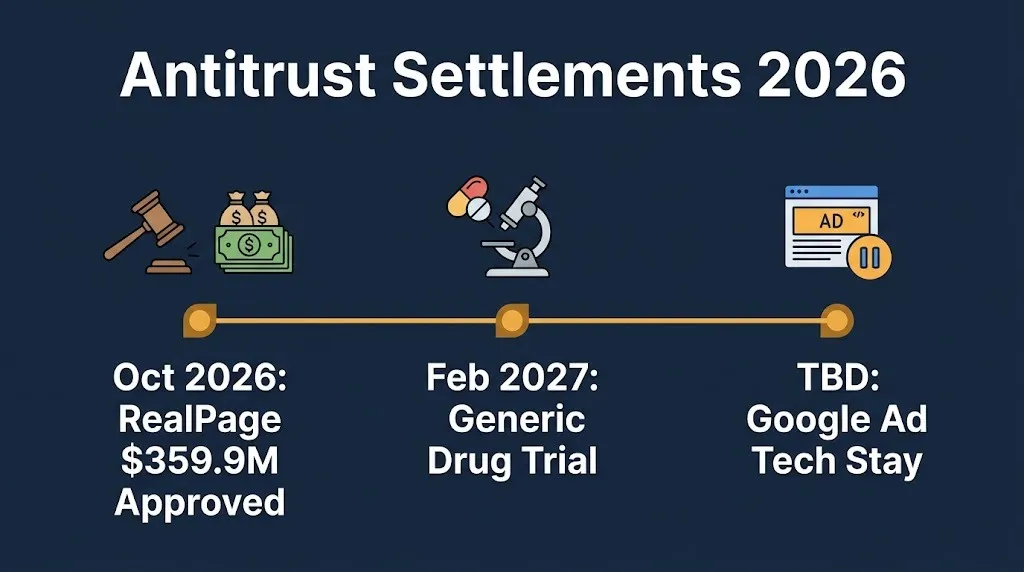
- October 2026: RealPage settlements received final approval; watch for a claims administrator announcement.
- Expected late 2026: The court in the RealPage matter may issue further orders on claim procedures.
- February 2027: First trial in the broader generic drug antitrust litigation is scheduled in Hartford, Connecticut .
- Pending: Google’s stay request in the ad tech case awaits a ruling.
- Ongoing: Yardi discovery proceeds; no settlement date exists.
Frequently Asked Questions
What is an antitrust lawsuit?
An antitrust lawsuit is a civil or criminal case alleging that a company illegally restrained competition through monopoly power, price fixing, or market allocation.
Is there an antitrust settlement I can claim right now?
The RealPage settlement received final approval on October 16, 2026, but a consumer claims process is not yet confirmed. Check the official court docket and settlement site.
How much is the RealPage antitrust settlement?
The settlements total $359,925,000 in cash across 41 defendants, approved by a federal judge in Tennessee .
Do I qualify for the generic drug antitrust settlement?
You may qualify if you bought certain generic prescription drugs between May 2009 and December 2019, according to the multistate settlement notice .
Is the Google antitrust case settled?
No. Google is seeking a stay of the New York ad tech litigation while it appeals a related Virginia loss .
Can I file an antitrust claim before a settlement is approved?
No. A claim form only exists after a court approves a settlement and appoints an administrator.
What should I do if I get a text about an antitrust payout?
Do not click the link or provide personal information. Verify the case on a court docket or official government page first.