How Does Work Compensation Work in 2026? Minnesota Requirements, Benefits, and Deadlines
Quick Answer
- Workers’ comp in Minnesota pays medical bills and part of lost wages when you are hurt on the job.
- Maximum weekly wage benefit is $1,536.84 for qualifying injuries, not a one-time settlement check.
- You must report the injury to your employer and file a claim; there is no universal deadline like a class action.
You just got hurt at work. Someone told you to file workers’ comp, or your employer handed you a form and said little else. You need to know what the system actually pays, who qualifies, and what Minnesota requires before you sign anything.
This article explains how the system works in plain terms, using the Minnesota Department of Labor and Industry’s own rules and rate tables. The surprising part for most people: the money is not automatic, and the deadlines are shorter than you think.
The Facts
| Case | Minnesota workers’ compensation system (not a lawsuit) |
|---|---|
| Status | Active insurance system, benefits paid by employer’s insurer or self-insured employer |
| Fund Size | Not applicable (no settlement fund) |
| Est. Per Person | Medical bills paid in full plus wage benefits up to $1,536.84 per week |
| Claim Deadline | Report injury to employer promptly; claim petition rules apply for disputes |
| Administrator | Minnesota Department of Labor and Industry (DLI) |
| Proof Needed | Medical records, injury report, wage verification |
How Does Work Compensation Work in Minnesota?
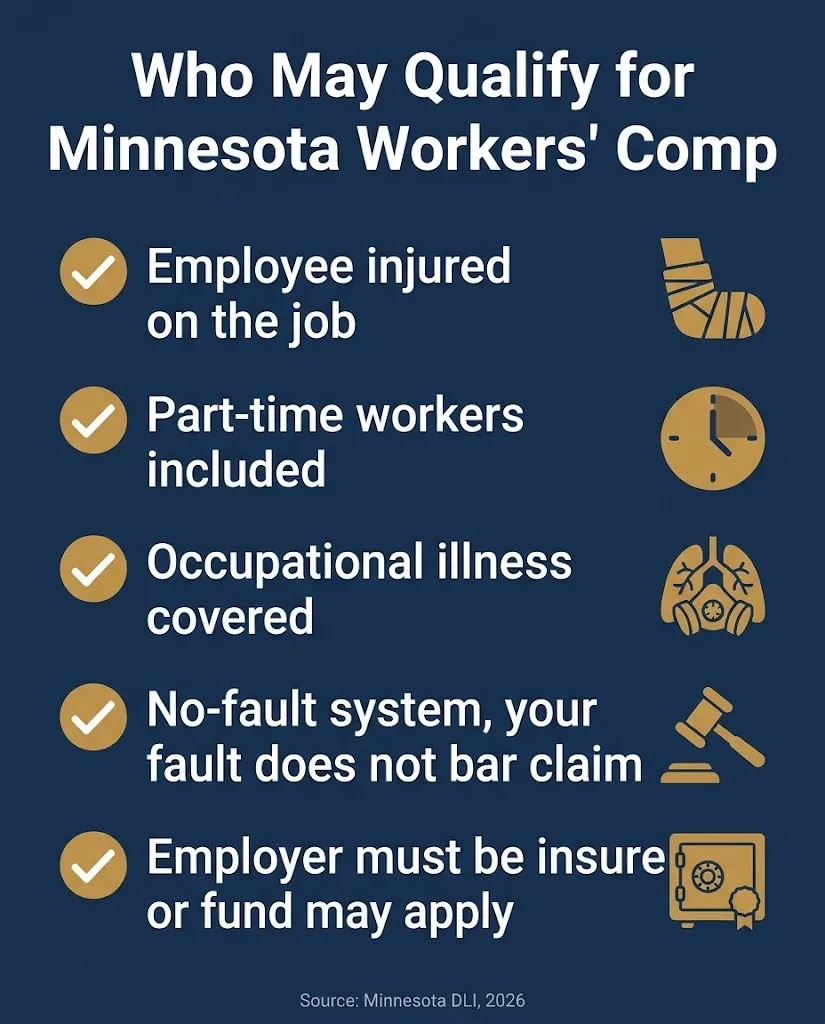
Workers’ compensation in Minnesota is a no-fault insurance system that pays medical costs and wage-loss benefits when an employee is injured on the job or develops a work-related illness . You do not sue your employer to get these benefits. The trade-off is that you give up the right to sue for most workplace injuries in exchange for faster, guaranteed benefits.
The process starts when you report the injury. Your employer’s insurance carrier then investigates and either pays or denies the claim. If the claim is accepted, the insurer pays reasonable and necessary medical bills and wage-loss benefits subject to state maximums. If it is denied, you can appeal through the DLI and the Office of Administrative Hearings .
Minnesota law requires almost all employers to carry this insurance. Even a business with one part-time employee generally must have a policy . If your employer did not have coverage, the state’s Special Compensation Fund may step in for certain benefits .
How Much Money Can You Get From Minnesota Workers’ Comp?
The money comes in two main forms: medical benefits and wage-loss benefits. Medical benefits cover treatment for the work injury, and Minnesota’s fee schedule sets maximum charges for providers . Wage-loss benefits replace part of your lost income, but they are capped by a statewide maximum.
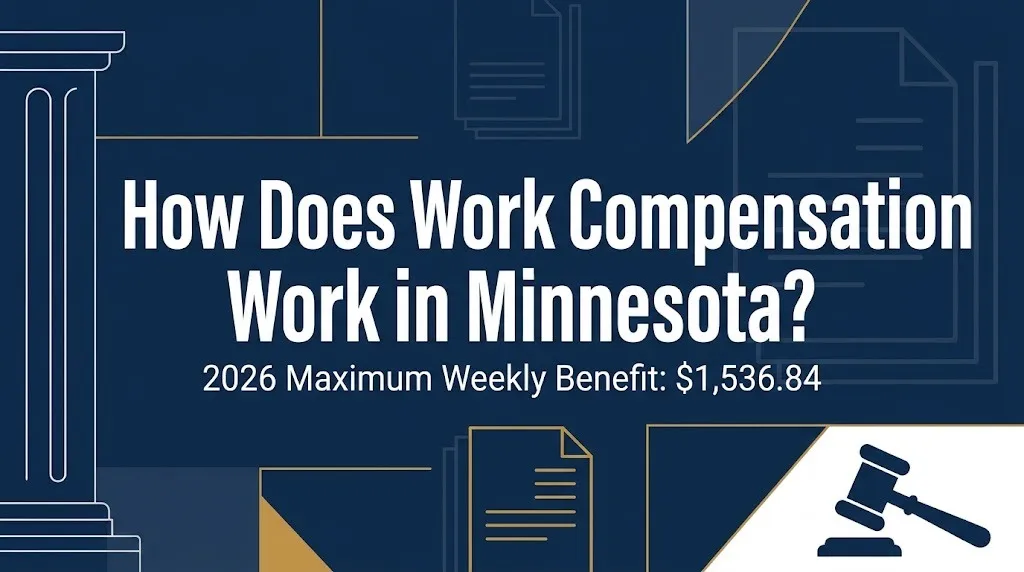
For injuries on or after Oct. 1, 2025, the maximum weekly benefit is $1,536.84 . That figure is 108% of the statewide average weekly wage. The minimum weekly benefit for that same period is $307.37, or your actual weekly wage if it is lower .
Here is the breakdown for recent injury dates:
| Injury Date Range | Maximum Weekly Benefit |
|---|---|
| On or after Oct. 1, 2025 | $1,536.84 |
| Oct. 1, 2024 to Sept. 30, 2025 | $1,481.76 |
| Oct. 1, 2023 to Sept. 30, 2024 | $1,363.74 |
Your actual check is generally two-thirds of your average weekly wage, up to the cap. If you return to work at a lower pay rate, you may receive temporary partial benefits covering part of the difference . Permanent partial disability benefits may also apply if your injury leaves lasting impairment, but those are rated by a schedule and are separate from weekly wage loss.
Key Takeaway: Minnesota workers’ comp does not hand you a lump sum for pain and suffering. It pays medical bills and a capped percentage of lost wages, with the top weekly rate set by the state every October.
What Are the Minnesota Workers Compensation Requirements for Employers?
Minnesota requires nearly every employer to carry workers’ compensation insurance or qualify as self-insured . The rule is broad: if you hire someone to perform services, you are generally an employer, and that person is generally an employee under the law .
Nonprofits are not automatically exempt. A nonprofit that pays more than $1,000 in salary or wages in a year must provide coverage for its employees, including part-time workers . Construction contractors face extra exposure: if a subcontractor is uninsured and gets hurt, the general contractor can be treated as the employer and held liable .
Penalties for going without coverage are real. The DLI can order an uninsured employer to pay up to $1,000 per employee per week for the uninsured period, buy coverage, and stop employing people until coverage is in place . If an employee is injured while the employer is uninsured, the employer may owe the benefits directly plus a penalty to the state equal to 65% of those benefits .
New rules also took effect Jan. 1, 2026 for construction employers using zero estimated exposure policies and wrap-up policies. If you work in construction, your employer may be required to disclose the existence of a zero-payroll policy in writing to anyone they contract with .
Who Qualifies for Workers’ Compensation in Minnesota?
You may qualify if you are an employee who suffered an injury or occupational disease that arose out of and in the course of your employment . There is no fault requirement. It does not matter whether you were careless or whether a coworker caused the accident, as long as the injury happened because of work.
Not everyone is covered. Independent contractors are generally not employees, but the label alone does not decide it. The DLI looks at the actual relationship. Sole proprietors and their immediate family members (spouse, parents, children) are excluded from the insurance requirement in some situations, though coverage can still be purchased .
Home health care workers present a special case. A patient who hires a personal care assistant may be considered the employer and may need to carry workers’ comp coverage for that worker, depending on how the funding and hiring are structured . This catches many families off guard.
If your employer was uninsured at the time of injury, you may still have a path to benefits through the Special Compensation Fund, which exists partly to cover injured workers whose employers failed to carry coverage . The fund does not cover every scenario, so confirming your employer’s status early matters.
What Benefits Does Minnesota Workers’ Comp Actually Pay?
Minnesota workers’ comp pays four main categories of benefits: medical care, wage replacement, rehabilitation, and permanency benefits for lasting impairment. Each has its own rules and its own maximums.
Medical benefits cover reasonable and necessary treatment for the work injury. The provider must follow Minnesota’s treatment parameters and fee schedule, and the insurer pays the allowed amount. You should not be billed for covered treatment beyond any required copays under the fee rules .
Wage-loss benefits replace part of your income when you cannot work or can only work at reduced pay. Temporary total disability (TTD) applies when you are off work entirely. Temporary partial disability (TPD) applies when you return at lower pay. The benefit is generally two-thirds of your lost wages, subject to the state maximum .
Vocational rehabilitation is available if you cannot return to your previous job. Services may include job placement, skills analysis, and retraining, at no cost to you .
Permanent partial disability (PPD) benefits are paid when your injury leaves a permanent impairment, such as loss of range of motion or a scheduled loss. These are rated using a state schedule and are paid separately from wage-loss benefits.
Key Takeaway: The system is built to replace income and cover treatment, not to compensate you for inconvenience or pain. Knowing which benefit category you fall into tells you what to ask the adjuster for.
How Do You File a Workers’ Comp Claim in Minnesota?
Filing starts with your employer, not with a state form. The steps below follow the DLI’s claim process guidance . If your employer refuses to cooperate at any step, contact the DLI directly.
- Report the injury to your employer. Tell your supervisor or HR as soon as possible. Ask them to complete a First Report of Injury.
- Get medical treatment. Tell the provider the injury is work-related and give them your employer’s insurance information.
- Confirm your employer filed the report. Minnesota law requires the employer to report lost-time injuries to the insurer and the state within set timeframes.
- Watch for the insurer’s response. The insurer must pay or deny benefits. If wage-loss benefits are due, payment generally must start within 14 days of notice or knowledge of the injury .
- Call the adjuster if something is wrong. Write down the date, time, and name of the person you spoke with. Many problems get fixed at this stage .
- Ask DLI for help if the adjuster does not resolve it. The DLI offers free mediation and alternative dispute resolution .
- File an Employee’s Claim Petition if the claim is denied or benefits are cut off. This starts a formal case before a compensation judge.
- Consider a lawyer for disputed claims. Attorney fees in Minnesota workers’ comp are regulated and generally paid out of disputed benefits, not upfront.
What Happens If Your Workers’ Comp Claim Is Denied?
A denial is not the end of the process. Minnesota has a structured dispute system that starts with a phone call and can end with a hearing before a compensation judge .
If the insurer denies primary liability and has never paid benefits, first call the claims adjuster and try to resolve the problem informally . If that fails, a DLI Alternative Dispute Resolution specialist can help. Mediation through the DLI is free and informal, and it resolves a high share of disputes without a hearing.
If informal efforts fail, you can file an Employee’s Claim Petition with the Office of Administrative Hearings. A compensation judge then handles the case. Certain decisions can be appealed to the Workers’ Compensation Court of Appeals and, in rare cases, to the Minnesota Supreme Court .
If your wage-loss benefits are stopped, the insurer must send you a Notice of Intention to Discontinue (NOID) form. You then have a short window to contact the Office of Administrative Hearings and request a conference to challenge the discontinuance . Missing that window can cost you weeks of benefits.
Reality Check: No one from the state or the insurer will text you asking for a fee to release your workers’ comp money. Filing a claim is free, and the DLI does not charge injured workers to mediate a dispute. Any “claim helper” demanding an upfront payment is not part of the official system.
How Long Does a Minnesota Workers’ Comp Case Take?
Simple claims with accepted liability can pay medical bills and wage benefits within weeks. Disputed claims take longer, and the timeline depends on what is being fought over.
If the insurer accepts the claim, wage-loss payments generally must begin within 14 days of the employer’s notice or knowledge of the injury . If the claim is denied and you file a claim petition, getting to a hearing can take months. One Minnesota law firm notes that a claim petition can take up to a year to reach a hearing .
Mediation and informal conferences often resolve disputes faster than a formal hearing. The DLI’s mediation process is designed to be quick and low-cost . For a discontinuance of benefits, the timeline is much shorter: you must act quickly after receiving the NOID to keep benefits flowing.
There is no class action-style payout date because workers’ comp is not a settlement fund. Your benefits continue as long as you qualify, and they end when you return to work, reach maximum medical improvement, or the insurer successfully stops them.
What Happens Next: Key Dates and Stages
The timeline below covers the stages that matter most for a new Minnesota claim. Dates are based on the DLI’s rules for injuries in 2026.
- Day 0: Report the injury to your employer.
- Within days: Get medical treatment and confirm the First Report of Injury is filed.
- Within 14 days of notice: Wage-loss benefits should begin if the claim is accepted .
- If benefits are discontinued: Respond to the NOID quickly and request a conference.
- If denied: Call the adjuster, then the DLI, then file a claim petition if needed.
- Oct. 1, 2026: New medical fee schedule conversion factors take effect for services on or after that date .
Frequently Asked Questions
Is workers’ compensation the same as a lawsuit settlement?
No. Workers’ comp is an insurance benefit, not a class action or a lawsuit against your employer. You file a claim, not a lawsuit, and benefits are paid under a statutory schedule.
How much does Minnesota workers’ comp pay per week?
The maximum weekly benefit is $1,536.84 for injuries on or after Oct. 1, 2025 . The minimum is $307.37, or your actual wage if it is lower.
Do I have to be a full-time employee to qualify?
No. Minnesota law covers part-time employees, and even a single part-time employee can trigger the employer’s insurance requirement .
What if my employer does not have workers’ comp insurance?
You may still have options. The Special Compensation Fund can pay certain benefits when an uninsured employer is involved . Report the situation to the DLI.
Can I be fired for filing a workers’ comp claim?
Minnesota law prohibits retaliation for filing a good-faith workers’ comp claim. If you face retaliation, document it and contact the DLI or an attorney.
How much does a workers’ comp lawyer cost in Minnesota?
Fees are regulated. A lawyer generally receives 20% of the first $130,000 recovered in a disputed case, with a maximum fee of $26,000 in most circumstances . You do not pay upfront.
What is the deadline to report a work injury in Minnesota?
Report it to your employer as soon as possible. Waiting can jeopardize your claim, and the insurer may argue the injury was not work-related if notice was delayed.
Does workers’ comp cover only accidents, or also illnesses?
It covers occupational diseases as well as sudden injuries, as long as the condition arises out of and in the course of employment .
Your Next Step
If you were hurt at work in Minnesota, report the injury today and get medical care. Confirm that your employer filed the First Report of Injury, and write down the name of the insurer and the adjuster. The single most important number to remember is $1,536.84, the maximum weekly benefit for injuries on or after Oct. 1, 2025. If the claim is denied or your benefits are stopped, contact the DLI for free mediation before the window closes. The system is not automatic, but it does have a process. Use it.