Types of Compensation in 2026: What Injury, Lawsuit, and Settlement Claims Actually Pay For
Quick Answer
- Types of compensation split into two buckets: compensatory damages for your losses and punitive damages to punish conduct.
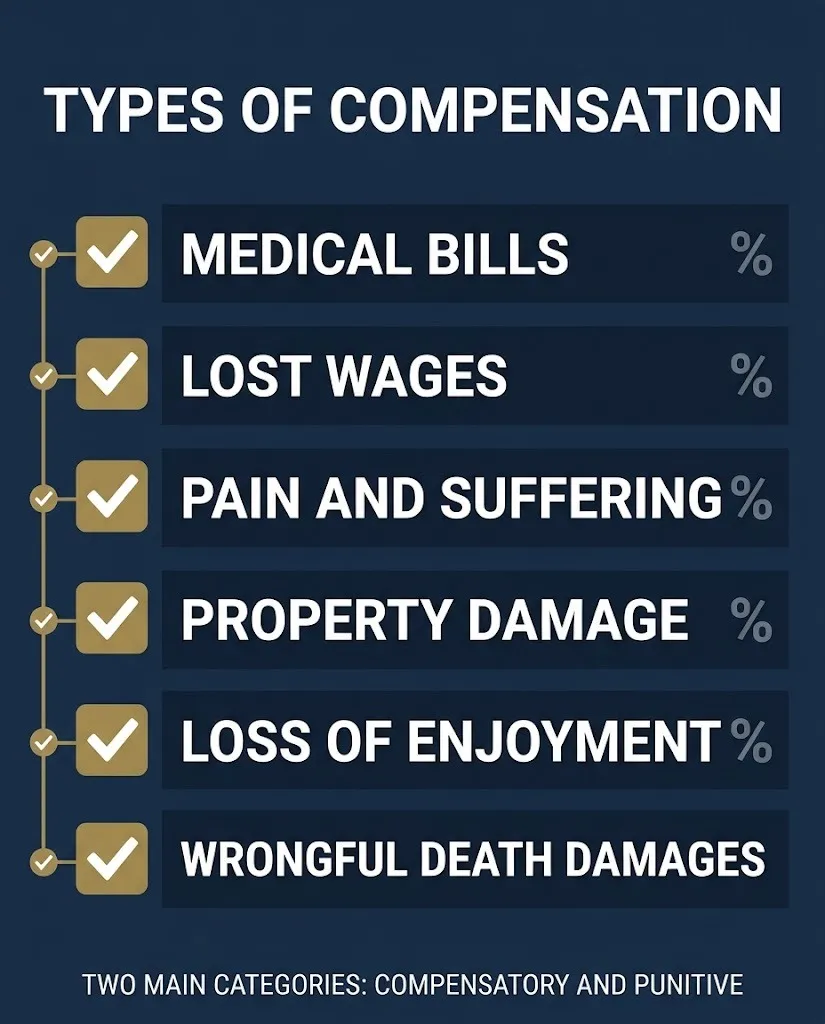
- Compensatory damages cover medical bills, lost wages, pain and suffering, and property damage.
- Average personal injury settlements sit near $40,500, but amounts depend heavily on injury severity and proof.
You got hurt, or someone you love did. Now the bills are stacking up and somebody said you might be entitled to “compensation.” The phrase gets thrown around like everyone already knows what it means.
Here is what it actually means. Compensation is the money a court or insurer pays to fix what was taken from you. Not a jackpot. Not a lottery ticket. A calculation, built from medical records, pay stubs, and the parts of your life the injury damaged.
This article breaks down every type of compensation you can claim in 2026, from the obvious hospital bills to the harder-to-prove pain and suffering. It also covers the one thing most people miss: the type of compensation you ask for changes how long the case takes and what proof you need. A surprising detail from the legal record: punitive damages, the scary-sounding category, show up in a small fraction of civil cases and almost never in a standard injury claim.
The Facts
| Case | Not a single case: these are the categories of damages available across civil claims |
|---|---|
| Status | Active. Damages rules are set by state law and federal court precedent, not one settlement |
| Fund Size | Not applicable. Each case is valued individually |
| Est. Per Person | Average personal injury settlement is $40,500 as of 2026; car accident injury settlements average $30,416 |
| Claim Deadline | Varies by state: typically 1 to 6 years from injury or discovery; personal injury in Pakistan is 1 to 2 years under the Limitation Act 1908 |
| Administrator | No central administrator. Courts and insurance adjusters handle each claim |
| Proof Needed | Medical records, income evidence, property receipts, and documentation of non-economic impact |
Are compensation claims legitimate or a scam?
Compensation claims are legitimate and built into every civil legal system. The concept is simple: if someone’s negligence costs you money, the law lets you recover it. That principle is as old as tort law itself and shows up in every U.S. state and in countries like Pakistan under the Fatal Accidents Act of 1855 .
The scam risk sits outside the courtroom. Anyone who calls you promising a specific compensation amount before reviewing your medical records is not giving you legal advice. They are guessing or lying. No legitimate attorney quotes a number on the first phone call.
A second red flag: upfront fees. Most personal injury attorneys work on contingency, meaning they get paid a percentage of what you recover. If someone asks for a retainer before doing any work on a standard injury claim, that is unusual and worth questioning.
How much compensation can you expect in 2026?
Not yet determined for your specific situation, because compensation is calculated from your actual losses, not from a published schedule. But the national averages give you a baseline.
The average personal injury settlement in the United States is $40,500 as of 2026 data . Car accident injury settlements average lower, around $30,416 based on May 2026 figures . Those numbers include soft tissue injuries, minor crashes, and claims that settle quickly without litigation.
The range is enormous. A slip and fall with a broken wrist might settle for a few thousand dollars. A truck accident with permanent disability can reach six or seven figures. The difference comes down to three variables: the severity of your injury, the clarity of the other party’s fault, and the quality of your documentation.
Compensation ranges by claim type (general, not case-specific):
| Claim Type | Typical Settlement Range |
|---|---|
| Minor soft tissue injury | $3,000 to $15,000 |
| Moderate injury with ongoing treatment | $15,000 to $50,000 |
| Serious injury with surgery or disability | $50,000 to $250,000 |
| Catastrophic injury or wrongful death | $250,000 and up |
Those ranges are not guarantees. They are patterns from published settlement data. Your case depends on your facts, your state’s laws, and the insurance coverage available.
Key Takeaway: Compensation amounts are not fixed by law; they are built from your documented losses, and the average personal injury settlement of $40,500 reflects mostly moderate claims, not catastrophic ones.
What are the two main types of compensation?
The two main types are compensatory damages, which reimburse you for what you lost, and punitive damages, which punish the defendant for egregious conduct. Compensatory damages make up the vast majority of every award you will ever see .
Compensatory damages split further into special damages (money you can count) and general damages (harm you can describe but not invoice). A third category, wrongful death damages, applies when the injured person died and family members are claiming.
Punitive damages are rare. They require proof that the defendant acted with willful recklessness or intentional harm, not just negligence. A car accident caused by a distracted driver does not qualify. A manufacturer that knew a product was killing people and hid the evidence might.
The compensation tree:
- Compensatory damages
- Special damages (economic)
- General damages (non-economic)
- Wrongful death damages
- Punitive damages
- Awarded only for egregious conduct
- Rare in standard injury claims
What are special compensatory damages?
Special compensatory damages are the money you can count with receipts and pay stubs. They are the easiest part of any claim to prove and the first thing an insurance adjuster will ask about.
Medical expenses lead the list. That means doctor visits, hospital stays, surgeries, physical therapy, medications, assistive devices, home modifications, and travel to appointments . If your health insurance paid part of the bill, the full billed amount still counts toward the value of your claim in most negotiations .
Lost wages come next. If you missed work because of the injury, those paychecks are recoverable. So are bonuses, commissions, sick time, and vacation time you burned during recovery. If the injury prevents you from returning to your old job or earning capacity, future lost earnings enter the calculation .
Property damage rounds out the category. A wrecked car. A destroyed phone. Anything of value that the accident damaged or destroyed.
Special damages checklist:
- Medical bills (all providers, all dates)
- Future medical care estimates
- Lost pay stubs and benefit statements
- Vehicle repair estimates or replacement cost
- Receipts for home modifications or assistive equipment
- Mileage logs for medical travel
What are general compensatory damages?
General compensatory damages pay for the harm that does not come with a receipt: pain, suffering, emotional distress, and the loss of the life you had before the injury. These are harder to prove but often make up a large share of a serious claim.
Pain and suffering covers the physical discomfort from the injury and the recovery. Emotional distress covers anxiety, fear, sleep loss, and post-traumatic stress that the injury caused . Loss of enjoyment compensates you when the injury stops you from doing things you loved, whether that is hiking, playing with your kids, or working in your garden.
Loss of consortium is a separate claim available to a spouse or family member. It covers the damage the injury did to your relationship, including loss of companionship, intimacy, and support .
There is no formula that works everywhere. Some attorneys use a multiplier method, multiplying special damages by a number between 1.5 and 5 depending on severity. Others build a daily pain diary and let a jury decide. A store return without a receipt is a rough comparison: you know the item has value, but proving exactly how much requires negotiation, not a barcode scan.
What are wrongful death damages?
Wrongful death damages are compensation paid to surviving family members when the injured person died from the defendant’s negligence or intentional act. They cover the costs the family now carries and the income and presence they lost.
Funeral and burial expenses are recoverable. So is the cost of medical care the person received before death. The larger claims usually come from loss of financial support, loss of inheritance, and loss of services the deceased provided to the household .
Non-economic wrongful death damages are harder to quantify but real. Loss of companionship, guidance, care, and emotional support all count in most states. The rules for who can file and what they can recover vary widely by jurisdiction.
Common wrongful death damages:
| Category | Examples |
|---|---|
| Economic | Funeral costs, final medical bills, lost income, lost inheritance |
| Non-economic | Loss of companionship, guidance, emotional support |
| Survival action | Pain and suffering the deceased experienced before death |
What are punitive damages and when do they apply?
Punitive damages are extra money awarded on top of compensatory damages to punish the defendant and deter similar conduct. They are not available in every case and are rarely awarded in standard negligence claims.
The standard is high. You need proof that the defendant acted with willful recklessness, malice, or intentional harm, not just carelessness . A drunk driver might face punitive damages. A driver who looked at a text for two seconds probably will not.
Some statutes set specific multipliers. Treble damages, for example, allow a court to award three times the actual damages in certain consumer protection or antitrust cases . Those are statutory, not discretionary, and they apply only in the specific contexts the law names.
Most personal injury attorneys will tell you not to count on punitive damages. They are a bonus if the facts support them, not a planning assumption.
How do you file a compensation claim?
Filing a compensation claim is a sequence of documentation and deadlines, not a single form. The steps below apply to most injury and property damage claims.
- Get medical treatment immediately. Your health comes first, and the medical record anchors the claim.
- Document the scene and the injury. Photos, witness names, incident reports, and dates.
- Notify the responsible party or insurer. Report the incident without giving a recorded statement.
- Collect your financial records. Medical bills, pay stubs, property receipts, and estimates.
- Consult an attorney if the claim is significant. Most offer free consultations and contingency fees.
- File the claim or lawsuit before the deadline. State statutes of limitations range from one to six years.
- Track every communication. Settlement offers, adjuster names, and dates matter if negotiations stall.
What is the deadline for filing a compensation claim?
The deadline is your jurisdiction’s statute of limitations, and missing it usually ends your right to compensation permanently. In the United States, personal injury deadlines range from one year in states like California and Louisiana to six years in Maine.
In Pakistan, the Limitation Act 1908 sets a one-year period for personal injury tort claims and three years for property damage . Some Pakistani legal sources cite a two-year period for tort damages under Article 36 . The conflict between sources reflects how courts interpret the act, so local counsel matters.
Reality Check: No one texts you compensation money. Insurers do not cold-call accident victims with settlement offers before reviewing medical records. Any “claims specialist” charging an upfront fee to unlock your compensation is unnecessary. Filing a claim costs nothing, and contingency attorneys get paid only if you recover.
What happens next in a compensation claim
Immediately: Medical treatment and scene documentation. The record you build now controls the claim value later.
Within days: Notify the insurer or responsible party. Decline recorded statements until you understand the claim.
Within weeks: Gather medical records, income proof, and property estimates. Consult an attorney if the injury is serious or fault is disputed.
Within months (expected): The adjuster reviews the demand package and makes an offer. Negotiation follows.
Before the statute of limitations: File a lawsuit if settlement talks fail. The deadline is jurisdictional and does not extend for negotiation.
Frequently Asked Questions
What are the main types of compensation?
The two main types are compensatory damages, which reimburse your losses, and punitive damages, which punish egregious conduct. Compensatory damages include special damages like medical bills and general damages like pain and suffering.
How much is the average personal injury settlement?
The average personal injury settlement is $40,500 as of 2026 data. Car accident injury settlements average around $30,416. Amounts vary widely based on injury severity, liability clarity, and insurance coverage.
What is the difference between special and general damages?
Special damages are economic losses you can document with receipts, like medical bills and lost wages. General damages are non-economic harms like pain, suffering, and loss of enjoyment that do not have a receipt.
Can I get compensation for pain and suffering?
Yes, in most jurisdictions. Pain and suffering is a form of general compensatory damages. Proving it requires medical records, a pain diary, and often testimony about how the injury changed your daily life.
Are punitive damages common in injury cases?
No. Punitive damages require proof of willful recklessness or intentional harm, not simple negligence. They are rare in standard injury claims and should not be counted on in settlement planning.
What is the deadline to file a compensation claim?
Deadlines vary by jurisdiction. In the U.S., personal injury statutes of limitations range from one to six years. In Pakistan, the Limitation Act 1908 sets periods from one to three years depending on the claim type.
Do I need a lawyer to get compensation?
You can negotiate a small claim on your own. Serious injuries, disputed liability, and wrongful death claims benefit from legal representation. Most injury attorneys work on contingency and offer free consultations.
What if the person who caused my injury has no money?
Insurance coverage is the usual source of compensation, not the defendant’s personal bank account. If the at-fault party had auto, home, or business insurance, that policy may pay. Uninsured motorist coverage may apply in car accidents.
Get your records in order before anything else
Compensation is not a mystery number handed down by a judge. It is a calculation built from medical charts, pay stubs, and the story of what your life was like before the injury.
The first step is not calling a lawyer. It is gathering the paperwork. Start with the medical records and the income proof. The strongest claim is the one with the clearest file.