Nanny Workers Compensation Insurance in 2026: The State Rules, the Real Cost, and What Happens If You Skip It
Quick Answer
- Is it required? Depends on your state. At least 15 states mandate coverage for household employees, including California, New York, and Illinois .
- How much does it cost? Most families pay $300 to $800 per year, based on the nanny’s annual wages .
- What happens if you skip it? You can be personally liable for the nanny’s medical bills and lost wages, plus state fines in strict states .
If you’re searching for nanny workers compensation insurance, you’re probably a parent who just hired someone to care for your kids. Maybe a payroll service mentioned it. Maybe a friend said you need it. Maybe you didn’t know it existed until now.
Here’s the direct answer. Workers’ comp for a nanny is a state-regulated insurance policy that pays for a household employee’s medical care and part of their lost wages if they’re hurt on the job. It’s separate from your homeowners policy. It’s not optional in many states. And it’s cheaper than most families expect.
This article covers the state triggers, the real premium math, what the policy actually pays for, and the one mistake that turns a $500 policy into a six-figure personal liability.
The Facts
| The Facts | |
|---|---|
| What it is | State-regulated insurance covering a household employee’s work injury |
| Who needs it | Families employing a nanny, housekeeper, or senior caregiver |
| Required in | At least 15 states, including CA, NY, IL, MA, NJ, CT, and Washington D.C. |
| Typical Annual Cost | $300 to $800 for most families |
| What It Covers | Medical bills and a portion of lost wages from a work injury |
| What It Doesn’t Cover | Off-the-job injuries, damage to your home, or injuries to your family |
| Penalty Example | New York: fines up to $2,000 per 10-day period without coverage |
Is Nanny Workers Compensation Insurance Required?
It depends entirely on your state, and the thresholds vary more than most families expect. At least 15 states require household employers to carry workers’ comp for domestic employees, but the trigger can be hours worked, wages paid, or simply having any employee at all .
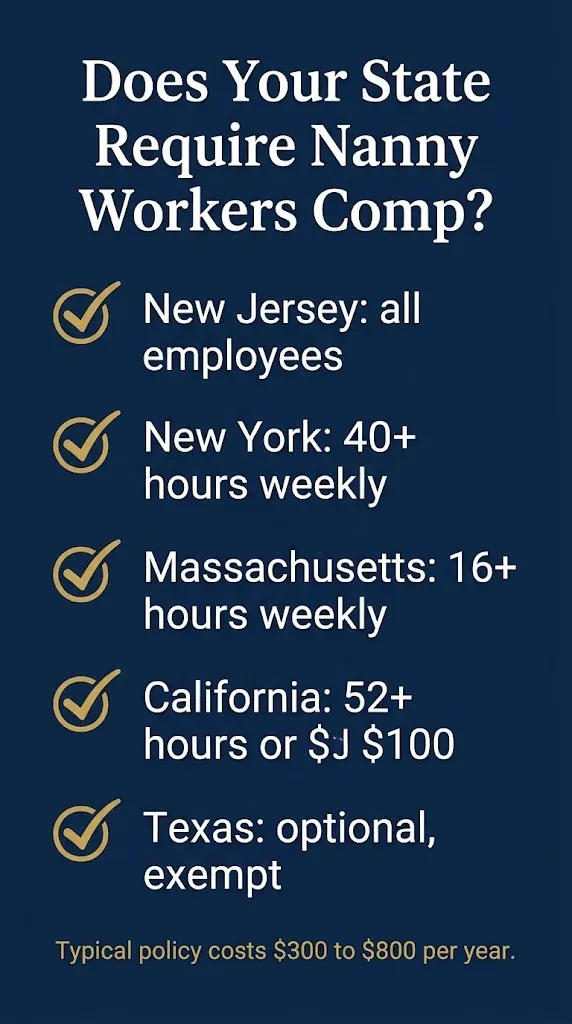
New Jersey requires coverage from the first dollar, with no hours or earnings minimum. New York requires it once your nanny works 40 or more hours per week, or immediately if the nanny lives in. Massachusetts triggers at 16 hours per week. California covers household workers unless they logged both under 52 hours and under $100 in wages in the 90 days before the injury .
The states where it’s optional are just as important to know. Texas expressly exempts domestic workers from its workers’ comp mandate. Florida exempts domestic servants in private homes. Pennsylvania exempts domestic servants unless the employer elects coverage .
A common myth is that homeowners insurance fills the gap. It usually doesn’t. Standard homeowners policies generally exclude injuries to people you employ. Some carriers offer a domestic worker endorsement, but coverage may be limited compared with a standalone policy .
How Much Does Nanny Workers Compensation Insurance Cost?
Most families pay $300 to $800 per year for a standalone nanny workers’ comp policy, according to 2026 analyses . The exact number depends on your state’s filed rate and your nanny’s annual payroll.
The premium formula is straightforward. Take your nanny’s annual payroll, divide by 100, and multiply by your state’s rate for domestic or household work .
Here’s how that looks at different wage levels:
| Nanny Profile | Approx. Annual Payroll | Rating Units (Payroll ÷ 100) |
|---|---|---|
| Part-time or nanny share | $25,000 to $30,000 | 250 to 300 |
| Full-time nanny | ~$45,000 | ~450 |
| Full-time nanny, higher wage | $52,000 | 520 |
The 2026 national average nanny rate is about $870 per week, or roughly $45,000 per year for full-time work . Multiply 450 rating units by your state’s rate, and you get your estimated premium.
A homeowners policy endorsement is often cheaper, sometimes $100 to $300 per year, but coverage can be limited . A standalone policy costs more and does more.
What Does Nanny Workers Compensation Insurance Cover?
The policy pays for medical expenses and a portion of lost wages when your nanny is hurt doing the job. It is a no-fault system, meaning your nanny doesn’t have to prove you were negligent to receive benefits .
Covered costs include doctor visits, hospital stays, surgery, physical therapy, and medications. Lost wages are typically paid at 60 to 70 percent of the nanny’s average weekly wage during recovery. Disability benefits and vocational rehabilitation may also be covered if the injury is serious enough .
What it does not cover matters just as much. Workers’ comp does not pay for injuries that happen off the job, pre-existing conditions, or illnesses unrelated to work. It does not cover damage your nanny causes to your home or injuries to your own family .
One more limit: workers’ comp generally bars your nanny from suing you for the injury in exchange for the no-fault benefits. That protection disappears if you don’t have the policy in a state that requires it .
Reality Check: No one calls you from the state demanding a workers’ comp payment over the phone. The policy is bought through an insurance agent, broker, or state fund. If a “compliance service” wants a fee to “register” your nanny for coverage, it’s a scam. Your state workers’ comp agency or a licensed agent handles this for free.
How Do You Get Nanny Workers Compensation Insurance?
You get coverage through a homeowners policy endorsement, a standalone policy, or a state fund. Here are the steps:
- Confirm your state’s rule. Check your state workers’ comp agency for the exact hours or wage trigger .
- Ask your homeowners insurer about a domestic worker endorsement first, since it’s often the cheapest route .
- Get a standalone quote from a business insurer or household employer specialist if the endorsement isn’t enough .
- Use a state fund if private insurers won’t cover you. California, New York, and Washington operate state funds .
- Report estimated annual payroll accurately. Underestimating leads to an audit bill later .
- Keep the policy active for as long as your nanny works for you.
The payroll estimate is the trap. Carriers set initial premiums on what you expect to pay, then audit at year-end. Underestimate and you get a bill. Overestimate and you get a refund. Neither is a disaster, but the audit bill is never welcome .
What Happens If You Don’t Carry Nanny Workers Compensation Insurance?
You can be personally liable for the nanny’s full medical bills and lost wages, and some states add fines or criminal exposure. The consequences are not theoretical.
New York imposes fines of up to $2,000 per 10-day period of non-compliance, plus potential criminal charges . California treats failure to carry workers’ comp as a misdemeanor, with fines of at least $10,000, up to a year in county jail, or both .
Beyond fines, the civil exposure is the bigger risk. If your nanny is hurt and you lack required coverage, you pay the medical bills out of pocket. In California, an illegally uninsured employer must pay all treatment bills and can be sued civilly beyond the workers’ comp system .
The financial asymmetry is stark. A $300 to $800 annual policy versus uncapped personal liability for a back injury, a fall down the stairs, or a car accident while driving your children. That’s the trade every household employer is making.
What Happens Next
Ongoing: Check your state’s trigger and confirm whether your nanny’s hours or wages cross it. The rules vary by state and can change with new legislation .
When you hire: Get a quote before the nanny’s first day. Coverage should start on day one.
At policy renewal: Expect a payroll audit. Report actual wages paid to avoid a surprise bill .
If your nanny’s hours increase: Recheck the threshold. A part-time nanny who crosses 40 hours in New York or 16 hours in Massachusetts triggers a requirement that didn’t apply before .
Frequently Asked Questions
Do I need workers comp for my nanny?
It depends on your state.
At least 15 states require it, with triggers ranging from any employee to 40 hours per week or a wage threshold.
How much does nanny workers comp cost?
Most families pay $300 to $800 per year.
The premium depends on your nanny’s annual wages and your state’s filed rate.
Does homeowners insurance cover a nanny’s work injury?
Usually not.
Standard homeowners policies exclude injuries to household employees, though some carriers offer a domestic worker endorsement.
What happens if my nanny gets hurt and I don’t have coverage?
You may be personally liable for all medical bills and lost wages.
Some states add fines, and a few impose criminal penalties for non-compliance.
Which states require workers comp for nannies?
At least 15, including California, New York, Illinois, Massachusetts, New Jersey, Connecticut, and Washington D.C.
Thresholds vary by state.
Is workers comp required for a part-time nanny?
It depends on the state and the hours or wages.
Massachusetts triggers at 16 hours per week. New York triggers at 40. New Jersey has no minimum.
Can I pay my nanny as a contractor to avoid workers comp?
No, not if you control the work.
The IRS control test generally classifies a nanny as a household employee, and misclassification doesn’t eliminate the workers’ comp requirement.
How do I buy nanny workers comp insurance?
Ask your homeowners insurer about an endorsement, or get a standalone quote from a business insurer.
State funds are available in some states if private coverage isn’t.
The One Thing to Do Now
Check your state’s trigger today. Count your nanny’s weekly hours and annual wages. If you’re close to the threshold, get a quote before the next pay period.
The policy costs less than a month of after-school care. The liability it prevents can follow your family for years. The first step is knowing whether your state requires it.