Tennessee Workers’ Comp Settlement Chart 2026: Maximum Rates, Payout Math, and What the Numbers Actually Mean
Quick Answer
- Is there an official chart? Tennessee publishes official compensation rates, not a single settlement chart with dollar payouts.
- How much? Payouts depend on your impairment rating, average weekly wage, and injury date. No fixed amount exists.
- Key deadline? You must notify your employer within 15 days and file a claim within 1 year of injury or last payment.
A Tennessee workers’ comp settlement chart is not one official document. The state publishes compensation rates and a schedule of losses, but your actual settlement depends on your wage, your impairment rating, and whether your injury is scheduled or unscheduled.
If you’re looking for a simple table that says “back injury equals $50,000,” that chart does not exist in Tennessee law. The state uses a formula, and the variables matter more than any generic number you’ll find online.
This article breaks down the verified 2026 rates from the Tennessee Bureau of Workers’ Compensation, explains how the payout math actually works for scheduled and unscheduled injuries, and flags the places where third-party “charts” mislead injured workers. One detail the headline rates hide: the maximum weekly benefit for temporary disability ($1,488.30) is higher than the permanent disability cap ($1,353.00).
The Facts
| State Agency | Tennessee Bureau of Workers’ Compensation |
| Court | Court of Workers’ Compensation Claims |
| Status | Rates updated annually; FY2026-27 rates effective July 1, 2026 |
| Max Weekly (Permanent) | $1,353.00 for injuries 7/1/26 through 6/30/27 |
| Max Weekly (Temporary) | $1,488.30 for same period |
| Min Weekly | $202.95 |
| Body as Whole | 450 weeks maximum |
| Max Total Benefit | $608,850 (450 weeks × $1,353.00) |
| Deadline | 15 days to notify employer; 1 year to file claim |
Is There an Official Tennessee Workers’ Comp Settlement Chart?
No, Tennessee does not publish a single official settlement chart with dollar amounts by injury type. The state publishes compensation rates and a schedule of losses that determine maximum weeks for specific body parts.

The confusion comes from third-party sites that build tables with estimated payouts. Those tables use assumptions, not official state data. One site even states plainly that its chart “does not establish a measured average settlement” and uses “modeled examples” rather than actual Tennessee settlement records .
What Tennessee actually publishes is more useful if you understand it. The Bureau of Workers’ Compensation updates weekly benefit caps every July 1 based on the state’s average weekly wage . The schedule of losses sets maximum weeks for scheduled body parts like hands, arms, and fingers .
Your settlement gets calculated from those two inputs plus your medical impairment rating. No single chart can capture that formula.
What Is the Maximum Weekly Benefit in Tennessee for 2026?
The maximum weekly benefit for permanent disability is $1,353.00 for injuries occurring July 1, 2026 through June 30, 2027. For temporary disability benefits, the cap is higher at $1,488.30 per week.
The Tennessee Comptroller’s office publishes these rates annually . The permanent rate equals 100% of the state’s average weekly wage, which is $1,353 for the current period. The temporary rate is set at 110% of that average.
| Benefit Type | Maximum Weekly | Minimum Weekly |
| Temporary Total Disability | $1,488.30 | $202.95 |
| Permanent Partial Disability | $1,353.00 | $202.95 |
Here’s what this means for you in plain terms. If your average weekly wage is high enough, your weekly comp check cannot exceed these caps. High earners hit the ceiling and lose leverage above it. Lower earners get 66.67% of their actual wage, which may fall below the cap but above the minimum.
The rates reset every July 1. An injury on June 30, 2026 uses the prior year’s rates. An injury on July 1, 2026 uses the new rates. That one-day difference can change your weekly benefit by roughly $56.
How Is a Tennessee Workers’ Comp Settlement Calculated?
A Tennessee settlement is calculated using a formula: 450 weeks × your impairment rating × your compensation rate. That formula applies to unscheduled injuries, often called “body as a whole” injuries.
For scheduled injuries (specific body parts like hands, arms, or fingers), the calculation uses the scheduled weeks for that body part instead of 450. The formula is scheduled weeks × impairment rating × compensation rate.
Your compensation rate is 66.67% of your average weekly wage, capped at $1,353.00 for permanent benefits .
Here’s the math in action. Suppose your average weekly wage is $900. Your compensation rate is $600 per week (66.67% of $900). If you receive a 10% impairment rating to the body as a whole, your original award is:
450 weeks × 0.10 × $600 = $27,000
That’s the base award. Tennessee law adds multipliers in certain situations. If you don’t return to work at the same or greater pay, the original award gets multiplied by 1.35 . If you also lack a high school diploma, another 1.45 multiplier applies. If you’re over 40, a 1.2 multiplier applies.
Those multipliers compound. A 10% rating that started at $27,000 can grow substantially if you meet the return-to-work and vocational criteria.
What Does the Tennessee Schedule of Losses Say for Specific Body Parts?
The schedule of losses assigns maximum weeks of permanent partial disability to specific body parts. These weeks determine the maximum payout for scheduled injuries when multiplied by your compensation rate.
The schedule covers hands, arms, legs, feet, eyes, hearing, and fingers . Backs, necks, shoulders, and knees are not on the schedule. Those are unscheduled injuries that use the 450-week body-as-a-whole formula.
| Body Part | Maximum Weeks | Max Dollars at $1,353 Rate |
| Hand | 160 | $216,480 |
| Arm | 200 | $270,600 |
| Leg | 175 | $236,775 |
| Foot | 125 | $169,125 |
| Eye (loss of sight) | 100 | $135,300 |
| Thumb | 60 | $81,180 |
| Index Finger | 35 | $47,355 |
| Middle Finger | 30 | $40,590 |
| Ring Finger | 20 | $27,060 |
| Little Finger | 15 | $20,295 |
The max dollar column assumes the highest possible impairment rating (100%) and the maximum weekly rate. Most injuries receive partial ratings, so actual awards are a fraction of these maximums.
Key Takeaway: Tennessee’s schedule sets ceilings, not guarantees. A 10% rating to your hand is worth 10% of the scheduled maximum, not the full number.
How Do Unscheduled Injuries Like Back and Neck Work in Tennessee?
Unscheduled injuries use the 450-week body-as-a-whole formula, not a fixed schedule. Back, neck, shoulder, and knee injuries fall into this category.
For these injuries, the treating physician assigns an impairment rating using the AMA Guides to the Evaluation of Permanent Impairment. That rating gets plugged into the 450-week formula .
A 5% whole-body impairment rating at a $600 compensation rate produces an original award of $13,500 (450 × 0.05 × $600). With the return-to-work multiplier of 1.35, that grows to $18,225. Add the age or education multipliers and it can climb higher.
This is where the settlement chart approach falls apart. Two workers with the same back injury can receive wildly different awards. The variables are your wage, your rating, your return-to-work status, your age, and your education.
What Is the Average Workers’ Comp Settlement in Tennessee?
There is no verified statewide average settlement figure published by the Tennessee Bureau of Workers’ Compensation. Third-party estimates range widely because they use different assumptions.
One calculator site lists ranges of $10,000 to $30,000 for minor sprains and $50,000 to $200,000 or more for herniated discs or surgical injuries . Those ranges are not official state data and should not be treated as benchmarks.
Not yet determined applies to any single “average” because the state does not publish one. Settlement values depend on the specific facts of each claim: your wages, your medical evidence, the impairment rating, whether the claim is disputed, and whether future medical benefits get closed.
If you want a realistic picture, focus on your own variables. Gather your pay stubs, find out whether your injury is scheduled or unscheduled, and get the impairment rating from your treating physician.
How Do You File a Tennessee Workers’ Comp Claim?
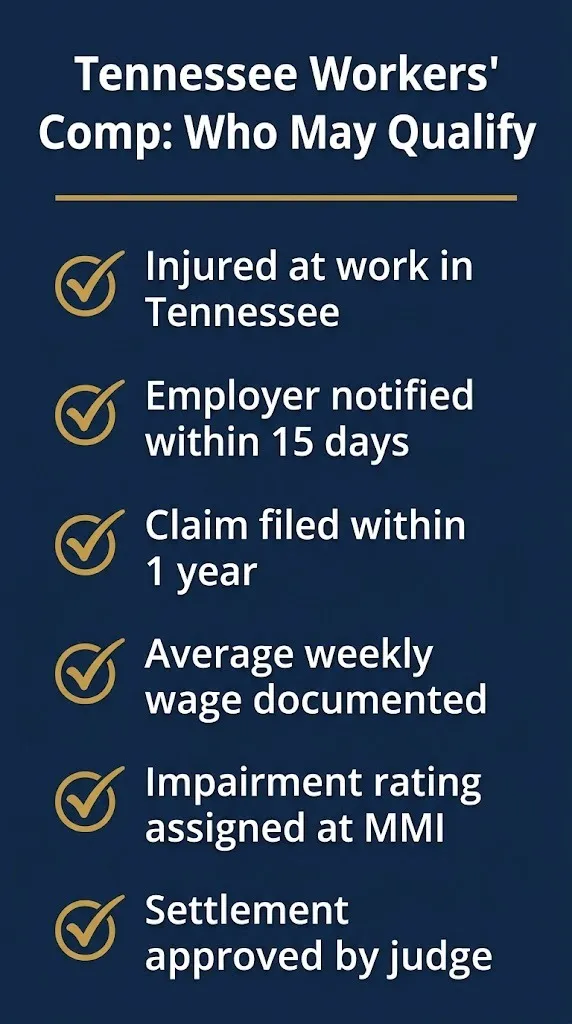
You file a Tennessee workers’ comp claim by notifying your employer within 15 days of the injury and filing a formal claim with the Bureau of Workers’ Compensation within 1 year of the injury or last payment.
Here are the steps:
- Report the injury to your employer in writing within 15 days.
- Get medical treatment from a doctor on your employer’s panel of at least three.
- Confirm your employer filed a First Report of Injury with the state.
- Track your wage replacement checks against your calculated rate.
- File a Petition for Benefit Determination if benefits stall or get denied.
- Complete medical treatment and receive your impairment rating at Maximum Medical Improvement.
- Negotiate a settlement or request a hearing before a Workers’ Compensation Judge.
Settlements must be approved by a judge or a Bureau mediator . The judge reviews the agreement to ensure it’s fair and that you understand what rights you’re giving up, especially if you’re closing future medical benefits.
What Happens If You Close Future Medical Benefits in a Settlement?
Closing future medical benefits means your employer no longer pays for treatment related to the work injury after the settlement. You take a lump sum instead, and you become responsible for future care costs.
This is a critical decision. Tennessee’s Bureau publishes a guide explaining the trade-offs. If you close medicals, you may not receive enough funds to cover future costs. If you keep them open, you retain the right to treatment but must navigate claim handlers and authorizations for years .
Medicare and TennCare rules add complexity. If you’re on Medicare or expect to be within 30 months, a Workers’ Compensation Medicare Set-Aside Arrangement (WCMSA) may be required if the settlement exceeds certain thresholds ($25,000 for current Medicare beneficiaries, $250,000 for those with reasonable expectation of Medicare enrollment) .
Reality Check: No third-party “settlement calculator” can tell you what your case is worth. The numbers depend on medical records, wage documentation, and legal variables that a generic chart cannot see. Be skeptical of any service charging a fee for a “guaranteed” settlement estimate.
What Happens Next After a Tennessee Work Injury?
The timeline after a work injury moves through notice, treatment, impairment rating, and either settlement or hearing. Missing the notice deadline can jeopardize your claim.
Within 15 days: Report the injury to your employer in writing.
Within 1 year: File a formal claim with the Bureau if benefits are disputed or denied.
During treatment: Track wage replacement checks and medical authorizations.
At Maximum Medical Improvement: Receive your impairment rating from the treating physician.
After rating: Negotiate settlement or request a hearing before a Workers’ Compensation Judge.
Before signing: The settlement must be approved by a judge or mediator.
If you miss the one-year filing deadline, you may lose your right to benefits. The clock generally starts from the injury date or the last payment of benefits, whichever is later .
Frequently Asked Questions
Is there an official Tennessee workers’ comp settlement chart?
No. Tennessee publishes compensation rates and a schedule of losses, not a single chart with dollar payouts by injury.
What is the maximum weekly workers’ comp benefit in Tennessee for 2026?
For permanent disability, the maximum is $1,353.00 per week. For temporary disability, it’s $1,488.30 per week, for injuries from July 1, 2026 through June 30, 2027.
How much is a 10% impairment rating worth in Tennessee?
It depends on your compensation rate and whether the injury is scheduled or unscheduled. The formula is 450 weeks × 0.10 × your weekly rate for body-as-a-whole injuries.
What is the deadline to file a workers’ comp claim in Tennessee?
You must notify your employer within 15 days and file a formal claim within 1 year of the injury or last payment.
Are workers’ comp settlements taxable in Tennessee?
No. Workers’ compensation benefits are not subject to federal or state income tax under IRC §104(a)(1) .
What is the maximum number of weeks for a body-as-a-whole injury in Tennessee?
Tennessee sets the body as a whole at 450 weeks. That’s the multiplier used in the permanent partial disability formula.
Do I need a lawyer to settle a workers’ comp claim in Tennessee?
You are not required to have a lawyer, but settlements must be approved by a judge or mediator. Attorney fees are capped at 20% of the recovery under Tennessee law .
What You Should Do Now
If you were injured at work, the clock is already running. Report the injury to your employer in writing within 15 days. Document your wages, keep copies of every medical record, and confirm that a First Report of Injury gets filed with the state.
Do not rely on a generic settlement chart to estimate your case. The only number that matters comes from your wage records, your impairment rating, and the specific facts of your injury. Check the Tennessee Bureau of Workers’ Compensation’s official compensation rates page for the injury-date period that applies to you. The deadline that matters most: 1 year from your injury or last payment to file a formal claim.