Workers Compensation in Florida 2026: The $1,358 Weekly Cap, the 6.9% Rate Cut, and What Injured Workers Actually Get
Quick Answer
- Workers’ compensation in Florida is a no-fault insurance system that pays medical bills and wage replacement for work injuries.
- The maximum weekly benefit for 2026 injuries is $1,358, based on the statewide average weekly wage.
- Employer premiums dropped 6.9% on January 1, 2026, but that does not change what injured workers can collect.
Workers’ compensation in Florida is a state-regulated insurance system that covers medical care and partial wage replacement when you get hurt on the job. It is not a lawsuit, not a settlement you opt into, and not a claim you file online. The system runs through your employer’s insurance carrier, and the rules are set by Chapter 440 of the Florida Statutes.
For 2026, the numbers that matter most are fixed and public. The maximum weekly compensation rate is $1,358 for injuries occurring on or after January 1, 2026 . That figure comes from the statewide average weekly wage of $1,357.95, rounded to the nearest dollar . The minimum is $20 per week .
This article breaks down what the 2026 rules mean for your paycheck, your medical care, and your timeline. It also flags the parts of the system that are not confirmed, because Florida workers’ comp has gaps that the state does not fill.
The Facts
| Item | Detail |
|---|---|
| System | Florida workers’ compensation, Chapter 440, Florida Statutes |
| Max Weekly Benefit (2026 injuries) | $1,358 |
| Min Weekly Benefit | $20 |
| Wage Replacement Rate | 66 2/3% of average weekly wage (most cases) |
| Employer Premium Change | 6.9% average decrease, effective Jan. 1, 2026 |
| First 7 Days | Not paid unless disability exceeds 21 days |
| Regulator | Florida Division of Workers’ Compensation |
| Appeal Forum | Office of the Judges of Compensation Claims |
| Proof Needed | Medical records, wage statements, accident report |
Is Workers Compensation in Florida Real or a Scam?
Workers’ compensation in Florida is real, mandatory for most employers, and enforced by the state. It is not a scam, and it is not optional for employers who meet the coverage threshold.
Florida law requires nearly every employer with employees in the state to carry workers’ comp coverage. The system is no-fault, meaning you do not have to prove your employer did anything wrong to get benefits. You just have to show the injury happened at work and arose out of your job duties.
The scam risk sits elsewhere. Predators target injured workers with fake claim services, upfront fees, or promises of fast settlements. No legitimate workers’ comp process requires you to pay a third party to “unlock” your benefits. The Florida Division of Workers’ Compensation runs a free employee assistance line, and the state does not charge you to file a claim.
How Much Can You Get From Florida Workers Compensation in 2026?
The maximum weekly benefit for a 2026 work injury in Florida is $1,358, but most injured workers receive less than that. Your actual check depends on your average weekly wage, not the state cap.
Florida pays temporary total disability at 66 2/3% of your average weekly wage, up to the maximum . The average weekly wage is calculated from your earnings in the 13 calendar weeks before the accident, excluding the week of the injury . Wages must have been reported for federal income tax purposes to count.
Here is how the math works in practice:
| Your Average Weekly Wage | 66 2/3% Rate | Do You Hit the $1,358 Cap? |
|---|---|---|
| $600 | $400 | No |
| $1,200 | $800 | No |
| $1,800 | $1,200 | No |
| $2,037 | $1,358 | Yes, capped |
| $3,000 | $2,000 (capped) | Yes, capped at $1,358 |
If your average weekly wage is roughly $2,037 or higher, you hit the 2026 maximum. Below that, your benefit is simply two-thirds of your wage. The $1,358 cap is a ceiling, not a guarantee.
There is one exception worth knowing. If the injury causes loss of a limb or total loss of eyesight, the benefit rate is 80% of your average weekly wage for six months from the accident date . That higher rate applies only to those specific catastrophic losses.
What Is the Deadline to Report a Work Injury in Florida?
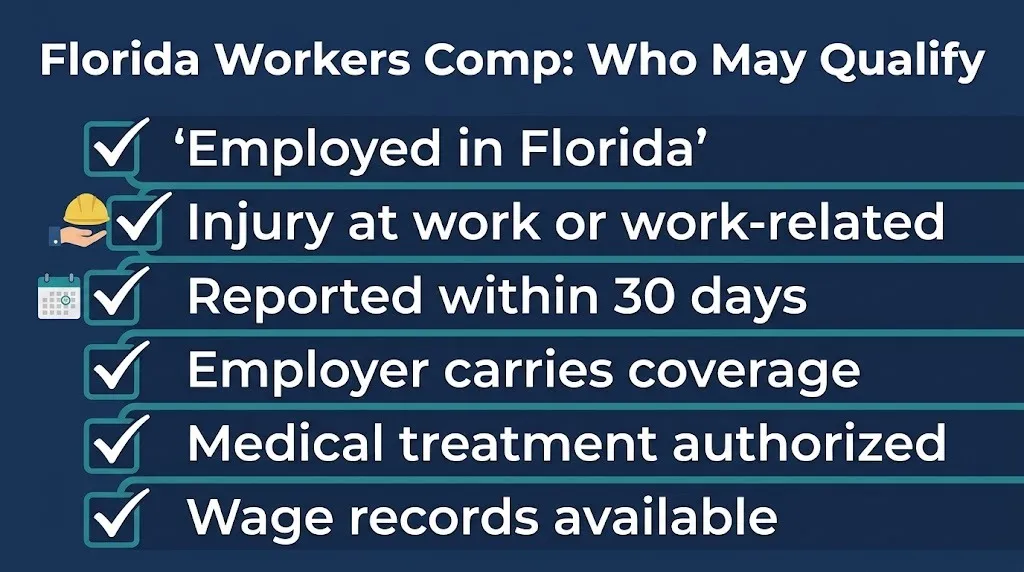
You must report the injury to your employer within 30 days of the accident or the date you knew the injury was work-related. Miss that window and you risk losing benefits.
Florida’s 30-day reporting rule is strict. The clock starts on the date of the accident for sudden injuries, or the date you discovered the condition for occupational illnesses. Tell your supervisor in writing, keep a copy, and note the date. A verbal report is better than nothing, but a written record is what protects you if the carrier later disputes notice.
There is a second deadline that matters more over the long term. Florida has a two-year statute of limitations for filing a petition for benefits with the Office of the Judges of Compensation Claims. If the carrier denies your claim or stops paying, the two-year clock governs how long you have to fight back. That deadline can be tolled in some cases, but you should not assume it will be.
Think of the 30-day rule like a store return window without a receipt. The store might still take it back, but the longer you wait, the more the policy works against you.
What Does Florida Workers Compensation Pay For?
Florida workers’ compensation pays for medical care related to the work injury and partial wage replacement while you recover. It does not pay for pain and suffering, and it does not cover lost wages at 100%.
The medical benefit is the broadest part. The carrier must pay for doctor visits, hospital care, surgery, prescriptions, physical therapy, and medically necessary equipment, as long as the treatment follows the state’s treatment guidelines. You do not pay a copay for authorized care.
The wage benefit comes in two main forms:
- Temporary Total Disability (TTD): You cannot work at all while recovering. Pays 66 2/3% of your average weekly wage, capped at $1,358 for 2026 injuries, for up to 104 weeks .
- Temporary Partial Disability (TPD): You can work but earn less than before the injury. Pays a partial wage replacement based on the difference.
Permanent impairment benefits may apply once you reach maximum medical improvement. Those are paid separately and depend on your impairment rating.
Key Takeaway: Florida workers’ comp covers your medical bills and roughly two-thirds of your lost wages, but it never pays you for the injury itself unless you have a permanent impairment rating.
Why Did Florida Workers Comp Rates Drop 6.9% in 2026?
Florida approved a 6.9% average decrease in workers’ compensation insurance premiums for 2026, the ninth consecutive year of rate cuts. The reduction applies to new and renewal policies effective January 1, 2026 .
Insurance Commissioner Mike Yaworsky signed the final order in November 2025, following a filing by the National Council on Compensation Insurance . The cut follows a 1% decrease for 2025, a 15.1% cut for 2024, and an 8.4% cut for 2023 . Since the 2003 reforms, Florida’s overall workers’ comp rates have fallen by about 85% .
The rate cut is good news for employers, but it has no direct effect on what an injured worker collects. Your benefit is set by statute and your wage history, not by what your employer pays in premiums. A lower premium does not mean a lower benefit check. The $1,358 cap applies regardless of the rate environment.
One caveat: insurance industry reporting suggests some carriers may raise minimum premiums per employer to compensate for the rate cut . That affects small businesses, not injured workers.
How Do You File a Workers Compensation Claim in Florida?
You file a Florida workers’ comp claim by reporting the injury to your employer, getting medical treatment from an authorized provider, and letting the carrier open the claim. You do not file a lawsuit or submit a form to a court.
Here are the steps in order:
- Report the injury to your supervisor within 30 days, in writing if possible.
- Ask for the carrier’s information and the claim number your employer opens.
- Get medical care from a provider authorized by the carrier or your employer.
- Keep every document: medical records, work restrictions, pay stubs, and any correspondence from the carrier.
- Watch your wage statements to confirm the average weekly wage calculation is correct.
- File a Petition for Benefits with the Office of the Judges of Compensation Claims if the carrier denies or delays benefits.
- Track the two-year deadline from the date of injury or the last benefit payment.
The state’s employee assistance office can answer basic questions about the process at no cost. You do not need to pay anyone to open a claim.
What Is the Reality Check on Florida Workers Comp?
Reality Check: No one texts you workers’ comp money first, and no third party can speed up your claim for a fee. Florida’s system is free to file, and the state does not authorize “claim helpers” to charge you for access. If someone asks for an upfront payment to release your benefits, it is a scam. The only legitimate fees in the system are attorney fees, and those are regulated and typically paid from the benefit award, not out of your pocket upfront.
What Happens if Your Florida Workers Comp Claim Is Denied?
If your Florida workers’ comp claim is denied, you can challenge the denial by filing a Petition for Benefits with the Office of the Judges of Compensation Claims. The petition is the formal document that starts the dispute process.
The carrier must respond, and the case goes before a Judge of Compensation Claims. You can represent yourself, but the process involves deadlines, evidence rules, and medical opinions. Most injured workers who reach this stage hire a workers’ comp attorney, and the fee is usually paid from the benefits recovered if you win.
A June 2026 order from the West Palm Beach district office illustrates how these disputes resolve. In that case, the judge awarded temporary partial disability benefits for a specific window, granted penalties and interest, and granted attorney fees, after finding the employer failed to prove its affirmative defense . The average weekly wage was stipulated at $774.06 . The case shows that disputes are winnable, but they require documentation.
How Long Do Florida Workers Comp Benefits Last?
Florida workers’ comp benefits last as long as you remain medically eligible, with a hard limit on temporary total disability. TTD benefits are capped at 104 weeks, or until you reach maximum medical improvement, whichever comes first .
After maximum medical improvement, the wage replacement benefit stops. If you have a permanent impairment rating, you may receive permanent impairment benefits under a separate schedule. Medical benefits can continue beyond the 104-week mark if the treatment remains medically necessary and related to the injury.
The 104-week cap is the number to remember. If you are still unable to work after two years of TTD, the system expects a different outcome: either a permanent impairment rating, a settlement, or a return to work in some capacity.
What Happens Next for Florida Workers Comp in 2026 and 2027?
The 2026 rules are set. The $1,358 cap applies to all injuries occurring in the calendar year. The 6.9% premium cut is locked in for new and renewal policies. The next changes will come from the annual rate-setting cycle and any legislative session activity.
October 2026: The $1,358 cap is active for all 2026 injuries. The 30-day reporting rule applies to every new claim.
November 2026: Florida Commerce will determine the statewide average weekly wage for the four quarters ending June 30, 2026. That figure sets the 2027 maximum rate.
January 1, 2027: A new maximum weekly compensation rate takes effect for 2027 injuries. The figure is not yet confirmed.
Ongoing: The Office of the Judges of Compensation Claims continues to hear benefit disputes. The two-year statute of limitations applies to each claim.
Frequently Asked Questions
What is the maximum workers compensation rate in Florida for 2026?
The maximum weekly compensation rate for 2026 injuries is $1,358. It is based on the statewide average weekly wage of $1,357.95, rounded to the nearest dollar .
How much of my wages does Florida workers comp pay?
Florida pays 66 2/3% of your average weekly wage for temporary total disability, up to the $1,358 cap . The average weekly wage is calculated from your earnings in the 13 weeks before the injury.
Do I have to report a work injury within a certain time in Florida?
Yes. You must report the injury to your employer within 30 days. Missing that deadline can cost you benefits.
Can I sue my employer for a work injury in Florida?
Generally, no. Workers’ compensation is the exclusive remedy for most work injuries in Florida. You cannot sue your employer in civil court for negligence, with very limited exceptions.
What if my workers comp claim is denied in Florida?
You can file a Petition for Benefits with the Office of the Judges of Compensation Claims. A judge will hear the dispute, and you can appeal the decision.
How long can I receive temporary total disability in Florida?
TTD benefits are capped at 104 weeks, or until you reach maximum medical improvement, whichever comes first .
Does Florida workers comp pay for pain and suffering?
No. Florida workers’ compensation does not pay damages for pain and suffering. It covers medical care and wage replacement only.
Is the 6.9% rate cut in 2026 good for injured workers?
The rate cut lowers what employers pay in premiums. It does not change the benefit formula or the $1,358 maximum for injured workers.
What You Should Do If You Were Hurt at Work in Florida
Report the injury to your employer in writing today. Keep a copy of the report. Write down the names of everyone you told and the dates you told them.
Then confirm the claim number and the carrier’s contact information. Do not sign anything from the carrier without reading it carefully, and do not accept a quick settlement before you know your full medical picture. The $1,358 cap for 2026 is the ceiling, but your actual benefit depends on your wage records and your medical restrictions. Get those documents, and the numbers will follow.