Workers Compensation Insurance Quotes 2026: Real Costs and What Drives Your Premium
Quick Answer
- Is it legit? Yes. Workers’ comp is required in 49 states, and quotes come from private carriers or state funds.
- How much? National averages run about $94 to $113 monthly per employee, with a wide range by industry.
- Key deadline: Coverage must be in place before your first employee starts work, not after.
If you’re shopping for workers compensation insurance quotes, the first thing to understand is that the “average” price you see online is nearly meaningless for your business. A roofing company and a software firm can have identical payrolls and pay wildly different premiums. The quote depends on what your employees actually do, where they do it, and how safely they’ve done it in the past.
This guide breaks down verified 2026 pricing data, explains how insurers calculate your rate, and shows you where the real savings hide. The numbers are sourced, not guessed, and the ranges reflect what businesses actually pay.
The Facts
| Item | Verified Detail |
|---|---|
| National Average (Per Employee) | $94 to $113 per month |
| Average Annual Per Employee | $1,128 to $1,354 |
| Rate Per $100 Payroll | National average about $1.03 |
| State Rate Range | $0.35 to $1.83 per $100 payroll |
| Coverage Requirement | Mandatory in 49 states; Texas is the exception |
| Monopolistic States | North Dakota, Ohio, Washington, Wyoming |
| Quote Validity | Typically 30 to 60 days, varies by carrier |
Is the workers compensation insurance quote real or a scam?
A workers compensation insurance quote is real when it comes from a licensed carrier or state fund. It’s a binding estimate of what you’ll pay for coverage, based on your payroll and job classifications.
The scam risk comes from unlicensed “brokers” who collect your payroll data and disappear, or from carriers selling ghost policies that exclude the very workers you meant to cover. A legitimate quote names the carrier, the class codes, the rate per $100 of payroll, and any credits or debits applied.
Ask for the class code and the filed rate in writing. If the quote doesn’t show those two numbers, you can’t verify the price. That’s the difference between a real quote and a sales pitch.
How much do workers compensation insurance quotes cost in 2026?
Workers compensation insurance quotes in 2026 average about $94 to $113 per month per employee, depending on the source and the business population measured . The national average rate sits near $1.03 per $100 of payroll .
The spread between sources is real, not error. MoneyGeek’s benchmark study found $113 monthly for businesses with one to four employees, while Insureon’s median customer pays $54 per month . Those are different populations. A tech startup with two desk workers isn’t the same risk as a landscaping crew with four employees.
Here’s how reported 2026 averages break down:
| Source | Monthly Per Employee | Annual Per Employee |
|---|---|---|
| InsuredBetter | ~$45 | Not specified |
| Insureon (median) | $54 | $643 |
| U.S. News (range) | $75 to $125 | Not specified |
| The Hartford | ~$81 | Not specified |
| Zippia | $78 | $936 |
| WorkersCompCost.com | ~$94 | $1,128 |
| MoneyGeek benchmark | $113 | $1,354 |
Not yet determined is the honest answer for your specific business before an underwriter reviews your payroll and class codes. No legitimate quote comes without that information.
What drives the price of a workers compensation insurance quote?
The price of a workers compensation insurance quote is driven primarily by your industry classification code, your total payroll, your state’s rate level, and your claims history. Those four factors explain most of the variance between quotes.
Industry classification is the single biggest lever. Insurers assign every job a class code with its own base rate per $100 of payroll . A clerical worker might carry a rate of $0.25 per $100, while a roofer can exceed $15.00 . That’s not a typo. The same payroll produces radically different premiums depending on what those employees do.
Payroll is the multiplier. Premium scales linearly with payroll, so doubling payroll doubles the base premium, holding the rate constant . Insurers audit your actual payroll at year-end, so under-declaring at quote produces a back-billed premium.
State rates vary from about $0.35 per $100 of payroll in the cheapest states to $1.83 in the most expensive . Benefit levels, medical fee schedules, and litigation rates drive those differences.
Claims history enters through the experience modifier, which adjusts your premium up or down based on a three-year loss lookback . A clean record can earn a credit; a claims-heavy history produces a debit.
Key Takeaway: Four factors control your quote: class code, payroll, state, and claims history, and the class code matters more than the other three combined.
Reality Check: No legitimate carrier charges you a fee to produce a quote. Workers comp quotes are free, and anyone asking for payment before you’ve seen a written proposal with class codes and rates is not selling insurance in the normal way.
Who may qualify for a workers compensation insurance quote?
You may qualify for a workers compensation insurance quote if you employ workers in a state that requires coverage and you can document your payroll and job duties. Nearly every business with employees qualifies, though high-risk industries may face fewer carriers willing to quote.
Coverage requirements vary by state. Some states require coverage with one employee, others with three or five . Texas is the only state where private employers are not required to carry workers comp, though opting out forfeits legal protections .
Four states run monopolistic funds where you cannot buy from private carriers: North Dakota, Ohio, Washington, and Wyoming . In those states, you get your quote from the state fund, not from a broker shopping the market.
If you’re a sole proprietor with no employees, you may not need coverage at all. But general contractors and clients can still require proof of insurance before you work on their sites.
How do you get the best workers compensation insurance quote?
The best workers compensation insurance quote comes from shopping multiple carriers, verifying your class codes, and correcting any payroll misclassification before you bind coverage. Most businesses overpay because they accept the first quote without checking the class code breakdown.
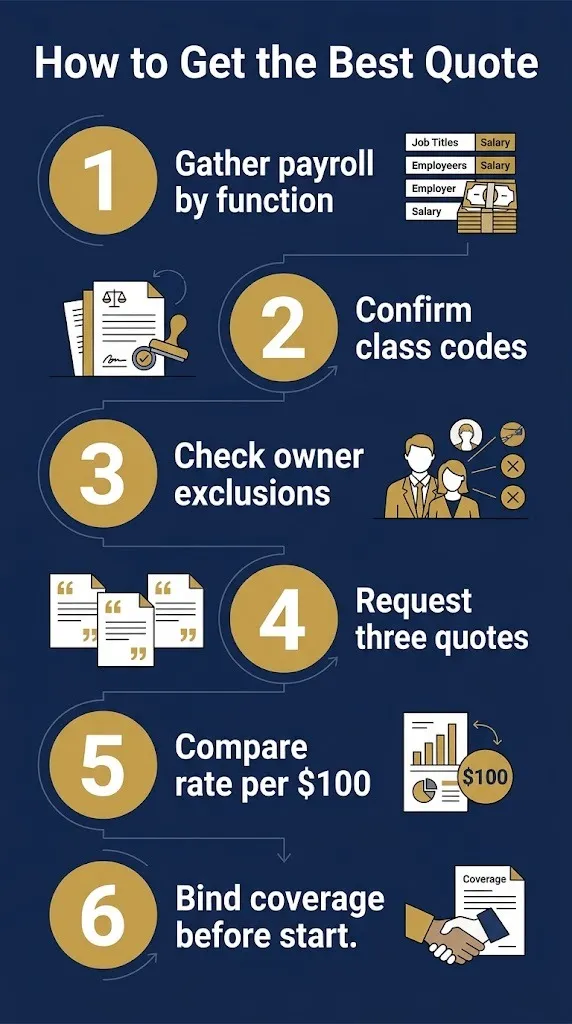
Here are the steps:
- Gather your payroll records by job function, not just total.
- Confirm your class codes with each carrier or your agent.
- Verify owner/officer exclusions if you’re eligible to exclude yourself.
- Request quotes from at least three carriers or a broker who shops the market.
- Ask for the experience modifier and any scheduled credits in writing.
- Compare the effective rate per $100 of payroll, not just the monthly premium.
Misclassified payroll is the largest source of premium error in both directions . An office manager coded as a field worker inflates your premium. A roofer coded as a general contractor may underinsure you and create coverage disputes at claim time.
Key Takeaway: The fastest way to lower a workers comp quote is to verify your class codes and split payroll correctly, since misclassification is the single largest source of premium error.
What happens next after you receive a quote?
Once you receive a workers compensation quote, you have a window to compare, negotiate, and bind coverage before your first employee starts work. The quote is an offer, not a contract, until you accept it and pay the premium.
Here’s the expected sequence:
- Quote received: Review class codes, rates, and credits in writing.
- Comparison: Shop the quote against at least two other carriers.
- Corrections: Fix any payroll split or owner exclusion issues.
- Binding: Accept the quote and pay the initial premium.
- Coverage effective: Policy starts, often the day after payment clears.
- Annual audit: Carrier reviews actual payroll and adjusts premium.
In Pennsylvania, for example, coverage begins the day after the state fund receives a completed application and premium check . Private carriers have their own effective-date rules.
The audit matters. If your actual payroll comes in higher than projected, you’ll owe additional premium at year-end. If it comes in lower, you may get a refund. Getting the projection right at quote time avoids both surprises.
Frequently Asked Questions
How much is workers comp insurance per month?
National averages run about $94 to $113 per employee per month. Small office businesses can pay as little as $45, while high-risk construction crews pay far more.
Is workers comp insurance required in all states?
No. It’s required in 49 states. Texas is the only state where private employers are not generally required to carry coverage.
What is the cheapest state for workers comp?
North Dakota and Indiana have some of the lowest rates, around $0.35 per $100 of payroll. California, New York, New Jersey, and Alaska sit at the high end near $1.83.
Can I exclude myself from workers comp as a business owner?
Many states allow sole proprietors and certain officers to exclude themselves. The rules vary by state and entity type, so confirm eligibility before excluding your own payroll.
What happens if I underreport payroll for a workers comp quote?
You’ll likely face a back-billed premium after the annual audit. Under-declaring at quote doesn’t save money long-term; it just defers the bill.
How often should I shop for a new workers comp quote?
Every year before renewal, and whenever your payroll, class codes, or claims history changes. Carrier appetite shifts, and a business that wasn’t competitive last year may get better quotes now.
Do workers comp quotes include the experience modifier?
A complete quote should show your experience modifier and how it was applied. If the quote doesn’t list it, ask for it in writing before you compare prices.
What You Should Do Now
Pull your payroll records by job function today, not by total headcount. That breakdown is what determines your class codes, and your class codes determine your premium.
Then request quotes from at least three sources and compare the effective rate per $100 of payroll, not the monthly headline number. The cheapest monthly premium can be the most expensive policy if the class codes are wrong.