PEO Workers Compensation 2026: How Co-Employment Changes Your Coverage and Costs
Quick Answer
- Is it legit? Yes. PEOs are licensed co-employers that carry workers’ comp for client employees, often through pooled master policies.
- How much? High-risk employers save 15% to 35%; low-risk employers with clean claims may see 5% to 15% savings or none.
- Key risk: Your coverage ends if the PEO relationship ends, and four states require separate state-fund coverage.
If you’re exploring a PEO for workers compensation, you’re likely a small business owner tired of audits, class codes, and premium surprises. The pitch sounds clean: hand off payroll and coverage to a co-employer, pay one predictable rate, and stop worrying about claims paperwork. That pitch is partly true, but the savings depend heavily on your risk profile and claims history.
This guide breaks down how PEO workers comp actually works, where the money comes from, and the coverage gaps that catch employers off guard. The rules are state-specific and contract-specific, and the details matter more than the marketing.
The Facts
| Item | Verified Detail |
|---|---|
| Relationship Type | Co-employment; PEO becomes employer of record for payroll and benefits |
| Coverage Structure | Usually a master policy pooling multiple client companies |
| High-Risk Savings | 15% to 35% typical premium reduction |
| Low-Risk Savings | 5% to 15%, or potentially negative |
| Monopolistic States | Ohio, Washington, Wyoming, North Dakota require separate state-fund coverage |
| Key Coverage Risk | PEO termination or insolvency can leave you uninsured |
Is PEO workers compensation real or a scam?
PEO workers compensation is real and widely used, but it’s not a simple insurance product. A PEO is a licensed co-employer that takes on payroll, tax, and benefits responsibilities, and it typically maintains a master workers comp policy covering all its clients’ worksite employees .
The scam risk comes from unlicensed PEOs or vague contracts that don’t spell out who covers what. A legitimate PEO agreement names the coverage, the carrier, and the allocation of claims responsibilities. If the contract doesn’t show those details, you’re exposed.
The other risk is the assumption that the PEO’s coverage is your coverage. It is, while the relationship lasts. But if the PEO cancels the contract or becomes insolvent, your coverage disappears with it . The client remains legally responsible for workers comp obligations, and a lapse can mean operating without required insurance.
How does PEO workers compensation pricing work?
PEO workers compensation pricing works through a pooled master policy, where the PEO’s claims experience and class codes are blended across all client companies. Your premium is based on your payroll and class codes, multiplied by the pool’s experience modifier, plus the PEO’s administrative load.
The formula looks like this: (Payroll / 100) × Class Rate × Pool EMR × State Multipliers + Administrative Load .
The pool EMR is the key variable. Most PEO pools sit near 1.0 because averaging dilutes individual employer variation. If your own EMR is high (above 1.2), joining the pool can reset it to the average, producing immediate savings . If your EMR is low (well below 1.0), you give up that favorable rate and may pay more on the workers comp line.
Administrative load varies widely and often isn’t transparent. Some PEOs mark up the underlying premium significantly, and the markup is where the real cost difference hides . A business that could get a standalone policy at a 2.8% effective rate might pay 4.2% through a PEO .
Key Takeaway: PEO workers comp savings are real for high-EMR employers and often illusory for low-risk employers with clean claims histories.
How much can a PEO save on workers compensation?
A PEO can save high-risk employers 15% to 35% on workers comp premiums, according to industry analysis . Low-risk employers typically see 5% to 15% savings, and some may pay more than a standalone policy would cost.
The savings come from three places. First, the pool averages out individual claims volatility. Second, the PEO handles claims management and return-to-work programs that reduce long-tail costs. Third, the PEO reduces audit exposure by standardizing class codes and payroll reporting .
Here’s how savings break down by employer profile:
| Employer Profile | Typical Savings | Why |
|---|---|---|
| High-risk, high-EMR | 15% to 35% | Pool resets unfavorable modifier |
| High-risk, average EMR | 10% to 20% | Claims management and pooling |
| Low-risk, clean claims | 5% to 15% or negative | Gives up favorable modifier |
| Low-risk, high EMR | 15% to 25% | Pool reset still helps |
Not yet determined is the honest answer for any individual business before an EMOD review and class-code audit. The PEO quote is a starting point, not a guarantee.
Who may qualify for PEO workers compensation coverage?
You may qualify for PEO workers comp coverage if you have employees, operate in a state where the PEO is licensed, and your business fits the PEO’s underwriting appetite. Most small and mid-sized businesses qualify, but high-risk industries and poor claims histories can limit options.
Coverage exclusions exist. Four states (Ohio, Washington, Wyoming, and North Dakota) run monopolistic workers comp funds, and PEOs cannot include those states in their master policies . If you have employees there, you need separate state-fund coverage.
PEOs also may exclude certain worker types. Independent contractors, temporary staff hired through other agencies, and some owner-officers may not be covered under the PEO’s policy . If you engage contractors, you may need your own coverage for them.
What are the biggest PEO workers compensation risks?
The biggest PEO workers compensation risk is coverage loss when the PEO relationship ends or the PEO fails financially. A second major risk is inadequate claims control, since the PEO owns the carrier relationship and you don’t.
PEO insolvency is a verified concern. When a PEO becomes insolvent, its insurer may use the PEO’s failure to pay as grounds to deny claims, and the client may not be notified immediately that coverage is gone . Claims payments can stop mid-treatment, and access to collateral may require litigation.
The second risk is claims handling. The PEO’s interests (closing claims quickly to protect the pool modifier) may not align with yours (ensuring appropriate care and return-to-work support) . You don’t have a direct relationship with the carrier, so you can’t escalate issues the way you could with your own policy.
Contract termination creates a third risk. If the PEO cancels your agreement, your coverage terminates with it, and you must find replacement coverage immediately . A lapse in coverage can expose you to penalties and personal liability.
Reality Check: No PEO contract makes your workers comp obligation disappear. The client remains legally responsible for coverage, and if the PEO’s policy lapses or the relationship ends, the obligation falls back on you immediately.
How do you verify a PEO’s workers compensation coverage?
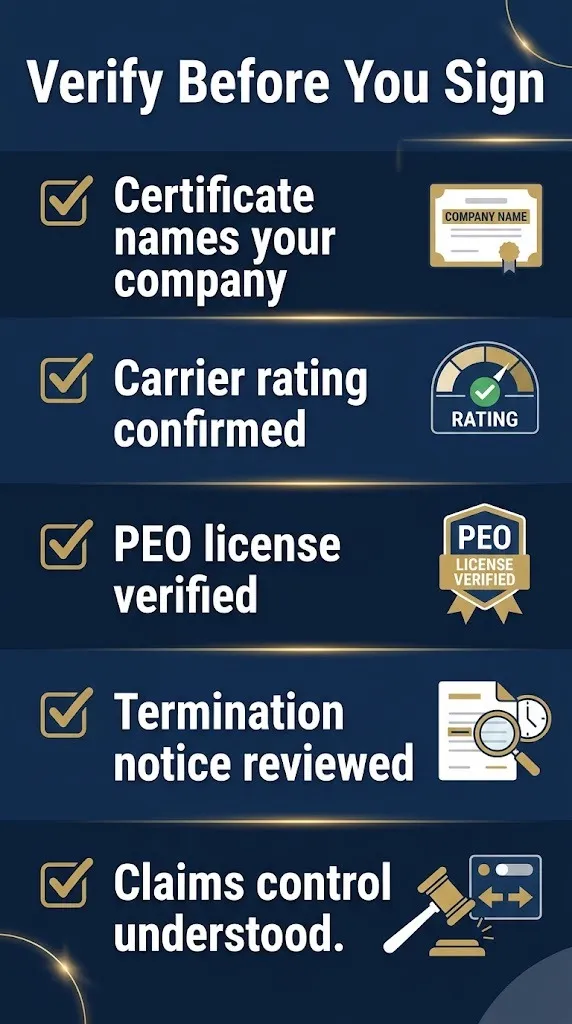
You verify a PEO’s workers compensation coverage by requesting the certificate of coverage, confirming the carrier’s rating, and checking the state licensing status. The contract should specify whether coverage is on a master policy or a multiple coordinated policy basis.
Here are the steps:
- Request the certificate of coverage naming your company and the PEO.
- Confirm the carrier’s financial rating and state licensing.
- Check the PEO’s license with your state’s labor or insurance department.
- Verify the coverage type (master policy or multiple coordinated policy).
- Review the claims control provisions in the contract.
- Confirm what happens on termination, including notice requirements.
State law often requires the PEO to provide written notice before coverage terminates, but the notice rules vary . The NAIC model guidelines require PEOs to disclose coverage arrangements clearly, including whether the client remains responsible for obtaining its own coverage .
What happens next after you sign a PEO agreement?
After you sign a PEO agreement, the PEO becomes your co-employer and begins administering payroll and workers comp. The transition involves payroll setup, class-code assignment, and coverage confirmation.
Here’s the expected sequence:
- Signing: The PEO agreement and coverage documents are executed.
- Onboarding: Payroll data and employee classifications are submitted.
- Coverage effective: The PEO’s policy extends to your worksite employees.
- Ongoing: Pay-as-you-go premium deductions from payroll.
- Annual review: PEO reconciles payroll and claims experience.
- Termination (if any): Coverage ends, and you must secure replacement insurance.
The onboarding period is a coverage gap risk. New employees not yet processed into the PEO’s system may not be covered if injured on day one . Confirm the effective date in writing before any employee starts work under the PEO arrangement.
Frequently Asked Questions
Does a PEO provide workers compensation coverage?
Yes, most PEOs provide workers comp through a master policy or multiple coordinated policies. The PEO becomes the employer of record for coverage purposes.
Is PEO workers comp cheaper than a standalone policy?
It depends on your risk profile. High-EMR employers often save 15% to 35%, but low-risk employers with clean claims may pay more than a standalone policy.
What happens to my workers comp if I leave the PEO?
Coverage terminates when the PEO relationship ends. You must secure replacement coverage immediately to avoid a lapse and potential penalties.
Can I use a PEO in Ohio, Washington, Wyoming, or North Dakota?
No, not for workers comp. Those states run monopolistic funds, and PEO master policies cannot cover employees there. You need separate state-fund coverage.
Does the PEO cover independent contractors?
Generally no. PEO policies cover worksite employees on the PEO’s payroll. Contractors and temporary staff from other agencies may need separate coverage.
Who handles a workers comp claim under a PEO?
The PEO coordinates with the carrier’s claims adjuster and manages the claim process, including return-to-work programs. You may have limited direct control over the claim.
What if the PEO goes out of business?
Your coverage may terminate without immediate notice. You remain legally responsible for workers comp, so you need to secure replacement coverage quickly.
What You Should Do Now
Request the PEO’s certificate of coverage and read the termination clause before you sign anything. The certificate names the carrier, and the termination clause tells you how much notice you get if coverage disappears.
Then compare the PEO’s effective rate to a standalone quote from a broker who knows your industry. The pool discount is real for some employers and a markup for others. The only way to know which side you’re on is to see both numbers side by side.