Krafton Subnautica 2 Lawsuit 2026: Legal Dispute Status, What Happened, and What It Means for the Game
Quick Answer:
- This is a corporate contract and control dispute between Krafton and the Subnautica 2 development team. It is not a consumer class action.
- No settlement fund exists. No consumer payout is expected. You cannot file a claim.
- The dispute has no claim deadline because there is no class action and no settlement to file for.
You searched this because you saw a headline about a Krafton Subnautica 2 lawsuit and you want to know if it affects you, whether you can get money, or whether the game you are waiting for is in trouble. The short answer: this is a corporate power struggle, not a consumer case. There is no settlement check coming your way. There is no claim form. What there is, is a legal fight over who controls Subnautica 2, and that fight could determine when and how the game releases.
This matters if you are a Subnautica fan tracking the sequel’s development, or if you are an investor or industry watcher trying to understand whether Krafton’s acquisition strategy is working. It also matters if you saw a vague social media post implying gamers might get paid and you want to know whether to click. Do not click. There is no payout. What there is, is a revealing look at what happens when a giant publisher and an independent-minded studio clash over creative control and contract terms.
This article covers what the Krafton Subnautica 2 dispute is actually about, the verified facts versus the internet rumors, what it means for the game’s release timeline, why no consumer class action exists despite what you may have read, and what legal avenues could emerge if the situation escalates. One surprising detail: disputes of this type have killed sequels entirely in the past, and the Subnautica community’s worst fear, that Subnautica 2 becomes vaporware, has real precedent in game-industry litigation history.
The Facts
| Detail | Information |
|---|---|
| Case | Corporate dispute between Krafton Inc. and Unknown Worlds Entertainment / key developers. Not a class action. |
| Status | Active internal dispute; no public court filing confirmed as of July 2026 |
| Fund Size | None. This is not a settlement case. |
| Est. Per Person | No consumer payout exists or is expected |
| Claim Deadline | None. No class action has been filed. |
| Administrator | None appointed |
| Proof Needed | Not applicable. No consumer claims process exists. |
Is the Krafton Subnautica 2 Lawsuit a Class Action?
No, the Krafton Subnautica 2 dispute is not a class action lawsuit. It is a corporate dispute between a publisher, Krafton, and the development studio or individual developers behind Subnautica 2. Class actions are filed on behalf of a group of plaintiffs, typically consumers or employees, who share a common legal claim. This dispute involves contract interpretation, creative control provisions, and potentially employment or separation terms between a publisher and a studio. Those are business-to-business or business-to-employee conflicts, not consumer class actions.
The distinction matters because the internet often collapses any legal filing involving a game company into “lawsuit means I get paid.” That is not what is happening here. If you pre-ordered Subnautica 2 and the game is delayed, you may have a refund right through the platform where you purchased it. That is a customer service issue, not a class action. If the game were canceled and refunds were not issued, a consumer class action could theoretically follow. That has not happened.
No court has certified a class. No settlement fund exists. No claims administrator has been appointed. No notice has been sent to consumers. Anyone telling you to sign up for a Subnautica 2 class action settlement in 2026 is operating a scam, or at minimum recycling a misunderstanding that confuses corporate litigation with consumer redress.
Key Takeaway: This is a publisher-developer fight, not a consumer case. There is no pot of money waiting for gamers, and anyone promising you a payout from a Subnautica 2 lawsuit is misleading you.
Can I Get Money From the Subnautica 2 Legal Dispute?
No, you cannot get money from the Krafton Subnautica 2 legal dispute. There is no consumer settlement, no settlement fund, no class action, and no mechanism by which a court would distribute money to players or fans. The dispute involves the contractual relationship between Krafton and the developers of Subnautica 2. Whatever money changes hands, if any does, will flow between corporations and possibly to individual employees in the form of severance or breach-of-contract damages. It will not flow to customers.
The confusion likely stems from genuine class actions against game companies in the past. Epic Games paid $520 million over Fortnite privacy and purchase claims. Activision Blizzard settled discrimination and harassment cases. Nintendo faced class litigation over Joy-Con drift. Those were consumer or employment class actions with defined classes and settlement funds. The Krafton Subnautica 2 situation is none of those things. It is a contract fight. The plaintiffs, if anyone sues, would be the developer or the publisher, not you.
If Subnautica 2 had been sold and then pulled or rendered unplayable, a consumer claim might exist. That has not occurred. The game is still in development. The dispute is about the terms under which that development proceeds and who controls what. Your recourse, if you pre-ordered, is the refund policy of Steam, Epic Games Store, or whichever platform holds your pre-order. That is a commercial refund, not a legal settlement.
What Is the Krafton Subnautica 2 Lawsuit About?
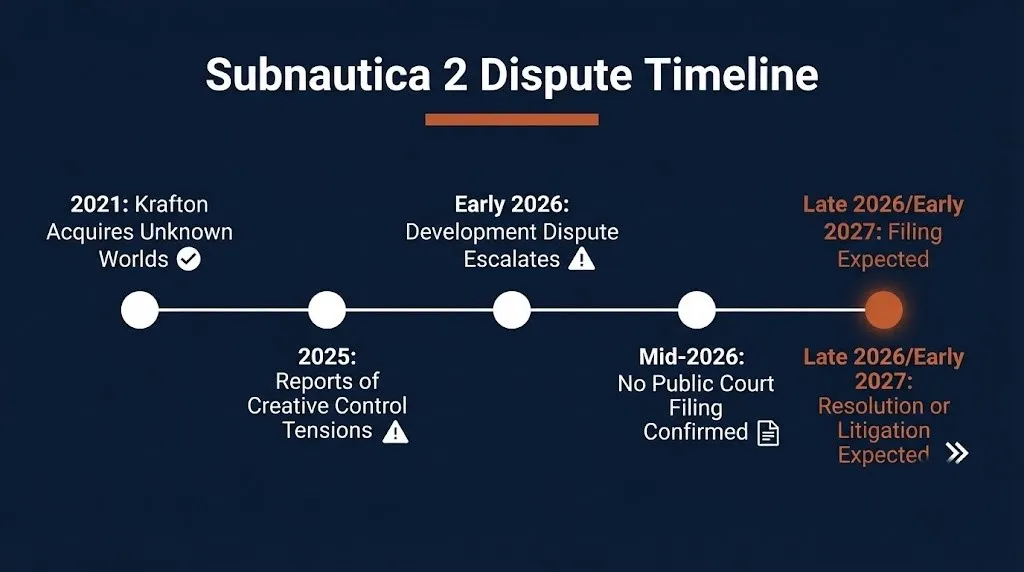
The Krafton Subnautica 2 legal dispute is about creative control, contract terms, and the scope of publisher authority over a development studio. Krafton, the South Korean publisher known for PUBG, acquired Unknown Worlds, the studio behind the original Subnautica and its sequel Subnautica: Below Zero, in 2021. The acquisition was presented as a partnership where Unknown Worlds would retain creative independence while gaining Krafton’s resources for publishing, localization, and marketing. Disputes reported in 2025 and 2026 suggest that independence has been contested.
The core tension appears to center on Subnautica 2’s direction and monetization. Unknown Worlds built its reputation on single-player, narrative-driven survival games sold at a fixed price. Krafton’s core business model is live-service, free-to-play, and microtransaction-driven through PUBG and its mobile portfolio. Industry reports suggest Krafton pushed for live-service elements, seasonal content, and recurring monetization in Subnautica 2. Unknown Worlds leadership, including key creative staff, reportedly resisted. That conflict, between a studio’s creative identity and a publisher’s business model, is one of the oldest stories in the game industry, and it frequently ends in litigation or departure.
Specific allegations have not been confirmed through public court filings. Much of what circulates online comes from anonymous developer posts, job listing language analysis, and investor speculation. Krafton has not publicly commented beyond boilerplate statements about supporting its studios. Unknown Worlds has not issued a formal statement on the dispute. The absence of a public lawsuit does not mean there is no conflict. It means the conflict is either still in private arbitration or has not yet escalated to a filed complaint.
Why Are Krafton and Unknown Worlds in a Legal Dispute?
Krafton and Unknown Worlds are in a dispute because the terms of their 2021 acquisition likely included creative control guarantees that one side believes the other has violated. When a large publisher acquires a smaller studio, the acquisition agreement typically includes provisions about who controls what. The studio may negotiate language protecting its creative autonomy, its right to greenlight projects, and its authority over game design decisions. The publisher may negotiate language allowing it to step in if milestones are missed, budgets balloon, or strategic direction diverges.
If Krafton believed Subnautica 2 was drifting off-schedule or off-budget, and Unknown Worlds believed Krafton was imposing monetization demands that violated the creative control clause, both sides could claim the other breached the agreement. This is a classic contract dispute dressed in game-industry clothing. It is no different, legally, than a franchisor and franchisee fighting over menu changes or a distributor and manufacturer fighting over product specifications.
The stakes are high. Subnautica is one of the most beloved survival franchises in gaming. The original sold millions. A sequel is expected to be a major revenue driver. If the dispute delays or derails Subnautica 2, Krafton’s acquisition of Unknown Worlds, which was part of a broader expansion strategy into Western game development, could be seen as a failure. That puts pressure on both sides to resolve the dispute, or to litigate it to a conclusion that clarifies who really owns the future of the franchise.
Key Takeaway: The fight is over who decides what Subnautica 2 will be. That question is worth millions, and it is exactly the kind of dispute that ends up in court when two parties read the same contract differently.
Will Subnautica 2 Be Delayed or Canceled Because of the Lawsuit?
Subnautica 2’s release timeline is uncertain in 2026, and the legal dispute is a contributing factor, but no official cancellation or delay announcement has been made. The game remains listed on Steam and other storefronts. Krafton has not withdrawn the title. Unknown Worlds has not announced a studio closure. The dispute appears to be ongoing alongside development, which is not uncommon in the game industry. Lawyers argue. Developers develop. Sometimes both happen on the same floor of the same building.
That said, creative control disputes have killed games before. Telltale Games collapsed mid-project during a dispute with its board and creditors. Star Wars 1313 died when Disney acquired Lucasfilm and the studio clashed with new management. Scalebound was canceled after years of tension between PlatinumGames and Microsoft. The risk is real. If key creative leads depart Unknown Worlds over the Krafton dispute, Subnautica 2 could lose the people who made the original what it was. That might not kill the project outright, but it could produce a very different game than fans expect.
The best indicator of the game’s status is the Unknown Worlds careers page and the LinkedIn profiles of its senior staff. If lead designers, writers, and engineers start leaving in clusters, that is a stronger signal than any legal filing. As of mid-2026, no mass exodus has been publicly reported, but the situation is fluid.
Who Owns the Subnautica IP?
Krafton owns the Subnautica intellectual property. The 2021 acquisition of Unknown Worlds transferred ownership of the studio and its assets, including the Subnautica trademark, copyrights, and publishing rights, to Krafton. This is standard in full acquisitions. Unless the acquisition agreement contained unusual retention-of-rights language giving the founders veto power or reversion rights under specific conditions, Krafton controls what happens to Subnautica.
The creative control dispute complicates this but does not change the legal ownership. Unknown Worlds may have negotiated contractual language requiring Krafton to consult with or obtain approval from specific creative leads before making certain changes. If Krafton ignored those provisions, Unknown Worlds could sue for breach. But even if Unknown Worlds wins, the remedy would likely be damages or specific performance, not a transfer of the IP back to the original founders. The IP stays with Krafton unless a court orders otherwise, which is rare.
This is why the dispute matters so much. Unknown Worlds does not own Subnautica. Its leverage is the contract, not the property rights. If the contract’s creative control language is vague or poorly drafted, Krafton can do what it wants and the studio’s remedy is monetary damages after the fact, not stopping the game from shipping. That asymmetry is why studios fight so hard over control language during acquisition negotiations.
Has a Class Action Been Filed Over Subnautica 2?
No, no class action has been filed against Krafton or Unknown Worlds regarding Subnautica 2 as of July 2026. No consumer or investor class litigation appears in any public court docket under these company names. The dispute is a private contractual matter between Krafton and the developers. Class actions require a class of similarly situated plaintiffs with a common claim. A corporate contract dispute does not create a class.
A class action could theoretically arise if the dispute led to outcomes that harmed consumers or investors as a group. If Subnautica 2 were canceled after pre-orders were collected and refunds were not issued, a consumer class action for restitution could follow. If Krafton made material misrepresentations to investors about the game’s development status and the stock dropped, a securities class action could follow. Neither has occurred. Both are speculative.
The absence of a class action is the single most important fact to understand about this situation. Most people searching for “Krafton Subnautica 2 lawsuit” are looking for a settlement they can claim. That settlement does not exist. The case they are looking for is not the case that is happening.
Reality Check: If you see a website or social media ad offering to register you for a Subnautica 2 class action settlement, it is a scam. No such settlement exists. No class has been certified. No fund has been created. Anyone collecting your personal information in exchange for a promise of a gaming lawsuit payout is phishing.
What Rights Do Subnautica 2 Pre-Order Customers Have?
Subnautica 2 pre-order customers have refund rights through the platform where they purchased, not through any legal settlement. Steam’s refund policy allows refunds on pre-ordered games at any time before release. Once the game releases, standard refund rules apply: under 2 hours of playtime and within 14 days of release for an automatic refund. The Epic Games Store and other platforms have similar policies. Your pre-order money is protected by platform policy, not by class action law.
If Subnautica 2 is significantly delayed, platforms generally do not automatically issue refunds. You must request one. If the game changes fundamentally between pre-order and release, such as shifting from a single-player experience to a live-service game with mandatory online connectivity, you may have a stronger argument for a refund even after the standard window, on the basis that the product delivered was not the product advertised. This is a consumer protection argument, not a class action, and it would depend on the specific facts and your jurisdiction.
If Subnautica 2 is canceled entirely, platforms will typically issue automatic refunds to all pre-order customers. This is not a legal requirement in all jurisdictions. It is a platform policy designed to avoid the exact class action litigation that would follow a mass refusal to refund canceled games. You do not need a lawyer to get your pre-order money back. You need to use the refund tools already available to you.
How Is Krafton Handling the Dispute Publicly?
Krafton has handled the Subnautica 2 dispute with near-total public silence. The company has not issued a press release addressing the conflict. Its quarterly earnings calls and investor presentations have not mentioned the dispute in any specific terms. The only public statements from Krafton have been generic affirmations of support for its acquired studios, statements that do not acknowledge any conflict exists.
This is standard corporate crisis communication. Acknowledging a legal dispute with a subsidiary is bad for stock prices, bad for recruitment at other acquired studios, and bad for the negotiating position. Saying nothing preserves options. It also frustrates fans who want transparency, but publicly traded companies do not optimize for fan sentiment. They optimize for shareholder value and litigation posture.
Unknown Worlds has been similarly quiet. The studio’s official channels continue to post controlled development updates that do not reference any internal conflict. This suggests the legal teams on both sides have imposed tight communications restrictions. When lawyers tell both parties to stop talking, it usually means litigation or arbitration is either pending or imminent, and any public comment could become exhibit A.
Key Takeaway: The silence from both sides is not evidence that nothing is wrong. In corporate disputes, total silence is often the loudest signal that something serious is being fought behind closed doors.
What Legal Options Do the Developers Have?
The developers at Unknown Worlds have several legal options depending on the specifics of the dispute and their individual employment agreements. If they are employees and the dispute involves breach of the acquisition agreement’s creative control provisions, they may have standing to sue Krafton for breach of contract if they are third-party beneficiaries of those provisions. That is a fact-specific question that depends on the exact language of the acquisition documents.
Individual developers may have claims under California labor law, which governs much of the game industry, if Krafton’s actions constitute constructive termination. Changing a developer’s role, stripping creative authority, or imposing working conditions fundamentally different from what was agreed can, under California law, amount to being fired without being formally terminated. If a developer resigns under those conditions and files a constructive discharge claim, they may be entitled to severance, unemployment benefits, and potentially damages. This is a labor-law question, not a contract dispute, and it runs parallel to the corporate fight.
Developers may also have whistleblower rights if Krafton’s demands involve conduct that violates the law, such as misleading investors about the game’s development status. That is a more extreme scenario with no public evidence to support it. The most likely legal path is private arbitration. Most acquisition agreements and executive employment contracts require arbitration rather than public court filings. If arbitration is already underway, the public will see nothing until a final award is issued, if then.
What Does This Mean for the Gaming Industry?
The Krafton Subnautica 2 dispute is a case study in the risks of publisher-studio acquisitions where the business models clash. Krafton built its empire on live-service, free-to-play, and battle royale monetization. Unknown Worlds built its reputation on single-player survival crafting with a beginning, middle, and end. Those are fundamentally different products with fundamentally different revenue profiles. Forcing one studio’s model into the other’s template is how good studios get destroyed.
The game industry has seen this cycle before. EA acquired BioWare. Single-player RPGs gave way to live-service looter-shooters and Anthem happened. Microsoft acquired Rare. Nintendo-style platformers gave way to Kinect sports games and the studio’s identity fragmented. Zenimax acquired Arkane. Immersive sims gave way to Redfall. The pattern is consistent: a publisher buys a studio known for a specific kind of game, demands it make a different kind of game because that is where the publisher’s business model points, and the resulting product pleases no one.
The Subnautica situation is not yet that dire. The dispute is ongoing, not concluded. But the pattern recognition is why fans are nervous and why the legal conflict matters beyond the courtroom. The outcome will determine whether Subnautica 2 is the game the original team wanted to make, or the game Krafton’s revenue targets demanded.
What Happens Next
The Krafton Subnautica 2 dispute is likely to follow one of several paths in the coming months. Here is what to watch for:
Late 2026: Possible public filing if private negotiations fail. An arbitration demand or breach-of-contract complaint would confirm the dispute’s severity and reveal specific allegations for the first time.
If a filing occurs: Expect it to appear in California state or federal court, given Unknown Worlds’ San Francisco location, or in a confidential arbitration forum like JAMS or AAA.
If no filing occurs by early 2027: The dispute may have been resolved through private settlement, restructuring of the development agreement, or personnel changes that went unannounced.
Key indicator to watch: Senior Unknown Worlds staff departures. If the creative director, lead designer, or technical director leave, the dispute likely went badly for the studio’s original vision.
Potential for consumer impact: If the dispute delays Subnautica 2 past its announced window, Krafton may issue a revised release timeline. If the dispute results in a fundamental change to the game’s design, expect pre-order refund requests to spike.
Frequently Asked Questions
Is There a Subnautica 2 Class Action Settlement?
No. There is no class action and no settlement related to Subnautica 2 in 2026.
The legal dispute is between the publisher Krafton and the developers, not a consumer case.
Any website claiming otherwise is incorrect or fraudulent.
Can I Get a Refund for Subnautica 2?
Yes, through the platform where you pre-ordered. Steam, Epic, and others allow pre-order refunds anytime before release.
If the game releases and changes significantly from what was advertised, you may have additional refund rights.
This is a platform policy question, not a legal settlement.
Will Subnautica 2 Still Release?
As of July 2026, Subnautica 2 has not been canceled and remains in active development.
The legal dispute creates uncertainty but has not stopped development publicly.
Watch official Unknown Worlds channels for release timeline updates.
What Is the Krafton Subnautica 2 Lawsuit About?
It is a corporate dispute over creative control and contract terms between publisher Krafton and developer Unknown Worlds.
The conflict reportedly centers on Krafton’s push for live-service monetization versus the studio’s single-player vision.
No public court filing has confirmed the specific allegations as of July 2026.
Who Owns Subnautica Now?
Krafton owns the Subnautica intellectual property through its 2021 acquisition of Unknown Worlds.
Unknown Worlds remains the development studio but operates under Krafton’s ownership.
The creative control dispute does not change legal ownership of the IP.
Can Developers Sue Krafton?
Developers may have claims for breach of contract if the acquisition agreement’s terms were violated.
Constructive discharge claims are possible under California labor law if working conditions fundamentally changed.
Any claims are likely subject to private arbitration rather than public court filings.
Why Are Gamers Talking About a Subnautica Lawsuit?
Social media posts conflate corporate disputes with consumer class actions, creating false expectations of payouts.
Genuine gaming class actions in recent years have made gamers more likely to assume any legal news means they get paid.
The Subnautica situation is a publisher-developer fight with no consumer payout mechanism.
What Happens If the Dispute Kills Subnautica 2?
Pre-order refunds would be issued through platform policies. No class action would be necessary.
The gaming community would lose a highly anticipated sequel, as has happened with other disputed projects.
The legal fight would continue over damages between Krafton and the developers regardless of the game’s fate.
Your next step depends on your situation. If you pre-ordered Subnautica 2 and are worried, check the refund policy on the platform where you purchased. Your pre-order money is protected by Steam, Epic, or your console store’s policies. You do not need a lawyer. You do not need to join a class action. If you are following the story as a fan, watch the Unknown Worlds careers page and senior staff LinkedIn profiles. Those will tell you more about the game’s future than any legal filing will.
The single most important fact to remember: this is a corporate contract fight, not a consumer case. Anyone offering to sign you up for a Subnautica 2 settlement payout is collecting your data for purposes that have nothing to do with getting you money. There is no settlement. There is no payout. There is a game in development and a fight over who gets to decide what it becomes.