Tylenol Autism Lawsuit 2026: Latest MDL Status, Settlement Odds, and Who May Qualify
Quick Answer:
- The Tylenol autism lawsuits are real, consolidated as MDL No. 3043, alleging prenatal acetaminophen exposure causes autism and ADHD.
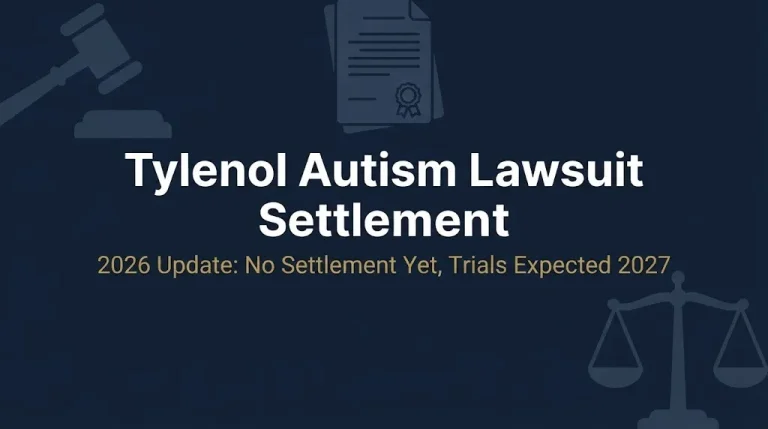
- No settlement fund exists yet; any payout amount per claimant remains entirely undetermined.
- No claim deadline has been set; you can still speak to an attorney about joining the litigation.
Parents across the country are filing lawsuits against the makers and sellers of Tylenol and generic acetaminophen. They allege one thing: that taking the drug during pregnancy caused their child to develop autism spectrum disorder or attention deficit hyperactivity disorder. The litigation has grown from a handful of cases in 2022 to over 1,500 consolidated federal cases, with more being filed every month.
This guide covers every verified fact about the Tylenol autism litigation as of mid-2026. That includes the exact court where the cases are pending, what the science actually says, who may be eligible to file a claim, and the realistic timeline for any resolution.
One fact most coverage skips: the multidistrict litigation is still in the Daubert phase, where the judge decides what scientific evidence is admissible. That ruling, expected within the next year, will determine whether the entire litigation survives or collapses. No settlement talks of substance can begin until that happens.
The Facts
| Detail | Value |
|---|---|
| Case | In re: Acetaminophen ASD/ADHD Products Liability Litigation |
| Court | U.S. District Court, Southern District of New York |
| MDL Number | 1:22-md-03043 |
| Judge | Hon. Denise Cote |
| Filed | October 2022 (MDL created) |
| Number of Cases | Over 1,500 as of mid-2026 |
| Current Phase | Daubert motions and general causation expert discovery |
| Settlement Fund | None (no global settlement) |
| Estimated Per-Person Payout | Not yet determined |
| Claim Deadline | Not yet set (litigation still in pretrial phase) |
| Administrator | Not yet appointed |
| Proof Required | Medical records, proof of acetaminophen use during pregnancy, diagnosis records |
Is the Tylenol Autism Lawsuit Legitimate or a Scam?
The Tylenol autism litigation is legitimate, court-sanctioned, and among the largest mass torts currently pending in the federal court system. It is not a scam. It is not a class action settlement that landed in your inbox. It is an active, ongoing multidistrict litigation overseen by a sitting federal judge.
The MDL was created by the Judicial Panel on Multidistrict Litigation in October 2022. It centralized dozens of individual lawsuits that had been filed across the country into a single court for pretrial proceedings. The number of cases has since grown to over 1,500. Every case is filed by real families represented by licensed attorneys.
The scam risk around this litigation is not the cases themselves. It is the wave of misleading advertisements and data-harvesting websites that have appeared since late 2022. You have likely seen them: “Tylenol Autism Settlement: Check Your Eligibility Now” or “File Your Tylenol Claim Before the Deadline.” These are not official. No settlement exists. No claims administrator has been appointed. No deadline has been set. Any website asking for your personal information in exchange for checking your eligibility is a lead-generation operation, not an official court-approved process.
How to Spot a Real Tylenol Lawsuit Attorney
Real mass tort attorneys do not guarantee results. They do not ask for upfront payment. They work on contingency and evaluate your case individually. They will ask for medical records, pharmacy records, and a detailed history of acetaminophen use during pregnancy. Anyone promising you a specific dollar amount before reviewing those records is not being honest about the state of the litigation.
Key Takeaway: The litigation is real, in federal court, with over 1,500 cases. The settlement offers in your social media feed are not. No settlement exists yet.
What Is the Tylenol Autism MDL and Where Does It Stand?
The Tylenol autism MDL (In re: Acetaminophen ASD/ADHD Products Liability Litigation, MDL No. 3043) is pending before Judge Denise Cote in the Southern District of New York. Judge Cote is a veteran jurist with decades of experience handling complex pharmaceutical litigation. She has moved the case through initial organizational phases and into the critical scientific evidence stage.
As of mid-2026, the litigation is in the Daubert phase. This is the stage where both sides file motions challenging the admissibility of each other’s expert witnesses. The plaintiffs have designated experts in epidemiology, toxicology, obstetrics, and child psychiatry who will testify that prenatal acetaminophen exposure can cause autism and ADHD. The defendants, including Johnson & Johnson Consumer Inc. and major retailers that sold store-brand acetaminophen, have designated their own experts who will testify the science does not support a causal link.
Judge Cote will hold Daubert hearings, listen to expert testimony, and issue rulings on which experts are permitted to testify and which are excluded. This ruling is the single most important event in the litigation. If the plaintiffs’ general causation experts are excluded, the cases effectively collapse. If they are admitted, the litigation moves toward bellwether trials. The Daubert ruling is expected sometime between late 2026 and mid-2027, though no firm date has been set.
Has There Been a Tylenol Autism Settlement in 2026?
No settlement has been reached in the Tylenol autism MDL as of July 28, 2026. There is no global settlement fund. There is no claims process. There is no per-person payout figure. Any website, advertisement, or social media post claiming otherwise is false.
Settlement in mass tort litigation of this type typically occurs only after bellwether trials. Bellwether trials are a small number of representative cases selected to go to trial first. The outcomes give both sides a realistic picture of what juries think the cases are worth. That picture drives settlement negotiations. The Tylenol MDL has not yet reached the bellwether trial stage. The Daubert rulings must come first.
Even after bellwether trials, settlement is not guaranteed. Some mass torts settle globally. Some go to trial case by case. Some plaintiffs win. Some lose. The outcome depends on the strength of the scientific evidence, the skill of the attorneys, and the willingness of the defendants to litigate rather than pay. Johnson & Johnson has a long history of taking pharmaceutical cases to trial when it believes the science is on its side. There is no public indication that the company is seeking a quick settlement here.
How Much Is the Tylenol Autism Lawsuit Worth Per Person?
No per-person payout amount exists because no settlement has been reached. Any dollar figure you see online is pure speculation. The eventual value of individual claims, if the litigation succeeds, will depend on several factors: the strength of the scientific evidence admitted at trial, the outcomes of bellwether trials, the total number of claimants, and the severity of each individual child’s diagnosis.
That said, mass tort settlements involving birth-related neurological injury have historically produced per-claimant payouts ranging widely. Some have resolved for low five figures per claimant. Others, involving severe and lifelong injuries with clear causal links, have resolved for six or seven figures. The Tylenol litigation faces a steeper causation challenge than many pharmaceutical mass torts because acetaminophen is not a prescription drug with a known rare side effect. It is an over-the-counter medication used by roughly 65 percent of pregnant women, and autism has multiple contributing factors including genetic predisposition.
The value of these cases, if they succeed, will likely be tiered. A tiered settlement structure pays more to families whose children have severe, nonverbal autism requiring lifelong care, and less to families whose children have milder presentations. This is how the majority of pharmaceutical mass tort settlements are structured.
Hypothetical Tier Structure (Illustrative Only, Not Confirmed)
| Tier | Description | Potential Range (Speculative) |
|---|---|---|
| Tier 1 | Severe autism, nonverbal, requires 24/7 care | Speculative, no confirmed figures |
| Tier 2 | Moderate autism, significant support needs | Speculative, no confirmed figures |
| Tier 3 | Mild autism or ADHD only | Speculative, no confirmed figures |
This table is not a prediction. It is an illustration of how mass tort settlements are typically structured. No tier structure has been proposed or negotiated in this litigation.
Key Takeaway: Nobody knows what these cases are worth. The Daubert rulings and bellwether trials will provide the first real data. Until then, every number is a guess.
What Does the Science Say About Acetaminophen and Autism?
The scientific evidence is mixed, and that is the central tension of the litigation. The plaintiffs rely on a body of epidemiological studies that have found associations between prenatal acetaminophen use and increased risk of autism and ADHD. The defendants point to the same studies and argue that association is not causation, and that the underlying science does not establish acetaminophen as a cause of neurodevelopmental disorders.
The key studies include a 2018 meta-analysis published in the American Journal of Epidemiology that found a 20 to 30 percent increased risk of ADHD and autism with prolonged prenatal acetaminophen exposure. A 2019 study in JAMA Psychiatry using umbilical cord blood samples found a dose-response relationship between acetaminophen levels and ADHD risk. Multiple cohort studies from Europe and the United States have reported similar associations.
The limitations are also real. These are observational studies, not randomized controlled trials. Pregnant women cannot be randomly assigned to take acetaminophen or a placebo for ethical reasons. The studies rely on self-reported acetaminophen use, which is imprecise. Confounding factors, including the conditions for which women take acetaminophen (fever, infection, pain), are themselves associated with adverse neurodevelopmental outcomes.
The FDA reviewed the available evidence and declined to change its labeling as of 2026, stating that the evidence is inconclusive. The American College of Obstetricians and Gynecologists continues to recommend acetaminophen as the preferred over-the-counter pain reliever during pregnancy when clinically indicated. This regulatory and professional consensus is a headwind the plaintiffs must overcome.
Reality Check: A scientific association between acetaminophen and autism does not equal legal causation. The litigation’s outcome hinges on whether the plaintiffs can convince a judge, and later a jury, that the evidence crosses the threshold from association to causation. That is a high bar, and it has not been tested yet in this MDL.
Who Can File a Tylenol Autism Lawsuit?
You may be eligible to file a claim if your child has been diagnosed with autism spectrum disorder or ADHD and the child’s mother took acetaminophen during pregnancy. The litigation covers both brand-name Tylenol and generic store-brand acetaminophen products. Defendants include Johnson & Johnson Consumer Inc. as well as major retailers such as Walmart, CVS, Walgreens, and Costco that sold their own store-brand versions.
The core eligibility factors attorneys evaluate are: a confirmed diagnosis of autism or ADHD by a qualified medical professional, documented use of acetaminophen during pregnancy (whether Tylenol brand or generic), and a credible timeline linking the exposure to the diagnosis. Attorneys typically look for cases where the mother used acetaminophen during the second or third trimester, as the epidemiological studies focus most heavily on those exposure windows.
You cannot file a claim directly with the court. The MDL is not a class action where you fill out a form on a settlement website. You must hire an attorney who will file an individual lawsuit on your behalf. That lawsuit will be transferred into the MDL if it meets the criteria. The attorney works on contingency, meaning you pay nothing upfront and the attorney takes a percentage of any eventual recovery.
What You Need to File
- Medical records confirming the child’s autism or ADHD diagnosis.
- Pharmacy records or medical records documenting acetaminophen use during pregnancy.
- The child’s birth records and developmental history.
- A detailed timeline of acetaminophen exposure during pregnancy (product, dosage, frequency, trimester).
- The mother’s pregnancy medical records.
How to File a Tylenol Autism Claim: Step by Step
Filing a claim is not a do-it-yourself process. It requires an attorney admitted to practice in the MDL. Here is the sequence.
- Gather your child’s medical records, including the diagnostic report confirming autism spectrum disorder or ADHD and the date of diagnosis.
- Gather the mother’s pregnancy medical records and any pharmacy records showing acetaminophen purchases or prescriptions during pregnancy.
- Contact a mass tort attorney or law firm that is actively filing cases in the Tylenol MDL. Most offer free case evaluations.
- Provide the attorney with all records. The attorney will evaluate whether your case meets the criteria being accepted by the MDL leadership.
- If accepted, the attorney will draft and file a complaint in the appropriate federal district court. The case will then be transferred into MDL No. 3043.
- Stay in contact with your attorney. MDLs move slowly. Your attorney should provide periodic updates as the litigation progresses through Daubert, bellwether trials, and any potential settlement.
- Do not pay any upfront fees. Legitimate mass tort attorneys work on contingency and advance case costs.
Key Takeaway: You need an attorney to file into the MDL. You need medical records and proof of prenatal acetaminophen use. You should not pay anything upfront.
Tylenol Autism Lawsuit Update: The 2026 Timeline So Far
The litigation has moved through several distinct phases since the MDL was created in October 2022. Here is the verified timeline of key events.
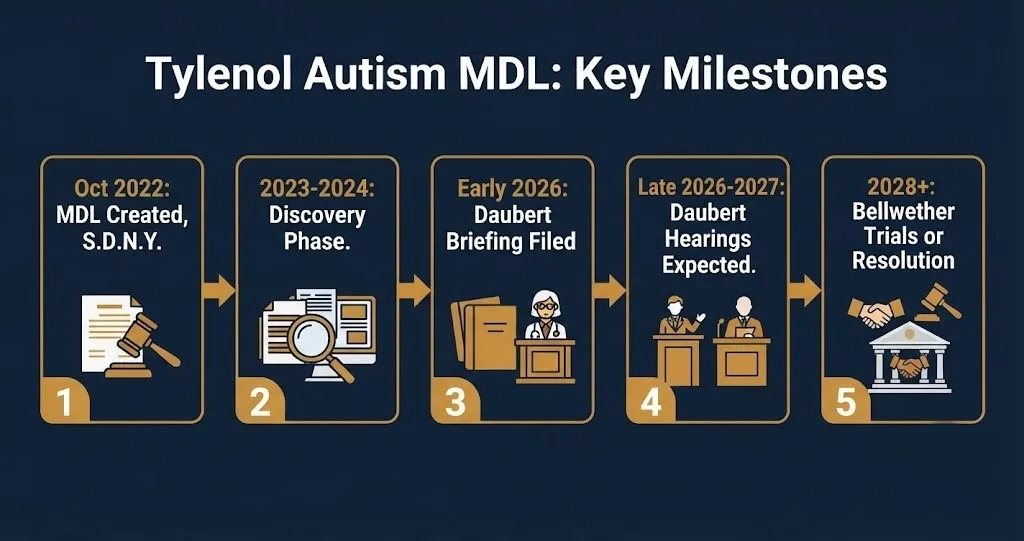
- October 2022: The Judicial Panel on Multidistrict Litigation creates MDL No. 3043 and assigns it to Judge Denise Cote in the Southern District of New York. Roughly 20 cases are initially consolidated.
- Early 2023: Judge Cote issues initial case management orders. Leadership counsel is appointed for plaintiffs and defendants. The number of filed cases grows into the hundreds.
- Mid to Late 2023: Fact discovery begins. Plaintiffs submit plaintiff fact sheets detailing exposure and diagnosis. The case count exceeds 1,000.
- 2024: The parties begin expert discovery on general causation. Both sides designate expert witnesses in epidemiology, toxicology, and related fields.
- 2025: Expert reports are exchanged. Depositions of expert witnesses begin. The number of filed cases exceeds 1,500.
- Early 2026: The parties brief Daubert motions. Each side moves to exclude the other’s expert witnesses. Briefing is completed in the first half of 2026.
- Mid-2026 (Current): The court reviews Daubert briefing. No hearing date has been set, but a hearing is expected within the next six to twelve months. No settlement discussions of substance have been reported.
What Happens Next: The Road Ahead for the Tylenol MDL
- Late 2026 to Mid-2027: Daubert hearings held. Judge Cote hears oral argument on the admissibility of expert testimony. A written ruling follows weeks to months later.
- Mid to Late 2027: If general causation experts are admitted, the case moves to bellwether trial selection. A small number of representative cases are chosen.
- Late 2027 to 2028: Bellwether trials begin. Verdicts provide the first real data on case value and jury receptivity.
- 2028 and Beyond: If bellwether verdicts favor plaintiffs, global settlement negotiations begin in earnest. If they favor defendants, the litigation may collapse or continue case by case.
This timeline assumes the litigation survives Daubert. If Judge Cote excludes the plaintiffs’ general causation experts, the timeline collapses. The cases would be dismissed or remanded with little value. That outcome is possible. No one, including the attorneys on both sides, knows how Judge Cote will rule.
What Is an MDL and How Is It Different From a Class Action?
An MDL, or multidistrict litigation, is a federal procedure that consolidates similar lawsuits from across the country into one court for pretrial proceedings. It is different from a class action in ways that matter for anyone considering filing a claim.
In a class action, one or a few named plaintiffs represent a large group of similarly situated people. If the class action settles, every class member who does not opt out is bound by the settlement and receives a share of the fund. In an MDL, each plaintiff files an individual lawsuit. Each case retains its own identity. If the MDL settles, each plaintiff’s case is evaluated individually, and payouts vary based on the specific facts of each case.
The Tylenol litigation is an MDL, not a class action. That means you cannot wait for a settlement notice in the mail and fill out a claim form. You must affirmatively hire an attorney and file your own lawsuit. If the MDL later settles, your attorney will present your individual case for inclusion in the settlement.
Think of it like a group of people all buying the same defective car. In a class action, one lawsuit covers everyone, and a judge approves a common settlement. In an MDL, everyone files their own lemon law claim, but they all share discovery and pretrial rulings. The individual claims are stronger, but they require more individual effort.
Frequently Asked Questions
Is there a Tylenol autism class action lawsuit?
No. The litigation is an MDL, not a class action.
Each plaintiff files an individual lawsuit that is consolidated for pretrial proceedings.
There is no class to join by signing a form.
Has Tylenol been recalled because of autism concerns?
No. The FDA has not recalled acetaminophen products.
The FDA reviewed the available studies and found the evidence inconclusive.
Acetaminophen remains available over the counter.
What proof do I need to join the Tylenol lawsuit?
You need a confirmed autism or ADHD diagnosis for your child.
You need documentation of acetaminophen use during pregnancy.
Pharmacy records, medical records, and a detailed timeline are required.
How long will the Tylenol lawsuit take?
Years. The MDL is still in the Daubert phase.
If the litigation survives, bellwether trials are not expected before late 2027.
A global settlement, if it happens, is likely a 2028 event at the earliest.
Can I still file a Tylenol autism lawsuit in 2026?
Yes. New cases are still being accepted.
No deadline or statute of limitations bar has been set by the MDL court.
Consult an attorney promptly because state statutes of limitations vary.
How much does it cost to file a Tylenol lawsuit?
You should pay nothing upfront.
Mass tort attorneys work on contingency.
They take a percentage of any recovery, typically 33 to 40 percent.
What if I took generic acetaminophen, not Tylenol brand?
Generic acetaminophen cases are included in the MDL.
Retailers like Walmart, CVS, and Walgreens are named as defendants.
The active ingredient, not the brand name, is what matters.
Will taking Tylenol during pregnancy definitely cause autism?
No. The science shows association, not proven causation.
Most children exposed prenatally do not develop autism.
Multiple factors, including genetics, contribute to autism risk.
The Tylenol autism litigation is real, active, and unresolved. If your child has an autism or ADHD diagnosis and you used acetaminophen during pregnancy, you may have a claim worth discussing with a qualified attorney. If you are reading this because you saw an ad promising a settlement check, understand that no settlement exists yet and no check is coming soon.
The single most important event to watch is Judge Cote’s Daubert ruling on the admissibility of expert testimony. That ruling will determine whether this litigation moves toward trials and potential settlement or collapses under the weight of its own scientific burden. No one knows the answer yet. The court will tell us, likely within the next year.