Wrongful Death Lawsuit Payout 2026: What the Verified Data Actually Shows
Quick Answer
- Wrongful death payouts are real, but no government agency tracks an official national average.
- The only federal court median is $961,000 for jury awards, from older trial data.
- Most states allow two years from the death. Tennessee allows only one year.
A wrongful death lawsuit payout has no official average. Settlements are private, and no government registry counts them. That surprises people who’ve seen headlines promising millions.
This guide is for families whose loved one died because of someone else’s negligence. The number that matters most is your state’s filing deadline, usually two years from the death. Claims against government bodies can carry notice deadlines measured in months.
You’ll get verified benchmarks, state caps, tax rules, and a plain answer on who gets paid. One surprise: the most-quoted online average traces back to no named source.
| The Facts | Detail |
|---|---|
| Case | No single case: a general guide to wrongful death claims in all states |
| Status | No official national average exists |
| Fund Size | Not applicable, each claim is separate |
| Est. Per Person | Not yet determined, varies by case. Only federal median: $961,000 (2001 trials) |
| Claim Deadline | Two years in most states, one year in Tennessee |
| Administrator | None. Claims go through insurers and courts |
| Proof Needed | Death certificate plus proof of fault and loss, per your state’s rules |
What is the average wrongful death lawsuit payout in 2026?
There is no official average, because settlements are private and no government registry tracks them.
That’s the first fact most competing pages bury. They lead with a dollar figure and hope you won’t ask where it came from.
Two benchmarks hold up. The Bureau of Justice Statistics found a $961,000 median wrongful death jury award across 452 trials, and plaintiffs won 36 percent of them. A 2024 analysis of National Practitioner Data Bank reports put the median malpractice payment in death cases at $295,000.
Both numbers carry caveats. The jury figure comes from 2001 trial data, and the federal survey was discontinued after 2005. The malpractice figure covers only one type of case.
Treat any single average as a rough signal. It isn’t a prediction for your claim.
Where does the $973,054 wrongful death settlement average come from?
It traces to an anonymous settlement-calculator site that never published a methodology or case list.
A June 2026 data review found no government agency or named research group behind the figure. From the calculator page, it spread to law firm sites and AI-generated answers.
Why does it stick? It sits close to the $961,000 federal median, so it looks plausible. But a median of jury awards isn’t an average of settlements.
If an AI summary hands you $973,054, treat it as unverified. Ask for the source. If there isn’t one, you’ve learned something about the page.
Here’s what you can check instead:
- The Bureau of Justice Statistics Civil Justice Survey (452 wrongful death trials)
- National Safety Council and NHTSA per-death cost tables
- Your state’s wrongful death statute
- IRS rules on settlement taxation
Why do law firm pages list different wrongful death payout ranges?
They disagree because each range is a marketing estimate, not a published dataset.
| Page type | Range it claims |
|---|---|
| North Carolina law firm page | $250,000 to $750,000 |
| San Francisco law firm page | $500,000 to $1 million (framed as national) |
| Pennsylvania law firm page | $1 million to $1.5 million |
| Legal-news site | $1 million to $3 million |
That’s a four-way spread on one question. It’s like quoting an average home price without naming the city.
Averages mislead in another way. If four cases settle for $50,000 and one settles for $1 million, the average is $240,000. Nobody in that group received $240,000.
Medians and ranges tell you more than a mean. Even then, they describe other families’ cases, not yours.
Key Takeaway: No official average exists, so any single dollar figure without a named source is a guess.
How much is a wrongful death lawsuit worth in the official data?
Official benchmarks run from $961,000 to $14.39 million, and they measure different things.
| Benchmark | Figure | What it measures |
|---|---|---|
| BJS median jury award (2001 trials) | $961,000 | Median award in wrongful death trials plaintiffs won |
| NHTSA economic cost per traffic death (2019 data) | $1.6 million | Discounted lifetime economic cost |
| NSC economic cost per death (2024 data) | $2.05 million | Wage, medical, administrative, and property losses |
| NHTSA with quality-of-life value (2019 data) | $11.3 million | Economic cost plus valued life-years |
| NSC with quality-of-life value (2024 data) | $14.393 million | Economic cost plus valued lost quality of life |
None of these is a settlement offer. They’re the economics a negotiation is built on.
The gap isn’t a contradiction. Courts reward what gets proven and collected. The larger figures describe what a death costs society, and NSC warns against reading them as the impact of past crashes.
Insurance limits often decide the real number. A typical at-fault driver carries limits far below any figure above. You can’t pour more water than the glass holds, so many real settlements close at six figures or below.
Reality Check: No insurer, court, or website can promise you a payout before the evidence is in. Treat any guaranteed number, or any stranger who contacts you first about “your claim,” as a red flag. Quoted averages describe other families, not yours.
What factors change a wrongful death payout?
Payout size depends on the victim’s age and income, the cause of death, available insurance, and state law.
- Age and earning potential: these drive the lost-income calculation.
- Cause of death: a medical malpractice death, a car crash, and a product defect follow different rules and insurers.
- Surviving family: spouse, children, and parents shape who claims losses.
- Insurance and assets: coverage limits cap what’s collectable.
- State law: caps, eligible claimants, and allowed damages vary.
- Liability evidence: a clear case of fault supports a stronger negotiation.
Damages usually fall into economic, non-economic, and sometimes punitive categories. Economic damages cover lost income, support, and expenses such as funeral and medical costs. Non-economic damages cover losses like companionship and guidance.
Jurisdiction can change the whole picture. The same facts can produce very different outcomes in two states.
Which states cap wrongful death payouts?
A handful of states cap wrongful death damages, and most states have no general cap.
Caps limit what a jury may award, not what parties may agree to in a settlement. They still set the ceiling both sides negotiate under.
| State | 2026 value | What it covers |
|---|---|---|
| California | $650,000 | Noneconomic damages in medical malpractice deaths. Rises $50,000 a year to $1 million by 2033 |
| Maryland | $965,000 | Noneconomic damages in all wrongful death cases arising Oct. 2025 to Sept. 2026. $1,447,500 with two or more beneficiaries |
| Indiana | $1.8 million | Total recovery in medical malpractice only. Provider pays first $500,000 |
| Colorado | $2.125 million | Noneconomic damages in general wrongful death actions filed 2025 or later. $810,000 for malpractice deaths in 2026 |
| Virginia | $2.7 million | Total medical malpractice recovery for acts July 2025 to June 2026. Rises yearly to $3 million by 2031 |
Treat every row as a snapshot. Maryland adds $15,000 each October, so deaths on or after October 1, 2026 sit under a higher figure than the one shown. Virginia steps up each July, and California each January. Confirm the current number in the statute.
Government defendants add another limit. Many states cap claims against public entities lower and require notice within months.
Key Takeaway: Caps limit jury awards, not settlements, and most states have no general cap on wrongful death damages.
Can punitive damages increase a wrongful death payout?
Punitive damages can raise a payout, but only where state law allows them and the conduct was extreme.
In some states, punitive damages aren’t available in wrongful death cases at all. Alabama is the unusual case. Its courts have read the statute to allow only punitive damages.
Where they exist, they target reckless or malicious behavior. Massachusetts, for example, ties them to malicious, willful, wanton, or reckless conduct. Ordinary carelessness generally doesn’t support them.
Their purpose is to punish the defendant, not to compensate the family. That purpose is why the tax code treats them differently.
Expect them to be the exception rather than the rule. Most payouts you’ll read about are compensatory.
What comes out of a wrongful death payout before families get paid?
Attorney fees, case costs, and liens come out before beneficiaries receive their shares.
The headline settlement is the gross figure. Think of a paycheck: the number on the offer letter isn’t the deposit.
This report didn’t verify a standard fee percentage, because fee agreements vary by contract and state. Ask for the percentage in writing. Ask whether costs come out before or after the fee.
Here’s what can reduce the amount you receive:
- The attorney fee
- Case costs such as filing fees and experts
- Liens against the recovery
- Estate creditors, who may reach survival action proceeds
- Court-ordered allocation when minors are beneficiaries
After a signed release, payment usually follows within four to six weeks. Deductions come out of that amount.
Is a wrongful death payout taxable?
Compensatory wrongful death damages are excluded from federal income tax under IRC section 104(a)(2).
| Part of the payout | Federal tax treatment |
|---|---|
| Compensatory damages | Excluded under IRC 104(a)(2) |
| Punitive damages | Taxable in most states |
| Punitive damages in Alabama-type systems | Excluded under IRC 104(c) |
| Interest on a judgment | Taxable |
The exclusion applies whether you receive a lump sum or periodic payments. A structured settlement changes your control and risk, not the tax answer.
The IRS says punitive damages aren’t excludable. The one exception covers states where law allowed only punitive damages in wrongful death cases. State income tax usually follows the federal rule.
How the settlement papers allocate the money matters. Estate-side questions, such as creditor access, are state law.
Key Takeaway: Compensatory wrongful death damages aren’t federally taxed, but punitive damages and interest usually are.
Who gets the money in a wrongful death settlement?
State law decides who gets paid, usually the spouse, children, and sometimes parents, in shares set by statute.
The will doesn’t control this. Some states divide money in fixed shares in priority order. Others divide it by each survivor’s proven loss.
Courts commonly approve the split. Approval is almost always required when minors are beneficiaries.
Who files matters too. In Pennsylvania, the estate’s personal representative must file the case. Other states set their own rules.
The line between the wrongful death claim and the survival action decides whether estate creditors can reach part of the money. This is where families most often need state-specific guidance rather than a national rule of thumb.
How long do you have to file a wrongful death lawsuit?
Most states allow two years from the death, but Tennessee allows only one year.
| Jurisdiction | Filing rule |
|---|---|
| Most states | Two years from the death |
| Tennessee | One year (Tenn. Code 28-3-104) |
| Kentucky | One year from the date the personal representative is appointed |
| Louisiana | One year from death or two years from the injury, whichever is longer (Act 176, effective August 1, 2025). Medical malpractice deaths stay at one year from death |
| Pennsylvania | Two years |
| Connecticut | Two years, with a general five-year limit from the act |
| New York | Two years |
| Some other states | Three years |
Many pages still say Louisiana allows only one year. The legislature’s own records show Act 176 changed that for most cases.
A missed deadline is like a store return window. The reason doesn’t matter once the day passes.
Two traps catch families. Claims against government bodies can require notice within months. And the underlying injury claim may have to be timely at the time of death in some states.
How do you file a wrongful death claim?
You file through the estate’s personal representative in many states, either by insurance claim or by lawsuit.
Here are the usual steps:
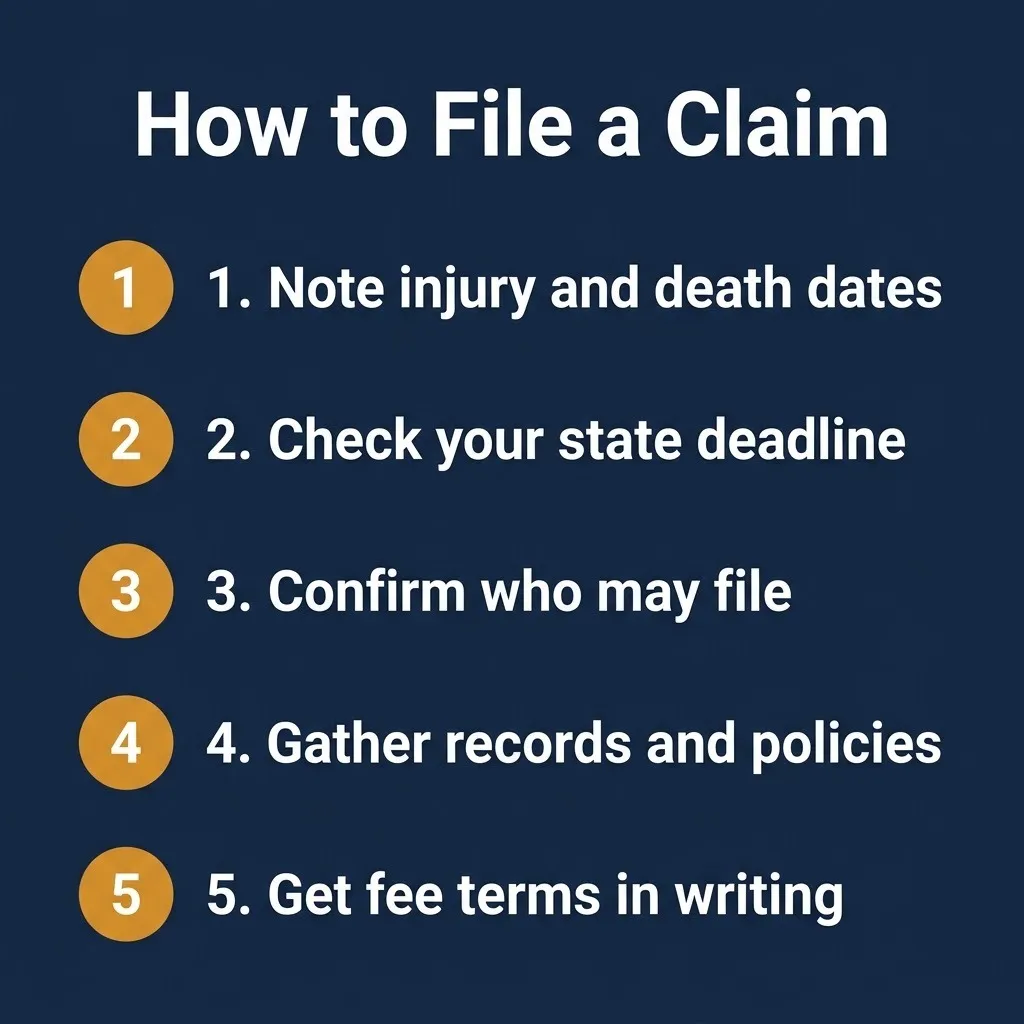
- Write down the date of the injury and the date of death.
- Look up your state’s filing deadline in the statute.
- Find out who may file in your state.
- Collect the death certificate, medical records, and any incident reports.
- Locate every insurance policy that might apply, and note the limits.
- Check whether a government body is involved, since notice deadlines can be short.
- Get any fee agreement in writing before you sign.
Some families recover through an insurance claim without filing suit. Others file when talks stall or deadlines near.
Steps one and two come first for a reason. Everything else depends on the clock.
Key Takeaway: Start with your state’s deadline, then gather records and insurance information before any negotiation begins.
How long does a wrongful death settlement take?
Most cases take one to three years, and payment follows a signed release in about four to six weeks.
| Stage | Typical timing |
|---|---|
| Whole case, start to resolution | One to three years |
| Litigated case to trial disposition | About 23 months (median, last national study) |
| Payment after a signed release | Usually four to six weeks |
Clear-liability cases can settle in months. Disputed cases, especially medical ones, run longer.
Court approval can add time when minors are beneficiaries. So can disputes over who the beneficiaries are.
Fees and liens come out of the payment after it arrives. Plan around the net amount, not the headline figure.
Do most wrongful death cases settle or go to trial?
Most wrongful death cases settle, since roughly 96 percent of tort cases end without a trial.
Trials produce the big headlines, but few families get one. In the last federal survey, plaintiffs won 36 percent of the wrongful death trials that did happen.
A trial adds years, costs, appeal risk, and a real chance of zero. Settling is like taking a fixed-price quote instead of a bid that could come in at nothing.
Both sides price a settlement against that verdict risk. That’s why the negotiation, not the courtroom, produces almost every outcome.
What changed for wrongful death payouts in 2026?
Four developments matter: Maryland’s repeal effort stalled, New York’s reform was vetoed again, Louisiana’s deadline changed, and traffic deaths fell.
- Maryland: House Bill 476, which would repeal the noneconomic damages cap, went to interim study on March 21, 2026. Its Senate companion, SB 474, shows as dead as of April 13, 2026. The cap stands.
- New York: Governor Hochul vetoed the Grieving Families Act for the fourth time in December 2025. Earlier versions would have allowed damages for emotional grief and stretched the filing window to three years and six months. She says she wants a substantial narrowing.
- Louisiana: Act 176 took effect August 1, 2025, with the one-year-or-two-years rule described above.
- Traffic deaths: NHTSA’s early estimate is 36,640 deaths in 2025, down 6.7 percent from 39,254 in 2024.
Check these against your state’s current statute. Legislatures keep moving the numbers.
Key Takeaway: Caps and deadlines change by year and by state, so confirm your state’s current rule before relying on any chart.
What’s the difference between a wrongful death claim and a survival action?
A wrongful death claim covers the family’s own losses, while a survival action covers what the deceased could have claimed.
Wrongful death damages compensate the family for lost support, services, and companionship. Survival damages belong to the estate. They can include pre-death medical bills, lost wages, and in some states conscious pain and suffering.
Most states allow both claims. Settlements usually resolve them together, sometimes under different caps.
The split matters for your net amount. Survival proceeds pass through the estate, where creditors can reach them. Wrongful death proceeds often don’t.
What Happens Next
- Now: Write down the dates of injury and death, then look up your state’s deadline.
- Expected, first weeks to months: Gather the death certificate, records, and every insurance policy.
- Expected, months to years: Investigation, claim filing, and negotiation with insurers.
- Expected, one to three years: Most cases resolve, by settlement or trial.
- After a signed release: Payment usually follows in four to six weeks, minus fees and liens.
Frequently Asked Questions
What is the average payout for a wrongful death lawsuit?
No official national average exists, because settlements are private.
The best verified benchmarks are a $961,000 median jury award and a $295,000 median malpractice death payment.
Both describe other cases, not yours.
Is a wrongful death settlement taxable?
Compensatory damages aren’t taxed federally under IRC section 104(a)(2).
Punitive damages and interest are taxable, with a narrow Alabama-type exception for punitive damages.
How long do I have to file a wrongful death lawsuit?
Most states allow two years from the death, but Tennessee allows one year.
Kentucky runs from the personal representative’s appointment, and Louisiana uses a one-or-two-year rule.
Who gets the money in a wrongful death settlement?
Statutory beneficiaries do, usually the spouse, children, and sometimes parents.
State law sets the shares, and courts commonly approve the split.
How long does a wrongful death settlement take?
Most cases take one to three years.
After a signed release, payment usually follows in four to six weeks.
Is there a cap on wrongful death payouts?
Settlements aren’t capped, but some states cap what a jury may award.
California, Maryland, Colorado, Indiana, and Virginia have caps with different scopes.
Do you need a criminal conviction to file a wrongful death lawsuit?
No, a conviction isn’t required to bring a civil wrongful death case.
Civil cases use a lower burden of proof than criminal trials.
Check your state’s statute today and calendar the deadline. Then gather the death certificate, medical and incident records, and every insurance policy that might apply.
Skip any page that quotes a payout without naming its source. Most states give you two years from the death. Tennessee gives you one year.