Gabapentin Lawsuit 2026: Latest Updates, Claims, and How to Join
Quick Answer
- The gabapentin lawsuits are real. Multiple federal cases are consolidated in multidistrict litigation.
- No settlement has been reached. No per-person payout amount has been determined.
- There is no deadline to join. Attorneys are still accepting clients for individual lawsuits, not a class action.
If you took gabapentin (brand name Neurontin or generic) and experienced serious side effects that were not adequately warned about, you may be eligible to file an individual claim. This is not a class action with a single claim form. It is a mass tort, which means each case is filed separately but managed together for efficiency.
This article tracks every verified detail about the gabapentin litigation as of August 2026. You will find what the lawsuits allege, who may qualify, what side effects are involved, how to find an attorney, and what timeline to expect. Every fact comes from federal court records, FDA communications, and verified legal filings, not marketing pages from law firms.
The Facts
| Case | In re: Gabapentin Product Liability Litigation (MDL) |
| Status | Active litigation. No global settlement reached. |
| Fund Size | Not yet confirmed |
| Est. Per Person | Not yet determined |
| Claim Deadline | No deadline. Cases accepted on rolling basis. |
| Administrator | Not yet appointed |
| Proof Needed | Medical records, prescription history, diagnosis of alleged injury |
Is the Gabapentin Lawsuit Real?
Yes. The gabapentin litigation is real. It is not a single lawsuit. It is a collection of hundreds of individual product liability cases filed against the manufacturers of gabapentin, including Pfizer (Neurontin) and several generic manufacturers.
The federal cases have been consolidated into multidistrict litigation, or MDL. MDL is a procedure that groups similar cases before one judge for pretrial proceedings. It is not a class action. Each plaintiff keeps their own case. Each case rises or falls on its own facts.
The MDL is active. Discovery is underway. Bellwether trials, which are test cases used to gauge how juries respond to the evidence, have not yet been scheduled as of mid-2026.
This litigation is separate from the older Neurontin off-label marketing cases that settled years ago. Those cases were about improper promotion. These cases are about the drug itself and what the manufacturers allegedly knew and did not disclose about its risks.
Key Takeaway: The litigation is real and active in federal court. It is not a scam. It is also not a settlement you can sign up for with a simple online form.
What Is the Gabapentin Lawsuit About?
The lawsuits allege that long-term gabapentin use causes serious side effects that the manufacturers knew or should have known about but failed to adequately warn patients and doctors.
The central claims involve neurological damage, movement disorders, cognitive impairment, and physical dependence. Plaintiffs argue the warning labels did not reflect the true risk profile of the drug, especially for patients taking it for off-label conditions at high doses over long periods.
Some complaints focus on gabapentin’s effects on the brain’s ability to form new synapses. The drug was designed to mimic the neurotransmitter GABA. Plaintiffs allege that long-term use can disrupt normal brain function in ways the manufacturers did not adequately study or disclose.
Other cases focus on withdrawal. Gabapentin withdrawal can be severe, with symptoms including anxiety, agitation, confusion, and seizures. Plaintiffs argue the label downplayed this risk and that doctors were not adequately informed that tapering protocols might not prevent serious withdrawal.
The legal theories in most complaints include failure to warn, design defect, negligence, and in some cases, fraudulent concealment. Some lawsuits also name pharmacy benefit managers and prescribing physicians, though the majority target manufacturers.
Why Are People Suing Over Gabapentin?
People are suing because they took a prescribed medication and experienced side effects they say were never properly disclosed. The specific injuries alleged in the litigation include several categories.
Movement disorders are a central claim. Some long-term users developed tardive dyskinesia, a condition involving involuntary repetitive movements, or drug-induced parkinsonism, with symptoms resembling Parkinson’s disease.
Cognitive impairment is another major claim. Plaintiffs report memory loss, difficulty concentrating, word-finding problems, and brain fog that persisted or worsened with continued use and did not fully resolve after stopping the drug.
Physical dependence and withdrawal injury are alleged across many cases. Some plaintiffs say they were never warned that gabapentin could cause dependence similar to benzodiazepines or that withdrawal could require months of supervised tapering.
Mood and behavioral changes, including new or worsening depression, anxiety, and in rare cases, suicidal ideation, are cited in several complaints.
Some cases allege kidney damage, though this claim is less central to the MDL and more common in separate state-level filings.
The unifying theme is that patients took a drug their doctor prescribed, often for off-label uses like anxiety, insomnia, or chronic pain, and suffered harm they say could have been avoided with better warnings.
What Side Effects Are Involved in the Gabapentin Lawsuits?
The lawsuits focus on a specific set of serious, lasting side effects. Not every person who took gabapentin experienced these. The litigation is for people who did.
- Tardive dyskinesia or drug-induced movement disorders
- Parkinsonism (tremors, rigidity, gait disturbance)
- Cognitive decline, memory impairment, brain fog
- Severe withdrawal symptoms upon discontinuation
- Physical dependence requiring extended medical tapering
- Mood changes, anxiety, depression, suicidal thoughts
- Kidney injury (in some separate state court cases)
Common side effects like dizziness or drowsiness are not the subject of these lawsuits. The cases target serious, disabling, or permanent conditions that plaintiffs say the manufacturers knew about but did not adequately disclose.
Each plaintiff’s medical records must document the diagnosis. A causal link between gabapentin and the injury must be supported by expert testimony. This is not a case where anyone who took the drug automatically qualifies.
Key Takeaway: The litigation is about serious, lasting harm, not common or temporary side effects. You need a specific diagnosis and medical evidence to participate.
What Is the Difference Between Class Action and Mass Tort?
The gabapentin litigation is a mass tort, not a class action. This distinction matters for how you participate, how your case is valued, and what you may recover.
In a class action, one or a few plaintiffs represent a large group. Everyone in the group is bound by the outcome. Payouts are typically uniform or tiered based on broad categories. You fill out a claim form and wait for a check.
In a mass tort, each plaintiff files their own individual lawsuit. The cases are grouped for pretrial efficiency, but each case is separate. Your recovery depends on your specific facts: your dosage, your duration of use, your diagnosis, your medical costs, your lost wages, your pain and suffering.
Mass torts typically produce higher per-person recoveries than class actions for serious injury cases. They also require more individual proof. You cannot simply check a box. You must provide medical records, employment records, and often a deposition.
This is not like filing a claim for a data breach settlement where you submit your email and receive $45. This is a serious legal process that requires an attorney and a documented injury.
How Do I Join the Gabapentin Lawsuit?
You join by contacting a product liability law firm and having your case evaluated. There is no central sign-up form. There is no government portal.
The process follows predictable steps.
- Contact a law firm that handles pharmaceutical mass torts. Most offer free case evaluations.
- Provide your medical records and prescription history. The firm reviews whether your diagnosis matches the litigation.
- The firm confirms the manufacturer of the gabapentin you took. Brand name Neurontin is made by Pfizer. Generic versions come from multiple manufacturers.
- If you have a viable claim, the firm drafts and files an individual complaint in the appropriate federal or state court.
- Your case is coordinated with the MDL or a state-level consolidated proceeding.
- Discovery proceeds. You may need to provide a deposition and authorize release of medical and pharmacy records.
- Your case is eventually resolved by settlement, summary judgment, or trial.
You do not pay upfront fees. These cases are handled on contingency. The firm covers case costs and takes a percentage of any recovery, typically 33% to 40% depending on the stage at which the case resolves.
Reality Check: Law firms advertising for gabapentin clients are screening for specific injuries with documented medical evidence. Calling a lawyer does not guarantee you have a case. Many people who call are told they do not qualify. This is not a mass claims process where everyone gets something. This is litigation with evidence requirements and legal standards of proof. If a firm promises you a specific dollar amount before reviewing your medical records, treat that promise as a red flag.
What Do Lawyers for Gabapentin Lawsuits Look For?
Lawyers are screening for a specific fact pattern. Not every gabapentin user fits.
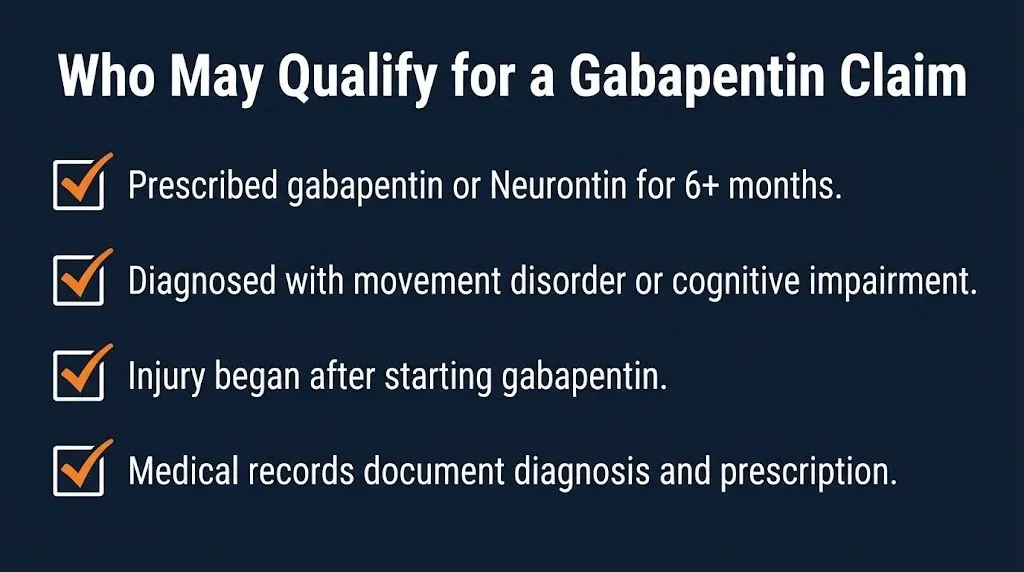
You must have a current or past prescription for gabapentin or Neurontin. Pharmacy records must confirm this. The duration of use matters. Most firms are looking for use of six months or longer, often at doses of 600 mg per day or more.
You must have a documented diagnosis of one of the injuries alleged in the litigation. A movement disorder diagnosis from a neurologist is strong evidence. Cognitive impairment documented by neuropsychological testing is strong evidence. A vague complaint of brain fog with no medical record is not enough.
The timeline must support causation. Your diagnosis should have occurred after you started taking gabapentin. Injuries that predate your first prescription are not part of these cases.
Other potential causes of your injury must be ruled out or minimized. If you have a history of Parkinson’s disease in your family, or if you took other medications known to cause movement disorders, your case becomes more complicated.
Age matters. Younger plaintiffs with longer life expectancies and higher economic damages typically have higher-value cases.
How Much Is the Gabapentin Settlement Worth?
No global settlement has been reached. No per-case payout amount exists. Any figure you see online is speculation.
What can be said is that pharmaceutical mass tort settlements follow patterns. In cases involving serious, permanent neurological injury, individual case values can range significantly depending on the strength of the evidence.
Here is what typically influences case value in litigation like this.
| Factor | Impact on Case Value |
|---|---|
| Severity and permanence of injury | Higher severity = higher value |
| Strength of medical evidence | Clear diagnosis and causation = higher value |
| Age of plaintiff | Younger plaintiffs = higher economic damages |
| Duration and dosage of gabapentin use | Longer use at higher doses = stronger causation |
| Off-label vs. on-label use | Can affect warning label arguments |
| Venue and presiding judge | Some jurisdictions are more plaintiff-friendly |
| Defendant manufacturer | Different defendants have different settlement postures |
These are general factors. No dollar amounts can be attributed to any of them until bellwether trials produce verdicts or the defendants enter global settlement negotiations.
What Is the Statute of Limitations for Gabapentin Lawsuits?
The statute of limitations varies by state. Most states allow two to three years from the date you knew or should have known that your injury was linked to the drug.
The discovery rule applies in pharmaceutical cases. The clock does not start running on the day you took your first pill. It starts when you were diagnosed with the injury and had reason to connect it to gabapentin.
For many plaintiffs, this connection came after reading news coverage of the litigation or after a doctor suggested the link. If you were diagnosed with drug-induced parkinsonism in 2024 and only learned in 2026 that gabapentin may have caused it, your clock may have started in 2026.
This is state-specific and fact-specific. Only a lawyer reviewing your specific timeline can tell you whether you are within the statute of limitations. Do not assume you missed a deadline without checking.
For wrongful death claims, the clock typically starts on the date of death. These deadlines are rigid. If you lost a family member who took gabapentin and had a qualifying injury, contact a firm promptly.
Is Gabapentin Still Being Prescribed?
Yes. Gabapentin remains widely prescribed. It is on the World Health Organization’s List of Essential Medicines. The FDA has not withdrawn approval. No recall has been issued.
Gabapentin is approved for postherpetic neuralgia (pain after shingles) and as an adjunctive therapy for partial-onset seizures. It is the approved indications that are narrow. Its actual use is broad.
An estimated 80% to 90% of gabapentin prescriptions are written for off-label uses. Anxiety, insomnia, chronic pain, fibromyalgia, migraine prevention, bipolar disorder, and alcohol use disorder are among the most common. The lawsuits do not allege off-label use is inherently wrong. They allege the risks of long-term use were inadequately disclosed regardless of indication.
The FDA has issued safety communications about gabapentin and respiratory depression, particularly when combined with opioids or in patients with underlying respiratory conditions. In 2019, the FDA required new warnings about serious breathing difficulties. The agency has not issued a specific warning about movement disorders or cognitive impairment as of mid-2026.
Key Takeaway: The drug is still available and prescribed. The litigation concerns past use and past warnings. Do not stop taking gabapentin without consulting your doctor.
What Is the Status of the Gabapentin MDL in 2026?
The MDL is in the discovery phase. This is the fact-gathering stage where both sides exchange documents, take depositions, and build their cases.
The MDL was formed to handle the growing number of federal cases efficiently. One judge oversees all pretrial matters. This avoids conflicting rulings and streamlines the process for both sides.
Discovery is extensive. Plaintiffs’ lawyers are seeking internal Pfizer documents, pharmacovigilance data, adverse event reports submitted to the FDA, and communications with generic manufacturers. Defendants are reviewing each plaintiff’s medical and pharmacy records.
No bellwether trial dates have been set. Bellwethers are test trials selected by both sides to see how juries react. The outcomes of bellwether trials often drive settlement negotiations. Until bellwethers are scheduled and tried, a global settlement is unlikely.
Some individual cases may settle before bellwethers. These early settlements are not publicly disclosed and do not establish a per-case value for the broader litigation.
What Happens Next in the Gabapentin Litigation?
The litigation follows a path typical of large pharmaceutical mass torts. Here are the expected stages based on the current posture.
- Late 2026: Discovery continues. Document productions and depositions ongoing.
- Early to mid-2027: Plaintiffs and defendants identify potential bellwether cases.
- Late 2027: First bellwether trials scheduled.
- 2028: Bellwether verdicts. Outcomes may trigger global settlement negotiations.
- 2029 or later: If no settlement, individual cases remanded to their home districts for trial.
These are estimates. Litigation this large rarely moves quickly. Defendants have incentives to test the evidence before committing to settlement. Plaintiffs have incentives to build the strongest possible record. Both sides benefit from the structure the MDL provides.
If a global settlement is reached, a claims process will be established. That process would include eligibility criteria, a claims administrator, filing deadlines, and a review of each claimant’s medical records. That process does not exist today.
Can I Sue for Gabapentin Withdrawal Alone?
Gabapentin withdrawal cases are part of the litigation, but they are legally complex. A withdrawal injury claim typically requires more than discomfort.
Severe withdrawal resulting in medical intervention, hospitalization, seizures, or lasting neurological or psychiatric harm is more likely to support a claim than temporary anxiety or insomnia during tapering.
The label on gabapentin already warns that abrupt discontinuation can cause withdrawal symptoms and recommends gradual tapering. To succeed in a failure-to-warn claim, a plaintiff must show that the label’s warning was inadequate for the injury they actually experienced.
If you followed a doctor-supervised taper and still suffered severe, lasting harm, your claim may be stronger than someone who quit cold turkey against medical advice. Medical records documenting the withdrawal course are essential.
What If I Took Generic Gabapentin?
Generic gabapentin cases are part of the litigation. Generic manufacturers are named as defendants in many complaints.
In 2011, the U.S. Supreme Court ruled in Pliva v. Mensing that generic drug manufacturers cannot be held liable for failure to warn under state law because federal law requires their labels to match the brand-name label. That decision created a barrier for generic drug plaintiffs.
In 2023, the Supreme Court issued a new ruling in Mallory v. Norfolk Southern Railway that opened the door for plaintiffs to sue companies in states where they do business, even if the injury occurred elsewhere. Some lawyers are using this ruling to pursue generic manufacturers in jurisdictions with plaintiff-friendly laws.
The legal landscape for generic drug claims is shifting. The viability of a generic gabapentin case depends on the specific manufacturer, the state where you file, and the legal theories your attorney advances. Some firms are accepting generic cases. Others are not. It depends on their assessment of the evolving case law.
What Evidence Do I Need for a Gabapentin Claim?
The evidence required mirrors what any product liability case demands: proof of use, proof of injury, and proof of causation.
Pharmacy records are the best proof of use. Prescription records show the drug, dosage, prescribing doctor, and dates of use. Medical records documenting gabapentin use during hospital stays or clinic visits also help.
Medical records documenting the injury are essential. A neurologist’s diagnosis of a movement disorder, a neuropsychologist’s report of cognitive impairment, or hospital records from a severe withdrawal episode are all examples.
The temporal relationship matters. Records should show that you started gabapentin, developed the injury afterward, and that other potential causes have been ruled out or are less likely.
Your own testimony matters. You may be asked to describe when you started the drug, why you took it, what symptoms you developed, how those symptoms affected your life and work, and whether any doctor ever discussed these risks with you.
Frequently Asked Questions
Is there a gabapentin class action lawsuit in 2026?
No. The cases are individual lawsuits consolidated as multidistrict litigation.
This is a mass tort, not a class action. Each case is filed separately.
What injuries qualify for the gabapentin lawsuit?
Movement disorders, cognitive impairment, severe withdrawal injuries, and drug-induced parkinsonism.
Medical records must document the diagnosis. Symptoms alone are not enough.
How much does it cost to join the gabapentin lawsuit?
Nothing upfront. Law firms handle these cases on contingency.
You pay only if you recover money. Fees are typically 33% to 40%.
How long will the gabapentin lawsuit take?
Most mass torts take two to four years from filing to resolution.
Bellwether trials may occur in 2028. Settlements often follow bellwether verdicts.
Can I file a lawsuit if I already stopped taking gabapentin?
Yes. Many plaintiffs are former users who developed injuries during or after use.
The statute of limitations applies. Contact a lawyer to confirm you are within the deadline.
What if a family member died after taking gabapentin?
You may have a wrongful death claim. The statute of limitations runs from the date of death.
Contact a law firm to evaluate the case. Survivors include spouses, children, and dependents.
Do I have to stop taking gabapentin to join the lawsuit?
No. Many plaintiffs still take the drug. Do not stop without medical supervision.
Abrupt discontinuation can cause serious withdrawal. Talk to your doctor.
Is there a settlement for gabapentin lawsuits yet?
No. No global settlement has been reached. No claims process exists.
Ignore any website claiming to process gabapentin settlement claims for a fee.
The gabapentin litigation is real. It is active. It is also in the middle stages of a process that will take years to resolve. No settlement. No claim form. No deadline to join yet. What exists are hundreds of individual cases, a federal MDL, and law firms actively evaluating new clients.
If you took gabapentin and received a diagnosis of a movement disorder, cognitive impairment, or another serious condition you believe is linked to the drug, the next step is a single phone call to a product liability firm for a case evaluation. The call costs nothing. The evaluation is free. From that conversation, you will know whether you have a claim worth pursuing or whether you can close this chapter and move on.