Real Estate Litigation Lawyer in 2026: Costs, When to Hire, and What to Expect
Quick Answer:
- A real estate litigation lawyer handles property disputes, contract breaches, and title claims in court.
- Hourly rates typically range from $250 to $750 depending on market and case complexity.
- Most states impose a 2 to 10 year statute of limitations on real estate claims, varying by claim type.
A real estate litigation lawyer represents buyers, sellers, landlords, tenants, developers, and lenders in property-related lawsuits. These attorneys handle disputes that cannot be resolved through negotiation or mediation.
You may need one if you face a boundary dispute, a failed closing, a construction defect, or a breach of a purchase agreement. Acting quickly matters because missing a legal deadline can bar your claim.
This guide explains what these lawyers do, how much they charge, when to hire one, and how to find qualified counsel near you. One surprising fact: many real estate disputes settle before trial, with some studies suggesting over 90 percent never reach a jury.
The Facts
| Case | Not a single case. Covers real estate litigation broadly. |
| Status | Active practice area across all U.S. jurisdictions |
| Fund Size | Not applicable. Individual case damages vary widely. |
| Est. Per Person | Depends on claim value and legal fees |
| Claim Deadline | Varies by state and claim type, often 2 to 10 years |
| Administrator | Not applicable |
| Proof Needed | Contracts, deeds, title reports, correspondence, photos, inspection reports |
What Is a Real Estate Litigation Lawyer?
A real estate litigation lawyer is an attorney who represents clients in property-related lawsuits and legal disputes.
These lawyers handle cases involving purchase agreements, commercial leases, boundary lines, easements, zoning, construction defects, and title defects. They appear in state and federal courts, arbitration hearings, and mediation sessions.
Unlike transactional real estate attorneys who draft contracts and close deals, litigators focus on disputes after a problem arises. Some attorneys do both, but litigation requires courtroom experience and discovery skills.
You may need one whether you own a home, manage commercial property, or hold a mortgage. The lawyer’s job is to protect your legal rights and financial interests when a property dispute escalates.
When Should You Hire a Real Estate Litigation Attorney Near You?
You should hire a real estate litigation attorney as soon as a property dispute involves a legal threat, a formal demand letter, or a filed lawsuit.
Waiting too long can hurt your case. Evidence disappears, witnesses forget details, and legal deadlines pass. The statute of limitations for breach of contract claims is often 4 to 6 years, but some claims have shorter windows.
A lawyer can also help before litigation starts. If you receive a demand letter, a cease and desist notice, or a notice of default, consult counsel immediately.
Signs you need a real estate litigator:
- You received a lawsuit or summons related to property.
- A buyer or seller breached a signed purchase agreement.
- A neighbor is encroaching on your land or blocking an easement.
- A contractor performed defective work and refuses to fix it.
- A title search revealed a competing ownership claim.
- Your commercial tenant stopped paying rent and refuses to leave.
Key Takeaway: Early legal help often prevents a full lawsuit. But if litigation is already filed, hire counsel immediately.
How Much Does a Real Estate Litigation Lawyer Cost in 2026?
Real estate litigation lawyers in 2026 typically charge hourly rates between $250 and $750, with most falling in the $350 to $500 range.
Large firm partners in major cities may bill $800 or more per hour. Solo practitioners and attorneys in smaller markets often charge $200 to $350 per hour.
Most real estate litigators work on an hourly fee basis, not contingency. Some may offer flat fees for discrete tasks like drafting a demand letter or reviewing a settlement agreement. Contingency arrangements are rare in real estate litigation because outcomes are uncertain and damages may be non-monetary.
You will also pay for court filing fees, deposition transcripts, expert witnesses, and document production costs. These expenses can add thousands of dollars to a contested case.
Cost comparison table:
| Fee Structure | Typical Range | When Used |
|---|---|---|
| Hourly rate | $250 to $750 per hour | Most litigation matters |
| Flat fee | $1,500 to $10,000 | Demand letters, limited reviews |
| Retainer | $5,000 to $25,000 upfront | Ongoing litigation |
| Contingency | Rare, 25 to 40 percent | Only in select cases with clear damages |
| Pro bono | No cost | Legal aid for qualifying low-income clients |
Key Takeaway: Expect to pay an upfront retainer and hourly fees. Real estate litigation is rarely free or contingency-based.
How Do You Find a Real Estate Litigation Attorney Near You?
You can find a real estate litigation attorney through state bar referrals, local legal directories, and targeted online searches.
The state bar association in your state maintains a lawyer referral service. Many offer low-cost initial consultations, typically $30 to $50 for a 30-minute session.
You can also search legal directories like Martindale-Hubbell, Avvo, and Justia. Filter for real estate litigation and your city or county. Read client reviews and disciplinary records.
Ask for referrals from real estate agents, mortgage brokers, or title companies. These professionals work with litigators regularly and know who handles cases well.
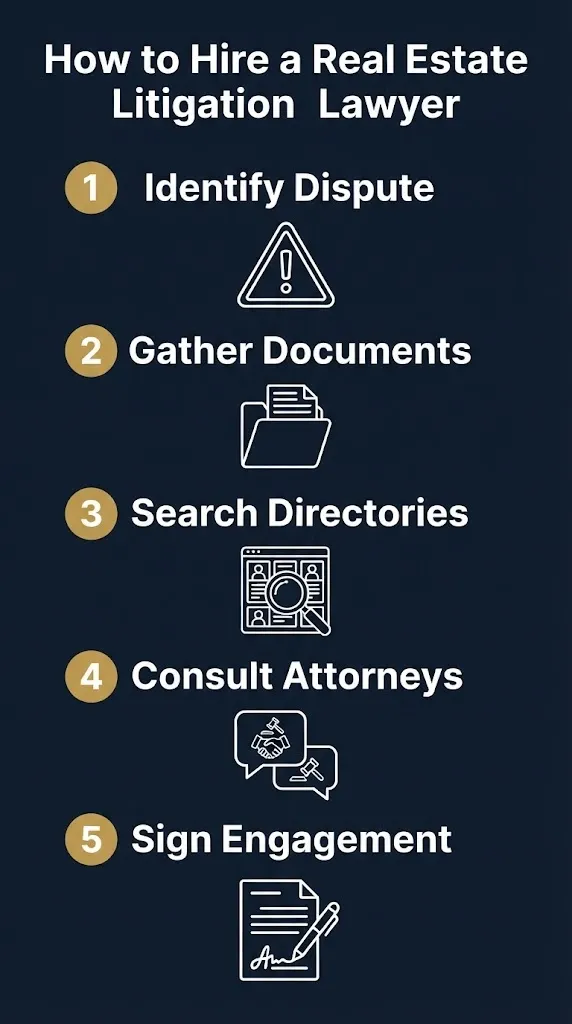
Steps to find qualified counsel:
- Contact your state bar association for a referral.
- Search legal directories with a real estate litigation filter.
- Read attorney profiles, reviews, and disciplinary history.
- Schedule two to three consultations before deciding.
- Ask about case experience, trial record, and fee structure.
What Types of Cases Do Real Estate Litigation Lawyers Handle?
Real estate litigation lawyers handle disputes over property ownership, contracts, land use, and construction.
The most common case types include breach of purchase agreements, boundary and easement disputes, landlord-tenant conflicts, and construction defect claims. Commercial matters also include partnership disputes and commercial lease enforcement.
Some lawyers specialize in specific niches. A condominium dispute attorney handles HOA conflicts. A construction litigator focuses on defect and payment claims. A title litigator handles competing ownership claims.
Your case type determines the relevant law, court, and timeline. A residential boundary dispute may resolve in state court within a year. A complex commercial development dispute can take three to five years.
Common real estate litigation case types:
- Breach of real estate purchase contract
- Boundary line and easement disputes
- Title defects and quiet title actions
- Commercial lease disputes and evictions
- Construction defect claims
- Real estate fraud and misrepresentation
- HOA and condominium disputes
- Zoning and land use appeals
- Partition actions between co-owners
Reality Check: Not every property dispute needs a lawsuit. Mediation or arbitration clauses in many real estate contracts require alternative dispute resolution before court. Read your contract carefully. A lawyer can tell you if litigation is even available.
What Is the Difference Between a Real Estate Litigator and a Transactional Attorney?
A real estate litigator represents clients in disputes and court proceedings.
A transactional real estate attorney handles contracts, closings, and title work without going to court.
The litigator’s work includes drafting complaints, conducting discovery, taking depositions, arguing motions, and trying cases before judges or juries. The transactional attorney’s work includes drafting purchase agreements, reviewing title commitments, and facilitating closings.
Some attorneys do both, but most focus on one side. Litigation requires different skills than transaction work. A closing attorney may not know how to depose a hostile witness. A litigator may not know the latest title insurance standards.
Hire the right type for your situation. If a deal is falling apart and a lawsuit is likely, call a litigator.
Comparison table:
| Feature | Litigator | Transactional Attorney |
|---|---|---|
| Focus | Disputes, lawsuits | Deals, contracts, closings |
| Court appearances | Frequent | Rare or never |
| Fee structure | Hourly, retainer | Flat fee or hourly |
| Typical clients | Buyers, sellers, landlords with disputes | Homebuyers, sellers, developers |
| Outcome | Judgment, settlement | Signed contract, completed closing |
Key Takeaway: Match the attorney to the problem. A dispute needs a litigator. A deal needs a transactional attorney.
What Should You Bring to Your First Meeting With a Real Estate Litigation Lawyer?
Bring every document related to the property and the dispute to your first meeting with a real estate litigation lawyer.
The lawyer will need the purchase contract, deed, title report, mortgage documents, survey, inspection reports, and all correspondence with the other party.
Emails and text messages matter. Courts treat them as evidence. Print or save everything before your meeting.
Photos and videos of property conditions help too. If you have repair estimates, appraisals, or expert reports, bring those as well.
Document checklist for your first meeting:
- Signed purchase agreement or lease.
- Deed and title insurance policy.
- Property survey and boundary documents.
- Mortgage and loan documents.
- Inspection reports and repair estimates.
- Photos or videos showing the problem.
- All emails, texts, and letters with the other party.
- Any court papers you received.
- Your notes on dates and conversations.
How Long Does a Real Estate Lawsuit Take?
Most real estate lawsuits take 12 to 24 months to resolve, but complex cases can last three to five years.
The timeline depends on the court’s docket, the complexity of the issues, and whether the parties settle early. A simple breach of contract claim might settle in six months. A construction defect case with multiple defendants can drag on for years.
Discovery is often the longest phase. Document production, depositions, and expert reports take months. Courts schedule hearings and trials based on available dates, which can add delays.
You can speed things up by responding promptly to your lawyer’s requests, organizing documents early, and staying reachable. You cannot control the court calendar.
Timeline by case type:
| Case Type | Typical Duration |
|---|---|
| Residential boundary dispute | 6 to 18 months |
| Breach of purchase contract | 9 to 18 months |
| Commercial lease dispute | 12 to 24 months |
| Construction defect claim | 18 to 36 months |
| Complex multi-party development dispute | 36 to 60 months |
Key Takeaway: Plan for a long process. Even a “fast” real estate lawsuit takes months, not weeks.
Can You Sue Your Real Estate Agent for Misrepresentation?
Yes, you can sue your real estate agent for misrepresentation if the agent made false statements that caused you financial harm.
Common claims include failure to disclose known defects, misrepresenting property boundaries, or concealing material facts about the neighborhood or property condition.
To win, you must prove the agent knew or should have known the statement was false, that you relied on it, and that you suffered damages. Mere puffery like “this home is wonderful” is not actionable. A specific false statement like “the roof was replaced last year” when it was not may be.
Most states require agents to disclose known material defects. Failure to do so can support a fraud or negligence claim.
Report the agent to the state real estate commission as well. That can trigger a license investigation alongside your civil case.
What Is a Quiet Title Action in Real Estate Litigation?
A quiet title action is a lawsuit that asks a court to determine who holds legal ownership of a property.
The court’s judgment “quiets” competing claims and establishes clear title. This is common when a deed contains an error, a prior owner claims an interest, or a lien clouds the title.
You file the action in the county where the property sits. All parties with a potential interest receive notice and can respond. The court then issues a ruling on ownership.
Quiet title actions often resolve relatively quickly compared to other real estate litigation. A simple uncontested case may conclude in under a year.
Key Takeaway: A quiet title action clears up ownership confusion so you can sell, refinance, or develop the property.
What Happens After You Win a Real Estate Lawsuit?
After you win a real estate lawsuit, the court issues a judgment that may award damages, order specific performance, or quiet title.
Collecting the judgment is your next step. If the losing party refuses to pay, you may need to garnish wages, place liens on property, or levy bank accounts.
A judgment for specific performance orders the other party to complete the contract, such as closing on a sale. Courts issue this remedy when money damages are inadequate, often in unique property transactions.
Enforcement can take additional months. Your litigator can help with post-judgment collection or refer you to a collections attorney.
Post-judgment steps:
- Obtain a certified copy of the judgment.
- Record the judgment as a lien against the debtor’s property.
- Request a writ of execution to seize assets.
- Garnish wages or bank accounts if allowed.
- Return to court for contempt if the other party disobeys.
What Happens Next in Real Estate Litigation in 2026?
Real estate litigation in 2026 is shaped by rising interest rates, commercial lease defaults, and new construction defect claims.
Commercial property foreclosures and landlord-tenant disputes over unpaid rent remain high in several major markets. Residential construction defect claims tied to rapid post-2020 building are emerging.
Some states have passed new laws affecting eviction timelines and short-term rental restrictions. Those changes create new litigation for property owners and municipalities.
Expected developments:
| Date | Development |
|---|---|
| 2026 | Increased commercial lease default litigation expected |
| 2026 | New construction defect claims from post-2020 builds likely |
| 2026 to 2027 | State court rulings on short-term rental bans pending |
| TBD | Federal interest rate shifts affecting property disputes |
| TBD | New title fraud cases tied to digital closing platforms |
Frequently Asked Questions
Do I need a lawyer for a real estate dispute?
Yes, you generally need a lawyer for a real estate dispute involving litigation.
Property law is complex and court rules are strict.
Self-representation often leads to costly mistakes.
How much does a real estate litigation lawyer charge per hour?
Most real estate litigation lawyers charge $250 to $750 per hour in 2026.
Rates vary by location, experience, and firm size.
Expect a retainer of $5,000 to $25,000 for active litigation.
Can I sue my neighbor over a boundary dispute?
Yes, you can sue your neighbor over a boundary dispute.
Courts resolve these cases through surveys, deeds, and title evidence.
Mediation is often required before trial in many counties.
What is the statute of limitations for real estate lawsuits?
The statute of limitations for real estate lawsuits varies by state and claim type.
Breach of contract claims often have a 4 to 6 year limit.
Fraud and injury claims may have shorter or longer windows.
Can a real estate litigator help with landlord-tenant disputes?
Yes, real estate litigators handle landlord-tenant disputes including evictions and lease breaches.
Some states have specialized housing courts for these cases.
Commercial lease disputes often go to general civil court.
What should I ask a real estate litigation lawyer before hiring?
Ask about their experience with your specific case type, their fee structure, and their trial record.
Request a written engagement letter with fee terms.
Ask who will handle your case day to day.
Will my real estate lawsuit go to trial?
Most real estate lawsuits settle before trial.
Over 90 percent of civil cases settle or get dismissed before a jury verdict.
Your lawyer prepares for trial but works toward settlement when possible.
Real estate litigation is expensive, slow, and uncertain. Hire a lawyer early, gather your documents, and understand the fee structure before signing an engagement letter.
The single most important deadline is the statute of limitations. If you miss it, your claim is likely barred forever. Calendar a consultation this month.