Georgia Workers Compensation Lawyer: 2026 Claim Guide, Deadlines & Settlement Updates
Quick Answer
- Georgia workers compensation is a no-fault system, meaning you may qualify for benefits regardless of who caused the workplace injury.
- Average settlement amounts in Georgia range from $15,000 to $45,000 for permanent partial disability, with catastrophic injury claims reaching six figures.
- You must report your workplace injury to your employer within 30 days, and a formal claim must be filed within one year of the accident date.
If you were injured on the job in Georgia, you are likely searching for clear answers about your rights, the claims process, and what your case might be worth. You may have received conflicting information from coworkers, your employer, or insurance adjusters.
This guide covers verified information about Georgia workers compensation law as of August 2026, including current deadlines, benefit calculations, settlement ranges, and when hiring a workers compensation lawyer in Georgia becomes necessary.
One surprising verified fact: Georgia law requires employers with three or more employees to carry workers compensation insurance, a threshold lower than many states.
The Facts
| Category | Details |
|---|---|
| Governing Agency | Georgia State Board of Workers’ Compensation (SBWC) |
| Employer Coverage Threshold | 3 or more employees |
| Injury Reporting Deadline | 30 days to employer |
| Formal Claim Filing Deadline | 1 year from accident date |
| Average Settlement Range | $15,000 to $45,000 (PPD claims) |
| Temporary Total Disability Rate | Two-thirds of average weekly wage, capped |
| Current Maximum Weekly Benefit | $800 (as of July 1, 2026) |
| Waiting Period Before Benefits | 7 days (paid retroactively if disabled 21+ days) |
| Catastrophic Injury Cap | No lifetime cap for medical treatment |
| Attorney Fee Cap | 25% of settlement, capped by law |
Is a Georgia Workers Compensation Lawyer Worth It?
Hiring a workers compensation lawyer in Georgia is worth considering if your injury is significant, your claim has been denied, or your employer disputes the facts. You do not need a lawyer for every claim, but the data on outcomes shows a pattern.
Workers who retain counsel typically recover higher settlements than those who negotiate alone. Insurance companies employ adjusters and defense attorneys whose job is to minimize payout amounts. The imbalance is real.

A Georgia workers compensation lawyer works on contingency. That means you pay nothing upfront. The attorney receives a fee only if you win benefits or a settlement. Georgia law caps attorney fees at 25 percent of the recovered amount for most claims.
When You Can Handle It Alone
- Minor injury requiring only first aid or a single doctor visit
- Employer immediately accepts the claim and starts benefits
- No lost time beyond the seven-day waiting period
- Full recovery expected with no permanent impairment
When You Should Hire a Lawyer
- Claim denied by the insurance carrier
- Employer disputes that the injury happened at work
- Injury requires surgery or extended time off
- Permanent impairment expected
- You receive a low settlement offer
- Your employer retaliates against you for filing
Key Takeaway: Most workers with serious injuries benefit from legal representation because contingency fees mean the lawyer only gets paid if you do.
How Much Does a Workers Compensation Lawyer Cost in Georgia?
A workers compensation lawyer in Georgia costs nothing upfront. The attorney fee is a percentage of your recovery, capped at 25 percent by Georgia law. If the lawyer loses your case, you owe no attorney fee for their time.
Some cases involve additional costs, such as medical record retrieval fees, deposition expenses, or expert witness charges. These costs are typically advanced by the law firm and deducted from your settlement if you win.
The 25 percent cap applies to most settlements and awards. For example, if your case settles for $40,000, the attorney fee is $10,000, and you receive $30,000 before any case costs are deducted.
Georgia Attorney Fee Cap Table
| Settlement Amount | Maximum Attorney Fee (25%) | You Receive (Before Costs) |
|---|---|---|
| $10,000 | $2,500 | $7,500 |
| $20,000 | $5,000 | $15,000 |
| $40,000 | $10,000 | $30,000 |
| $75,000 | $18,750 | $56,250 |
| $100,000 | $25,000 | $75,000 |
The State Board of Workers’ Compensation must approve all attorney fee agreements in contested cases. This adds a layer of oversight that protects injured workers from excessive fees.
What Is the Average Workers Comp Settlement in Georgia?
The average workers compensation settlement in Georgia ranges from $15,000 to $45,000 for permanent partial disability claims. This range reflects verified data from SBWC records and legal industry reporting through mid-2026.
Catastrophic injury settlements, involving spinal cord damage, traumatic brain injuries, amputations, or severe burns, often exceed $100,000. These cases typically involve lifetime medical care needs, and the settlement structure accounts for future treatment costs.
Your individual settlement amount depends on several factors:
- Your average weekly wage before the injury
- The body part injured and the impairment rating assigned
- Whether you can return to any work or only restricted duty
- Your age and education, which affect future earning capacity
- Whether the insurer disputes the claim
Settlement Range by Injury Type
| Injury Type | Typical Settlement Range |
|---|---|
| Minor sprain or strain | $5,000 to $15,000 |
| Herniated disc (non-surgical) | $25,000 to $50,000 |
| Shoulder tear requiring surgery | $40,000 to $75,000 |
| Knee injury with surgery | $35,000 to $60,000 |
| Back injury with fusion | $60,000 to $120,000 |
| Catastrophic (paralysis, brain injury) | $200,000 to $500,000+ |
These ranges are not guarantees. They represent observed outcomes in settled Georgia claims. A workers compensation lawyer georgia can evaluate your specific circumstances and give you a realistic estimate based on the impairment rating and wage calculations.
Key Takeaway: Settlement amounts hinge on your pre-injury wage and the medical impairment rating, not on pain and suffering, which workers comp in Georgia does not pay.
How Does Georgia Workers Compensation Work?
Georgia workers compensation is a no-fault insurance system. It pays medical benefits and wage replacement when you suffer an injury arising out of and in the course of your employment. Fault does not matter in most cases.
The system exists because before workers comp laws, injured workers had to sue their employers in court. That process was slow, expensive, and often failed. Workers comp trades the right to sue for a faster, more predictable benefit system.
Under Georgia law, most employers with three or more employees must carry workers compensation insurance. The insurance pays for reasonable and necessary medical treatment related to the work injury.
You cannot sue your employer for pain and suffering in a standard workers comp claim. Georgia law limits your recovery to specific benefit types unless a third party, someone other than your employer or a coworker, caused your injury.
Benefit Types Available
| Benefit Type | What It Covers | Duration |
|---|---|---|
| Medical Benefits | Doctor visits, surgery, medication, physical therapy | Lifetime for the injury, if authorized |
| Temporary Total Disability (TTD) | Two-thirds of average weekly wage when completely out of work | Until you return to work or reach maximum medical improvement |
| Temporary Partial Disability (TPD) | Two-thirds of the wage difference when working reduced hours | Up to 350 weeks from injury date |
| Permanent Partial Disability (PPD) | Payment based on impairment rating and body part | Varies by body part schedule |
| Death Benefits | Paid to dependents of workers killed on the job | Varies by dependent status |
What Are the Deadlines for Filing a Georgia Workers Comp Claim?
The deadlines for filing a Georgia workers compensation claim are strict. Missing a deadline can extinguish your right to benefits entirely.
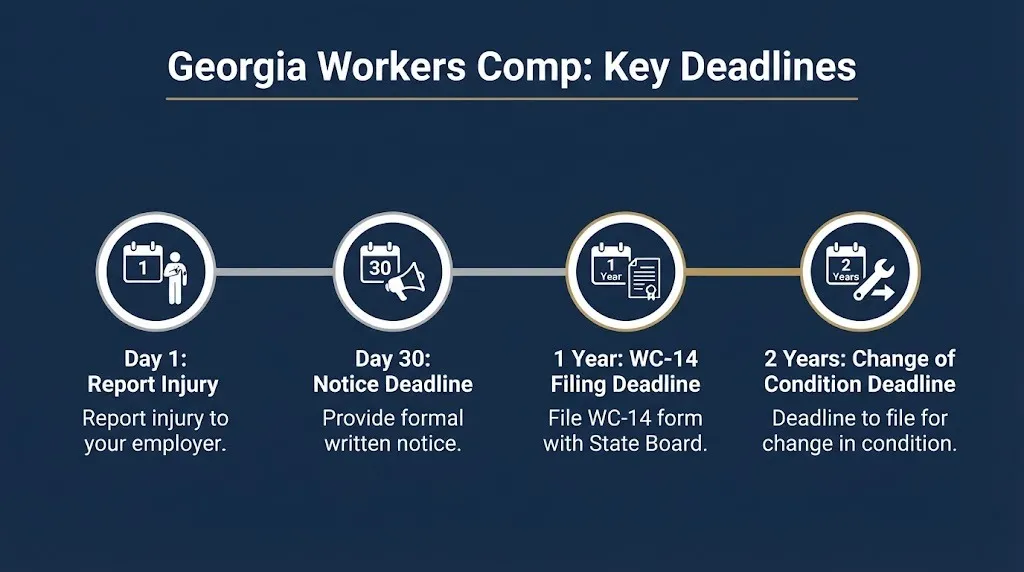
You must report your injury to your employer within 30 days of the accident or the date you reasonably should have known the injury was work-related. This is the notice requirement. Failing to give notice gives the employer a defense to your claim.
You have one year from the date of the accident to file a formal claim with the State Board of Workers’ Compensation. This is the statute of limitations. If you received workers comp benefits, the one-year period is extended to one year from the last date benefits were paid in some cases.
Critical Deadlines Checklist
| Action | Deadline | Consequence of Missing |
|---|---|---|
| Report injury to employer | 30 days from accident | Claim may be barred |
| File WC-14 claim form | 1 year from accident | Claim barred |
| Request hearing after denial | Within 1 year of denial | Claim barred |
| File for change of condition | 2 years from last benefit payment | Claim barred |
| Appeal Board decision to court | 20 days from award | Decision final |
Treat these deadlines like a flight departure time. Arriving a few minutes late means you miss the plane. There is no grace period for most workers comp deadlines in Georgia.
How Do I File a Workers Comp Claim in Georgia?
Filing a workers compensation claim in Georgia follows a specific sequence. The process works best when you complete each step in order and keep documentation at every stage.
Step-by-Step Filing Process
Step 1: Report the injury to your supervisor immediately, in writing if possible.
Step 2: Seek medical treatment. Your employer may direct you to an authorized treating physician.
Step 3: Complete the WC-14 form if the employer or insurer denies your claim or you want to protect your rights.
Step 4: File the WC-14 with the State Board of Workers’ Compensation. You can file online through the SBWC’s ICMS system.
Step 5: Attend all medical appointments and follow the treatment plan. Missing appointments can hurt your claim.
Step 6: Keep a file with all medical records, work restrictions, and correspondence from the insurer.
Step 7: If the insurer denies your claim or stops benefits, request a hearing before an Administrative Law Judge.
The WC-14 form is the official notice of claim document. You can download it from the SBWC website or file electronically through the Integrated Claims Management System. Filing this form is free.
Can a Georgia Workers Comp Lawyer Help After a Claim Denial?
A workers compensation lawyer in Georgia can help after a claim denial by requesting a hearing, presenting medical evidence, and negotiating with the insurance carrier. Denials are common, and they are not the end of your case.
Insurance carriers deny claims for several reasons. They may argue the injury did not arise out of employment. They may claim you had a preexisting condition. They may dispute the severity of your disability. Each denial reason has a legal response.
When your claim is denied, you have the right to request a hearing before an Administrative Law Judge at the State Board of Workers’ Compensation. The hearing operates like a trial but with less formal procedures.
Common Denial Reasons and Legal Responses
| Denial Reason | Legal Response |
|---|---|
| Injury not work-related | Medical causation evidence, witness testimony |
| Preexisting condition | Aggravation of preexisting condition argument |
| Missed reporting deadline | Evidence of employer’s actual knowledge |
| Intoxication alleged | Toxicology records, witness accounts |
| Independent contractor classification | Control test analysis, employment relationship evidence |
Key Takeaway: A claim denial means you need to act quickly. The one-year filing deadline still applies, and delay weakens your case.
What Are the Current Georgia Workers Comp Benefit Rates for 2026?
The current Georgia workers compensation weekly benefit rates for 2026 reflect the July 1, 2026, adjustment. The maximum temporary total disability rate is $800 per week.
This maximum applies regardless of how much you earned. If your average weekly wage is $1,500, you still receive $800 per week while totally disabled. If your average weekly wage is $600, you receive $400 per week, which is two-thirds of your wage.
The minimum temporary total disability rate is $50 per week. Low-wage workers receive at least this amount.
2026 Georgia Workers Comp Rate Table
| Average Weekly Wage | TTD Rate (Two-Thirds) | Notes |
|---|---|---|
| $300 | $200 | Above minimum |
| $500 | $333 | Standard calculation |
| $750 | $500 | Standard calculation |
| $1,000 | $667 | Standard calculation |
| $1,200 | $800 | Capped at maximum |
| $2,000 | $800 | Capped at maximum |
The maximum weekly benefit adjusts annually based on the statewide average weekly wage. The 2026 rate of $800 represents an increase from the 2025 maximum of $775.
Reality Check
No one from the State Board of Workers’ Compensation or any insurance company will text you to say you won a settlement. Filing a workers comp claim is free. Third-party “claim helpers” who charge fees to file your forms are unnecessary and often scams. If someone asks for payment upfront to process your workers comp claim, walk away.
What Types of Injuries Qualify for Georgia Workers Comp?
Georgia workers compensation covers injuries and occupational diseases that arise out of and in the course of employment. The injury does not need to happen at your physical workplace. It must happen while you are performing work duties.
Common qualifying injuries include:
- Back injuries from lifting, falling, or repetitive motion
- Shoulder and rotator cuff tears
- Knee injuries including ACL and meniscus tears
- Fractures and crush injuries
- Burns and electrical injuries
- Head injuries and concussions
- Carpal tunnel syndrome and other repetitive stress injuries
- Occupational illnesses from chemical exposure
- Heart attacks and strokes, if work exertion caused them
- Mental injuries, only if accompanied by a physical injury
Georgia law generally does not recognize standalone mental injuries, such as PTSD from witnessing a traumatic event, unless there is a physical injury component. This is a significant limitation compared to some other states.
Excluded Claims
- Injuries from willful misconduct, such as fighting
- Injuries caused by intoxication or illegal drug use
- Injuries from horseplay not related to work duties
- Injuries during an unpaid break while off the premises
- Self-inflicted injuries
- Injuries occurring during a commute, with limited exceptions
How Does the Georgia Workers Comp Panel of Physicians Work?
Georgia uses a panel of physicians system. Your employer must maintain a list of at least six doctors, called a panel of physicians. You must choose a doctor from this panel for treatment of your work injury.
The panel must include at least one orthopedic physician and no more than two industrial clinics. The doctors on the panel must be reasonably accessible to you. Your employer must post the panel in a visible location.
You get one free choice from the panel. You can switch to another panel doctor one time without employer approval. Beyond that, changes require agreement from the insurer or an order from the State Board.
Panel of Physicians Rules
| Rule | Detail |
|---|---|
| Minimum panel size | 6 physicians |
| Required specialty | At least 1 orthopedic surgeon |
| Industrial clinic limit | Maximum 2 |
| Free choices | 1 selection, 1 switch |
| Emergency exception | Any emergency room for immediate care |
| Panel not posted | You may choose any doctor |
If your employer fails to maintain a valid panel, you may treat with any physician of your choosing. This gives you more control over your medical care.
What Is a Catastrophic Injury Under Georgia Workers Comp?
A catastrophic injury under Georgia workers compensation law qualifies for extended benefits beyond standard limits. Catastrophic designations unlock lifetime medical care and longer wage replacement benefits.
Georgia law defines catastrophic injuries as:
- Spinal cord injury causing paralysis
- Amputation of an arm, hand, foot, or leg
- Severe brain or closed head injury
- Second or third degree burns over 25 percent of the body
- Third degree burns over 5 percent of the face or hands
- Total or industrial blindness
- Any injury that prevents the worker from performing prior work and any work available in substantial numbers
Catastrophic vs. Non-Catastrophic Benefits
| Benefit | Non-Catastrophic | Catastrophic |
|---|---|---|
| Medical treatment | Lifetime if authorized | Lifetime |
| TTD benefits | 400 weeks maximum | Unlimited while disabled |
| PPD benefits | Schedule-based | Not limited by schedule |
| Vocational rehabilitation | Up to 52 weeks | Extended services available |
Catastrophic injury claims require careful legal handling. Insurance carriers often contest the designation because it significantly increases their financial exposure.
Key Takeaway: Catastrophic injury classification dramatically changes your benefit rights. If your injury is severe, a legal evaluation is essential.
Can I Sue My Employer Outside of Workers Comp in Georgia?
You generally cannot sue your employer outside of workers compensation in Georgia. The workers comp system is your exclusive remedy against your employer and coworkers for workplace injuries.
The exclusive remedy doctrine means you give up the right to sue in civil court in exchange for the workers comp benefit system. This applies even if your employer was negligent.
There are narrow exceptions. You can sue a third party whose negligence caused your injury. Examples include:
- A delivery driver injured by another motorist while making deliveries
- A construction worker injured by a defective tool manufactured by an outside company
- A factory worker injured by a machine installed and maintained by a contractor
- A worker exposed to toxic chemicals produced by an outside manufacturer
Third-Party Claims vs. Workers Comp
| Claim Type | Who You Sue | What You Can Recover |
|---|---|---|
| Workers comp | Employer’s insurer | Medical, wage loss, disability benefits |
| Third-party claim | Negligent outside party | Pain and suffering, full wage loss, punitive damages |
| Both | Separate defendants | Both, with workers comp lien on third-party recovery |
Third-party claims often produce larger recoveries because pain and suffering damages become available. The workers comp insurer holds a lien on the third-party recovery, but the net result frequently exceeds what workers comp alone would pay.
What Happens Next
August 2026: The SBWC continues processing claims under the new $800 maximum weekly benefit rate that took effect July 1, 2026.
September 2026: Expected release of the SBWC annual report with updated claim volume and average settlement data.
October 2026: Administrative Law Judge hearing dates for claims filed in early 2026 will be scheduled.
January 2027: New legislative session may consider workers comp reform bills, though no specific proposals are confirmed.
July 1, 2027: The next scheduled adjustment to the maximum weekly benefit rate based on the statewide average weekly wage.
Frequently Asked Questions
How long does a workers comp case take in Georgia?
A straightforward workers comp case in Georgia takes 6 to 12 months from filing to resolution.
Contested cases requiring hearings can take 12 to 18 months.
Settlement negotiations typically begin after maximum medical improvement is reached.
Can I be fired for filing a workers comp claim in Georgia?
Georgia law prohibits employers from retaliating against workers for filing workers comp claims.
Retaliation includes termination, demotion, or reduced hours.
You must file a retaliation complaint within one year of the adverse action.
What if my employer does not have workers comp insurance?
You may file a claim with the Georgia Subsequent Injury Trust Fund or seek benefits through the Uninsured Employers Fund.
You may also sue your employer directly in civil court.
The State Board can impose penalties on employers who fail to maintain required coverage.
Can I choose my own doctor in Georgia workers comp?
You must choose from your employer’s panel of physicians, if a valid panel exists.
You can make one free switch to another panel doctor.
If the panel is invalid or not posted, you may choose any doctor.
What is maximum medical improvement?
Maximum medical improvement, or MMI, means your condition has stabilized and further recovery is unlikely.
It is determined by your authorized treating physician.
MMI triggers the impairment rating that forms the basis for permanent partial disability benefits.
Do I have to pay taxes on workers comp settlement in Georgia?
Workers compensation settlements are generally not taxable at the federal or state level.
This applies to both weekly benefits and lump-sum settlements.
Exceptions are rare and involve specific offset situations with Social Security Disability Insurance.
Can I get workers comp and Social Security Disability at the same time?
You can receive both workers comp and Social Security Disability Insurance benefits.
Your SSDI benefit may be reduced by the workers comp offset.
The combined benefit cannot exceed 80 percent of your average current earnings before disability.
How much is a hand injury worth in Georgia workers comp?
Hand injury settlements in Georgia range from $10,000 to $60,000 depending on severity and impairment rating.
Amputations are catastrophic injuries with significantly higher value.
The specific PPD schedule for hand injuries assigns a number of weeks based on impairment percentage.