What Is a Workers Compensation Claim: 2026 Filing Guide, Deadlines & Benefit Amounts
Quick Answer
- A workers compensation claim is a formal request for benefits after a work-related injury or illness, filed with your employer or state agency.
- Benefit amounts vary by state, but most pay two-thirds of your average weekly wage for temporary total disability, subject to state maximums.
- Most states require you to report the injury within 30 days, but the formal claim deadline ranges from one to three years depending on your state.
A workers compensation claim is how you formally request medical and wage benefits after a workplace injury. If you got hurt on the job, the claim starts the process that can pay your medical bills and replace part of your lost income.
This guide covers the claim process as of August 2026, including how to file, where to report, what benefits exist, and what can go wrong at each stage. You will learn the exact steps, the key deadlines, and the common mistakes that delay or derail legitimate claims.
One surprising verified fact: workers compensation is the oldest social insurance program in the United States, with the first state law passed in 1911, yet millions of eligible workers still never file because they do not know the claim exists.
The Facts
| Category | Details |
|---|---|
| Program Type | State-mandated no-fault insurance system |
| Governing Bodies | State workers compensation agencies, U.S. Department of Labor |
| Coverage Threshold | Varies by state (1 to 5+ employees) |
| Typical Benefit Rate | Two-thirds of average weekly wage, subject to state caps |
| Reporting Deadline | 30 days in most states |
| Formal Filing Deadline | 1 to 3 years, varies by state |
| Waiting Period | 3 to 7 days, varies by state |
| Medical Benefits | Covered for authorized treatment related to the injury |
| Attorney Fee Cap | 15 to 25 percent of recovery, varies by state |
| Federal Program | Federal Employees’ Compensation Act (FECA) for federal workers |
What Is a Workers Compensation Claim Exactly?
A workers compensation claim is a formal request for benefits under a state or federal no-fault insurance system that covers work-related injuries and occupational diseases. It is not a lawsuit against your employer. It is an insurance claim against your employer’s policy.
The claim exists because state law requires most employers to carry workers compensation insurance. That insurance pays for medical care, partial wage replacement, disability benefits, and vocational rehabilitation when you are injured on the job.
The no-fault design means you do not have to prove your employer was negligent. You only need to show the injury arose out of and in the course of your employment. This is a lower legal bar than a personal injury lawsuit.
What a Workers Compensation Claim Covers
| Benefit Type | What It Pays |
|---|---|
| Medical treatment | Doctor visits, surgery, medication, physical therapy |
| Temporary total disability | Wage replacement while completely out of work |
| Temporary partial disability | Wage difference when working reduced hours |
| Permanent partial disability | Payment for permanent impairment of a body part |
| Permanent total disability | Long-term benefits for permanent inability to work |
| Vocational rehabilitation | Job retraining and placement assistance |
| Death benefits | Payments to dependents of fatally injured workers |
What It Does Not Cover
- Pain and suffering damages
- Punitive damages against your employer
- Injuries from horseplay or intoxication
- Commuting injuries, with limited exceptions
- Mental injuries without a physical component in most states
How Do I Know If I Have a Valid Workers Compensation Claim?
You have a valid workers compensation claim if your injury or illness arose out of and in the course of your employment. This legal standard has two parts: the injury must be work-related, and it must happen while you are doing something for your employer.
The injury does not have to occur at your physical workplace. A delivery driver injured while making a delivery has a valid claim. A remote worker who trips over a home office chair during work hours may have a valid claim depending on state law.
Certain categories of workers face more scrutiny. Independent contractors generally do not qualify. Undocumented workers may qualify in some states. Agricultural and domestic workers are excluded in some jurisdictions.
Workers Typically Covered
- Full-time and part-time employees
- Seasonal and temporary workers
- Minors, regardless of age
- Undocumented workers in most states
- Federal employees under FECA
Workers Typically Excluded
- Independent contractors
- Volunteers without specific coverage
- Sole proprietors without elected coverage
- Some agricultural workers in certain states
- Maritime workers, who fall under the Jones Act instead
Key Takeaway: The test is whether you were working for your employer’s benefit when the injury happened, not where you were physically located.
How Much Can I Get From a Workers Compensation Claim?
The amount you can get from a workers compensation claim depends on your average weekly wage, the severity of your injury, and your state’s benefit caps. Most states pay two-thirds of your average weekly wage for temporary total disability.
This rate is subject to a maximum. In 2026, state maximums range from about $600 to over $1,800 per week. New York, for example, sets its maximum at a higher level than most states due to cost of living adjustments.
Permanent partial disability payments follow a schedule. Each body part has an assigned number of weeks. Your impairment rating, assigned by a physician, determines the percentage of that schedule you receive.
Sample Weekly Benefit Calculation
| Average Weekly Wage | Two-Thirds Rate | State Cap Applied | Weekly Benefit |
|---|---|---|---|
| $600 | $400 | $1,200 cap | $400 |
| $900 | $600 | $1,200 cap | $600 |
| $1,200 | $800 | $1,200 cap | $800 |
| $2,000 | $1,333 | $1,200 cap | $1,200 |
The waiting period before benefits start varies. Many states use a 7-day waiting period. If your disability extends beyond a certain threshold, often 14 to 21 days, the waiting period is paid retroactively.
How Do I Start a Workers Compensation Claim?
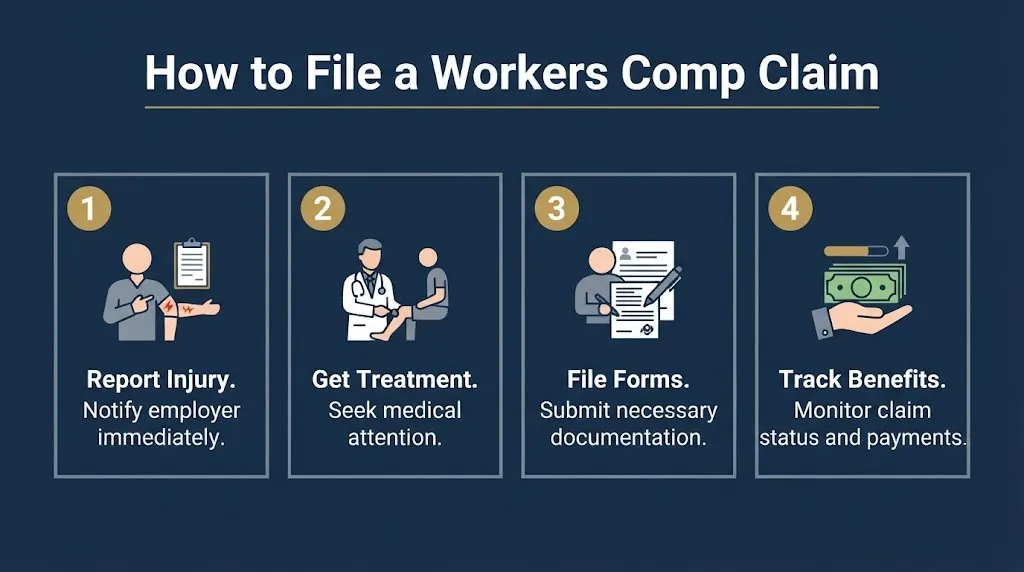
Starting a workers compensation claim follows a clear sequence. The first step is always reporting the injury to your employer. This notification triggers the employer’s duty to provide medical care and file a claim with its insurer.
You can start the process verbally, but written notice is better. A dated email or letter creates a record that prevents disputes later. Some states provide specific forms, but any written notice that identifies the injury and the date is usually sufficient.
After you report, the employer or its insurer files the claim paperwork. If they refuse or delay, you can file directly with your state’s workers compensation agency.
Step-by-Step Claim Process
Step 1: Report the injury to your supervisor immediately, preferably in writing.
Step 2: Seek medical treatment from an authorized provider if your employer maintains a panel or network.
Step 3: Complete any state-required claim form, such as a first report of injury or employee claim form.
Step 4: The employer or insurer files the claim with the state agency, typically within 7 to 10 days.
Step 5: The insurer accepts or denies the claim within a state-mandated timeframe, often 14 to 21 days.
Step 6: If accepted, you begin receiving wage benefits and medical treatment authorization.
Step 7: If denied, you can request a hearing or mediation through your state agency.
The process works like a store return with a receipt. You need the receipt, the item, and the timing right. Missing one piece slows everything down.
Key Takeaway: Report the injury in writing immediately. The notice deadline is short, and the entire claim depends on this first step.
What Is the Deadline for Reporting a Workers Compensation Claim?
The deadline for reporting a workers compensation claim is 30 days in most states. Some states set shorter windows, such as 10 days in Colorado or 14 days in some jurisdictions. A few allow longer, but waiting is always a risk.
Reporting means telling your employer, not the state agency. The formal claim filing deadline is separate and longer, typically one to three years from the date of injury or the date you knew the injury was work-related.
Employers and insurers use late reporting as a defense. The argument is that delayed notice prevented a prompt investigation. This defense succeeds often enough that late reporters face an uphill fight.
State-by-State Reporting Deadlines
| State | Reporting Deadline | Formal Filing Deadline |
|---|---|---|
| California | 30 days | 1 year |
| Texas | 30 days | 1 year |
| New York | 30 days | 2 years |
| Florida | 30 days | 2 years |
| Georgia | 30 days | 1 year |
| Pennsylvania | 21 days | 3 years |
| Illinois | 45 days | 3 years |
| Ohio | Not specified | 1 year |
The reporting deadline applies even if you do not immediately realize the injury is serious. A sore back on Monday may become a herniated disc by Friday. Report it on Monday anyway.
What Happens After I File a Workers Compensation Claim?
After you file a workers compensation claim, the insurance carrier must accept or deny it within a state-mandated timeframe. This decision period is typically 14 to 21 days, though some states allow up to 30 days.
If the insurer accepts the claim, you begin receiving benefits. Medical treatment continues. Wage replacement checks begin after the waiting period. The insurer may require periodic status reports from your doctor.
If the insurer denies the claim, you receive a written notice explaining the reason. You then have the right to challenge the denial through your state’s dispute resolution process.
The Post-Filing Timeline
| Stage | Typical Timing |
|---|---|
| Insurer decision | 14 to 21 days |
| Benefit start | After waiting period, often 3 to 7 days |
| First wage check | 2 to 4 weeks after acceptance |
| Medical treatment | Ongoing, as authorized |
| Maximum medical improvement | 6 weeks to 2 years depending on injury |
| Settlement negotiation | After MMI for permanent cases |
| Appeal hearing, if denied | 3 to 12 months after request |
The claim process is not fast. Initial benefits arrive within weeks. Permanent disability determinations take months. Full resolution of a contested claim can take a year or more.
Why Was My Workers Compensation Claim Denied?
Workers compensation claims get denied for several recurring reasons. Understanding these before you file can help you avoid the most common pitfalls.
Insurers deny claims because they are skeptical of causation, not because you did something wrong. The three most frequent denial reasons are: the injury was not work-related, the claim was filed late, or the medical evidence does not support the claimed disability.
A denial is not the end. Most states provide an appeals process that starts with a hearing before an administrative judge. Many denied claims ultimately result in benefits after appeal.
Common Denial Reasons and How to Avoid Them
| Denial Reason | How to Avoid |
|---|---|
| Late reporting | Report the injury the same day or next day |
| No medical evidence | Seek treatment immediately and follow the plan |
| Preexisting condition | Document any work-related aggravation clearly |
| Employer disputes the incident | Report in writing, keep a copy |
| Intoxication alleged | Request the toxicology report be produced |
| Claimed as independent contractor | Document your work relationship and control |
Key Takeaway: A denial is an insurance company decision, not a legal final judgment. The appeals process exists for exactly this reason.
Can I Apply for Workers Compensation Online?
You can apply for workers compensation online in most states. The process varies by jurisdiction, but many state agencies now offer electronic filing portals for initial claims and subsequent forms.
The employer usually files the first report of injury, not the employee. Your role is to report to the employer and complete any employee claim form. In some states, that employee form is available online.
For federal workers, the Employees’ Compensation Operations and Management Portal (ECOMP) handles online claims. For state workers, check your state’s workers compensation agency website.
Online Filing Steps by State Type
| State Type | Online Portal | What You Can File |
|---|---|---|
| State with e-filing | State agency website | WC-14, DWC-1, or similar forms |
| Federal employee | ECOMP | CA-1, CA-2 claim forms |
| State without e-filing | Mail or fax | Paper forms to state board |
Online filing is faster but not required in most cases. A paper claim filed on time is just as valid as an electronic one. Do not delay filing because you are waiting for online access.
Reality Check
No legitimate workers compensation agency, insurer, or employer will ask you to pay money to process a claim. Filing is free. Any third party that offers to “expedite” your claim for a fee is unnecessary. Scammers target injured workers because they know you are hurting and may be desperate. The only fee you might ever owe is a capped attorney fee after a successful recovery, never upfront.
What Is the Difference Between a Workers Comp Claim and a Lawsuit?
A workers compensation claim is an insurance claim, not a lawsuit. You file it against your employer’s insurance policy, not against a person or company in court. The process is administrative, not litigated in civil court.
A lawsuit is a court case where you sue a party for damages. In the workers comp context, you generally cannot sue your employer. The exclusive remedy doctrine bars most workplace injury lawsuits against employers.
You can sue third parties whose negligence caused your injury. This is common in construction accidents, delivery driver crashes, and product failure cases.
Claim vs. Lawsuit Comparison
| Feature | Workers Comp Claim | Third-Party Lawsuit |
|---|---|---|
| Filed against | Employer’s insurance | Negligent third party |
| Fault required | No | Yes |
| Pain and suffering | Not available | Available |
| Time to resolve | Months | One to three years |
| Administrative process | Yes | No, court process |
| Attorney fee structure | Percentage, capped | Contingency, often 33 to 40 percent |
What Does Workers Compensation Not Cover?
Workers compensation does not cover every injury or illness connected to your job. The system has specific exclusions that vary by state and by the circumstances of your injury.
The most common exclusions are injuries caused by intoxication, self-inflicted injuries, injuries from horseplay, and injuries during an unpaid break off the premises. Commuting injuries are generally excluded unless you were performing a work duty during the commute.
Occupational diseases must be proven to arise from employment conditions, not just from the passage of time. This standard is harder to meet for conditions like back pain or carpal tunnel that have multiple potential causes.
Typical Exclusions
- Injuries from willful misconduct
- Injuries caused by illegal drug use
- Injuries from fighting not related to work
- Mental injuries without physical component, in most states
- Injuries occurring during personal errands on work time
- Stress-related conditions without physical manifestation
What Is a First Report of Injury Form?
A first report of injury is the document your employer completes after you report a workplace injury. It records the date, time, location, nature of the injury, and the initial medical response.
This form goes to the employer’s workers compensation insurance carrier and, in most states, to the state workers compensation agency. It is the official start of the claim record.
You should review this form before it is submitted, if possible. Errors on the first report, such as the wrong date or an incomplete injury description, can create disputes later. Ask for a copy.
What the First Report Contains
| Field | Why It Matters |
|---|---|
| Date of injury | Establishes the claim start date |
| Time of injury | Confirms injury occurred during work hours |
| Injury description | Defines the scope of the claim |
| Body part affected | Determines the medical treatment authorized |
| Witness information | Supports causation if disputed |
| Initial treatment | Documents immediate medical response |
How Do Permanent Disability Benefits Work in a Workers Comp Claim?
Permanent disability benefits in a workers compensation claim pay for lasting impairment after you reach maximum medical improvement. They come in two categories: permanent partial disability and permanent total disability.
Permanent partial disability, or PPD, follows a schedule. Each state publishes a list of body parts and the number of weeks each is worth. Your physician assigns an impairment rating, which determines the percentage of that schedule you receive.
Permanent total disability, or PTD, means you cannot return to any work. PTD benefits often last for life, or until retirement age in some states. These are the most serious and most valuable claims.
Permanent Partial Disability by Body Part
| Body Part | Typical Scheduled Weeks |
|---|---|
| Hand | 150 to 250 weeks |
| Arm | 200 to 250 weeks |
| Leg | 200 to 250 weeks |
| Foot | 100 to 150 weeks |
| Back | 250 to 400 weeks |
| Hearing loss | 50 to 150 weeks |
The actual payment is a percentage of your weekly wage benefit rate multiplied by the scheduled weeks. An impairment rating of 20 percent to a body part scheduled for 200 weeks means 40 weeks of benefits at your weekly rate.
What Happens Next
August 2026: State workers compensation agencies continue processing claims under 2026 rate schedules, with most states having implemented July 1 maximum benefit adjustments.
September 2026: The U.S. Bureau of Labor Statistics is expected to release updated workplace injury data for the prior year, which typically prompts policy discussions at the state level.
October 2026: Several states begin legislative pre-session hearings where workers compensation reform proposals may be introduced, though no specific bills are confirmed.
January 2027: New state legislative sessions open, with workers compensation reform bills likely in multiple jurisdictions.
July 1, 2027: The next scheduled maximum weekly benefit rate adjustments take effect in most states.
Frequently Asked Questions
How long does a workers compensation claim take to process?
A simple accepted claim starts paying benefits within 2 to 4 weeks.
Contested claims take 6 to 18 months through the appeals process.
Permanent disability determinations require reaching maximum medical improvement, which varies by injury.
Can I file a workers comp claim after I quit my job?
Yes, you can file a claim after quitting if the injury occurred while you were employed.
The reporting and filing deadlines still apply from the date of injury.
Quitting does not erase a valid claim.
What if my employer says I am an independent contractor?
Your classification is determined by the nature of your work relationship, not your employer’s label.
Many misclassified workers successfully establish employee status.
State agencies and administrative judges look at control, direction, and economic dependence.
Do I need a lawyer to file a workers comp claim?
You do not need a lawyer for a minor, accepted claim.
A lawyer helps when the claim is denied, disputed, or involves permanent disability.
Most workers comp lawyers charge a capped contingency fee.
Can I see my own doctor for a workers comp claim?
It depends on your state’s rules.
Some states allow you to choose your own treating physician.
Others require you to use a panel of doctors selected by the employer.
How long do workers comp benefits last?
Medical benefits last as long as treatment is needed for the work injury.
Temporary disability benefits last until you return to work or reach maximum medical improvement.
Permanent total disability benefits can last for life in some states.
Is workers comp taxable income?
Workers compensation benefits are generally not taxable at the federal or state level.
This applies to weekly benefits and lump-sum settlements.
Exceptions occur when the benefits offset Social Security Disability Insurance, creating a taxable portion.
What if my employer does not have workers comp insurance?
You may file a claim with a state uninsured employers fund.
You may also sue your employer directly in civil court in most states.
State agencies can impose penalties on employers who fail to carry required coverage.