Class Action Lawsuit Lawyers: How to Find and Vet One in 2026
Quick Answer
- Class action lawsuit lawyers work on contingency and are paid only if the case settles or wins.
- You do not need to hire one yourself to join most consumer class actions; you are included automatically.
- Vet any lawyer by checking federal court records, bar status, and their history with similar cases.
If you are searching for class action lawsuit lawyers, you may be wondering whether you need one, how to find one, or how to know if a law firm is legitimate. The answer depends on your situation.
Most consumers do not hire class action lawyers directly. In a typical consumer class action, the lawyers file the case, the court certifies the class, and you become a member automatically unless you opt out. You do not pay anything upfront.
But if you are an individual who suffered significant losses, or if you are being sued in a class action, the calculation changes. Knowing how class action lawyers work, how they get paid, and how to check their track record matters.
The Facts
| Case | Class action legal representation, general practice area |
| Status | Active and unregulated in terms of attorney fee caps per case |
| Fund Size | Varies by individual case or settlement |
| Est. Per Person | Not applicable to hiring a lawyer; contingency fees typically 25 to 40 percent |
| Claim Deadline | Varies by case; no single deadline applies |
| Administrator | Not applicable; court appoints lead counsel in each case |
| Proof Needed | Depends on the underlying claim and whether you lead or join a class |
Are Class Action Lawsuit Lawyers Legitimate?
Class action lawsuit lawyers are real, licensed attorneys who specialize in representing large groups of people with similar claims against the same defendant. The practice area is legitimate and well-established in federal and state courts.
The structure is governed by Rule 23 of the Federal Rules of Civil Procedure. Courts must certify that common questions predominate over individual ones and that a class action is the superior method to resolve the dispute.
Lawyers who lead class actions must be appointed by a judge. In multidistrict litigation, the court selects lead counsel and a plaintiffs steering committee from among the many firms that file cases. This selection process is competitive and based on experience, resources, and prior results.
Not every attorney who advertises class action experience is credible. Some firms simply file copycat cases hoping to collect a share of fees. Checking a firm’s actual court record is essential.
Key Takeaway: Class action lawyers are real, but their credibility varies widely, and courts, not advertising, determine who leads cases.
How Much Do Class Action Lawsuit Lawyers Charge?
Class action lawyers typically work on contingency, meaning they receive a percentage of the settlement or verdict only if they win. The percentage usually ranges from 25 to 33 percent of the total fund.
The court must approve attorney fees in every class action settlement. This is a built-in check on excessive fees. Judges review fee requests against the work performed and the benefit achieved for the class.
In large consumer settlements, the fee award is often calculated separately from the class fund. Some courts award fees as a percentage of the fund. Others use the lodestar method, multiplying hours worked by a reasonable hourly rate, then applying a multiplier for risk and results.
As a class member, you do not pay any fee directly. The fee comes out of the settlement, reducing the total amount available for distribution. If the case loses, the lawyers absorb their own costs.
| Fee Structure | Typical Range | Who Pays |
|---|---|---|
| Contingency percentage | 25 to 33 percent | Deducted from settlement or verdict |
| Lodestar with multiplier | Varies by case | Deducted from settlement or verdict |
| Hourly for defense work | 300 to 1,500 dollars per hour | Defendant or their insurer |
| Retainer for non-class matters | Case-specific | Client pays upfront |
Do I Need to Hire a Class Action Lawyer to Join a Class Action?
No. In most class actions, you are automatically included if you fall within the court-certified class definition. You do not need to hire a lawyer or pay anything to participate.
Class members receive a notice by mail or email when a settlement is reached or when a class is certified. The notice explains how to file a claim, opt out, or object. Filing a claim is free.
Hiring your own lawyer to join a class action is usually unnecessary and often counterproductive. Your individual lawyer cannot negotiate a separate settlement once a class is certified. The court-appointed lead counsel represents the entire class.
The exception is if you disagree with the settlement terms or the lead counsel’s decisions. In that case, you can hire your own lawyer to file an objection or opt out and pursue an individual claim.
When Should You Hire a Class Action Lawyer?
You should consider hiring a class action lawyer if you are the one initiating a case, not joining one. This applies to business owners, investors, or individuals with a unique claim that could represent many people.
Lead plaintiffs in securities class actions, for example, are often institutional investors with large losses. They hire experienced securities litigators to represent the class and seek appointment as lead plaintiff.
If you believe you have a claim that affects thousands or millions of people in the same way, a class action may be appropriate. But class certification is difficult. Courts deny certification if individual issues dominate.
An experienced class action attorney can assess whether your claim is suitable for class treatment. They will evaluate commonality, typicality, adequacy of representation, and predominance.
Key Takeaway: You only need to hire a class action lawyer if you are starting a case or defending one, not if you are joining an existing class.
How Do I Find a Reputable Class Action Lawyer?
Finding a reputable class action lawyer requires checking court records, not just websites. The best class action firms have a documented history of court-appointed leadership roles and successful settlements.
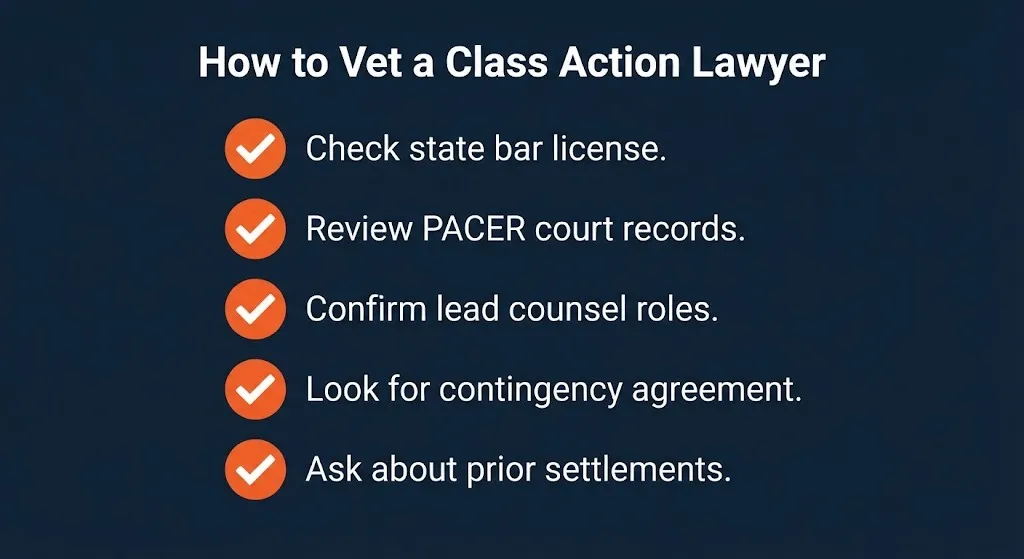
Start with the public dockets. PACER, the federal court records system, lets you search by firm name or attorney name. Look for cases where the firm served as lead counsel or on the plaintiffs steering committee.
Check state bar records for disciplinary history. Every state bar association maintains an online attorney directory with license status and any disciplinary actions.
Review firm websites for named cases they actually led, not cases they simply filed. Some firms list cases where they had a minor role. Court records clarify the distinction.
Ask specific questions in an initial consultation. How many class actions have you served as lead counsel in? What was the last class action settlement you negotiated? What percentage of your practice is class action work?
What Is Class Action Defense?
Class action defense is the practice of representing companies, organizations, or individuals who are being sued in a class action. Defense lawyers work on the opposite side from plaintiff class action attorneys.
Defense firms are typically large national or international law firms with dedicated class action practice groups. They represent corporations facing consumer fraud claims, employment class actions, securities litigation, and antitrust suits.
Class action defense lawyers charge hourly rates. Those rates range from 300 to over 1,500 dollars per hour depending on the firm and the seniority of the attorney.
Defense strategy often focuses on defeating class certification. If the defense can show that individual questions predominate, the court may deny class treatment, forcing plaintiffs to pursue separate cases.
Corporations also use class action defense lawyers to negotiate settlements that minimize exposure while resolving litigation efficiently.
What Is the Difference Between a Class Action and an Individual Lawsuit?
A class action aggregates many similar claims into one proceeding. An individual lawsuit involves one plaintiff seeking damages for their own specific harm.
Class actions offer efficiency. One judge, one set of discovery, one trial or settlement. Individual lawsuits offer control. You decide when to settle, what evidence to present, and how to pursue the case.
The trade-off is payout size. In a class action, each member may receive a small amount because the total fund is divided among many people. In an individual lawsuit, you may recover more, but you bear the full cost and risk.
Some cases start as class actions but are later decertified, forcing plaintiffs to proceed individually. Others start as individual claims that evolve into mass actions with hundreds of similar lawsuits consolidated for pretrial purposes.
What Is the Role of Lead Counsel in a Class Action?
Lead counsel is the law firm or group of firms appointed by the court to represent the class. They make strategic decisions about discovery, settlement, and trial.
In federal multidistrict litigation, the judge appoints lead counsel and a plaintiffs steering committee. These firms coordinate the work and often advance the costs of litigation.
Lead counsel owes a fiduciary duty to the entire class, not just the named plaintiffs. They must act in the best interest of all class members and seek court approval for any settlement.
The fee request from lead counsel is subject to court review. Judges consider the time spent, the risk undertaken, the complexity of the case, and the result achieved.
How Are Class Action Lawyers Paid in Settlements?
Class action lawyers are paid from the settlement fund, and the amount must be approved by the court. The fee is typically stated as a percentage of the total fund or calculated using the lodestar method.
In a 100 million dollar settlement, a 25 percent fee would be 25 million dollars. The remaining 75 million is distributed to class members, after administrative costs.
Some settlements include a separate fee agreement with the defendant. In those cases, the defendant pays a set amount for fees on top of the class fund. This structure can benefit class members because the fee does not reduce their recovery.
Courts scrutinize fee requests for reasonableness. Objections from class members can lead to reduced fees if a judge finds the request excessive.
Key Takeaway: Class action lawyers are paid only from successful settlements, and every fee request must pass court review for reasonableness.
Are There Class Action Lawyers in Colorado?
Yes. Colorado has an active class action bar with firms handling consumer, employment, and securities cases. Many national firms have Denver offices with dedicated class action practice groups.
Colorado class actions proceed under Rule 23 of the Colorado Rules of Civil Procedure, which mirrors the federal rule in most respects. State courts hear class actions involving Colorado-specific claims and smaller classes.
The United States District Court for the District of Colorado also handles federal class actions, including securities fraud, antitrust, and data breach cases.
If you are in Colorado and seeking representation, check the Colorado Bar Association directory and PACER for firms with documented class action leadership roles in the District of Colorado.
What Should I Watch Out for When Choosing a Class Action Lawyer?
Red flags exist in the class action lawyer market. Knowing them can save you from hiring a firm that overpromises and underdelivers.
Avoid any lawyer who guarantees a specific settlement amount. No ethical attorney guarantees outcomes, especially in class actions where court approval is required.
Be wary of firms that charge upfront fees for plaintiff class action representation. Legitimate plaintiff class action firms work on contingency.
Check for disciplinary history. A clean state bar record is the minimum, not the standard. You want a firm with no significant disciplinary actions and a history of court appointments.
Ask about conflicts of interest. A firm cannot represent a class if it has represented the defendant in a related matter. This is a strict ethical rule.
Reality Check
No class action lawyer can promise you a specific payout or guarantee that a case will settle. Any firm that asks you to pay money upfront to join a consumer class action is not legitimate. Filing a claim in an existing class action is always free, and you can do it yourself through the official settlement website.
What Happens Next
January 2026: Federal courts continue to appoint lead counsel in major multidistrict litigation proceedings across the country.
Ongoing: Class certification decisions in pending consumer and tech cases will determine which cases proceed as class actions.
If you are considering hiring a class action lawyer: Check court records, verify bar status, and request a written fee agreement.
If you are a class member: Watch your mail for notices and file claims through official settlement websites when they launch.
Frequently Asked Questions
Do I need a class action lawyer to get settlement money?
No. You are automatically included in a certified class and can file a claim yourself for free.
How much do class action lawyers take?
They usually take 25 to 33 percent of the total settlement fund, subject to court approval.
Can I hire my own lawyer for a class action?
You can hire a lawyer to object to a settlement or opt out, but not to negotiate separately within the class.
What is the difference between a class action and a mass tort?
In a class action, one case represents the group. In a mass tort, individual cases are consolidated for pretrial but remain separate for settlement.
How do I check if a class action lawyer is licensed?
Check your state bar association directory for license status and any disciplinary history.
Are class action settlement payments taxable?
Settlement payments may have tax consequences depending on the nature of the claim. Consult a tax professional.
What happens if a class action loses?
Class members receive nothing, and the lawyers absorb their own costs under contingency fee agreements.
How long do class action cases take?
Most class actions take two to five years from filing to resolution, sometimes longer with appeals.
If you are a class member, your job is simple: check your mail, file claims on time, and ignore anyone who asks for money to help you. If you are a lawyer or a potential lead plaintiff, your job is harder: verify, vet, and document everything.
The class action system works when courts oversee both sides. Knowing how the lawyer side operates gives you an edge, whether you are joining a case or considering starting one.