Workers Compensation Lawyers in 2026: Cost, Deadlines, and How to Find One Near You
Quick Answer
- Workers compensation lawyers work on contingency: you pay nothing upfront and the fee comes out of your recovery, often 10% to 25%.
- The average workers’ comp settlement nationally in 2026 is around $42,000, but your case depends on your state, wages, and injury.
- Filing deadlines are strict and vary by state: Colorado gives you 2 years to file a claim after 4 days to notify your employer.
Workers Compensation Lawyers in 2026: Cost, Deadlines, and How to Find One Near You
Getting hurt on the job throws your paycheck and your medical bills into chaos at the same time. If you’re searching for workers compensation lawyers right now, you’re probably staring down a denied claim, a lowball offer, or a form you don’t understand. This guide breaks down what these lawyers actually do, what they cost, and the deadlines that can quietly end your claim before you even hire one.
Every state runs its own workers’ comp system, so the rules that matter to you depend on where you got hurt. We pulled fee structures, statute of limitations data, and settlement figures from state agencies and legal-fee guides published in 2026. One detail surprises a lot of injured workers: represented claimants receive settlements averaging roughly three times higher than unrepresented ones in one recent analysis.
This article covers what a workers’ comp lawyer costs, what you might recover, how state deadlines work (including Colorado and New York specifics), and how to actually find and vet one near you. We’ll flag anywhere the numbers are estimates rather than guarantees, because your case is not “average.”
The Facts
| Topic | How workers’ compensation lawyers are paid, what they do, and state filing deadlines |
| Status | Ongoing, state-regulated legal service; not a single lawsuit or class action |
| Typical Fee | 10% to 25% of settlement, contingency basis, varies by state |
| National Average Settlement (2026) | Roughly $42,000, ranging from a few thousand to over $1,000,000 for catastrophic injuries |
| Filing Deadline | Varies by state; commonly 1 to 3 years, plus a separate short window to notify your employer |
| Upfront Cost | None in most states; fee comes out of your recovery only if you win |
| Proof Needed | Injury report, medical records, wage records, and employer/insurer correspondence |
Are Workers Compensation Lawyers Worth It? (VERIFY)
Hiring a workers’ comp lawyer is worth it if your claim is denied, disputed, or involves a serious injury, based on available settlement data. You don’t legally need a lawyer for a simple, undisputed claim.
But the numbers tell a clear story. One study found injured workers with a lawyer typically receive about 30% more in compensation than those who go it alone. Another analysis put represented settlements at an average of $58,200 compared to $19,400 for unrepresented claimants.
That gap usually covers the attorney’s fee and then some. A lawyer also becomes your point of contact with the insurance adjuster, so you’re not fielding pressure calls while you’re still healing.
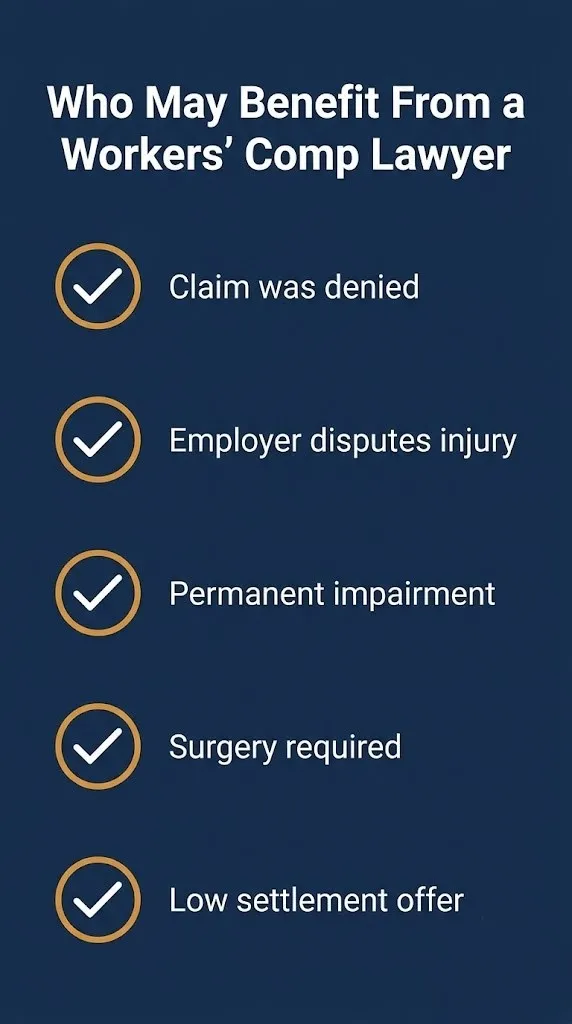
When it matters most:
- Your claim was denied outright
- Your employer disputes that the injury is work-related
- You have a permanent impairment or can’t return to your old job
- Surgery, spinal injury, or a long-term condition is involved
- The insurer’s settlement offer feels low compared to your medical costs
How Much Does a Workers Compensation Lawyer Cost? (MONEY)
A workers compensation lawyer typically costs nothing upfront and takes a contingency fee of 10% to 25% of your settlement or award. Some states allow higher percentages in specific circumstances.
Fee percentages and how they’re calculated vary by state, and some states cap the maximum a lawyer can charge. Here’s how a few states compare, based on figures reported by law firms and legal guides in 2026:
| State | Typical Contingency Range |
|---|---|
| California | Often approved around 9% to 15%, subject to judge approval |
| Georgia | Around 25% |
| Alabama | Fixed at 15% |
| Michigan | Up to 30% of disputed benefits later paid, or 30% of past-due benefits won at trial |
| Pennsylvania | Typically 15% to 20% |
| North Carolina | Commonly 25% |
Quick math example: on a $30,000 settlement with a 25% fee, you’d owe $7,500 and keep $22,500 before any separate case costs.
Key Takeaway: You almost never pay a workers’ comp lawyer out of pocket. The fee comes out of your settlement only if you win, and state agencies review the percentage for fairness.
What Does a Workers Compensation Lawyer Do? (BACKGROUND)
A workers compensation lawyer files paperwork, gathers medical and wage evidence, negotiates with the insurer, and represents you at hearings. Their job is to make sure the claim reflects the real cost of your injury.
Day to day, that means reviewing your medical records, calculating your average weekly wage, and pushing back when an insurer disputes causation. Once you reach maximum medical improvement, they help translate your impairment rating into a settlement number.
Think of it like disputing a denied warranty claim on a car, except instead of a refund you’re negotiating over your ability to earn a living. The paperwork looks simple. The stakes are not.
Workers Compensation Benefits Lawyer: What Can You Recover? (MONEY)
A workers compensation benefits lawyer helps you recover medical costs, lost wages, and disability payments, but not pain and suffering, since workers’ comp is a no-fault system.
Unlike personal injury settlements, workers’ comp settlements don’t include pain and suffering compensation. What you can pursue instead:
- Medical expenses tied directly to the injury
- Two-thirds of your average weekly wage while you’re out (subject to state minimums and maximums)
- Permanent disability or impairment payments
- Vocational rehabilitation if you can’t return to your old job
- A lump-sum settlement or structured payments, depending on your state and case
Settlements range enormously, from around $3,000 for a minor sprain that heals fully to over $1,000,000 for catastrophic, permanent injuries. Cases involving surgery tend to settle for 40% to 60% more than non-surgical cases.
Reality Check
No legitimate settlement administrator or law firm will text you out of the blue demanding payment to “release” your workers’ comp benefits. Filing a claim and getting a free consultation always costs nothing. If someone asks for a fee before doing any work, that’s a red flag, not standard practice.
Workers Compensation Attorney in Denver, Colorado: What’s Different (ACTION)
Colorado gives injured workers 2 years from the date of injury to file a formal claim, but only 4 working days to notify their employer in writing. Missing the notice window can reduce, though not eliminate, your benefits.
Within 10 days of your report, your employer must file a First Report of Injury with the Division, and the insurance carrier then has 20 days to admit or deny liability. A judge can extend the two-year filing deadline to three years in certain cases.
Colorado claim timeline:
- Report injury to employer within 4 working days (in writing)
- Employer files First Report of Injury within 10 days
- Insurer admits or denies liability within 20 days
- Ongoing medical treatment and documentation
- File Worker’s Claim for Compensation (WC-15) within 2 years
If your claim is contested, you must request a formal hearing within 45 days of the mailing date on any Notice of Contest. A Denver-based attorney familiar with the Colorado Division of Workers’ Compensation can help you avoid missing these interlocking deadlines.
Workers Compensation Attorney in Brooklyn or New York: State Rules (STATUS)
New York gives workers 30 days to notify an employer and 2 years to file a claim with the state Workers’ Compensation Board. Weekly benefits are capped at two-thirds of average weekly wage, up to $1,222.42 per week for injuries between July 1, 2025 and June 30, 2026.
The average workers’ comp settlement in New York is around $29,750, with payouts ranging from about $10,000 for minor injuries to over $100,000 for severe cases involving surgery or permanent disability. Minimum weekly payments run at least $325 during the same period.
Brooklyn claimants file through the same statewide board as the rest of New York, but local attorneys often know which hearing officers and insurers in the borough tend to dispute claims most aggressively.
Key Takeaway: New York’s benefit caps and deadlines are set statewide, but where you file and who you’re up against still shapes how a case gets negotiated.
Oklahoma Workers Compensation Attorneys: What to Know
Oklahoma, like most states, runs workers’ comp claims through its own administrative court system with its own filing deadlines and fee rules, separate from the states covered above. If you’re searching for Oklahoma-specific attorneys, confirm current deadlines directly with the Oklahoma Workers’ Compensation Commission, since exact figures for the state weren’t independently confirmed in this review. Treat any specific Oklahoma dollar figure you see elsewhere as pending until you verify it with the Commission or a licensed Oklahoma attorney.
Workman’s Compensation Lawyer Near Me: How to Actually Find One (ACTION)
To find a workman’s compensation lawyer near you, search your state bar association’s referral directory, confirm they’re licensed in your state, and book a free consultation before signing anything.
Steps to find and vet one:
- Search your state bar association’s lawyer referral service
- Confirm the attorney is licensed in the state where you were injured
- Ask whether they handle workers’ comp specifically, not just personal injury
- Book a free initial consultation (standard across nearly every firm)
- Ask for the fee agreement in writing before signing
- Confirm whether case costs (records, expert fees) are separate from the contingency fee
- Ask how many workers’ comp hearings they’ve handled in your state
A local attorney tends to know the specific judges, insurers, and hearing officers active in your area, which can matter more than you’d expect.
Lawyers Specializing in Workers Compensation vs. General Injury Lawyers (BACKGROUND)
Lawyers who specialize in workers compensation focus on the state administrative system, while general injury lawyers often handle car accidents, slip and falls, and other claims that go through civil court instead.
Workers’ comp is a no-fault system decided by state boards and administrative judges, not juries. A specialist knows the specific forms, deadlines, and impairment-rating formulas your state uses. A generalist may still take your case, but you’ll want to confirm they’ve actually handled comp hearings, not just personal injury settlements.
How to File a Workers Compensation Claim With a Lawyer (ACTION)
Filing a claim with a lawyer starts with reporting the injury to your employer, then having your attorney file the formal claim paperwork with your state’s workers’ comp agency before the deadline.
Typical process:
- Report the injury to your employer immediately, in writing
- Get initial medical treatment and document everything
- Consult a workers’ comp attorney (usually free)
- Attorney files the formal claim with your state agency
- Insurer investigates and admits or denies the claim
- If disputed, attorney requests a hearing before the deadline
- Reach maximum medical improvement (MMI) and get an impairment rating
- Negotiate settlement or proceed to a hearing/judge approval
From MMI to a check in hand, straightforward cases typically take 2 to 6 months. Contested cases with multiple hearings can stretch to 12 to 18 months.
Average Workers Comp Settlement Amount With a Lawyer (MONEY)
The average workers’ comp settlement in the U.S. in 2026 is approximately $42,000, though your specific payout depends heavily on your injury, wages, and state. Settlements range from about $3,000 for minor injuries to over $1,000,000 for catastrophic, permanent disability cases.
| Factor | Effect on Settlement |
|---|---|
| Surgery required | Settlements run 40% to 60% higher than non-surgical cases |
| Represented by attorney | Averages around $58,200 vs. $19,400 unrepresented |
| Permanent impairment rating | Higher rating generally increases settlement value |
| Initial insurer offer | Final settlements are commonly 50% to 100% higher than the first offer |
Not yet determined: your personal settlement figure, since it depends on your state’s benefit formula, your wage history, and your specific medical evidence, none of which can be estimated in a general article.
Are Workers Compensation Settlements Taxed? (STATUS)
Workers’ compensation settlements are generally tax-free under federal law. The IRS excludes workers’ comp benefits from taxable income under Section 104(a)(1) of the Internal Revenue Code.
One exception applies if you’re also receiving Social Security Disability Insurance, since the SSDI offset can carry tax implications. If you’re receiving both, a tax professional (not your workers’ comp attorney) is the right person to ask about your specific situation.
Key Takeaway: Most workers’ comp money is not taxed, but SSDI overlap can complicate things, so check with a tax professional if that applies to you.
Abogados de Workers Compensation: Hiring a Spanish-Speaking Attorney
Many workers’ compensation firms across the country now advertise bilingual staff or Spanish-speaking attorneys (“abogados de workers compensation” or “abogados worker compensation”), and free consultations apply the same way regardless of language. Ask directly whether the attorney speaks Spanish or works with a certified interpreter for hearings and paperwork.
Language should never be a barrier to filing on time. If a firm can’t confirm bilingual support, ask for a referral to one that can, since accurate communication about your injury and deadlines matters as much as the legal strategy itself.
Workcover Compensation Lawyers: A Different System
“Workcover” typically refers to workers’ compensation schemes outside the U.S., such as those in Australian states, which run under different rules than the American system covered in this guide. If you’re searching this term while located in the U.S., you likely mean a standard workers’ compensation attorney, and the state-by-state rules above apply to you instead.
What Happens Next
Now: Report any workplace injury to your employer in writing immediately, since notice deadlines are often just days.
Within your state’s filing window (commonly 1 to 3 years): File your formal workers’ comp claim before the statute of limitations closes.
After reaching maximum medical improvement: Expect an impairment rating and the start of settlement negotiations.
Expected 2 to 6 months after MMI (longer if contested): Settlement or hearing decision, followed by payment once approved.
Frequently Asked Questions
Do I need a lawyer for a workers’ compensation claim?
You don’t legally need one for a simple, undisputed claim.
Denied claims, disputes over causation, or serious injuries are where a lawyer’s involvement tends to raise settlement value most.
How much does a workers’ comp lawyer cost upfront?
Nothing upfront in almost every state.
Attorneys work on contingency, meaning they only get paid from your recovery, not out of your pocket first.
What is the average workers’ comp settlement in 2026?
Around $42,000 nationally, though the range runs from about $3,000 to over $1,000,000 depending on severity.
Your state, wages, and injury type will move you up or down from that figure.
How long do I have to file a workers’ comp claim?
It depends entirely on your state.
Colorado and New York both allow 2 years to file, but notice-to-employer windows are much shorter, often just days to weeks.
Are workers’ comp settlements taxed?
Generally no.
Federal law excludes them from taxable income, though SSDI overlap can create exceptions.
Can I negotiate my lawyer’s contingency fee?
In many cases, yes.
Some firms offer lower percentages for early settlements versus cases that go to a full hearing or trial.
What’s the difference between workers’ comp and a personal injury lawsuit?
Workers’ comp is a no-fault state system with no pain-and-suffering damages.
Personal injury claims go through civil court and can include broader damages, but require proving fault.
How do I find a workers’ comp lawyer near me?
Start with your state bar association’s referral directory.
Confirm licensing in your state and book a free consultation before signing any fee agreement.
Closing
Workers’ comp deadlines move fast, even when your recovery doesn’t. Report your injury in writing today, and calendar your state’s filing deadline before anything else.
A free consultation costs you nothing and can clarify what your specific claim is actually worth.