Columbus Workers Compensation Attorney 2026: How to Choose, What It Costs, and When to Hire One
Quick Answer
- A Columbus workers compensation attorney is a licensed Ohio lawyer who handles injury claims through the Ohio BWC system.
- Attorney fees in Ohio workers compensation cases are capped by law and typically range from 15 to 33 percent of awarded benefits.
- Ohio has no strict deadline to file a workers compensation claim, but reporting your injury to your employer within 30 days is critical.
You got hurt at work in Columbus. You filed a claim or you are thinking about it. Now you are searching for a workers compensation attorney because the system feels like a maze built by people who do not want you to win.
Here is the truth. Ohio’s workers compensation system is not like a personal injury lawsuit. You do not sue your employer. You file a claim through the Ohio Bureau of Workers Compensation, known as the BWC, and disputes go to the Industrial Commission of Ohio.
This guide covers what a Columbus workers compensation attorney actually does, what it costs, when hiring one makes sense, and how to avoid the mistakes that sink otherwise valid claims. One verified fact matters more than any sales pitch: Ohio law caps attorney fees in these cases, and no legitimate lawyer will ask you to pay upfront out of pocket to pursue a workers compensation claim.
The Facts
| Item | Detail |
|---|---|
| Governing Agency | Ohio Bureau of Workers Compensation (BWC) |
| Dispute Body | Industrial Commission of Ohio |
| Attorney Fee Cap | Set by Ohio law, varies by benefit type |
| Typical Fee Range | 15 to 33 percent of awarded benefits |
| Injury Reporting Deadline | Within 30 days of the incident, employer notification |
| Statute of Limitations | One year from injury date for most claims, with exceptions |
| Upfront Costs | Typically none; contingent fee structure |
| Free Consultations | Standard among Columbus workers compensation firms |
Is Hiring a Columbus Workers Compensation Attorney Worth It?
Yes, in many cases, hiring a Columbus workers compensation attorney is worth it. The determining factor is whether your claim is disputed, denied, or involves permanent impairment.
Ohio’s BWC processes thousands of claims each year. Some are straightforward. You get hurt, you report it, your employer files the claim, and benefits start. In those cases, you may not need a lawyer.
But claims get complicated fast. Your employer may contest the injury. The BWC may deny the claim as not work-related. A doctor may say you can return to work before you actually can. Each of those situations is where an attorney changes outcomes.
Think of it like doing your own taxes. The simple version is doable. The moment you have an audit, a dispute, or an unusual situation, you want a professional who knows the system’s internal rules.
How Much Does a Columbus Workers Compensation Attorney Cost?
A Columbus workers compensation attorney typically charges a contingent fee. That means the lawyer only gets paid if you win benefits, and the fee is a percentage of what you receive.
Ohio law sets maximum fee percentages for workers compensation cases. The exact cap depends on the type of benefit awarded. For example, fees for temporary total disability benefits may be capped differently than fees for permanent partial disability awards.
Here is what you can expect in most cases:
- No upfront retainer or hourly billing
- Free initial consultation
- Fee percentage between 15 and 33 percent of awarded benefits
- Costs for medical records and expert reports may be deducted separately
- Fee must be approved by the Industrial Commission or BWC in many cases
You should ask for a written fee agreement before signing anything. Ohio requires fee agreements to be filed with the appropriate state agency, which gives you an extra layer of protection against overcharging.
Key Takeaway: Legitimate Columbus workers compensation attorneys work on contingency, not upfront fees, and Ohio law caps what they can charge.
How Do Columbus Workers Compensation Attorneys Get Paid?
A Columbus workers compensation attorney gets paid only when you receive benefits or a settlement. The fee comes out of the awarded amount, not out of your pocket before the case resolves.
The BWC or Industrial Commission often must approve the fee. This matters because it prevents lawyers from taking an unreasonable cut of your benefits. You are not negotiating a fee against a corporate opponent. The state oversees the fee.
If your case involves a lump sum settlement, the fee is usually calculated as a percentage of that lump sum. If your case involves ongoing weekly benefits, the fee structure may differ and can be a percentage of a specific award period rather than all future benefits.
Always ask the attorney to explain exactly what the fee will be, in writing, before you agree to representation. If a lawyer avoids the question or gives vague answers, that is a red flag.
What Does a Columbus Workers Compensation Lawyer Do?
A Columbus workers compensation lawyer handles the entire process of filing, proving, and if necessary, litigating your work injury claim through Ohio’s administrative system.
The specific work includes:
- Gathering medical records and evidence of the injury
- Ensuring your claim is filed correctly and on time
- Communicating with the BWC on your behalf
- Representing you at Industrial Commission hearings
- Negotiating settlements with employers and their representatives
- Appealing denied claims through the administrative process
- Calculating the full value of your claim, including permanent impairment
This is not like a courtroom drama on television. Most of the work happens in administrative hearings, not jury trials. The rules of evidence are different. The timelines are different. Having someone who knows those differences is the entire value proposition.
Is There a Deadline to File a Workers Compensation Claim in Ohio?
Yes, Ohio has a one-year statute of limitations for most workers compensation claims. That means you generally have one year from the date of injury to file a claim with the BWC.
There are exceptions. Occupational diseases that develop over time may have different triggering dates. If your employer paid some benefits and then stopped, the clock may restart for certain issues. If you were a minor at the time of injury, different rules apply.
The more immediate deadline is employer notification. Ohio law requires injured workers to notify their employer of an injury within 30 days. Failing to do so can delay benefits and complicate your claim.
Do not wait until the last week of the one-year window to contact an attorney. Evidence gets harder to gather, witnesses forget details, and the BWC may view a delayed filing with suspicion.
Key Takeaway: Report your injury to your employer within 30 days and file your BWC claim within one year, or risk losing all benefits.
Reality Check
No legitimate Columbus workers compensation attorney will guarantee a specific outcome. No legitimate attorney will charge you upfront fees for a workers compensation claim. No legitimate attorney will tell you to ignore the 30-day employer notice rule. If a lawyer promises a specific dollar amount before reviewing your medical records and claim history, walk away.
How Do I Choose a Columbus Workers Compensation Attorney?
Choosing the right Columbus workers compensation attorney comes down to experience, communication, and fee transparency. You are not picking a brand. You are picking the person who will fight for your benefits.
Here is a practical checklist:
- Verify the attorney is licensed in Ohio with no disciplinary actions.
- Ask how many workers compensation hearings the attorney has handled.
- Request a clear written fee agreement before signing.
- Ask who will actually handle your case: the lawyer you meet or an associate.
- Confirm the attorney practices workers compensation, not just personal injury.
- Check online reviews specifically from Ohio injured workers.
- Ask about their familiarity with BWC forms and Industrial Commission procedures.
Workers compensation is a niche within Ohio law. A brilliant criminal defense lawyer may know nothing about BWC regulations. Pick someone who spends most of their practice in this field.
What Is the Difference Between a Workers Compensation Attorney and a Personal Injury Lawyer?
A workers compensation attorney focuses on the administrative claim process through the BWC and Industrial Commission. A personal injury lawyer handles negligence lawsuits in civil court against third parties.
The two fields overlap when a work injury involves a third party. For example, if you are a delivery driver injured in a crash caused by another motorist, you may have both a workers compensation claim and a personal injury lawsuit against the at-fault driver.
Most Columbus workers compensation attorneys also practice personal injury law. But you should confirm that the lawyer you choose regularly handles BWC claims specifically, not just car accidents and slip-and-fall cases.
The rules, deadlines, and evidence standards are different enough that experience in one does not automatically transfer to the other.
Can I File a Workers Compensation Claim Without an Attorney in Columbus?
Yes, you can file a workers compensation claim without an attorney. The BWC accepts claims directly from injured workers, and many simple claims are approved without legal representation.
The decision to go without a lawyer makes sense when your injury is minor, your employer is cooperative, and the BWC approves your claim quickly. If all of those are true, you may save the fee percentage.
But if your claim is denied, your employer disputes the injury, or you suffer permanent impairment, going without an attorney becomes risky. The appeal process involves hearings, deadlines, and legal arguments that are difficult to handle while you are also recovering from an injury.
Think of it like a store return without a receipt. The easy version works fine. The moment the store pushes back, you want someone who knows the return policy better than you do.
Key Takeaway: You can file alone, but a denied claim or a disputed injury changes the math quickly.
How Much Is My Columbus Workers Compensation Claim Worth?
The value of a Columbus workers compensation claim depends on your average weekly wage, the severity of your injury, and whether you have permanent impairment. There is no flat payout for a broken arm or a back injury.
Ohio calculates benefits based on your average weekly wage before the injury. Temporary total disability benefits typically pay a percentage of that wage while you are off work. Permanent partial disability awards depend on the body part injured and the impairment rating.
Some factors that affect claim value:
- Your average weekly wage
- The type and severity of your injury
- Whether you can return to your previous job
- Permanent impairment ratings from medical exams
- Whether you need vocational rehabilitation
- Whether a settlement is offered and on what terms
An attorney can help you understand what your specific claim may be worth. Be wary of any website or lawyer that quotes a number without seeing your wage records and medical history.
What Are the Most Common Columbus Workers Compensation Injuries?
The most common workers compensation injuries in Columbus mirror the city’s economy: warehouse, logistics, healthcare, construction, and office jobs.
Common injury types include:
- Back strains and herniated discs from lifting
- Repetitive motion injuries like carpal tunnel
- Slip and fall injuries with fractures
- Shoulder and knee injuries from overexertion
- Occupational diseases from chemical exposure
- Mental health conditions caused by workplace trauma
Each injury type has different proof requirements and different benefit calculations. A repetitive motion claim often requires more medical documentation than an acute injury from a specific accident.
What Happens If My Columbus Workers Compensation Claim Is Denied?
If your Columbus workers compensation claim is denied, you have the right to appeal. The appeal goes to the Industrial Commission of Ohio, where an administrative hearing officer reviews the evidence.
The appeal process has specific deadlines. You must file your appeal within a certain number of days after the denial notice. Missing that deadline can forfeit your right to appeal.
An attorney becomes almost essential at the appeal stage. The hearing is a legal proceeding with rules of evidence, witness testimony, and cross-examination. You can do it yourself, but you will be going against experienced employer representatives who do this for a living.
Most denied claims are denied for one of a few reasons: the injury was not reported in time, the medical evidence does not clearly connect the injury to work, or the employer presented evidence that the injury happened elsewhere. An attorney can address each of those issues with additional evidence.
Key Takeaway: A denial is not the end of your claim. The Industrial Commission appeal process exists for exactly this reason.
When Should I Hire a Columbus Workers Compensation Attorney?
You should hire a Columbus workers compensation attorney as soon as any of these things happen: your claim is denied, your employer disputes the injury, your benefits are reduced or stopped, or you receive a permanent impairment rating.
You do not need to hire a lawyer the day you get hurt. If the claim is smooth and benefits are flowing, you can wait. But if any friction develops, do not wait until the appeal deadline is days away.
Many Columbus workers compensation attorneys offer free consultations. You can meet with one early, learn your rights, and decide whether to hire them. That consultation does not commit you to anything.
What Happens Next
Here is the typical timeline for a Columbus workers compensation claim:
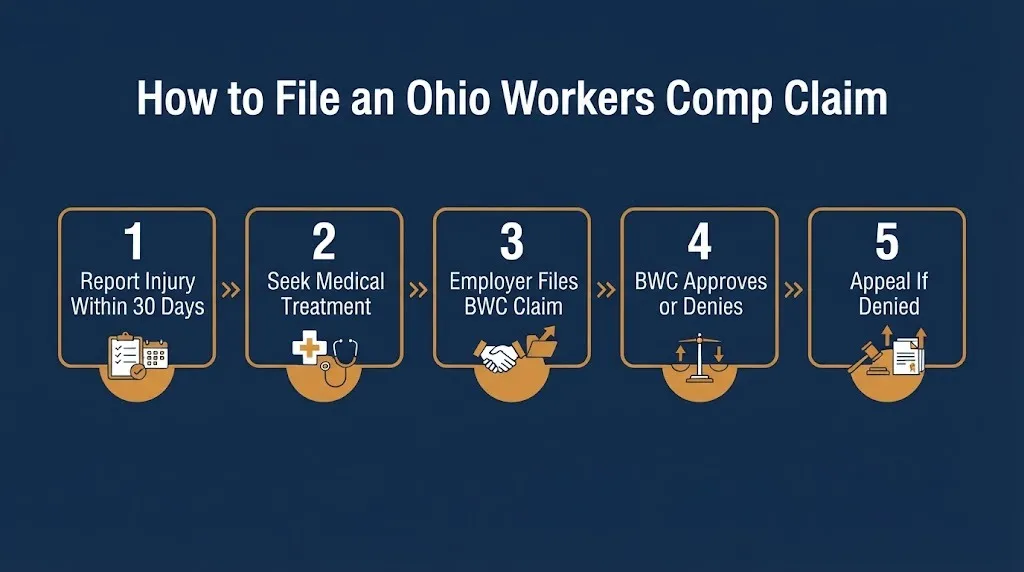
- Day 1: Report the injury to your employer.
- Within 30 days: Employer files the claim with the BWC, or you file directly.
- Weeks 1 to 6: BWC investigates and approves or denies the claim.
- If approved: Benefits begin based on your average weekly wage.
- If denied: You receive a denial notice with appeal instructions.
- Within 30 days of denial: File an appeal with the Industrial Commission of Ohio.
- Weeks to months later: Hearing scheduled and conducted.
- After hearing: Decision issued, further appeals possible.
Frequently Asked Questions
Do I need a workers compensation attorney in Columbus?
You need one if your claim is denied or disputed.
Simple approved claims may not require legal help.
An attorney adds value when the system pushes back.
How long do I have to report a work injury in Ohio?
You should report the injury to your employer within 30 days.
Ohio law requires employer notification for most claims.
Delayed reporting can complicate your claim.
What percentage does a workers compensation attorney take in Ohio?
Attorney fees typically range from 15 to 33 percent of awarded benefits.
Ohio law sets maximum fee percentages by benefit type.
The fee must often be approved by the BWC or Industrial Commission.
Can I sue my employer for a work injury in Columbus?
No, workers compensation is generally your exclusive remedy against your employer.
You cannot sue your employer in civil court for a work injury in most cases.
You may have a third-party lawsuit if someone other than your employer caused the injury.
How long does a Columbus workers compensation claim take?
A simple approved claim can start paying benefits within weeks.
A disputed claim can take months or over a year through hearings and appeals.
Settlement negotiations add more time depending on the complexity.
What if my employer says I was not hurt at work?
Your employer can contest the claim through the BWC process.
You will need medical evidence and witness statements to prove the injury was work-related.
An attorney can help you gather and present that evidence.
Is workers compensation taxable in Ohio?
No, Ohio workers compensation benefits are generally not subject to state or federal income tax.
This applies to temporary disability, permanent partial disability, and settlements.
Do not report workers compensation benefits on your tax return as ordinary income.
Report Your Injury Now and Gather Your Records
The most important step in any Columbus workers compensation case is the first one: report your injury to your employer immediately. After that, keep every medical record, every BWC notice, and every communication with your employer.
If the claim hits resistance, contact a workers compensation attorney who practices in Columbus and knows the BWC and Industrial Commission systems. Most offer free consultations, so you can learn your options without spending a dollar.
The single most important date to remember: you have one year from the date of injury to file your claim, but waiting that long only helps the other side.