OTE Compensation 2026: What On-Target Earnings Actually Mean for Your Pay
Quick Answer
- OTE means on-target earnings, the total pay you can expect if you hit 100 percent of your sales quota.
- OTE is not a guaranteed salary. It combines base pay plus variable commission at full target achievement.
- The most important thing to verify is the base salary split, because OTE alone can overstate real take-home pay.
You got a job offer that says “OTE $150,000.” You are not sure what that means for your actual paycheck. You searched for OTE compensation because you want to know if that number is real or just recruiter math.
Here is the direct answer. OTE stands for on-target earnings. It represents the total compensation you would earn in a year if you hit exactly 100 percent of your sales quota or performance target. It is a projection, not a promise.
This guide explains what OTE means, how it is calculated, how to evaluate an OTE offer, and what questions to ask before you sign. One surprising verified fact: many employers set quotas so that a significant percentage of sales reps do not hit full OTE, meaning the published OTE figure may be higher than what most employees actually earn.
The Facts
| Item | Detail |
|---|---|
| Term | OTE (On-Target Earnings) |
| Definition | Base salary plus commission at 100 percent quota attainment |
| Guaranteed Portion | Base salary only |
| Variable Portion | Commission, bonus, or performance pay |
| Common Base Split | 50/50 or 60/40 base to variable |
| Industry Usage | Sales, account management, recruiting |
| Legal Requirement | Must be disclosed accurately in offer letters |
| Risk Factor | Quota attainment below 100 percent reduces total pay |
What Does OTE Mean in Compensation?
OTE means on-target earnings. It is the total annual compensation an employee receives if they achieve exactly 100 percent of their performance targets.
The figure combines base salary and variable pay. Variable pay includes commissions, bonuses, or other performance-based incentives. The base salary is guaranteed. The variable portion depends on hitting quota.
For example, an OTE of $120,000 with a 60/40 split means a base salary of $72,000 and variable pay of $48,000 if you hit your full target. The $72,000 is yours regardless of performance. The $48,000 requires hitting 100 percent of quota.
OTE is not a legal term with a fixed definition. Different companies calculate it differently. Some include only commission. Others include bonuses, stock, or other incentives. You must read the offer letter carefully.
Is OTE Guaranteed?
No, OTE is not guaranteed. Only the base salary portion of OTE is guaranteed. The variable portion depends on performance.
This is the most common misunderstanding about OTE. A recruiter says “you’ll earn $150,000 OTE,” and the candidate hears “you’ll make $150,000.” Those are not the same thing.
If your OTE is $150,000 with a 50/50 split, your base is $75,000. That base is guaranteed. The other $75,000 comes from commission, and you only earn it if you hit your sales targets. If you hit 80 percent of quota, your variable pay may be 80 percent of $75,000, or $60,000. Your total earnings would be $135,000.
If you hit 50 percent of quota, your total could be $112,500. The guaranteed portion is only the base salary.
Key Takeaway: OTE is a target, not a guarantee. Your actual earnings depend on quota attainment.
How Is OTE Calculated?
OTE is calculated by adding your base salary to your expected variable compensation at 100 percent quota attainment.
The formula is simple: OTE = Base Salary + Variable Pay at Full Target.
The split between base and variable varies by role, industry, and company. Common splits include 50/50, 60/40, and 70/30. A 70/30 split means 70 percent base and 30 percent variable, which is less risky for the employee. A 50/50 split means half your pay is at risk.
Here is how different splits affect a $100,000 OTE:
| Split | Base Salary | Variable at 100% | Your Risk Level |
|---|---|---|---|
| 50/50 | $50,000 | $50,000 | High |
| 60/40 | $60,000 | $40,000 | Moderate |
| 70/30 | $70,000 | $30,000 | Lower |
| 80/20 | $80,000 | $20,000 | Low |
The riskier the split, the more your actual pay depends on performance.
What Is a Good OTE for Sales Roles?
A good OTE depends on the industry, the role, the location, and your experience. There is no single number that qualifies as good across all sales jobs.
In technology sales, entry-level sales development representatives often have OTE between $60,000 and $90,000. Account executives at software companies may see OTE between $120,000 and $250,000. Enterprise sales executives can have OTE exceeding $300,000.
In other industries, the numbers shift. Retail sales roles may have OTE between $35,000 and $60,000. Financial services sales roles often range from $80,000 to $200,000.
The more important question is whether the OTE is achievable. A $200,000 OTE with an unrealistic quota is worse than a $120,000 OTE with a quota that most reps hit. Ask about quota attainment rates before accepting.
Key Takeaway: A high OTE with an unrealistic quota is worth less than a moderate OTE with achievable targets.
What Is the Difference Between OTE and Base Salary?
Base salary is the fixed amount you are paid regardless of performance. OTE is base salary plus variable pay at full target.
Base salary is guaranteed. It appears in every paycheck, every month, no matter what. OTE includes the base but adds the commission or bonus you would earn at 100 percent quota.
The gap between base and OTE is your variable pay. That gap represents risk. A large gap means more upside if you perform well and more downside if you do not.
When comparing offers, look at base salary first. Then look at OTE. Then ask about quota attainment. A job with a $50,000 base and $100,000 OTE is riskier than a job with an $80,000 base and $100,000 OTE, even though the OTE is identical.
How Do You Evaluate an OTE Job Offer?
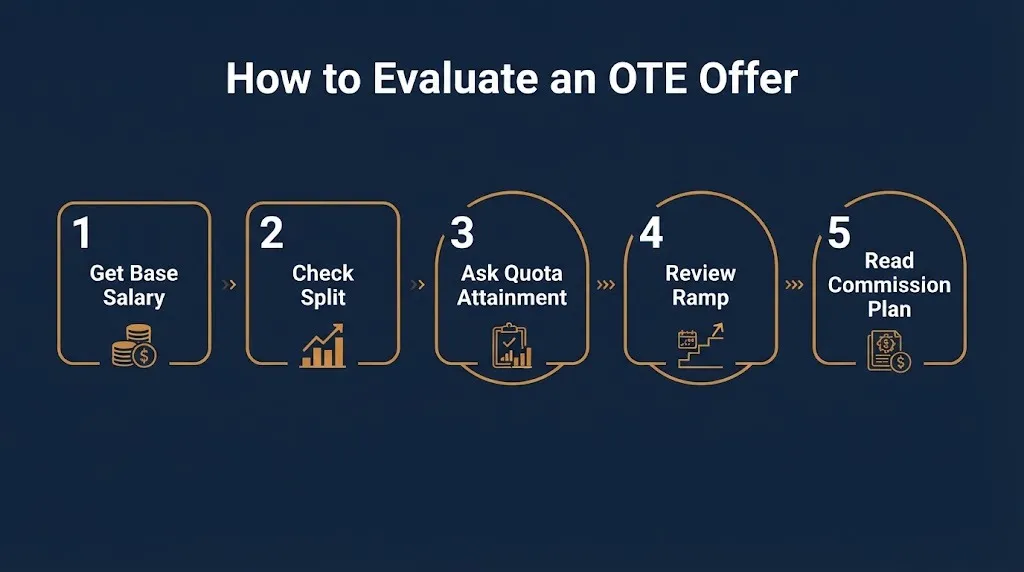
You evaluate an OTE job offer by looking at five things: base salary, OTE split, quota attainment history, ramp period, and payment structure.
Here is a checklist:
- What is the base salary, and is it enough to live on?
- What is the base-to-variable split?
- What percentage of current reps hit 100 percent of quota?
- Is there a ramp period with reduced quota and guaranteed commission?
- When is commission paid, monthly, quarterly, or annually?
- What happens to commission if you leave before it is paid?
- Is the quota based on bookings, revenue, or another metric you can control?
The answers tell you whether the OTE is realistic or a recruiting number designed to attract candidates.
What Percentage of Sales Reps Hit Their OTE?
The percentage of sales reps who hit their OTE varies by company and industry. Some companies report 60 to 70 percent of reps hitting quota. Others report fewer than 50 percent.
This data is rarely published in job postings. You must ask during the interview process. A good question is: “What percentage of your sales team hit 100 percent of quota last year?”
Companies with high quota attainment rates are more likely to deliver on their OTE promise. Companies with low attainment rates are using OTE as a recruiting tool, knowing most reps will earn less.
Do not accept vague answers. “We have a high-performing team” means nothing. Ask for a specific number. If they cannot or will not provide one, treat the OTE with skepticism.
Key Takeaway: Quota attainment data is the single most important factor in determining whether an OTE is realistic.
Reality Check
No company pays you the full OTE on day one. You earn commission only after you close deals, and most roles have a ramp period where your quota is reduced. No recruiter will tell you the unflattering quota attainment statistics unless you ask. No offer letter should list OTE without also listing the base salary separately. If the base salary is missing, the offer is incomplete.
What Is a Ramp Period in OTE Compensation?
A ramp period is the initial months of a sales role when your quota is reduced or waived while you learn the product, build pipeline, and start closing deals.
During the ramp, many companies pay a guaranteed commission or a draw. This means you receive your full OTE or close to it even though you are not yet hitting quota. The ramp typically lasts 3 to 6 months.
After the ramp ends, your quota becomes full, and your variable pay depends entirely on performance. If you have not built enough pipeline during the ramp, your post-ramp earnings may drop.
Ask about the ramp before you accept. A generous ramp gives you time to build momentum. No ramp or a short ramp means you are expected to produce immediately.
What Is a Draw in OTE Compensation?
A draw is an advance against future commissions. It provides a minimum income during ramp periods or slow months, and it is repaid from future commission earnings.
A recoverable draw means the company pays you a set amount each month, and that amount is deducted from future commissions once you start earning them. If you never earn enough commission, you may owe the draw back, depending on the company’s policy.
A non-recoverable draw is a guarantee. You do not have to repay it if your commissions never catch up.
Draws protect you during slow periods, but recoverable draws create debt if your performance does not improve. Read the draw terms carefully.
How Does OTE Work in Non-Sales Roles?
OTE is most common in sales, but it is also used in other roles with variable compensation. Account managers, customer success managers, recruiters, and some technical roles may have OTE components.
In these roles, the variable portion is often tied to retention, upsell revenue, placements, or other measurable outcomes. The structure is the same: a base salary plus a variable component at 100 percent target.
The same evaluation rules apply. Look at the base, the split, the target, and the historical attainment. Non-sales OTE roles can be just as risky as sales roles if the targets are unrealistic.
What Happens Next
Here is what you should do before accepting any OTE offer:
- Immediately: Ask for the base salary and the exact OTE split in writing.
- During interviews: Ask what percentage of reps hit 100 percent of quota last year.
- Before signing: Review the commission plan document, not just the offer letter.
- Negotiate: Push for a higher base salary or a longer ramp if the OTE is risky.
- After starting: Track your own performance against quota from month one.
Frequently Asked Questions
Is OTE the same as salary?
No, OTE includes base salary plus variable pay at full target.
The base salary portion is guaranteed.
The variable portion depends on performance.
Can OTE be lower than base salary?
No, OTE is always higher than base salary.
OTE includes the base plus variable pay.
The variable portion adds to the base, not subtracts from it.
Is OTE taxable?
Yes, OTE is taxable as ordinary income.
Base salary is taxed as regular wages.
Commission and bonus payments are also taxable.
What if I do not hit my quota?
You earn your base salary but less variable pay.
Your total earnings will be below OTE.
The gap depends on how far below quota you finish.
Can I negotiate OTE?
You can negotiate the base salary, the OTE amount, and the split.
Employers may be more willing to adjust the split than the total OTE.
A higher base with the same OTE reduces your risk.
Is OTE used outside the United States?
Yes, OTE is used globally in sales compensation.
The definition is consistent across most countries.
Local tax and labor laws may affect how it is paid.
What does OTE mean in a job posting?
It means the total expected earnings at full target achievement.
It is not a guaranteed salary.
Look for the base salary disclosure in the posting or ask for it.
Ask for the Base Salary First and the Quota Attainment Second
OTE is a useful number, but it is only part of the story. The base salary tells you what is guaranteed. The quota attainment rate tells you what is realistic. Without both, the OTE figure is just marketing.
Before you accept any OTE offer, get the base salary in writing, ask about quota attainment, and read the full commission plan. Those three steps protect you from accepting a job that pays far less than the headline number suggests.
The single most important question to ask: “What percentage of your sales team hit 100 percent of quota last year?” If the answer is vague, treat the OTE accordingly.