Michigan Workers Compensation 2026: Rates, Rules, and Requirements
Quick Answer
- Michigan workers compensation is a state-mandated insurance system, not a lawsuit or class action you sign up for.
- The 2026 maximum weekly benefit is $1,201, based on 80% of your after-tax average weekly wage.
- You have 90 days to notify your employer of an injury and 2 years to file a formal claim.
If you searched “workers compensation Michigan,” you’re likely trying to understand what you’re owed after a job injury, or what your business is legally required to carry.
Michigan sets a new wage-loss maximum every January 1. For 2026, that ceiling is $1,201 per week, calculated from the state’s official average weekly wage of $1,333.88.
This article breaks down exactly how those numbers work, who qualifies, and the two deadlines that actually control your claim, not the vague “check with a lawyer” answers most sites give.
The Facts
| Category | Details |
|---|---|
| Governing Law | Michigan Workers’ Disability Compensation Act (WDCA) |
| Administering Agency | Michigan Workers’ Disability Compensation Agency (WDCA), under LEO |
| Status | Active; 2026 rates in effect as of January 1, 2026 |
| 2026 Maximum Weekly Benefit | $1,201.00 (90% of the state average weekly wage) |
| Benefit Formula | 80% of your after-tax average weekly wage |
| Notice Deadline | 90 days from the date of injury or awareness of it |
| Claim Filing Deadline | 2 years from injury, disability onset, or last day of employment |
| Proof Needed | Documented work-related injury, employer notice, and supporting medical records |
Is Michigan workers compensation insurance required for your employer?
Yes, most Michigan employers are legally required to carry workers’ compensation insurance. Coverage isn’t optional once your business crosses certain size or hour thresholds.

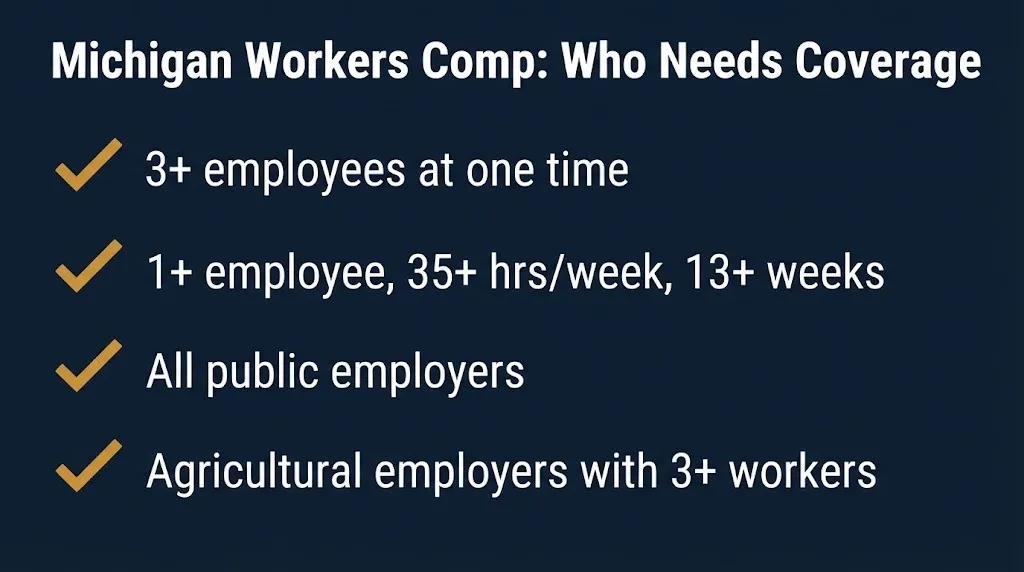
Under the Workers’ Disability Compensation Act, coverage is mandatory for:
- Private employers regularly employing 3 or more employees at one time, including part-time staff.
- Private employers with 1 or more employees working 35+ hours per week for 13+ weeks during the preceding 52 weeks.
- Agricultural employers with 3 or more employees working 35+ hours per week for 13 or more consecutive weeks.
- Households employing domestic workers 35+ hours per week for 13+ weeks in the preceding year.
- All public employers, regardless of size.
Key Takeaway: Nearly every Michigan business with even a handful of regular employees is legally required to carry workers’ compensation coverage, not just larger employers.
Is Michigan workers comp the same as a lawsuit or settlement?
No, Michigan workers compensation is a no-fault state insurance system, not a lawsuit you file against your employer or a class action you sign up for. That’s a common point of confusion.
Under the WDCA, injured employees generally give up the right to sue their employer directly for most workplace injuries. In exchange, they get faster, no-fault access to medical care and wage-loss benefits without having to prove the employer was negligent.
Disputes over benefits go through the Workers’ Disability Compensation Agency’s hearing and appeals process, not a civil courtroom class action. There’s no settlement fund shared among a “class” of claimants here, since every claim is evaluated individually based on your own wages and injury.
How much does Michigan workers compensation pay in 2026?
The 2026 maximum weekly wage-loss benefit is $1,201.00, based on 90% of the state’s official average weekly wage of $1,333.88. Your actual benefit depends on your own wages, not a flat rate everyone receives.
Here’s how Michigan’s official 2026 wage chart breaks down:
| Benefit Category | 2026 Amount |
|---|---|
| State Average Weekly Wage (SAWW) | $1,333.88 |
| Maximum weekly benefit (90% of SAWW) | $1,201.00 |
| Two-thirds of SAWW | $889.25 |
| Minimum benefit, death cases (50% of SAWW) | $666.94 |
| Minimum benefit, specific loss and total/permanent disability (25% of SAWW) | $333.47 |
Most injured workers receive 80% of their after-tax average weekly wage, capped at the maximum above. That’s different from most states, which typically calculate benefits as two-thirds of gross wages.
Reality Check: Michigan workers compensation isn’t a settlement fund you apply to online, and no third-party website can “sign you up” for a payout. Your benefit is calculated directly from your own wage records through your employer’s insurance carrier or the state’s official calculator, and filing a claim never requires paying a fee.
How is your Michigan workers comp weekly benefit calculated?
Your weekly benefit equals 80% of your after-tax average weekly wage, calculated from your highest-paid 39 weeks out of the 52 weeks before your injury. That number then gets capped at the current year’s maximum.
The calculation generally works like this:
- Identify your highest-paid 39 weeks out of the 52 weeks before your injury.
- Add those wages together and divide by 39 to get your average weekly wage.
- Convert that to an after-tax figure based on your filing status and dependents.
- Multiply the after-tax amount by 80%.
- Compare that result to the current year’s maximum ($1,201 for 2026).
- Your weekly benefit is whichever is lower.
If you can return to work in a limited capacity, you may instead receive 80% of the difference between your pre-injury wages and your current earning capacity. The Michigan Workers’ Disability Compensation Agency offers an online benefit calculator to help estimate this figure.
How to file a Michigan workers compensation claim
Filing a Michigan workers’ comp claim starts with notifying your employer, not filling out a court document. Here’s the general process:
- Report the injury or illness to your employer as soon as possible, ideally in writing.
- Get any necessary emergency or initial medical treatment.
- Confirm your employer files Form WC-100 with their insurance carrier and the agency, which is required for disabilities exceeding 7 consecutive days, death, or specific loss.
- Keep copies of all medical records and correspondence related to your injury.
- If your employer or their insurer disputes or delays your claim, you can file for a hearing with the Workers’ Disability Compensation Agency.
- Attend any required medical evaluations tied to your claim.
- Track your notice date and claim filing date against the 90-day and 2-year deadlines.
What proof do you need for a Michigan workers comp claim?
You generally need documentation showing your injury or illness happened in the course of your employment, along with timely notice to your employer. Verbal notice is technically allowed, but written notice creates a clearer paper trail.
Useful documentation includes:
- A written incident or accident report, ideally dated and signed.
- Medical records connecting your diagnosis to a work-related cause.
- Pay stubs or wage records covering the 52 weeks before your injury.
- Any communication with your employer about the injury or your ability to work.
For gradual conditions or occupational diseases, the clock for notice and filing generally starts when the disability becomes apparent, not necessarily the date of first exposure.
Key Takeaway: Two separate deadlines control your claim, a 90-day notice window and a 2-year filing window, and missing either one independently can jeopardize your right to benefits.
What is the deadline to file a Michigan workers comp claim?
You must notify your employer within 90 days of your injury and file a formal claim within 2 years of the injury, disability onset, or your last day of employment with that employer, whichever is later. These are two distinct requirements under state law.
Michigan doesn’t technically impose a hard statute of limitations that bars all future claims, as long as you meet both the notice and initial filing requirements. However, there’s a separate “two-year-back rule” limiting how far back you can collect past-due benefits from the date you file.
Think of it like an insurance claim after storm damage to your home. Reporting the damage quickly protects your claim, but you generally can’t recover for repairs going back indefinitely if you wait too long to file.
Michigan workers compensation insurance requirements in 2026
Michigan’s insurance coverage requirements remain unchanged for 2026, though the wage-loss benefit rates themselves increase every January 1. Employers meeting the size or hour thresholds must maintain coverage year-round, not just during high-risk periods.
Employers can satisfy this requirement in one of several ways:
| Coverage Option | Description |
|---|---|
| Private insurance policy | Purchased from a licensed, approved carrier |
| Assigned risk pool | Available through the Compensation Advisory Organization of Michigan |
| Self-insured group fund | Joining an approved group of similar employers |
| Individual self-insurance | Requires authorization from the WDCA director |
The agency’s Insurance Compliance Division maintains coverage records for more than 243,000 Michigan employers, tracking who is insured, self-insured, or properly excluded from the Act.
What happens if your Michigan employer doesn’t have workers comp insurance?
An uninsured employer who is legally required to carry coverage can face a fine of $1,000 and imprisonment between 30 days and 6 months, with each uninsured day treated as a separate offense. The agency can also petition a court to bar the company from employing anyone until proper coverage is secured.
If you’re injured while working for an uninsured employer, you may still be entitled to benefits. In some situations, an uninsured subcontractor’s claim can become the responsibility of the general contractor who hired them.
If you’re unsure whether your employer carries coverage, you can request verification through the WDCA’s Insurance Compliance Division rather than relying solely on what your employer tells you.
What is Michigan workers compensation insurance?
Michigan workers compensation insurance is coverage required under the Workers’ Disability Compensation Act that pays medical and wage-loss benefits to employees injured on the job. It operates on a no-fault basis, meaning you don’t need to prove your employer was careless to qualify.
The system dates back to Michigan’s first workmen’s compensation law in 1912, with the current Workers’ Disability Compensation Act enacted in 1969. It remains the primary law governing on-the-job injuries in the state.
In exchange for this faster, no-fault access to benefits, injured employees generally give up the right to sue their employer in civil court for most workplace injuries, aside from limited exceptions like intentional harm.
Who is covered under Michigan workers compensation?
Full-time, part-time, and seasonal employees are generally covered under Michigan workers compensation once their employer meets the coverage thresholds. Coverage isn’t limited to full-time staff only.
Broadly, you’re likely covered if:
- You’re classified as an employee, not an independent contractor.
- Your employer regularly employs 3 or more people, or 1+ person working 35+ hours weekly for 13+ weeks.
- Your injury or illness arose out of and in the course of your employment.
- You provided notice of the injury within the required 90-day window.
Corporate officers of closely-held corporations and LLC managers are generally considered employees under the Act, though some may elect exclusion under specific conditions.
Who is exempt from Michigan workers compensation coverage?
Independent contractors, casual laborers, and most sole proprietors are generally exempt from mandatory Michigan workers compensation coverage. A sole proprietor with no employees cannot purchase a policy covering only themselves.
Other notable exemptions and exclusions include:
- Employers who haven’t employed at least 1 qualifying person for 13 weeks.
- Agricultural employers with fewer than 3 qualifying employees.
- Households not employing domestic workers 35+ hours per week for 13+ weeks.
- Certain business owners, such as some partners and corporate officers, who file an exclusion form.
Key Takeaway: Being classified as an employee, not an independent contractor, is the threshold requirement for coverage, and misclassification disputes are common in denied claims.
What benefits does Michigan workers compensation cover?
Michigan workers compensation covers medical treatment, wage-loss benefits, specific loss benefits, and vocational rehabilitation for qualifying work injuries. Coverage isn’t limited to just a paycheck replacement.
Specific covered categories include:
- Medical care: All reasonable and necessary treatment, with no deductibles or copays, and the employee generally chooses their physician after an initial period.
- Wage-loss benefits: Weekly payments calculated from your average weekly wage, subject to the annual maximum.
- Specific loss benefits: Compensation for amputation, vision loss, hearing loss, or death.
- Vocational rehabilitation: Retraining services if you can’t return to your prior occupation.
There’s a 7-day waiting period before wage-loss benefits begin, though those days become retroactively payable if your disability lasts longer than 14 days.
What happens if your Michigan workers comp claim is denied?
If your claim is disputed or denied, you can file for a hearing with the Michigan Workers’ Disability Compensation Agency’s Board of Magistrates. This isn’t a court lawsuit, but a formal administrative hearing process specific to workers’ comp disputes.
A magistrate reviews medical documentation and testimony to decide whether your injury qualifies and what benefits are owed. If you disagree with that decision, further appeal options exist through the Workers’ Disability Compensation Appeals Commission.
Given the complexity of proving reduced wage-earning capacity and navigating insurer pushback, many workers consult an attorney at this stage, even though workers’ comp claims themselves don’t require one to file.
What Happens Next
Within 90 days of injury: You must notify your employer of the work-related injury or illness.
Ongoing: Your employer’s insurance carrier reviews and either pays or disputes wage-loss and medical benefits.
Within 2 years: You must file a formal claim if benefits are disputed, denied, or not properly initiated.
If disputed: Your case proceeds to a hearing before the Workers’ Disability Compensation Agency’s Board of Magistrates.
January 1, 2027 (expected): The state publishes updated wage-loss maximums for the following benefit year.
Frequently Asked Questions
How much is the maximum workers comp payment in Michigan for 2026?
The maximum weekly wage-loss benefit for 2026 is $1,201.00.
That figure is based on 90% of the state’s official average weekly wage of $1,333.88.
Most workers receive 80% of their after-tax average weekly wage, capped at that maximum.
Does my Michigan employer have to carry workers comp insurance?
Most Michigan employers are legally required to carry coverage once they regularly employ 3 or more people, or 1 or more employees working 35+ hours weekly for 13+ weeks.
All public employers must carry coverage regardless of size.
Some sole proprietors and independent contractors fall outside these requirements.
How long do I have to file a workers comp claim in Michigan?
You generally must notify your employer within 90 days of the injury and file a formal claim within 2 years.
These are two separate deadlines, and meeting one doesn’t satisfy the other.
There’s also a two-year-back rule limiting how far past benefits can be recovered once you do file.
Is Michigan workers compensation a lawsuit I need to join?
No, it’s a state-mandated, no-fault insurance system, not a lawsuit or class action.
Benefits are calculated individually based on your own wages and injury.
Disputes go through an administrative hearing process, not civil court litigation.
What if my employer doesn’t have workers comp insurance?
An employer required to carry coverage but failing to do so can face a $1,000 fine and 30 days to 6 months of imprisonment, with each day treated separately.
You may still be entitled to benefits even if your employer was improperly uninsured.
Contact the WDCA’s Insurance Compliance Division to verify your employer’s coverage status.
How is my weekly workers comp benefit calculated in Michigan?
Your benefit is generally 80% of your after-tax average weekly wage, based on your highest-paid 39 weeks out of the prior 52 weeks.
That number is then capped at the current year’s maximum, $1,201 for 2026.
The Workers’ Disability Compensation Agency offers an online calculator to estimate this figure.
What happens if my Michigan workers comp claim gets denied?
You can request a hearing before the Workers’ Disability Compensation Agency’s Board of Magistrates.
A magistrate reviews your medical records and testimony to decide the outcome.
Further appeals go through the Workers’ Disability Compensation Appeals Commission.
The 2026 maximum weekly benefit is $1,201, but your actual payment depends entirely on your own wage history and injury documentation. Report any workplace injury to your employer promptly and track your 90-day notice and 2-year filing deadlines closely.