Injury Lawsuit 2026: How Personal Injury Claims Work, What They Pay, and Deadlines That Control Everything
Quick Answer
- An injury lawsuit seeks compensation for harm caused by someone else’s negligence or intentional act.
- Most personal injury cases settle for $10,000 to $100,000, but serious injuries can reach millions.
- You must file within your state’s statute of limitations, usually one to three years from the injury.
You were hurt. A car crash. A fall. A defective product. A dog bite. Now the bills are piling up, the pain is not going away, and you want to know if you have a case.
The answer starts with negligence. Someone owed you a duty of care. They breached it. That breach caused your injury. That injury caused your damages. If all four elements line up, you have a claim.
This article explains how injury lawsuits work, what they are worth, how long they take, and the deadlines that will end your case if you miss them. It is written for someone holding a stack of medical bills and wondering where to start.
The Facts
| Fact | Verified Value |
|---|---|
| Case Type | Personal injury lawsuit |
| Jurisdiction | State court where the injury occurred |
| Statute of Limitations | 1 to 3 years in most states |
| Common Settlement Range | $10,000 to $100,000 for moderate injuries |
| Contingency Fee | 33% to 40% of recovery |
| Settlement Timeline | 6 to 18 months for most cases |
Is a personal injury lawsuit legitimate?
Yes. Personal injury law is one of the oldest and most established areas of the legal system. The basic principle is simple: if someone hurts you through carelessness, they pay.
The legal term is negligence. You must prove four things: duty, breach, causation, and damages. The driver owed you a duty to drive safely. The driver breached that duty by running a red light. The breach caused your broken leg. The broken leg caused your medical bills and lost wages.

The system is not perfect. Insurance companies fight claims. Cases take time. Not every injury leads to a payout. But the legal right to compensation is real, and it has existed for centuries.
Key Takeaway: Your injury lawsuit is not a lottery ticket. It is a claim for compensation based on provable negligence and measurable damages.
How much is my injury lawsuit worth?
There is no formula. The value depends on your medical costs, your lost income, your pain, and the strength of the liability evidence.
Here is a verified range by injury severity:
| Injury Type | Typical Settlement Range |
|---|---|
| Soft tissue, no surgery | $5,000 to $25,000 |
| Fractures requiring surgery | $25,000 to $100,000 |
| Joint replacement or spinal injury | $100,000 to $500,000 |
| Brain injury or paralysis | $500,000 to millions |
| Wrongful death | $250,000 to millions |
These are general ranges from reported settlements and verdicts. Your case may fall outside these numbers based on the specific facts.
The insurance policy limits also matter. If the at-fault driver has a $25,000 policy, that caps what you can collect from the insurer, regardless of your damages.
What damages can I recover in an injury lawsuit?
Damages fall into two categories. Economic damages are your financial losses. Non-economic damages are the human cost.
Economic damages include:
- Medical bills, current and future.
- Lost wages from missed work.
- Lost earning capacity if you cannot return to your old job.
- Rehabilitation and therapy costs.
- Medical equipment and home modifications.
- Property damage.
Non-economic damages include:
- Pain and suffering.
- Emotional distress.
- Loss of enjoyment of life.
- Scarring and disfigurement.
- Loss of consortium for a spouse.
Some states cap non-economic damages. The cap, if any, depends on where the injury occurred.
Key Takeaway: Your medical records and wage statements are the foundation of your claim. Document everything.
How long do I have to file an injury lawsuit?
The deadline is your state’s statute of limitations for personal injury. Most states give one to three years from the injury date.
Here are verified examples:
| State | Filing Deadline |
|---|---|
| California | 2 years |
| Texas | 2 years |
| New York | 3 years |
| Florida | 2 years |
| Illinois | 2 years |
If the injury was not discovered right away, some states apply a discovery rule. The clock starts when you knew or should have known about the injury. That rule is fact-specific and varies by state.
If the defendant is a government entity, special notice requirements apply. Some states require a notice of claim within 90 days or six months. Those deadlines are much shorter.
Do not guess your deadline. A missed deadline ends your case no matter how strong the facts are.
How do I file a personal injury lawsuit?
The process starts with an insurance claim, not a court filing. Most cases settle before a lawsuit is necessary. But you must protect your rights from day one.
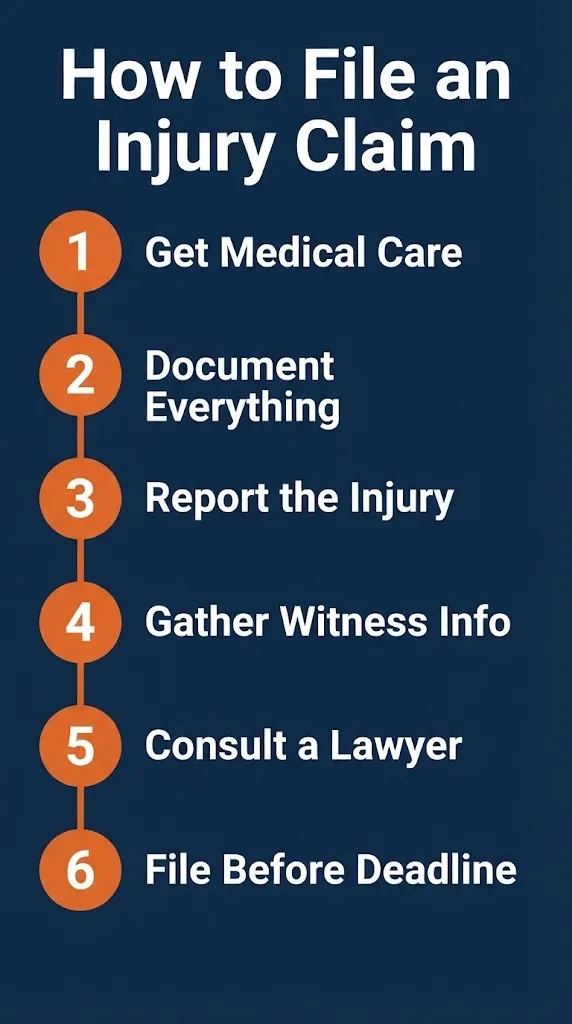
Here are the verified steps:
- Seek immediate medical care and follow every treatment recommendation.
- Report the injury to the responsible party or their insurer.
- Document the scene with photos if possible.
- Gather witness names and contact information.
- Keep a file of all medical bills, records, and wage loss statements.
- Consult a personal injury lawyer before accepting any settlement offer.
- File a lawsuit before the statute of limitations expires if no settlement is reached.
This is like a warranty claim on a major purchase. The sooner you document the problem, the stronger your position.
Do I need a lawyer for an injury lawsuit?
Not for a minor injury with no real medical treatment. But any case involving surgery, ongoing treatment, or significant lost wages deserves a lawyer.
Insurance companies have adjusters and lawyers on their side. They handle thousands of these cases. You have handled none. The playing field is not level.
A personal injury lawyer works on contingency. You pay nothing upfront. The lawyer advances case costs and recovers them from any settlement. If you lose, you owe nothing in most cases.
Here is what a lawyer does for you:
- Investigates the injury and preserves evidence.
- Requests medical records and bills.
- Hires experts to prove liability and damages.
- Negotiates with the insurance company.
- Files a lawsuit before the deadline if needed.
- Prepares the case for trial if settlement fails.
Key Takeaway: You are not required to hire a lawyer. But you are playing against professionals who do this every day.
What is the difference between a claim and a lawsuit?
A claim is a demand for compensation, usually made to an insurance company. A lawsuit is a formal court filing.
Most injury cases start as claims. You or your lawyer send a demand letter. The insurer responds. Negotiations follow. If no settlement is reached, you file a lawsuit.
Filing a lawsuit does not mean you are going to trial. Most lawsuits still settle before trial. The filing creates pressure and formalizes the process.
Here is the sequence:
- Injury occurs.
- Insurance claim filed.
- Demand letter sent.
- Negotiations conducted.
- Lawsuit filed if no settlement.
- Discovery and depositions.
- Settlement or trial.
How long does an injury lawsuit take?
Most cases settle in 6 to 18 months. Cases that go to trial take 18 to 36 months or longer. The timeline depends on the severity of your injuries, the clarity of liability, and whether a lawsuit is filed.
Here is a typical timeline:
| Stage | Duration |
|---|---|
| Medical treatment | 1 to 6 months |
| Insurance claim and negotiation | 2 to 6 months |
| Lawsuit filing if no settlement | 6 to 12 months after injury |
| Discovery and depositions | 6 to 12 months |
| Trial or settlement | 12 to 24 months after filing |
You cannot rush the process. The insurance company will not pay serious money until it sees your full medical picture.
What if I was partially at fault?
Most states use comparative negligence. Your recovery is reduced by your percentage of fault. If you were 20 percent at fault, you receive 80 percent of your damages.
Some states use a modified rule. If you are 50 percent or 51 percent at fault, you recover nothing. A few states still use contributory negligence, where any fault bars recovery entirely.
The defense will try to shift blame. They will argue you were not paying attention, made a bad choice, or contributed to your own injury. Those arguments matter. The more fault shifts to you, the less your case is worth.
Key Takeaway: Fault is not all-or-nothing in most states. It is a percentage, and that percentage affects your payout.
What is a contingency fee?
A contingency fee is how personal injury lawyers get paid. You pay nothing upfront. The lawyer takes a percentage of the recovery. The standard range is 33% to 40%.
The percentage often increases if the case goes to trial. Some lawyers use a sliding scale. The fee is negotiable.
Case costs are separate. The lawyer advances costs for filing fees, medical records, and expert witnesses. Those costs come out of the settlement before the fee is calculated.
If you lose, you owe nothing in most cases. The lawyer absorbs the costs. That is the risk the lawyer takes in exchange for the contingency percentage.
What is the average personal injury settlement?
There is no reliable average. The numbers reported in news stories and legal marketing sites are skewed toward large verdicts. Most cases settle quietly for modest amounts.
The most honest answer is that moderate injury cases settle in the $10,000 to $100,000 range. Cases with broken bones, surgery, or permanent limitations settle higher. Cases with no objective injury findings settle lower.
Your medical records are the foundation. If the X-ray shows a fracture, your case is worth more. If the records show only subjective pain complaints, the insurer will offer less.
Reality Check
No insurance company will text you a settlement offer. No legitimate adjuster asks for a gift card to release your funds. Personal injury claims settle through documented negotiations, not phone promises. If someone pressures you to sign a release before you have seen a doctor, stop. The release ends your claim forever. You cannot reopen it later when the pain does not go away.
What Happens Next
| Timeline | Expected Stage |
|---|---|
| Day 1 to 30 | Medical care, documentation, incident report |
| Month 1 to 3 | Insurance claim filed, treatment continues |
| Month 3 to 6 | Demand letter sent, negotiations begin |
| Month 6 to 12 | Settlement reached or lawsuit considered |
| Month 12 to 24 | Litigation if no settlement, then trial or resolution |
These dates are estimates. Your case moves at the pace of your recovery and the insurer’s cooperation.
Frequently Asked Questions
Can I sue for any injury?
You can sue if someone else’s negligence caused your injury and you have damages.
How much is my injury case worth?
Most moderate cases settle for $10,000 to $100,000. Serious injuries settle higher.
How long do I have to file?
Most states give one to three years from the injury date.
Do I need a lawyer?
Not for minor cases, but any serious injury benefits from legal representation.
What if I was partially at fault?
Your recovery is reduced by your fault percentage in most states.
How long will my case take?
Most cases settle in 6 to 18 months. Trials take longer.
What does a lawyer cost?
Personal injury lawyers work on contingency, typically 33% to 40% of the recovery.
Will my case go to trial?
Most personal injury cases settle. Only a small percentage reach trial.
The Deadline Is the Only Enemy You Cannot Negotiate With
You can negotiate a settlement. You can dispute an insurance denial. You can gather more evidence. You cannot negotiate with the statute of limitations.
The deadline is fixed. It does not care about your recovery time or your hesitation. Mark the injury date. Count forward. The day the deadline expires, your case is over no matter how strong it was.