What Does Desired Compensation Mean: A 2026 Guide
Quick Answer
- Desired compensation means the total pay or financial amount you want from an employer or settlement.
- In job contexts, it includes salary, bonuses, and benefits, not just base pay.
- In legal contexts, it’s your settlement demand, typically negotiable and not your final number.
You’re filling out a job application, and it asks for “desired compensation.” Or you’re in a settlement conversation and the other side asks what you want. The term seems simple. The implications are not.
Here’s what actually matters. Desired compensation is a request, not a final offer. In employment, it’s the total package you want, including salary, bonuses, and benefits. In legal settlements, it’s your opening demand, which is almost always higher than what you’d accept.
This article covers what desired compensation means in different contexts, how to calculate it, what to say when asked, and the mistakes that cost people money. One surprising fact: most job applicants who state a desired compensation first leave money on the table because they anchor too low.
The Facts
| Case | Not a lawsuit; general legal and employment term |
| Status | Standard usage in job applications and settlement talks |
| Fund Size | Not applicable |
| Est. Per Person | Not applicable |
| Claim Deadline | Not applicable |
| Administrator | Not applicable |
| Proof Needed | Pay stubs, market data, or settlement demand calculation |
What Does Desired Compensation Mean?
Desired compensation means the total financial amount you want to receive in a job offer or settlement. It is your request, not a binding number.
In employment, desired compensation includes more than base salary. It covers bonuses, commissions, benefits, retirement contributions, and sometimes equity. A job that pays $80,000 salary plus $10,000 bonus has a total compensation of $90,000.
In legal settlements, desired compensation is your demand amount. It’s the number you put in a demand letter or state in negotiation. It’s typically higher than your bottom line because negotiation expects movement.
The term is common across job applications, recruiter calls, and settlement discussions. Understanding the context tells you how to respond.
What Is Your Desired Compensation Meaning on a Job Application?
On a job application, “desired compensation” means the total pay you want for the role, including base salary, bonuses, and benefits. Employers ask this to screen candidates by budget.
The question forces you to name a number before you fully understand the role. That’s strategic for the employer. It gives them information without committing anything.
Here’s what to consider before answering.
- Research the market rate for the role in your location.
- Calculate your current total compensation, not just salary.
- Factor in benefits differences if you’re moving from a job with strong benefits.
- Decide on a target range, not a single number.
- Position your number as negotiable.
If the application requires a number, use a range when possible. If it requires a single figure, choose the midpoint of your researched range, then note it’s negotiable.
What Does Desired Compensation Mean in a Settlement?
In a settlement, desired compensation means the amount you’re asking to resolve a claim. It’s your demand, not your bottom line.
Settlement demands follow a logic. You calculate your damages, add non-economic harm like pain and suffering, and then add negotiation room. The demand is higher than your acceptable minimum because the other side will counter.
The process works like this.
- You calculate your actual damages: medical bills, lost wages, repair costs.
- You estimate non-economic damages: pain, stress, inconvenience.
- You add a multiplier or a negotiated premium.
- You submit that total as your desired compensation.
- The other side counters, and you negotiate toward the middle.
Your desired compensation in a settlement is a starting point, not an ending point.
Key Takeaway: In both job offers and settlements, desired compensation is an opening number, not a final answer, and it should include negotiation room.
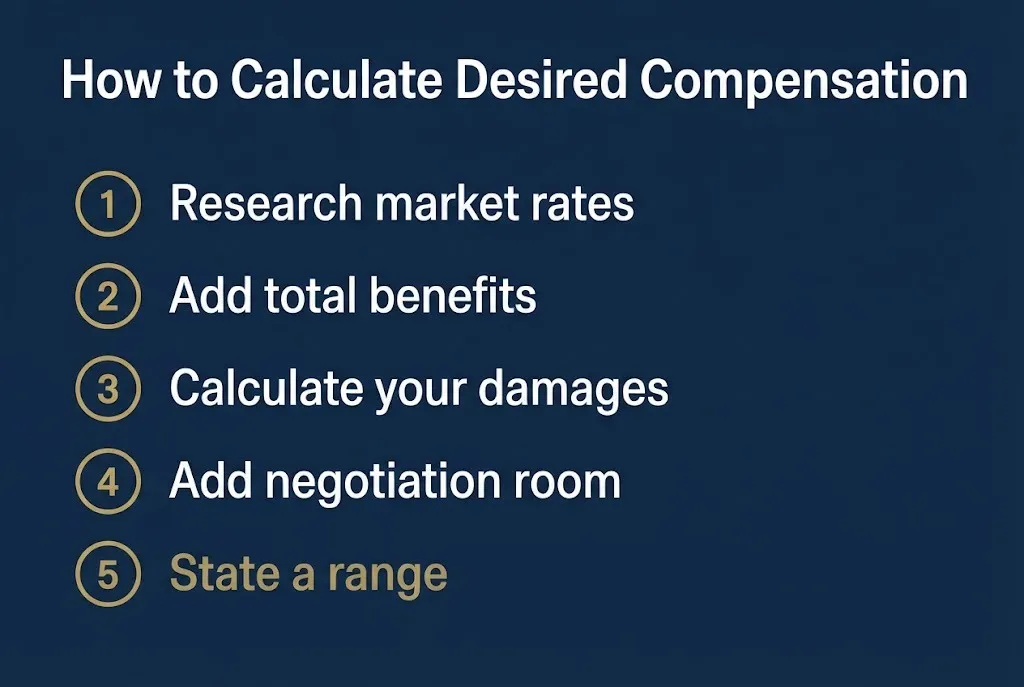
How Do You Calculate Desired Compensation for a Job?
Calculating desired compensation for a job requires more than guessing. You need data.
- Research salary ranges on sites like the Bureau of Labor Statistics or industry surveys.
- Identify the market rate for your role, experience level, and location.
- Add the value of benefits you need: health insurance, retirement, paid time off.
- Factor in commute costs, remote work flexibility, or relocation expenses.
- Set a target range with your ideal at the top and your minimum at the bottom.
A common method is to take your current total compensation and add 10 to 20 percent for a move. If you’re underpaid, the increase may be higher. If you’re moving to a lower-cost area, the number may adjust down.
The key is total compensation, not base salary. A $90,000 salary with no benefits may be worse than an $80,000 salary with strong benefits.
How Do You Calculate Desired Compensation in a Legal Claim?
Calculating desired compensation in a legal claim follows a structured approach. You’re not guessing. You’re building a number from documented damages.
- Add all economic damages: medical bills, lost income, property damage, future costs.
- Estimate non-economic damages: pain, suffering, emotional distress, inconvenience.
- Apply a multiplier if your jurisdiction commonly uses one, often 1.5 to 3 times economic damages.
- Add any statutory damages or penalties your claim supports.
- Round up to create negotiation room.
The demand is always higher than your acceptable settlement range. If you’d accept $20,000, your demand might be $35,000 or $40,000.
In personal injury claims, the demand letter states your desired compensation with documentation. The insurer counters lower. The negotiation moves toward the middle.
What Is the Difference Between Desired Compensation and Expected Salary?
Desired compensation and expected salary are often used interchangeably, but they mean slightly different things. Expected salary is usually base pay. Desired compensation is the total package.
A recruiter asking for expected salary wants a base number. An application asking for desired compensation may be inviting you to include bonuses, benefits, and other forms of pay.
The distinction matters because it changes your answer. If you state $75,000 as expected salary, the employer assumes base pay. If you state $75,000 as desired compensation, the employer may assume that’s your all-in number.
Always clarify what the employer means. If asked for desired compensation, say what you mean: “My target total compensation is $85,000, including base and bonus.”
What Should You Put for Desired Compensation on an Application?
What you put for desired compensation depends on whether the field allows a range, a single number, or a text response.
Here are three options, depending on the format.
- If a range is allowed: “$75,000 to $90,000, negotiable based on total package.”
- If a single number is required: “$82,000, flexible depending on benefits.”
- If a text field is open: “Open to negotiation based on the full compensation package.”
Avoid putting “negotiable” if the field requires a number. Some applicant tracking systems auto-reject blank or non-numeric entries. Use your researched midpoint.
Never put $0 or a placeholder number. That signals you haven’t done your research and invites a low offer.
What If You Lowball Your Desired Compensation?
If you lowball your desired compensation, you anchor the negotiation at a lower number than you’re worth. The employer or opposing party will use your number as the ceiling, not the floor.
This is the most common mistake in compensation discussions. People fear asking for too much, so they ask for too little. The other side accepts or counters slightly higher, and you’ve left money on the table.
In a job context, a low desired compensation can follow you. Some employers use your stated number to set your salary offer, even if the role’s budget was higher.
In a settlement, a low demand tells the insurer you don’t know your claim’s value. They’ll offer even less.
Key Takeaway: Naming a too-low desired compensation is worse than naming a too-high one because the too-low number becomes your anchor and your ceiling.
What If You Highball Your Desired Compensation?
If you highball your desired compensation, you risk being screened out by employers with fixed budgets or seen as unreasonable in a settlement.
In job applications, a number far above market can get you rejected before an interview. Employers with budget constraints filter by desired compensation. If your number exceeds their range, you’re out.
In settlements, an outrageous demand can stall negotiations. The other side may refuse to engage, thinking you’re not serious. A demand should be high but defensible.
The solution is research. Know the market. Know your damages. Anchor high but within a defensible range. A demand 20 to 30 percent above your target is reasonable. A demand triple your target is not.
How Do You Answer Desired Compensation in an Interview?
In an interview, the desired compensation question requires a strategic answer. You want to delay the number until you understand the role and the interviewer understands your value.
Here’s a response that works.
“I’m focused on finding the right fit. Based on my research, I’m targeting a total compensation range of $X to $Y, but I’m open to negotiation depending on the full package.”
This answer gives a range, shows you’ve researched, and leaves room for discussion. It doesn’t commit to a single number too early.
If the interviewer pushes for a specific number, provide your researched midpoint and note that you’re flexible based on the role’s full scope.
How Do You Answer Desired Compensation in a Demand Letter?
In a demand letter, your desired compensation is the opening number. It should be specific, documented, and higher than your bottom line.
The demand letter structure follows a pattern.
- State the facts of your claim.
- Document your damages with receipts and records.
- Explain your legal theory.
- State your desired compensation as a specific dollar amount.
- Set a response deadline.
The number in the demand letter is not your final number. It’s your anchor. If you’d settle for $25,000, demand $40,000. The insurer will counter at $15,000 or $20,000, and you’ll negotiate toward the middle.
Reality Check: No legitimate employer or settlement counterpart will ask for your desired compensation by text message with a “limited time offer.” Real compensation discussions happen in writing, in interviews, or through attorneys, never through high-pressure text messages.
What Does Desired Compensation Mean on a Settlement Website?
On a settlement website, “desired compensation” may appear as a field in a claim form asking what you think your claim is worth. It’s often optional and rarely binding.
Some class action settlement claim forms include a section asking for damages. For most consumer settlements, the payout is set by the settlement terms, not by what you request. Your desired compensation on the form doesn’t change your payout.
In personal injury or employment settlement portals, the term may appear in a negotiation interface. There, your number matters as an anchor.
Always read the instructions. If the field is for informational purposes, your number won’t affect your payout. If it’s a negotiation field, treat it like a demand letter.
What Are Common Mistakes With Desired Compensation?
Several mistakes recur in both job and settlement contexts. Avoiding them protects your negotiating position.
- Naming a number before researching the market.
- Confusing base salary with total compensation.
- Anchoring too low out of fear.
- Failing to document your damages or your market value.
- Treating the number as final instead of an opening position.
- Accepting the first counteroffer without negotiation.
- Providing a number in response to a text or unsolicited message.
Each mistake costs money. Research, documentation, and patience fix most of them.
Frequently Asked Questions
What does desired compensation mean on a job application?
It means the total pay you want, including salary, bonuses, and benefits.
It’s your opening request, not a binding commitment.
Is desired compensation the same as salary?
No. Desired compensation is the total package. Salary is just base pay.
Benefits, bonuses, and equity are part of compensation.
What should I put for desired compensation?
Use a researched range based on market data for your role and location.
If a single number is required, use your target midpoint and note flexibility.
How do I calculate desired compensation for a settlement?
Add economic damages, estimate non-economic damages, and add negotiation room.
The demand is always higher than your acceptable minimum.
Can I negotiate after stating desired compensation?
Yes. Desired compensation is an opening number, not a final answer.
Both employers and settlement counterparts expect negotiation.
What if I don’t know my desired compensation?
Research first. Use salary data and benefits comparisons.
Don’t guess. A wrong number anchors you badly.
Is desired compensation negotiable?
Yes. It’s your request, not your ceiling.
In both job and settlement contexts, negotiation is expected.
What does desired compensation mean in legal terms?
In legal terms, it’s your settlement demand.
It’s the amount you’re asking to resolve a claim.
If you’re asked for desired compensation, the most important step is research. Know the market rate for the job. Know your documented damages for the claim. Then anchor high but defensible.
Your number is an opening position, not a final answer. State it with confidence, back it with data, and leave room to negotiate. The people who get paid well are the ones who know what they’re worth before the question comes.