Divorce Settlement Agreement 2026: What It Covers, How Property Is Divided, and What to Watch For
Quick Answer
- A divorce settlement agreement is a written contract that divides assets, debts, and support obligations.
- Property division follows either community property or equitable distribution rules, depending on your state.
- Once signed and approved by a judge, the agreement is binding and hard to change.
A divorce settlement agreement is not a lawsuit. It is the contract that ends a marriage’s financial relationship.
The agreement covers who gets the house, how retirement accounts are split, who pays support, and what happens to the debts. It is the document that turns two married people into two separate financial lives.
In 2026, the rules are the same as they have been for years. Your state’s law controls how property is divided, and the judge has the final say.
This article explains what a divorce settlement agreement includes, how property division works, what support looks like, and the mistakes that cost people money.
The Facts
| Item | Details |
|---|---|
| Legal Area | Family law |
| Governing Law | State statutes |
| Property Division | Community property or equitable distribution |
| Support Types | Spousal support, child support |
| Court Approval | Required for enforcement |
| 2026 Law Change | None confirmed federally |
What Is a Divorce Settlement Agreement?
A divorce settlement agreement is a written contract between spouses that resolves the financial and legal issues of their divorce.
It covers property division, debt allocation, spousal support, child custody, and child support. Once both parties sign and a judge approves it, the agreement becomes a court order.
The agreement can be negotiated by the spouses, by their attorneys, or through mediation. It avoids a trial, which saves time and money.
Here is what the agreement typically includes:
| Section | What It Covers |
|---|---|
| Property division | Who gets the house, cars, accounts |
| Debt division | Who pays credit cards, loans |
| Spousal support | Alimony, duration, amount |
| Child custody | Physical and legal custody |
| Child support | Amount, duration, payment terms |
What Is Property Settlement in Divorce?
Property settlement in divorce is the process of dividing marital assets and debts between spouses.
The rules depend on your state. Nine states use community property rules. The other forty-one use equitable distribution.
Here is the difference:
| System | States | Rule |
|---|---|---|
| Community property | 9 states | Assets split 50/50 |
| Equitable distribution | 41 states | Assets divided fairly, not necessarily equally |
Community property states include California, Texas, Arizona, and Louisiana. Equitable distribution states include New York, Florida, and Georgia.
Key Takeaway: The state where you file for divorce controls how your property is divided. There is no national rule.
What Is Considered Marital Property?
Marital property is anything acquired during the marriage, regardless of whose name is on the title.
It includes wages, retirement accounts, real estate, vehicles, and debts. Separate property is what you owned before the marriage or received as a gift or inheritance.
Here is the breakdown:
| Category | Examples |
|---|---|
| Marital property | Home bought during marriage, 401(k) contributions |
| Separate property | House owned before marriage, inheritance |
| Mixed property | Separate asset that increased in value during marriage |
The increase in value of a separate asset during the marriage may be marital property in some states.
How Is a House Divided in a Divorce Settlement?
The house is usually the largest asset in a divorce. There are three ways to handle it.
One spouse keeps the house and buys out the other’s share. The house is sold and the proceeds are split. Or both spouses continue co-owning for a set period, often until children finish school.
Here are the options:
| Option | How It Works |
|---|---|
| Buyout | One spouse pays the other their share |
| Sale | House sold, proceeds divided |
| Co-ownership | Both keep the house temporarily |
The right choice depends on the mortgage, the equity, and whether one spouse can afford the payments alone.
How Is Retirement Divided in a Divorce Settlement?
Retirement accounts are marital property if contributions were made during the marriage.
Dividing a 401(k) or pension requires a special court order called a qualified domestic relations order, or QDRO. The QDRO tells the plan administrator how to split the account.
Here is how retirement division works:
| Account Type | Division Method |
|---|---|
| 401(k) | QDRO required |
| Pension | QDRO required |
| IRA | Direct transfer, no QDRO needed |
| Social Security | Not divisible, but may affect benefits |
Reality Check: You cannot simply withdraw money from a 401(k) to pay your ex-spouse. Without a QDRO, the withdrawal is taxable and possibly penalized.
What Is Spousal Support in a Divorce Settlement?
Spousal support, or alimony, is money paid by one spouse to the other after divorce.
The purpose is to help the lower-earning spouse maintain a standard of living or get back on their feet. The amount and duration depend on the length of the marriage, the earning capacity of each spouse, and the standard of living during the marriage.
Here is how spousal support works:
| Type | Duration |
|---|---|
| Temporary support | During the divorce case |
| Rehabilitative support | Until the recipient becomes self-supporting |
| Permanent support | Long-term or indefinite, rare |
| Lump sum support | One-time payment instead of monthly |
Can a Divorce Settlement Agreement Be Changed?
A divorce settlement agreement can be changed only in limited circumstances.
Property division is almost always final. Once the judge signs the order, the assets stay divided.
Spousal support and child support may be modified if circumstances change significantly. A job loss, a serious illness, or a change in custody can justify a modification.
Here is what can and cannot change:
| Item | Modifiable? |
|---|---|
| Property division | Almost never |
| Debt division | Almost never |
| Spousal support | Sometimes, if circumstances change |
| Child support | Yes, based on income changes |
| Child custody | Yes, based on best interest of child |
What Should I Do Before Signing a Divorce Settlement Agreement?
Do not sign until you understand every line. The agreement is a binding contract.
Gather your financial documents, know what you own, and know what you owe. Then have an attorney review the agreement before you sign.
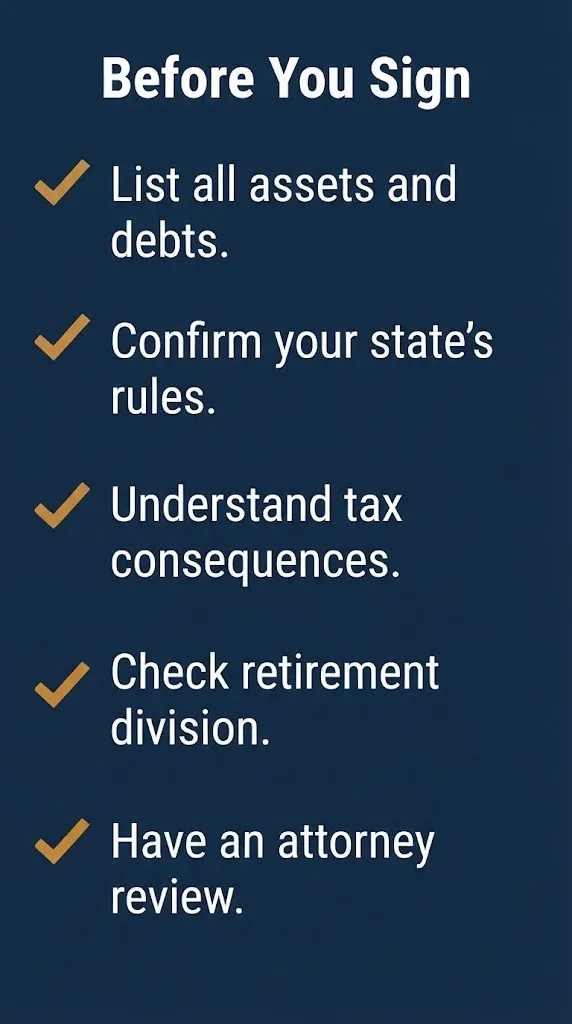
Here is the pre-signing checklist:
- List every asset and debt, with values and dates.
- Confirm which state’s law applies.
- Understand the tax consequences of every transfer.
- Check retirement account division against QDRO requirements.
- Review support terms for duration and modification rights.
- Have an independent attorney review the agreement.
- Do not sign under pressure or without full disclosure.
What Happens Next
Expected 2026: No federal changes to divorce settlement rules are pending.
Ongoing: State courts continue applying their property division statutes.
Your move: Gather financial records and consult an attorney before signing anything.
A divorce settlement agreement is the most important financial document you will sign in a divorce.
It decides who gets what, who pays what, and who is responsible for what. Once signed and approved, it is nearly impossible to undo.
Read it carefully. Understand your state’s rules. Get independent legal advice. The money you protect now is money you keep for the rest of your life.