How to File a Class Action Lawsuit in 2026: Steps, Costs, and What to Expect
Quick Answer
- A class action is a real legal process where one or more plaintiffs sue on behalf of a larger group with similar claims.
- Most class actions settle or are dismissed before trial, with no guaranteed payout for any individual class member.
- The most important early step is finding a qualified attorney, not filing paperwork yourself.
If you have been harmed by the same company, product, or practice as many other people, a class action may be the right legal tool. But filing one is not like filing a small claims case. The process is technical, expensive, and almost always requires a lawyer.
Class actions remain common in 2026 for consumer fraud, defective products, data breaches, employment disputes, and securities claims. But the rules for certification have not loosened. Courts still require proof that the claims share common questions of law and fact, and that a class action is the superior way to resolve the dispute.
This article explains the actual steps to file a class action lawsuit in 2026, what it costs, how long it takes, and what to expect if you become a named plaintiff.
The Facts
| Detail | Verified Information |
|---|---|
| Governing Rule | Federal Rule of Civil Procedure 23 |
| Key Statute | Class Action Fairness Act of 2005 |
| Certification Requirements | Numerosity, commonality, typicality, adequacy |
| Filing Cost | Varies by court, no fixed national fee |
| Attorney Fees | Usually contingency, 25 to 40 percent of recovery |
| Named Plaintiff Role | Represents the class, participates in discovery |
| Opt-Out Deadline | Set by court order after certification |
| Claim Deadline | Set by settlement administrator after approval |
Is a Class Action Lawsuit the Right Move for Your Claim?
A class action lawsuit may be the right move if many people suffered the same harm and no single individual’s damages are large enough to justify a solo lawsuit.
Class actions exist for practical reasons. If a company overcharges a million customers by $5 each, no single person will sue for $5. But together, the claim is worth $5 million. The class action aggregates those small claims into one case.
Before you consider filing, ask these questions.
- Did the same conduct affect at least 40 to 50 people in a similar way?
- Is your individual loss too small to justify hiring a lawyer alone?
- Can you show documentation of the harm?
- Are you willing to be a named plaintiff and participate in the case?
If you answer yes to most of these, a class action may be appropriate. If your individual damages are significant, you may be better off filing your own lawsuit.
Key Takeaway: Class actions work best when many people share a similar, relatively small harm that would not justify individual lawsuits.
How Do You Start a Class Action Lawsuit?
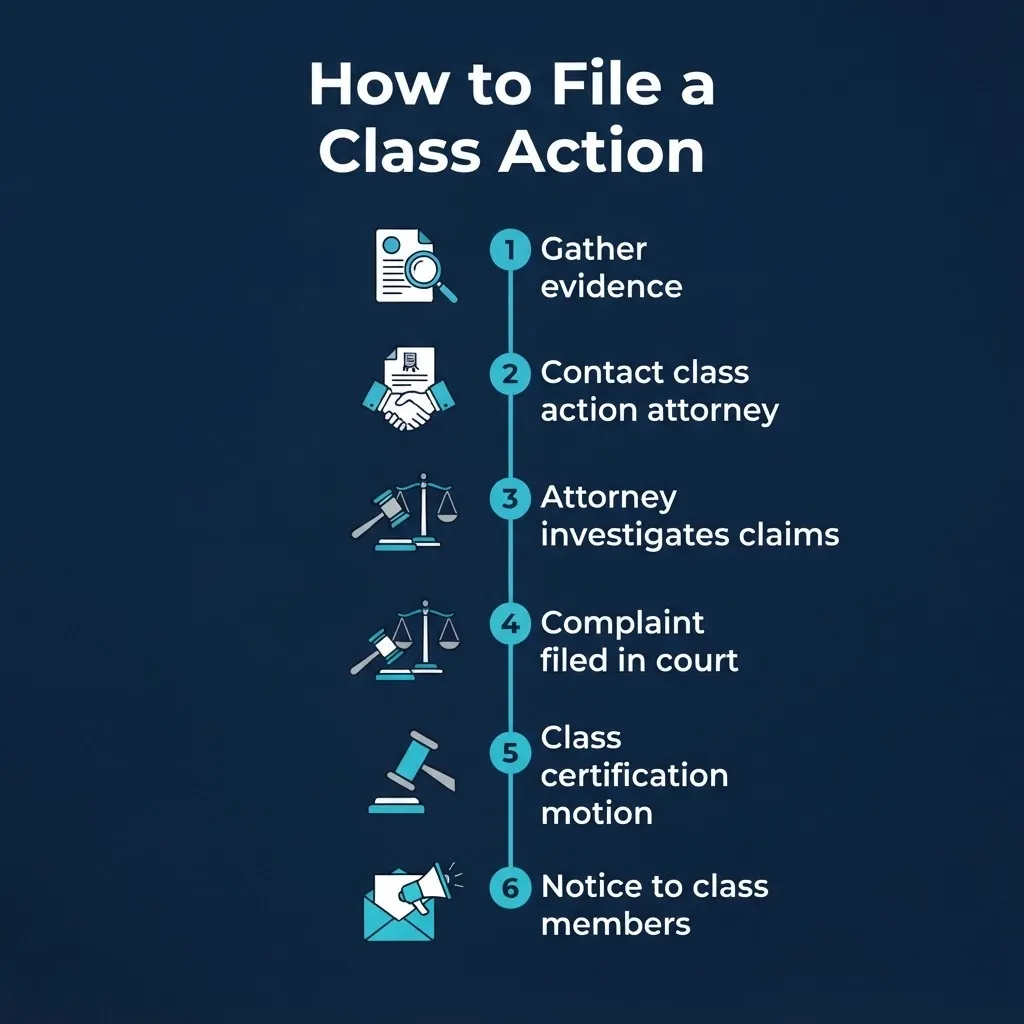
You start a class action lawsuit by hiring an attorney who files a complaint in federal or state court. You do not file the paperwork yourself unless you are a lawyer.
The attorney will first investigate your claim. They will look for evidence that the same conduct harmed many people. They will also assess whether your claim is typical of the group.
Then the attorney drafts a complaint. The complaint names the defendant, describes the alleged wrongdoing, identifies the proposed class, and states the legal claims.
The complaint is filed with the court. The defendant is served. The litigation begins.
You cannot skip the attorney step. Class action procedure is complex. Courts routinely reject complaints filed by non-lawyers in class actions because the stakes are too high for everyone else in the proposed class.
How Much Does It Cost to File a Class Action Lawsuit?
Filing a class action lawsuit costs money, but not out of your pocket in most cases. The attorney advances costs and recovers them only if the case succeeds.
The filing fee in federal court is $405 as of 2026. State court fees vary. But the filing fee is the smallest expense. Discovery, expert witnesses, depositions, and class notice can cost hundreds of thousands or millions of dollars.
Attorneys advance those costs. You do not pay them upfront. If the case loses, the attorney typically absorbs the loss. If the case wins, costs are deducted from the recovery before class members are paid.
Typical cost components include:
- Court filing fee
- Service of process
- Expert witness retainers
- Deposition transcripts
- Class notice and claims administration
- Mediation or special master fees
The named plaintiff is not responsible for these costs if the case fails. That is the standard arrangement in class action litigation.
Key Takeaway: Class action plaintiffs rarely pay out of pocket. The attorney advances costs and recovers them only from a successful outcome.
What Are the Requirements to Certify a Class?
To certify a class, a court must find that the case meets the requirements of Federal Rule of Civil Procedure 23. These apply in most state courts too.
The four core requirements are:
- Numerosity: the class is so large that joining all members individually is impractical.
- Commonality: there are questions of law or fact common to the class.
- Typicality: the named plaintiff’s claims are typical of the class.
- Adequacy: the named plaintiff and their attorney will fairly and adequately protect the class.
If the class seeks money damages, the court must also find that common questions predominate over individual ones. That is the hardest requirement to meet in many consumer cases.
Think of certification like a club membership test. You must prove the group shares enough in common to move together, not just a collection of unrelated gripes.
How Long Does a Class Action Lawsuit Take?
A class action lawsuit typically takes two to five years from filing to resolution. Some complex cases stretch beyond five years.
The timeline moves through distinct stages. First, the complaint is filed and the defendant moves to dismiss. That alone can take a year. If the case survives, discovery begins. Class certification briefing follows. The certification decision can take another year.
If the class is certified, the case may settle or proceed to trial. Settlement approval adds months. Appeals can add years.
A simple timeline looks like this.
- Filing to motion to dismiss ruling: 6 to 12 months
- Discovery: 12 to 24 months
- Class certification briefing and ruling: 12 to 18 months
- Settlement or trial: 12 to 24 months
- Final approval and appeals: 12 to 36 months
No class action resolves quickly. If you need fast money, this is the wrong legal vehicle.
Key Takeaway: Class actions are slow by design. Plan for at least two years, often more.
What Is a Named Plaintiff and What Do They Do?
A named plaintiff is the person who files the lawsuit and represents the class. You become a named plaintiff when your attorney files the complaint with your name on it.
The named plaintiff has real duties. You must participate in discovery, including answering written questions and sitting for a deposition. You must stay informed about the case. You may need to travel for court hearings or mediation.
The named plaintiff also has a fiduciary duty to the class. You cannot accept a side deal that benefits you at the expense of other class members.
For this work, named plaintiffs sometimes receive an incentive award. Courts have recently scrutinized these awards. Some courts have reduced or rejected them, citing concerns that named plaintiffs might be paid for loyalty rather than work.
Do not expect to get rich as a named plaintiff. The incentive award, if any, is typically a few thousand dollars.
Reality Check: Filing a Class Action Is Not a Do-It-Yourself Project
Filing a class action lawsuit is not something you do alone. Non-lawyers cannot competently navigate Rule 23, certification, and class notice requirements. Any website telling you to file a class action without a lawyer is giving dangerous advice. A lawyer will evaluate your case for free in most instances and tell you honestly whether a class action is viable. If a service charges you upfront fees to “help” you file a class action, walk away.
What Happens After the Class Action Is Filed?
After the class action is filed, the case moves through a predictable sequence. The defendant responds, usually with a motion to dismiss.
If the motion to dismiss fails, discovery begins. Both sides exchange documents, take depositions, and hire experts. The named plaintiff must cooperate fully.
Then the plaintiff’s attorney moves for class certification. The defendant opposes. The court holds a hearing and issues a ruling.
If certification is granted, the case becomes a true class action. Notice goes out to class members. From that point, the case may settle or proceed to trial.
If certification is denied, the named plaintiff’s individual case may continue alone. But the class action aspect ends.
How Does a Class Action Settlement Work?
A class action settlement resolves the case without a trial. The defendant agrees to pay a sum of money or provide other relief to the class.
The settlement must be approved by the court. First, the court grants preliminary approval. Then notice goes to class members. The notice explains the settlement terms, the class definition, and the right to opt out or object.
After a notice period, the court holds a final approval hearing. If the settlement is fair, adequate, and reasonable, the court approves it.
Then the claims process begins. Class members submit claim forms. The settlement administrator verifies claims. Payments are distributed.
Not every class member files a claim. Some cannot be located. Some do not bother. The actual payout per person depends on how many claims are filed against the fund.
Key Takeaway: Settlement is not the end. It triggers a claims process that can take another year or more.
How Do You Find a Class Action Lawyer?
Finding the right class action lawyer requires research. You want a firm with actual experience in class action litigation, not just personal injury or family law.
Look for these indicators.
- The firm has served as lead counsel in certified class actions.
- The attorneys have argued class certification motions.
- The firm has trial experience, not just settlement experience.
- The firm practices in federal court regularly.
- The firm has the financial resources to advance litigation costs.
Ask hard questions in your first call. How many class actions has the firm actually litigated? Who will be the lead attorney on my case? What is your track record in certification hearings?
A good class action lawyer will welcome these questions. A bad one will deflect.
What Types of Cases Become Class Actions in 2026?
Class actions in 2026 continue to cluster around certain types of claims. The most common categories include:
- Consumer fraud and deceptive marketing
- Data breaches and privacy violations
- Defective products and product liability
- Employment wage and hour violations
- Securities fraud and shareholder claims
- Antitrust and price-fixing
- Insurance bad faith and denial of claims
- Telecommunications and service fee disputes
The underlying law has not changed dramatically in 2026. What changes is the fact pattern. New data breaches, new fee practices, and new product defects create new class actions.
If your claim fits one of these categories and affects many people, a class action may be viable.
Key Takeaway: Consumer fraud, data breach, and wage claims remain the most common class action categories in 2026.
Can You File a Class Action in Small Claims Court Instead?
No, you cannot file a class action in small claims court. Small claims courts handle individual disputes with limited dollar amounts, typically under $10,000. They do not have jurisdiction over class actions.
If your individual damages are small, a class action may be the only practical way to recover anything. But you cannot file it yourself in small claims court.
If your individual damages are substantial, you may choose to file an individual lawsuit in a higher court. You can also wait to see if a class action is filed and join it as a class member.
What Is the Difference Between a Class Action and a Mass Tort?
The difference between a class action and a mass tort matters. In a class action, one lawsuit represents everyone with similar claims. In a mass tort, thousands of individual lawsuits are consolidated for pretrial purposes.
Class actions work best when the damages are uniform. Everyone was overcharged the same fee. Everyone lost the same data. Individual differences are minor.
Mass torts work best when injuries vary. Each plaintiff has different medical records, different damages, and different causation evidence.
The Suboxone tooth decay litigation is a mass tort, not a class action. Each plaintiff files an individual lawsuit. The cases are grouped for efficiency, but each case is separate.
If you are unsure which applies to your situation, a lawyer can explain the difference.
What Happens Next After You Contact a Lawyer
After you contact a class action lawyer, here is the expected sequence.
Week 1 to 2: The attorney evaluates your claim and requests documents.
Month 1: The attorney investigates whether the same harm affected many others.
Month 2 to 3: A complaint is drafted and filed if the attorney decides to take the case.
Month 3 to 12: The defendant responds and likely files a motion to dismiss.
Year 1 to 3: Discovery, certification briefing, and possible settlement.
Year 3 to 5: Resolution, final approval, and claims distribution if the case succeeds.
These dates are typical, not guaranteed. Every case moves at its own pace.
Frequently Asked Questions
Can I file a class action lawsuit by myself?
No. Class actions require an attorney. Non-lawyers cannot adequately represent a class.
How much does a class action lawyer cost?
Most class action lawyers work on contingency. You pay nothing upfront. They take a percentage of any recovery.
What is the minimum number of people for a class action?
There is no fixed number. But courts generally look for at least 40 to 50 similarly situated people.
How do I know if I qualify to join a class action?
You qualify if you fall within the class definition set by the court after certification.
Can I opt out of a class action?
Yes. Once a class is certified and notice is sent, you have the right to opt out and file your own lawsuit.
What happens if I do nothing in a class action?
You remain in the class and are bound by the outcome. You may receive a payment if the case settles and you file a claim.
How are class action settlements divided?
After attorney fees and costs are deducted, the remaining fund is divided among class members who file valid claims.
Are class action payouts taxable?
Some portions may be taxable. Tax treatment depends on the nature of the claim. Check with a tax professional.
Filing a class action is a serious, technical process. The first step is always the same: call a lawyer who actually litigates class actions. Ask hard questions. Do not pay upfront. Understand that the process takes years. But if many people share your harm and no one can afford to sue alone, it remains one of the most effective legal tools available in 2026.