Employment Litigation 2026: Types of Cases, Settlement Ranges, and What Workers Should Know
Quick Answer
- Employment litigation is real and covers discrimination, wage theft, retaliation, harassment, and wrongful termination.
- Settlement amounts vary widely, from a few thousand dollars to millions depending on the claim and employer.
- The most important deadline is the EEOC charge filing window, typically 180 or 300 days from the discriminatory act.
If you are searching for employment litigation, you probably have a workplace problem. Or you are researching before deciding whether to take legal action.
Employment litigation is the broad term for lawsuits between workers and employers. It covers a lot of ground. Discrimination, unpaid wages, retaliation, harassment, wrongful termination, and class actions all fall under the umbrella.
This article explains the types of cases, the settlement ranges, the deadlines, and what to expect if you sue or are sued. One verified detail most coverage misses: the Equal Employment Opportunity Commission received over 80,000 charges in fiscal year 2024, and retaliation charges were the most common.
The Facts
| Case | No single case; broad litigation category |
| Status | Ongoing; thousands of cases filed annually |
| Fund Size | Varies by case; no central fund |
| Est. Per Person | $5,000 to $250,000+ depending on case |
| Claim Deadline | 180 or 300 days for EEOC charges |
| Administrator | EEOC, state agencies, courts |
| Proof Needed | Documents, witness statements, employment records |
Is Employment Litigation Real?
Yes. Employment litigation is one of the largest categories of civil lawsuits in the United States.
Every year, workers file tens of thousands of claims against employers. The Equal Employment Opportunity Commission alone receives over 80,000 charges annually. Private attorneys file many more cases.
Employment litigation covers disputes over pay, discrimination, harassment, retaliation, wrongful termination, and workplace safety. Some cases are individual. Some are class actions involving thousands of workers.
The cases are real. The settlements are real. The question is whether your specific situation supports a claim.
What Types of Cases Fall Under Employment Litigation?
Employment litigation includes several distinct claim types.
Discrimination claims allege unfair treatment based on race, sex, age, disability, national origin, religion, or other protected categories.
Wage and hour claims allege unpaid overtime, minimum wage violations, or misclassification of employees as independent contractors.
Retaliation claims allege the employer punished a worker for complaining about discrimination, harassment, or illegal conduct.
Harassment claims allege a hostile work environment based on a protected characteristic.
Wrongful termination claims allege the firing violated a contract, a statute, or public policy.
Each type has its own legal standard, deadline, and damages model.
How Much Is the Average Employment Litigation Settlement?
The average settlement varies by case type and strength.
The Equal Employment Opportunity Commission reports average settlements around $40,000 to $50,000 per claimant for cases resolved through the agency.
Private lawsuits settle higher on average because they involve stronger cases and higher damages. Many private employment cases settle in the $75,000 to $250,000 range when the evidence is solid.
Wage and hour class actions can settle for millions. Individual wage claims settle for smaller amounts, often $5,000 to $50,000.
Here is a realistic range table.
| Case Type | Typical Settlement Range |
|---|---|
| Individual wage claim | $5,000 to $50,000 |
| Discrimination, moderate evidence | $40,000 to $100,000 |
| Discrimination, strong evidence | $100,000 to $250,000 |
| Wage and hour class action | $1,000,000 to $50,000,000+ |
| Sexual harassment, egregious | $100,000 to $500,000+ |
Key Takeaway: Settlement amounts depend on the evidence, the employer, and the legal claim. Strong cases settle higher. Weak cases settle for nuisance value.
What Is the Deadline to File an Employment Lawsuit?
The deadline depends on the claim type and the forum.
For discrimination claims under federal law, you must file an EEOC charge within 180 days of the discriminatory act. In states with a fair employment agency, the deadline extends to 300 days.
For wage claims under the Fair Labor Standards Act, the statute of limitations is two years, or three years for willful violations.
For state law claims, deadlines vary. California allows three years for many wage claims. New York allows six years for some wage claims.
Missing the deadline bars your claim. Courts enforce these deadlines strictly.
How Do You File an Employment Lawsuit?
Filing an employment lawsuit follows a process.
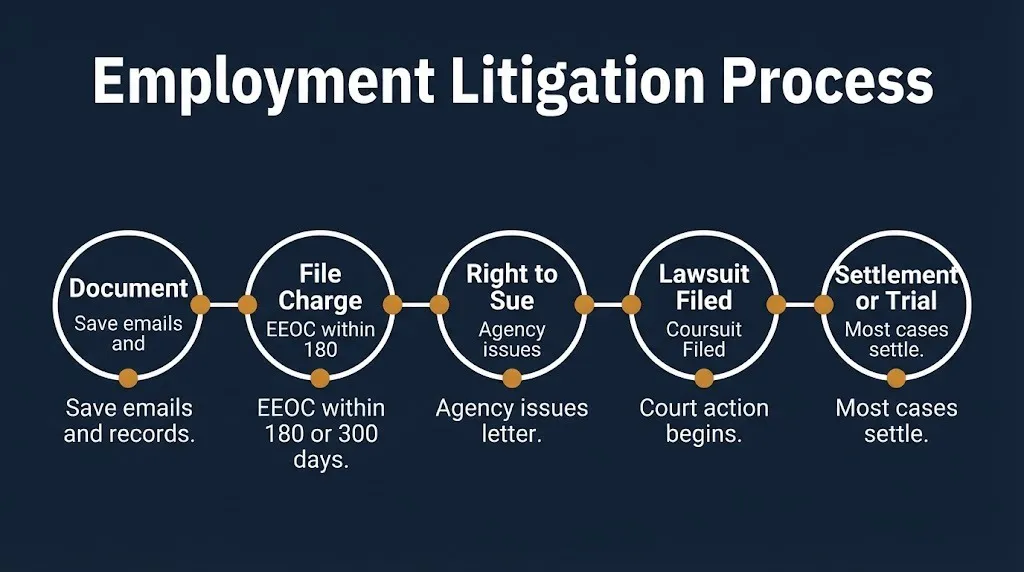
- Document everything: emails, texts, performance reviews, witness names.
- Report the issue through your employer’s internal complaint process.
- File a charge with the EEOC or your state fair employment agency if the claim involves discrimination.
- Receive the right-to-sue letter or agency determination.
- Consult an employment attorney.
- File a lawsuit in federal or state court before the deadline.
- Proceed through discovery, settlement negotiations, and possibly trial.
- Resolve by settlement or verdict.
The process takes months or years. Most cases settle before trial.
What Is the Difference Between an EEOC Charge and a Lawsuit?
An EEOC charge is an administrative complaint. A lawsuit is a court action.
You must file an EEOC charge before filing most federal discrimination lawsuits. The EEOC investigates and may attempt to resolve the case through mediation.
After the EEOC process ends, you receive a right-to-sue letter. That letter allows you to file a lawsuit in federal court.
The charge itself is not a lawsuit. It is a prerequisite.
For wage and hour claims under the FLSA, you can file a lawsuit directly without an EEOC charge.
Key Takeaway: The EEOC charge is a gate you must pass for discrimination claims. The lawsuit is the main event.
What Is Retaliation in Employment Litigation?
Retaliation is the most common charge filed with the EEOC.
Retaliation occurs when an employer takes adverse action against a worker for engaging in protected activity. Protected activity includes complaining about discrimination, filing a charge, or participating in an investigation.
Adverse action includes termination, demotion, pay cuts, schedule changes, and other material changes in employment conditions.
Retaliation claims are often easier to prove than the underlying discrimination claim. The timeline between the protected activity and the adverse action can be powerful evidence.
If you complained and then faced consequences, the retaliation claim may be stronger than the original claim.
What Are Wage and Hour Class Actions?
Wage and hour class actions involve groups of workers with similar claims.
Common claims include unpaid overtime, off-the-clock work, missed meal breaks, and misclassification of employees as independent contractors.
These cases often settle for large amounts because the damages multiply across many workers.
A wage and hour class action against a large employer can settle for tens of millions. Individual class members receive a share based on their work hours and pay rate.
The claim process typically involves submitting a claim form and proof of employment.
Reality Check: No legitimate employment settlement will ask you to pay a fee to join. Class members are usually included automatically or file a free claim form. Anyone demanding upfront money is running a scam.
What Is Wrongful Termination?
Wrongful termination is a firing that violates a law or contract.
Most employment in the United States is at-will. That means the employer can fire you for any reason or no reason, as long as it is not illegal.
Illegal reasons include discrimination, retaliation, whistleblowing, and refusing to commit illegal acts.
Wrongful termination claims require proof that the stated reason for firing was a pretext for an illegal reason.
These cases are fact-intensive. The strength depends on the paper trail and witness testimony.
What Should You Do If You Are Facing an Employment Dispute?
The steps you take early determine the strength of your case.
First, document everything. Save emails, texts, and any written communication about the issue.
Second, report the issue internally. This creates a record and triggers anti-retaliation protections.
Third, consult an employment attorney. Most offer free or low-cost consultations.
Fourth, do not resign without legal advice. Resigning can limit your damages.
Fifth, file any required administrative charge before the deadline.
What Happens Next in Employment Litigation?
The trend is continued high volume.
Expected late 2026: More wage and hour class action filings, especially in states with strict wage laws.
Ongoing: EEOC charge volume remains high. Retaliation continues to lead.
For workers, the next step is to know your deadlines and document your claims. The evidence you preserve now determines the outcome later.
Frequently Asked Questions
What is employment litigation?
It is the broad category of lawsuits between workers and employers.
It includes discrimination, wage, retaliation, harassment, and wrongful termination claims.
How much is an employment lawsuit worth?
It depends on the case type and evidence.
Settlements range from a few thousand to millions.
What is the deadline to file an employment claim?
For discrimination, 180 or 300 days to file an EEOC charge.
For wage claims, two to three years depending on the law.
Do I need a lawyer for employment litigation?
For most cases, yes. The process is complex.
Many employment attorneys work on contingency.
What is the most common employment claim?
Retaliation is the most common EEOC charge.
Wage and hour claims are the most common private lawsuits.
How long does an employment lawsuit take?
Most cases settle in one to three years.
Trials take longer.
Can I be fired for complaining about discrimination?
No. Retaliation for protected activity is illegal.
A retaliation claim may be stronger than the underlying claim.
The single most important action is to document everything and file any required charge before the deadline. The evidence and the timeline control the outcome.