Workers Compensation Insurance Policy 2026: Coverage, Costs, Claims, and Legal Rights
Quick Answer
- Workers compensation insurance is a legally required policy that pays medical bills and lost wages for employees injured at work.
- It is not a lawsuit settlement. It is an insurance system that replaces the right to sue your employer in most cases.
- There is no “claim deadline” for a settlement. Report injuries immediately. State laws set strict time limits, often as short as 30 days.
If you run a business, employ workers, or got hurt on the job, you need to understand how workers compensation insurance works in 2026. This is not a class action settlement. There is no fund to join and no check waiting in the mail. But this system affects nearly every working American. Employers pay for it. Employees rely on it when things go wrong. And when the system fails, lawsuits happen.
This article covers what workers compensation insurance is, who must carry it, what it costs in 2026, what it covers, how claims work, when you can sue outside the system, and the latest legal developments affecting both employers and injured workers. One fact most business owners miss: a single uninsured workers comp claim can cost more than a decade of premiums, and in some states, it can lead to criminal charges against the business owner.
The Facts
| Fact | Detail |
| Requirement | Mandatory for most employers. Texas is the only state where it is fully optional. |
| Who Pays | Employers pay all premiums. Employees pay nothing. |
| Coverage | Medical bills, lost wages, disability benefits, rehabilitation, death benefits. |
| Cost Drivers | Payroll size, job classification codes, claims history, state rating bureau |
| 2026 National Average Cost | Approximately $1.19 per $100 of payroll (varies widely by state and class code). |
| Claim Deadlines | Vary by state. Injury reporting deadlines range from 10 to 90 days. File immediately. |
What Is Workers Compensation and How Does It Work?
Workers compensation is a state-mandated insurance system. It pays for medical care and a portion of lost wages when an employee gets injured or sick because of their job. In exchange, the employee gives up the right to sue their employer for the injury in most cases.
The deal is a grand bargain that dates back over a century. Before workers comp, an injured worker had to sue their employer and prove negligence. That was slow, expensive, and often failed. Workers comp flipped the model. Now, fault does not matter. If you got hurt at work, your medical bills are covered and you get wage replacement. You do not have to prove your boss messed up. But you also cannot sue for pain and suffering in most situations.
The system is not federal. Each state runs its own workers compensation program with its own rules, its own benefit levels, its own dispute resolution process, and its own insurance requirements. A roofer in California is covered by very different rules than a nurse in Ohio. The core structure is similar everywhere: employer buys insurance, employee gets hurt, insurance pays.
The system is funded entirely by employers. Employees do not contribute. It is illegal in every state for an employer to deduct workers comp premiums from your paycheck. If your employer is doing that, they are breaking the law and likely committing fraud.
Is Workers Compensation Insurance Required by Law?
Yes, in every state except Texas, workers compensation insurance is mandatory for most employers. Texas allows employers to opt out entirely, though many Texas businesses still carry it.
The specific threshold for mandatory coverage varies by state. Some states require coverage the moment you hire your first employee. Others set a minimum employee count, often two to five employees, before coverage is mandatory. Some states exempt certain types of workers, like agricultural laborers, domestic workers, or independent contractors. But these exemptions are narrowing. More states are expanding mandatory coverage, not shrinking it.
The penalties for not carrying coverage are severe. In California, an uninsured employer faces fines of up to $10,000 per employee, a stop-work order that shuts down the business, and potential criminal charges. In New York, the fines start at $2,000 per 10-day period of noncompliance. In Florida, a stop-work order can be issued within hours of a compliance check. These are not idle threats. State regulators actively audit businesses, often triggered by an injured worker filing a claim with no insurance on file.
Even in Texas, where workers comp is optional, going without coverage is risky. A Texas employer who opts out loses the protection of the grand bargain. An injured Texas worker whose non-subscribing employer does not carry workers comp can sue for full tort damages, including pain and suffering, and the employer cannot use certain defenses like contributory negligence. Some Texas employers have lost everything in such lawsuits.
Who Pays for Workers Compensation Insurance?
The employer pays every dollar of the premium. Employees pay nothing. It is that simple.
Premiums are calculated based on several factors. Your payroll is the base. Each employee’s job classification code determines the rate per hundred dollars of payroll. A clerical worker costs less to insure than a construction worker. Your claims history modifies the rate. Fewer claims mean lower premiums. More claims mean higher premiums. The insurance carrier’s experience rating formula applies these adjustments.
The average cost nationally in 2026 runs about $1.19 per $100 of covered payroll. That is a broad average. A restaurant might pay $1.50 to $3.00 per $100. A roofing company might pay $8.00 to $15.00 per $100. A professional office might pay under $0.50 per $100. Your actual cost depends on your specific situation.
Some employers try to misclassify workers as independent contractors to avoid paying premiums. That is illegal. State agencies and the IRS have cracked down on misclassification aggressively since 2024. The penalties include back premiums, fines, and in some states, criminal fraud charges. If you are an employer, classify your workers correctly. If you are a worker who was misclassified and got hurt, talk to a workers comp attorney. You may still be covered even if your boss called you a contractor.
Key Takeaway: Employers pay all premiums. Workers pay nothing. Misclassifying employees to avoid premiums is illegal and risky. States are enforcing classification rules more aggressively than ever.
What Does Workers Compensation Insurance Cover?
Workers comp covers four main categories of benefits: medical treatment, wage replacement, disability benefits, and death benefits.
Medical benefits cover all reasonable and necessary medical care related to the injury. Doctor visits, hospital stays, surgery, physical therapy, prescription medications, and medical devices are covered. In most states, there are no copays and no deductibles for the injured worker. The employer or its insurer picks the doctor in many states, though some states allow the worker to choose after an initial period.
Wage replacement, called temporary disability benefits, kicks in when the injury prevents you from working. Most states pay about two-thirds of your average weekly wage, up to a state-set maximum. In California, the 2026 maximum for temporary total disability is not yet confirmed but typically adjusts annually. In New York, the maximum is similarly indexed. These benefits are not taxed. You receive them free of federal and state income tax.
Permanent disability benefits apply when the injury leaves a lasting impairment. A doctor assigns a permanent impairment rating. That rating translates into a number of weeks of benefits or a lump sum, depending on your state’s formula. Permanent total disability, meaning you cannot work at all in any capacity, typically pays benefits for life, though states define “total disability” differently.
Death benefits pay for funeral expenses and provide ongoing payments to surviving dependents. A spouse, children, or other dependents may receive a portion of the deceased worker’s wages, typically subject to a cap.
Vocational rehabilitation benefits help the injured worker return to the workforce. This may include job retraining, education, resume assistance, and job placement services. Not every state mandates vocational rehab, but most do.
What Is Not Covered by Workers Compensation?
Workers comp does not cover everything. Certain injuries and situations fall outside the system.
Injuries caused by intoxication or drug use are excluded in every state. If a drug test after the accident shows impairment, your claim will likely be denied. Self-inflicted injuries are excluded. Injuries that happen during horseplay or fighting that the worker started are often excluded. Injuries that occur off the clock, during a commute in most states, or while engaged in a personal errand at work are excluded.
Mental health claims without a physical injury are covered in some states but not others. A worker who witnesses a traumatic event and develops PTSD may be covered in California but not in Florida. The rules vary sharply by state. Stress-related claims from ordinary job pressures, like a demanding boss or heavy workload, are almost never covered.
Independent contractors are excluded from coverage because they are not employees. But misclassification disputes blur this line. If you were labeled a contractor but functioned as an employee, you may be covered. Courts and workers comp boards apply multi-factor tests to determine true employment status.
Reality Check: Workers comp is not health insurance. It covers work injuries only. It does not cover your kid’s ear infection or your spouse’s diabetes. It is not general disability insurance. It covers you only when the injury is work-related.
How Much Does Workers Compensation Insurance Cost in 2026?
The cost depends on your state, your industry, your payroll, and your claims history. The national average rate across all class codes is about $1.19 per $100 of payroll as of 2026.
Here is how costs break down by industry category based on typical class code rates.
- Clerical and office workers: $0.25 to $0.50 per $100 of payroll. Low risk, low cost.
- Retail and restaurant workers: $0.75 to $3.00 per $100. Moderate risk from slips, falls, and cuts.
- Manufacturing and warehouse workers: $2.00 to $6.00 per $100. Higher risk from machinery and lifting.
- Construction trades: $5.00 to $15.00 per $100. High risk, high cost.
- Roofing and iron workers: $15.00 to $30.00 or more per $100. Highest risk classifications.
A small restaurant with $200,000 in payroll might pay $3,000 to $6,000 annually. A roofing company with the same payroll might pay $30,000 to $60,000. The spread is enormous.
You can reduce your premium through several legitimate methods. A workplace safety program with documented training and incident reporting can earn you a credit from many carriers. A dividend plan, where the insurer returns a portion of premium if claims are low, can reduce net cost. Pay-as-you-go policies, which base premiums on actual payroll each period rather than estimates, prevent overpayment and large year-end audits.
Shopping around matters. Workers comp rates are not uniform. Each carrier files its own rates with state regulators. Comparing quotes from multiple carriers, including state funds in states that have them, can save significant money.
How to Buy Workers Compensation Insurance
You can buy workers comp insurance through several channels. The right one depends on your business size, your state, and your risk profile.
- Determine whether your state requires coverage for your business. Check your state’s workers compensation board or department of insurance website.
- Get your employee count, payroll projections, and job descriptions ready. Classify each employee by their actual work duties.
- Contact at least three insurance carriers or brokers. Include a mix of national carriers like The Hartford, Travelers, and biBERK, plus any state fund option your state offers.
- Request quotes using the same class codes and payroll estimates so comparisons are fair.
- Ask about discounts. Safety programs, drug-free workplace policies, and claims-free history can all reduce premiums.
- Check the insurer’s financial rating through AM Best. A low-rated carrier may offer cheap premiums but struggle to pay claims.
- Buy the policy. You will receive a certificate of insurance. Keep it. Post the required notices at your workplace.
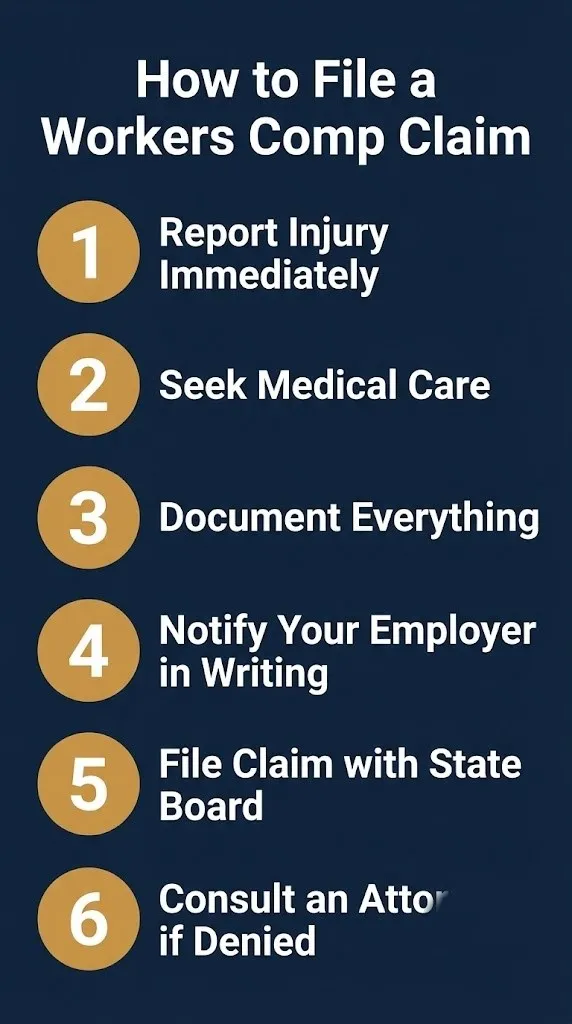
- Set up a system for reporting injuries immediately. Delay in reporting is one of the most common reasons claims get denied.
If you cannot find coverage through standard carriers, your state likely has an assigned risk pool. This is the market of last resort. Premiums are higher, but you get coverage. Some states operate competitive state funds that write coverage alongside private carriers. These can be good options for businesses with moderate risk.
What Is a Certificate of Workers Compensation Insurance?
A certificate of workers compensation insurance is proof that a business carries coverage. It is a one-page document showing the insurer name, policy number, effective dates, and coverage limits.
General contractors require certificates from every subcontractor. If a subcontractor lacks coverage and a worker gets hurt, the general contractor can be held liable. Certificates protect everyone in the contracting chain.
The certificate is not the policy. It summarizes coverage but does not amend or extend it. Relying on a certificate without verifying the underlying policy is a mistake. Insurers can cancel policies mid-term. A certificate issued in January does not guarantee coverage in June. Many contractors use third-party verification services to track subcontractor coverage in real time.
What Are Workers Compensation Lawsuit Rights?
Workers comp replaces the right to sue your employer in most cases. But there are exceptions. And sometimes, the lawsuit is against a third party, not the employer.
You generally cannot sue your employer for a work injury even if the employer was negligent. The grand bargain applies. You get benefits regardless of fault. You give up the right to a negligence lawsuit. There are narrow exceptions. If your employer intentionally hurt you, you can sue outside the system. If your employer had no workers comp insurance when required, you can sue in civil court. If your employer’s conduct was so reckless that it went beyond ordinary negligence, some states allow a lawsuit.
Third-party lawsuits are different. Workers comp covers you regardless of fault, but it only covers claims against your employer. If a delivery driver runs you over while you are working on a loading dock, you can file a workers comp claim and sue the delivery driver’s company. If a defective machine injures you, you can file workers comp and bring a product liability claim against the manufacturer. If a subcontractor’s employee causes your injury on a construction site, you may have a third-party claim.
These third-party lawsuits can produce damages that workers comp does not cover: pain and suffering, full lost wages, and sometimes punitive damages. Your workers comp insurer will typically have a lien on any third-party recovery, meaning it gets repaid for the benefits it paid out. Your net recovery is what remains after the lien and attorney fees. A workers comp attorney can evaluate whether a third-party claim exists in your case.
Key Takeaway: Workers comp blocks most lawsuits against your employer. Third-party lawsuits remain available and can produce compensation beyond what workers comp pays.
What Happens When a Workers Comp Claim Is Denied?
A denial is not the end of the road. You have the right to challenge it through your state’s dispute resolution process.
Denials happen for several reasons. The employer or insurer disputes that the injury is work-related. The injury was not reported on time. Medical records do not support the claimed severity. A preexisting condition is blamed. A drug test came back positive. Each of these can be challenged with evidence.
The appeals process varies by state but follows a general pattern. First, the insurer issues a written denial explaining the reason. Then you or your attorney file an application for a hearing with the state workers compensation board or commission. A hearing is scheduled, typically within a few months. At the hearing, both sides present evidence, including medical records, witness statements, and expert testimony. An administrative law judge decides.
If you lose at the hearing, you can appeal to the full board or commission. If you lose there, you can appeal to the state court system. The process can take a year or more from denial to final resolution. Having an attorney significantly improves your odds at every stage.
Do not give up after a denial. Many legitimate claims are denied initially. Insurers know that a percentage of workers will simply accept the denial and walk away. Persistence and legal representation change the outcome in a substantial number of cases.
What Is the Current State of Workers Compensation Lawsuits?
Workers comp disputes are not class actions. They are individual claims brought by individual workers. But patterns emerge. In 2026, several trends are shaping litigation.
COVID-19 presumption laws continue to produce litigation. Many states created temporary presumptions that certain workers, especially healthcare workers and first responders, contracted COVID at work. Those presumptions have expired in most states, but claims filed during the presumption windows are still being litigated. Courts are sorting out which claims qualify and what evidence of workplace exposure is sufficient.
Mental health claims for first responders are expanding. More states are passing laws that create presumptions for PTSD in police officers, firefighters, and paramedics. These claims do not require a physical injury. The trend is toward broader mental health coverage in workers comp, though it remains uneven across states.
Gig economy misclassification cases are working their way through courts. Plaintiffs’ firms are bringing claims on behalf of gig workers classified as independent contractors, arguing they are employees entitled to workers comp coverage. Some state legislatures are stepping in with new definitions. Others are waiting for courts to decide.
Frequently Asked Questions
Who pays for workers compensation insurance?
The employer pays all premiums.
Employees contribute nothing. Deductions from employee paychecks are illegal in every state.
Is workers compensation insurance required in all states?
No. Texas allows employers to opt out.
Every other state mandates coverage for most employers, though minimum employee counts vary.
What does workers compensation not cover?
Injuries from intoxication, self-inflicted harm, horseplay, and off-duty conduct.
Commuting injuries are generally excluded except in limited circumstances.
How much does workers comp cost per employee?
The national average is about $1.19 per $100 of payroll.
Actual cost depends on job classification, state, and claims history.
What happens if I get hurt and my employer has no insurance?
You can file a claim with your state’s uninsured employers fund.
You may also be able to sue your employer directly for full damages in civil court.
Can I sue my employer instead of filing workers comp?
Generally not. Workers comp is the exclusive remedy for work injuries.
Exceptions exist for intentional harm, uninsured employers, and certain extreme cases.
How long do I have to report a work injury?
Reporting deadlines vary by state, ranging from 10 to 90 days.
Report immediately. Late reporting is the most common reason for claim denial.
What is a certificate of workers compensation insurance?
It is a document proving a business carries coverage.
General contractors require it from all subcontractors to avoid liability.
Workers compensation insurance is not glamorous. It is not a settlement with a deadline and a check. It is the system that catches you when a workplace injury turns your life upside down. If you are an employer, buy the right coverage at the right price. If you are a worker, know what you are entitled to and report every injury immediately. The system works best when everyone follows the rules.
The single most important action you can take after a workplace injury is to report it that day. Delays kill claims. Document everything. And if your claim is denied, do not accept the denial without a fight. Get an attorney. The system is built for people who push back.