Workers Compensation Benefits 2026: Eligibility Rules, Payment Amounts, and How to File Without Losing Your Claim
Quick Answer
- Workers compensation is real insurance, not a lawsuit. It pays medical bills and lost wages.
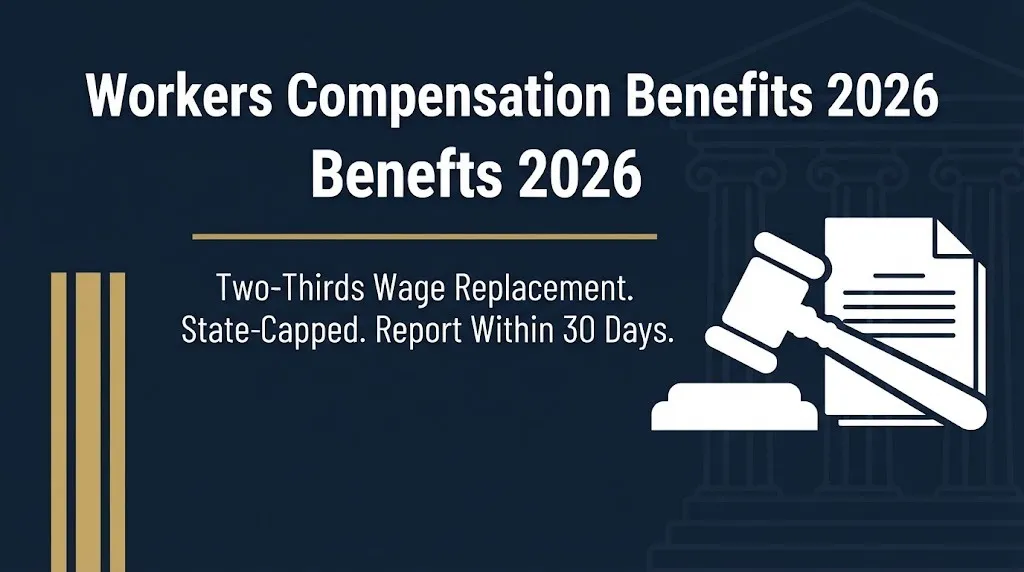
- Weekly benefits typically equal two-thirds of your average weekly wage, capped by state limits.
- You must report your injury to your employer immediately. Most states require written notice within 30 days.
If you got hurt at work, you are searching for one thing: how to get paid without losing your job or your claim. Workers compensation benefits are the legal mechanism for that.
Every state requires employers to carry workers comp insurance. That insurance pays your medical bills and a portion of your wages while you recover.
This article explains how the system works in 2026, what you might receive, and the mistakes that get claims denied. No class action settlement exists here. This is a statutory benefit system, not a lawsuit payout.
The Facts
| System | State-regulated workers compensation insurance |
| Federal Program | No single federal workers comp for private employees |
| Average Weekly Benefit | Two-thirds of average weekly wage, state-capped |
| Medical Coverage | Full coverage for approved injury treatment |
| Filing Deadline | Varies by state, typically 30 to 120 days |
| Administrator | State workers comp board or commission |
| Proof Needed | Medical records, incident report, wage statements |
Is Workers Compensation a Real Benefit or a Scam?
Workers compensation is real and legally mandated in all 50 states.
It is not a class action. It is not a settlement fund. It is an insurance system your employer pays into.
Every state has a workers compensation board or commission that oversees claims. If you are injured on the job, you file a claim through that agency.
The system is not optional. Employers who fail to carry coverage face fines and even criminal charges in some states.
How Much Do Workers Compensation Benefits Pay in 2026?
Most states pay two-thirds of your average weekly wage, subject to a maximum cap.
The cap varies widely. In 2026, the maximum weekly benefit ranges from about $600 in lower-paying states to over $1,800 in high-wage states.
You do not receive your full salary. The two-thirds figure is standard and has been for decades.
Some injuries qualify for additional payments. Permanent partial disability can add a lump sum or extended weekly payments.
| Benefit Type | Typical Payment |
|---|---|
| Temporary total disability | Two-thirds of average weekly wage |
| Permanent partial disability | Scheduled payments based on body part |
| Permanent total disability | Two-thirds of wage, often for life |
| Medical benefits | Full payment to medical providers |
| Vocational rehabilitation | Job retraining costs covered |
Key Takeaway: Workers comp replaces about two-thirds of your income, not all of it. Plan your budget around that reality.
Who Qualifies for Workers Compensation Benefits?
You may qualify if you are an employee injured while performing work duties.
Independent contractors generally do not qualify. Neither do volunteers in most states.
The injury must arise out of and occur during employment. That means the work caused the injury and it happened while you were working.
Pre-existing conditions complicate claims. If work aggravated a prior injury, you may still qualify, but the insurer will fight harder.
What Injuries Are Covered by Workers Comp?
Covered injuries include sudden accidents, repetitive stress injuries, and occupational illnesses.
A fall, a lifting injury, carpal tunnel from typing, and lung disease from chemical exposure all can qualify.
Mental health claims are harder. Most states require a physical injury to trigger mental health coverage.
Stress alone rarely qualifies unless tied to a specific traumatic event.
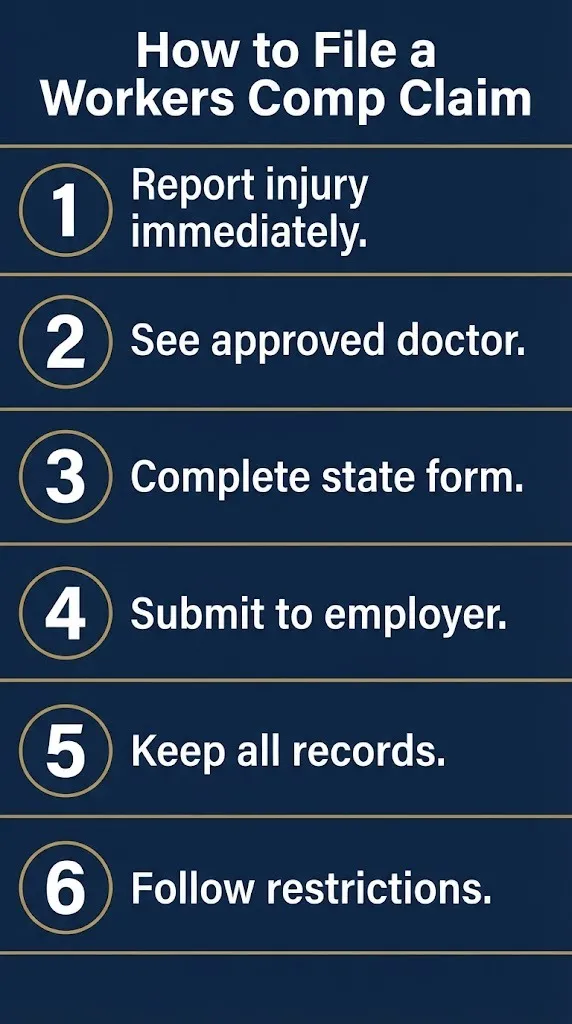
How Do I File a Workers Compensation Claim?
Filing correctly matters more than filing fast. Miss a step and the insurer has grounds to deny.
- Report the injury to your supervisor immediately, in writing if possible.
- Seek medical treatment from an approved provider if your state requires one.
- Complete the state workers comp claim form.
- Submit the form to your employer and the state board.
- Keep copies of every document, medical record, and wage statement.
- Follow all medical restrictions exactly.
- Respond to insurer requests within the stated timeframe.
Think of it like filing a warranty claim. You need the receipt, the defect, and the deadline.
What Is the Deadline to File Workers Comp in 2026?
Deadlines vary by state. Most states require you to report the injury within 30 days.
The formal claim filing deadline is often one to two years from the injury date.
Some states allow longer for occupational diseases that develop slowly.
Missing the reporting deadline can kill your claim even if the injury is real.
Key Takeaway: Report every workplace injury the day it happens. Written notice protects you more than a verbal report.
Can My Employer Fire Me for Filing Workers Comp?
No. Retaliation for filing a workers comp claim is illegal in every state.
But proving retaliation is hard. Employers rarely say “you are fired for filing.”
They may cite performance issues or restructuring. If that happens, document everything.
You may have a separate retaliation claim. That is a lawsuit, distinct from the workers comp benefit.
What If My Workers Comp Claim Is Denied?
Denials are common. Insurers deny claims hoping you will not appeal.
You have the right to appeal. Every state has an appeals process through the workers comp board.
Most states allow a hearing before an administrative law judge. You can present medical evidence and witness testimony.
Many denied claims get reversed on appeal. Persistence matters.
Reality Check: No one is sending you workers comp money via text message. You do not need to pay a third party to file. The process is free through your state board.
How Long Do Workers Comp Benefits Last?
Temporary benefits last until you reach maximum medical improvement, or MMI.
MMI means your condition has stabilized. Further treatment may not improve it.
After MMI, you may qualify for permanent disability benefits. Those can last years or a lifetime depending on your rating.
The insurer will push for an early MMI finding. Your doctor’s opinion carries weight.
What Is a Workers Comp Settlement?
A settlement closes your claim in exchange for a lump sum or structured payments.
Not every claim settles. Some workers prefer ongoing medical coverage over a one-time payout.
Settlements require approval from the state workers comp board. A judge must find the terms fair.
Once settled, you usually cannot reopen the claim for future medical costs.
How Are Workers Comp Settlements Calculated?
Settlements reflect future medical costs, lost wages, and disability ratings.
There is no single formula. Each state has guidelines.
Insurers start low. Your negotiating position depends on medical evidence and legal representation.
A workers comp attorney typically takes 15 to 25 percent of the settlement in most states.
| Factor | Impact on Settlement |
|---|---|
| Disability rating | Higher rating means higher payout |
| Future medical needs | Ongoing treatment increases value |
| Age | Younger workers may receive more |
| Wage history | Higher wages mean higher benefits |
| State caps | Maximums limit total payout |
Key Takeaway: Settlements are negotiations, not entitlements. Medical evidence drives value.
Do I Need a Workers Comp Lawyer?
You do not need a lawyer for a simple, approved claim with a quick recovery.
You likely need one for a denied claim, a serious injury, or a proposed settlement.
Lawyers work on contingency. You pay nothing upfront.
The fee comes from your settlement or award, never from your pocket directly.
What Does Workers Comp Not Cover?
Workers comp does not cover pain and suffering. It does not cover punitive damages.
It does not cover injuries from intoxication or fighting.
It does not cover commuting injuries in most states.
It does not cover independent contractor injuries.
For those harms, you would need a personal injury lawsuit, which is separate from workers comp.
How Do State Workers Comp Systems Differ in 2026?
Every state runs its own system with its own rules.
California has high benefit levels and a complex appeals process. Texas does not require most private employers to carry workers comp at all.
New York has generous wage replacement but strict deadlines. Florida has lower benefits and more insurer-friendly rules.
You must check your own state’s workers comp board website for current figures and forms.
What Is the Federal Workers Comp Program?
Federal employees use a separate system called the Federal Employees’ Compensation Act, or FECA.
FECA covers federal workers, not private employees.
It pays similar benefits but has different procedures and deadlines.
The Office of Workers’ Compensation Programs administers FECA.
Key Takeaway: Your state board controls your claim. Federal rules apply only to federal employees.
What Happens If My Employer Has No Workers Comp Insurance?
You may still receive benefits through a state uninsured employer fund.
Most states maintain such funds. They pay your claim and then pursue the employer for repayment.
You may also have a civil lawsuit against the employer directly. That option is normally barred when workers comp applies.
How Do I Check My Workers Comp Claim Status?
Most states offer an online portal.
- Visit your state workers comp board website.
- Find the claim status tool.
- Enter your claim number and personal details.
- Review current status and any pending actions.
- Contact your claims adjuster by phone or email if the portal is unclear.
- Keep a log of every contact and date.
This is like tracking a package. The system shows where your claim sits and what happens next.
What Happens Next After I File a Workers Comp Claim
- Days 1 to 14: Insurer accepts or denies your claim. Medical treatment should begin immediately.
- Weeks 2 to 8: Weekly wage benefits start if approved. You attend medical appointments.
- Month 3 to 6: Most temporary claims resolve. You return to work or reach MMI.
- Month 6 to 12: Permanent disability rating issued if applicable. Settlement talks may begin.
- Beyond 12 months: Appeals or settlement negotiations continue for serious injuries.
Workers compensation benefits are not a jackpot. They are a safety net with tight rules. Report injuries immediately. File forms completely. Appeal every denial. The system rewards persistence and documentation, not speed or emotion.
Frequently Asked Questions
How much do workers comp benefits pay per week?
Most states pay two-thirds of your average weekly wage, capped by state maximums.
What is the deadline to report a work injury?
Most states require written notice within 30 days of the injury.
Can I see my own doctor for workers comp?
It depends on your state. Some states require you to see an employer-approved provider.
What if my workers comp claim is denied?
You can appeal. Most states provide a hearing before an administrative law judge.
Do workers comp benefits cover mental health?
Sometimes, but most states require a physical injury to trigger mental health coverage.
How long does a workers comp settlement take?
Most settlements occur within 6 to 18 months after maximum medical improvement.
Is workers comp taxable income?
No. Workers comp benefits are not taxable at the federal or state level.
Can I work another job while on workers comp?
Possibly, if your restrictions allow it and you disclose the other income.
Workers compensation benefits exist to keep injured workers from financial ruin. They are not a bonus. They are not a lawsuit jackpot. They replace a portion of lost wages and pay for medical care. The system works best when you document everything and meet every deadline.