Illinois Workers Compensation Lawyer 2026: What an Attorney Actually Does and When You Need One
Quick Answer:
- An Illinois workers compensation lawyer handles denied claims, permanent disability ratings, and hearings before the Illinois Workers’ Compensation Commission.
- Attorney fees are capped by law at 20 percent of benefits recovered, and you pay nothing upfront.
- You have 45 days to report a work injury in Illinois, but the claim filing window runs 3 years.
You got hurt at work in Illinois. The bills are piling up. The insurance company is not returning calls. You are wondering whether hiring a lawyer is worth it or just another expense.
The honest answer: it depends on your case. Simple accepted claims with minor injuries often do not need a lawyer. Denied claims, permanent injuries, and disputes over medical care almost always do.
This article explains what an Illinois workers compensation lawyer actually does, how fees work, what the law says, and how to decide whether you need representation in 2026.
The most surprising verified fact: attorney fees in Illinois workers compensation cases are capped by law at 20 percent, and most lawyers work on contingency, meaning you owe nothing unless they win.
The Facts
| Detail | Verified Information |
|---|---|
| System | Illinois Workers’ Compensation Act |
| Governing Agency | Illinois Workers’ Compensation Commission |
| Injury Reporting Deadline | 45 days to notify employer |
| Claim Filing Window | 3 years from injury date |
| Attorney Fee Cap | 20 percent of benefits recovered |
| Fee Structure | Contingency, no upfront payment |
| Proof Needed | Medical records, incident report, wage documentation |
Is hiring an Illinois workers compensation lawyer worth it?
Yes, in many cases, hiring an Illinois workers compensation lawyer is worth it, especially after a denial or when permanent disability benefits are at stake.
The Illinois workers compensation system is adversarial. Your employer’s insurance company has lawyers. Those lawyers work to minimize payouts. You are at a structural disadvantage if you go through the process alone.
Studies and state data consistently show that represented workers recover more than unrepresented workers, even after attorney fees are deducted. The reason is simple: lawyers know the system’s rules, deadlines, and valuation methods.
That does not mean every case needs a lawyer. A simple, accepted claim with a minor injury and full medical coverage may not. But any denial, any dispute over medical treatment, any permanent impairment rating, or any settlement negotiation changes that calculus.
How much does an Illinois workers compensation lawyer cost?
Illinois law caps attorney fees in workers compensation cases at 20 percent of the benefits the lawyer recovers for you.
You pay nothing upfront. Almost all Illinois workers compensation attorneys work on contingency. That means the lawyer only gets paid if they win benefits for you.
Here is how the fee structure works:
| Fee Component | What It Means |
|---|---|
| Contingency fee | You owe nothing unless the lawyer recovers money |
| Statutory cap | Fees cannot exceed 20 percent of recovered benefits |
| No hourly billing | You do not pay by the hour |
| No retainer | You do not pay an upfront deposit |
| Costs | Filing fees and medical record costs may come out of your recovery |
The 20 percent cap is set by the Illinois Workers’ Compensation Act. It applies to most benefits recovered through hearings and settlements. Some limited exceptions exist, but the general rule is 20 percent.
Key Takeaway: You should never pay an Illinois workers compensation lawyer upfront. The law allows contingency representation with capped fees.
What does an Illinois workers compensation attorney do?
An Illinois workers compensation attorney handles every part of your claim, from filing to hearing to settlement.
The work falls into several categories. A lawyer does not just file paperwork. They build your case, negotiate with the insurance company, and represent you before the Illinois Workers’ Compensation Commission.
Here is what a lawyer typically does:
- Evaluates your claim and explains what benefits you may qualify for.
- Gathers medical records, wage statements, and incident documentation.
- Files your claim with the Illinois Workers’ Compensation Commission.
- Communicates with the insurance carrier on your behalf.
- Negotiates settlement offers and counteroffers.
- Prepares for and represents you at hearings.
- Cross-examines the insurance company’s medical experts.
- Appeals unfavorable decisions when warranted.
The lawyer’s job is to level the playing field. The insurance company has professionals working against you. A lawyer gives you a professional on your side.
What is the Illinois Workers’ Compensation Act?
The Illinois Workers’ Compensation Act is the state law that creates and governs the workers compensation system in Illinois.
The Act establishes the no-fault system for workplace injuries. It defines what injuries are covered, how benefits are calculated, what deadlines apply, and how disputes are resolved.
Key provisions include:
- The requirement that employers carry workers compensation insurance.
- The benefit formula for temporary and permanent disability.
- The medical treatment rights of injured workers.
- The dispute resolution process through the Illinois Workers’ Compensation Commission.
- The attorney fee cap of 20 percent.
The Act has been amended multiple times. Recent changes have adjusted benefit calculations and procedural rules. The core structure remains intact.
The Illinois Workers’ Compensation Commission administers the Act. It handles claims, conducts hearings, and issues decisions.
When should I hire an Illinois workers compensation lawyer?
You should hire an Illinois workers compensation lawyer if your claim is denied, if you have a permanent injury, or if the insurance company disputes your medical care.
The simple rule: the more contested your case, the more you need a lawyer. Uncontested claims with minor injuries may not require one. But disputes change everything.
Here are the situations where hiring a lawyer is strongly advised:
| Situation | Why a Lawyer Helps |
|---|---|
| Claim denied | You need to appeal through the Commission process |
| Permanent disability rating disputed | The rating determines your benefit amount |
| Medical treatment denied | You need to fight for necessary care |
| Settlement offered | You need someone to evaluate whether it is fair |
| Employer disputes the injury | You need evidence and representation |
| Pre-existing condition involved | The insurer will blame your prior condition |
If any of these applies to you, hiring a lawyer is not an extravagance. It is a practical necessity.
Reality Check
The insurance company is not on your side. It has adjusters, investigators, and lawyers whose job is to pay you as little as possible. The Illinois Workers’ Compensation Commission provides a neutral forum, but it does not advocate for you. The only person paid to advocate for you is your own lawyer. If your case involves a denial, a permanent injury, or any dispute, going without representation is like bringing a knife to a gunfight.
How do I file an Illinois workers compensation claim?
Filing an Illinois workers compensation claim requires notifying your employer, seeking medical care, and filing with the Commission if needed.
The process has specific steps. Missing one can delay or damage your claim.
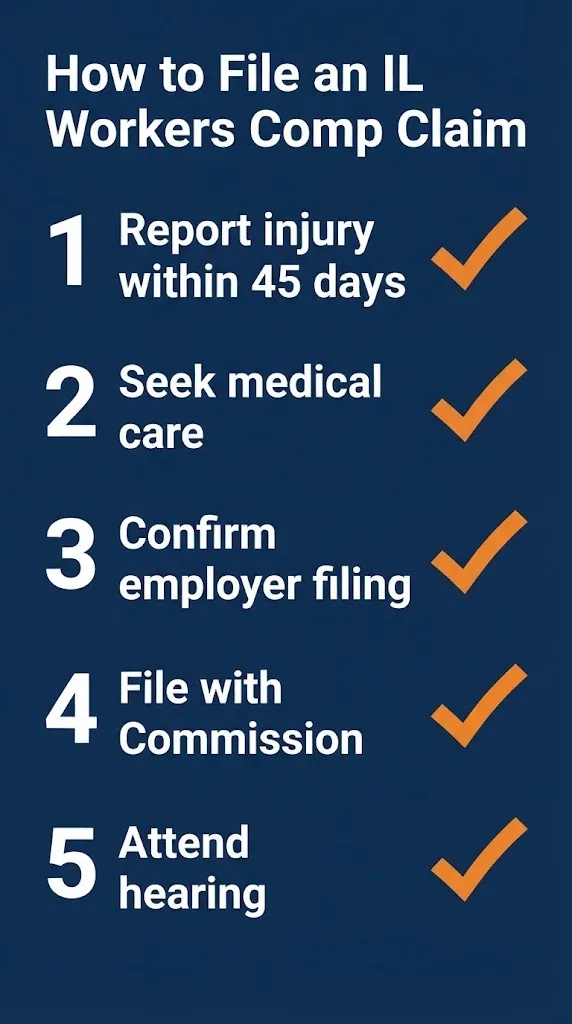
Here is the sequence:
- Report the injury to your employer in writing within 45 days.
- Seek medical treatment and tell the provider it is a work injury.
- Confirm your employer has filed a report with their insurance carrier.
- File an Application for Adjustment of Claim with the Illinois Workers’ Compensation Commission if benefits are denied.
- Gather medical records, wage statements, and incident documentation.
- Respond to all Commission deadlines and hearing notices.
- Attend all scheduled hearings and medical examinations.
- Appeal any unfavorable decision within the required timeframe.
The 45-day reporting deadline is critical. You have 3 years to file a formal claim, but the sooner you report, the stronger your case.
What are the deadlines for Illinois workers compensation claims?
Illinois has two key deadlines: 45 days to notify your employer and 3 years to file a claim with the Commission.
The 45-day notice requirement means you must tell your employer about the injury within 45 days of the accident or the date you reasonably knew the injury was work-related. Failing to meet this deadline can bar your claim, though there are some exceptions.
The 3-year filing window means you must file an Application for Adjustment of Claim with the Illinois Workers’ Compensation Commission within 3 years of the injury date. This is the formal legal deadline.
Here is the breakdown:
| Deadline | Timeframe | What It Means |
|---|---|---|
| Notify employer | 45 days | Tell your employer in writing about the injury |
| File formal claim | 3 years | File with the Commission if benefits are denied |
| Appeal a decision | Varies | Usually short, check the specific notice |
The practical advice is simple: report immediately. Waiting never helps your case.
What benefits does Illinois workers compensation provide?
Illinois workers compensation provides medical coverage, temporary disability payments, permanent disability benefits, and vocational rehabilitation.
The benefit structure is set by the Illinois Workers’ Compensation Act. The amounts depend on your average weekly wage and the severity of your injury.
Here is the summary:
| Benefit Type | What It Provides |
|---|---|
| Medical treatment | All reasonable and necessary medical care related to the injury |
| Temporary total disability | About two-thirds of your average weekly wage while fully off work |
| Temporary partial disability | A portion of lost earnings while on light duty |
| Permanent partial disability | Scheduled benefits based on body part and impairment rating |
| Permanent total disability | Benefits if you cannot return to any work |
| Death benefits | Payments to surviving dependents |
The wage replacement rate in Illinois is roughly two-thirds, which is in line with the national average. The exact figure and maximum weekly benefit adjust periodically.
How much does Illinois workers compensation pay?
Illinois workers compensation pays about two-thirds of your average weekly wage for temporary total disability, subject to a state maximum.
The calculation uses your average weekly wage over the 52 weeks before your injury. The replacement rate is two-thirds, with weekly maximum and minimum amounts set by law.
Here is how it works at different wage levels:
| Pre-Injury Weekly Wage | Two-Thirds Rate | State Maximum | Actual Weekly Benefit |
|---|---|---|---|
| $700 | $467 | Varies annually | $467 |
| $1,200 | $800 | Varies annually | $800 or capped amount |
| $2,000 | $1,333 | Varies annually | Capped amount |
The maximum weekly benefit changes each year. Check the Illinois Workers’ Compensation Commission website for the current figure.
What is the Illinois Workers’ Compensation Commission?
The Illinois Workers’ Compensation Commission is the state agency that administers workers compensation claims and resolves disputes.
The Commission is not a court, but it functions like one for workers compensation purposes. It holds hearings, takes evidence, and issues decisions on disputed claims.
The process works like this:
- You file an Application for Adjustment of Claim with the Commission.
- The Commission assigns an arbitrator to your case.
- The arbitrator holds a hearing and takes evidence.
- The arbitrator issues a decision on your benefits.
- Either side can appeal the decision to the full Commission.
- Further appeals go to the Illinois courts.
The Commission also oversees settlements. Most cases settle before reaching a full hearing, but the hearing process provides a backstop if negotiations fail.
Key Takeaway: The Illinois Workers’ Compensation Commission is the forum where disputes get resolved. A lawyer who knows its procedures has a significant advantage.
What happens at an Illinois workers compensation hearing?
At a hearing, an arbitrator reviews the evidence and decides whether you are entitled to benefits and how much.
The hearing is less formal than a court trial but still follows legal rules. Both sides present evidence, call witnesses, and make arguments.
Here is what to expect:
- You and your lawyer attend the hearing at the Commission.
- The insurance company’s lawyer attends as well.
- The arbitrator swears in witnesses.
- You testify about the injury and its impact.
- Medical experts may testify about causation and disability.
- Both sides present documentary evidence.
- The arbitrator issues a written decision, usually weeks later.
Having a lawyer at this hearing is critical. The insurance company will have one. You should too.
What happens next with an Illinois workers compensation claim?
Here is the expected timeline for an Illinois workers compensation case in 2026:
- Immediately: Report the injury and seek medical care.
- Within 45 days: Notify your employer in writing.
- Within weeks: The insurance company accepts or denies the claim.
- If denied: File with the Illinois Workers’ Compensation Commission.
- Months later: Attend hearings and negotiate settlement.
- Final resolution: Receive benefits through ongoing payments or a lump sum settlement.
These stages are general. Your case may move faster or slower depending on the issues involved.
Frequently Asked Questions
Do I need a lawyer for an Illinois workers compensation claim?
Not always, but you likely need one if your claim is denied, involves permanent disability, or any medical dispute.
How much does an Illinois workers compensation lawyer charge?
By law, fees are capped at 20 percent of the benefits recovered. You pay nothing upfront.
How long do I have to report a work injury in Illinois?
You have 45 days to notify your employer and 3 years to file a formal claim.
What if my employer does not have workers compensation insurance?
You can still file a claim through the Illinois Workers’ Compensation Commission. Your employer may face penalties.
Can I see my own doctor for an Illinois workers compensation injury?
Illinois law allows some choice of physician, but there are rules. Your employer may direct initial care in some situations.
What is the Illinois workers compensation maximum weekly benefit?
The maximum adjusts annually. Check the Illinois Workers’ Compensation Commission for the current figure.
Can I be fired for filing an Illinois workers compensation claim?
Firing an employee for filing a claim is illegal retaliation, but proving it can be difficult.
How long does an Illinois workers compensation case take?
Simple cases can resolve in months. Contested cases can take a year or more.
Closing
The single most important factor in an Illinois workers compensation case is whether you have representation when it matters most.
If your claim is denied, if your injury is permanent, or if the insurance company disputes anything, find a lawyer immediately. The fee cap protects you. The lawyer protects your benefits.