Structured Settlement 2026: How It Works, Lump Sum vs. Payments, and Selling Rights
Quick Answer
- A structured settlement is a financial arrangement where injury compensation is paid in regular installments over time instead of one lump sum.
- It is not a class action payout. It is an individual contract, typically funded by an annuity from a highly rated insurance company.
- You can sell future payments for cash, but state and federal laws require court approval. You will receive less than the full value of your payments.
If you won or settled a personal injury lawsuit, a workers compensation claim, or a wrongful death case, someone has probably asked you whether you took a structured settlement or a lump sum. The question matters because the choice shapes your financial future for years or decades. Structured settlements provide guaranteed, tax-free income. They also protect you from spending a large recovery too fast. But they lock up your money. If you need cash now, you can sell your future payments, but only with court approval and at a discount.
This article covers what a structured settlement is, how the payments work, whether you should take the lump sum or the payments, what happens if you want to sell, and how the 2026 regulatory landscape affects your rights. One fact most people miss: structured settlement payments are completely exempt from federal and state income tax. Not deferred. Not partially taxed. Zero tax. That tax advantage is worth real money and changes the math on the lump sum versus payments decision.
The Facts
| Fact | Detail |
| Definition | A financial product that pays injury compensation in scheduled installments over time. |
| Tax Treatment | 100% tax-free at federal and state levels. Internal Revenue Code Section 104(a)(2). |
| Funding Mechanism | Typically a qualified funding asset, usually an annuity from a highly rated life insurer. |
| Selling Payments | Requires court approval under state structured settlement protection acts and federal law. |
| 2026 Average Discount Rate | Varies by purchaser, payment schedule, and state. Commonly 8% to 18%. |
| Regulatory Agency | State courts and insurance departments. Federal oversight via the SEC and CFPB on factoring transactions. |
What Is a Structured Settlement?
A structured settlement is a contract. It replaces a single large cash payment with a stream of smaller payments over months, years, or a lifetime. The defendant or its insurer buys an annuity from a life insurance company. That annuity funds the payments to you. You never touch the annuity. You receive the scheduled payments directly.
The defining feature is predictability. You know exactly how much you will receive and when. The payments do not fluctuate with the stock market. They do not depend on the defendant staying solvent. The insurance company backing the annuity is legally obligated to pay even if the defendant goes bankrupt.
Structured settlements are most common in personal injury cases. A car accident victim who suffers a permanent disability might receive monthly payments for life instead of a single check. A child injured by medical malpractice might receive payments timed to cover college tuition. A widow in a wrongful death case might receive annual payments to replace the lost income of her spouse.
The structure is negotiated as part of the settlement agreement. Both sides must agree. The plaintiff cannot demand a structure if the defendant insists on a lump sum, and vice versa. In practice, structures are common because they benefit both sides: the plaintiff gets tax-free, guaranteed income, and the defendant gets a release of liability without writing a single large check.
Key Takeaway: A structured settlement turns a lump sum award into guaranteed, tax-free payments over time. It is a settlement tool, not an investment product you buy on your own.
What Is a Structured Settlement Annuity?
A structured settlement annuity is the insurance product that funds the payments. The defendant or its liability insurer purchases the annuity from a life insurance company. The insurance company then makes the payments according to the schedule in the settlement agreement.
The annuity is a “qualified funding asset” under federal law. That classification matters because it preserves the tax-free treatment of the payments. If the defendant simply gave you a lump sum and you bought an annuity yourself, the earnings on that annuity would be taxable. When the defendant buys the annuity as part of the settlement, the full payment stream, including the interest and earnings built into the annuity, is tax-free to you.
The life insurers that issue structured settlement annuities are typically large, highly rated companies. Names you will see include MetLife, Prudential, New York Life, Berkshire Hathaway’s structured settlement division, and Pacific Life. These are not fly-by-night operations. State insurance departments regulate them. Rating agencies like AM Best assess their financial strength.
You have no control over which insurance company issues your annuity. The defendant or its broker selects the company. Your only involvement is agreeing to the payment schedule. Once the annuity is purchased, you are the payee. The insurance company sends payments directly to you.
Structured Settlement vs. Lump Sum: Which Is Better?
Neither is universally better. The right choice depends on your age, your injury, your financial discipline, your other resources, and the specific numbers.
A lump sum gives you full control. You can invest the money, buy a house, start a business, or pay off debt. Control is valuable. It is also dangerous. Studies consistently show that a large percentage of personal injury plaintiffs exhaust their lump sum recoveries within five years. When the money is gone, the injury remains. A structured settlement protects against that risk. The money arrives in measured amounts. You cannot blow it all at once.
The tax advantage tilts the math toward the structured settlement in some cases. If you take a $1 million lump sum and invest it, your investment earnings are taxable. If you take a $1 million structured settlement paid over 20 years with an implicit interest rate built into the annuity, you pay zero tax on the entire stream. The tax savings alone can be worth tens of thousands of dollars.
The downside of the structured settlement is inflexibility. If your needs change, you cannot accelerate payments. You cannot skip a payment and get a larger one later. The schedule is fixed. Selling your payments, discussed below, is the only way to access cash early, and it costs you.
A hybrid approach is common. Take part of the settlement as a lump sum to cover immediate needs: medical bills, debt payoff, a home modification for a disability. Structure the rest for long-term income. This gives you both flexibility and security.
Lump Sum vs. Structured Settlement Comparison
| Factor | Lump Sum | Structured Settlement |
| Control | Full control over all funds immediately | No control over payment timing |
| Tax Treatment | Tax-free when received. Investment earnings are taxable. | 100% tax-free, including the implicit interest |
| Risk | Risk of overspending or bad investments | No market risk. Insurer credit risk, typically minimal. |
| Flexibility | Can spend, invest, or give away freely | Cannot change payment schedule. Must sell to access cash. |
| Inflation | Can invest to outpace inflation | Fixed payments lose purchasing power over time |
| Creditor Protection | Exposed to creditors unless protected by state law | Generally protected from creditors |
Key Takeaway: A lump sum offers control. A structured settlement offers guaranteed, tax-free income and protection from overspending. Many plaintiffs split the difference, taking some cash up front and structuring the rest.
How Do Structured Settlement Payments Work?
The payment schedule is custom-designed for your situation. There is no standard structure. Every settlement is different.
Common structures include monthly payments for a set number of years, monthly payments for life, annual payments, or lump sums at specified future dates. You can combine these. A typical structure might provide a $50,000 initial lump sum for immediate needs, then $3,000 per month for 20 years, plus a $100,000 payment in year 10 to fund a child’s college education, plus a $250,000 payment in year 20 as a retirement supplement.
The payment amounts are fixed. They do not adjust for inflation. A $3,000 monthly payment in 2026 will still be $3,000 in 2046, when it will buy considerably less. Some structures include cost-of-living adjustments, which increase payments by a fixed percentage each year. A COLA rider reduces the initial payment amount but preserves purchasing power over time. It is worth considering if you are young and the payments are designed to last decades.
Payments can be guaranteed for a minimum number of years. If you die before the guaranteed period ends, your estate or named beneficiary receives the remaining payments. A life-only structure pays for your lifetime and stops when you die, with nothing going to heirs. A life-with-period-certain structure pays for life, but if you die within, say, 20 years, payments continue to your beneficiary for the remainder of the period.
What Is a Structured Settlement Agreement?
A structured settlement agreement is the legal document that defines the payment terms. It is part of the broader settlement and release agreement that ends the lawsuit.
The agreement specifies the payment amounts, the payment dates, the payment method, the identity of the assignment company and the annuity issuer, the beneficiary designation if applicable, and whether the payments are guaranteed for a minimum period. It also includes a release of all claims against the defendant, which is the consideration the defendant receives in exchange for making the payments.
The agreement must be in writing and signed by all parties. It is binding and enforceable. If the insurance company misses a payment, you have legal remedies, including breach of contract claims against the defendant and the insurer.
You cannot change the agreement after it is signed. The payments are set. That is why it is worth spending time with a financial advisor or a settlement planner before you sign. A poorly designed structure can create problems that last decades.
Can You Sell a Structured Settlement?
Yes, you can sell your right to receive future structured settlement payments for a lump sum of cash today. This is called a structured settlement factoring transaction. The company that buys your payments is called a factoring company.
Selling is not automatic. Federal law and the structured settlement protection acts in 49 states require court approval. You must file a petition in the court where you live or where the settlement was approved. The judge reviews the transaction to determine whether it is in your best interest. The judge can approve it, deny it, or approve it with conditions.
The factoring company will offer you an amount that is less than the total value of your future payments. The difference is the discount rate. If you are owed $100,000 in payments over 10 years, a factoring company might offer you $70,000 cash today. The $30,000 difference represents the company’s profit, its cost of capital, and the time value of money. Discount rates in the structured settlement secondary market typically range from 8% to 18%, though they can be higher for small transactions or unusual payment schedules.
You do not have to sell all your payments. You can sell a portion. You might sell enough payments to generate $50,000 cash while keeping the remaining payments for future income. Partial sales are common and can be a reasonable way to access cash without sacrificing your entire settlement.
Reality Check: Structured settlement factoring companies are not charities. They are for-profit businesses. The offers they make are designed to generate a return on their capital. Selling your payments means leaving money on the table. Sometimes that tradeoff makes sense, like when you face an emergency expense with no other way to pay it. Sometimes it does not, like when a factoring company cold-calls you with a “special offer” you never asked for.
How to Cash Out a Structured Settlement
If you decide to sell some or all of your payments, the process follows a legal path designed to protect you from predatory buyers. Here are the steps.
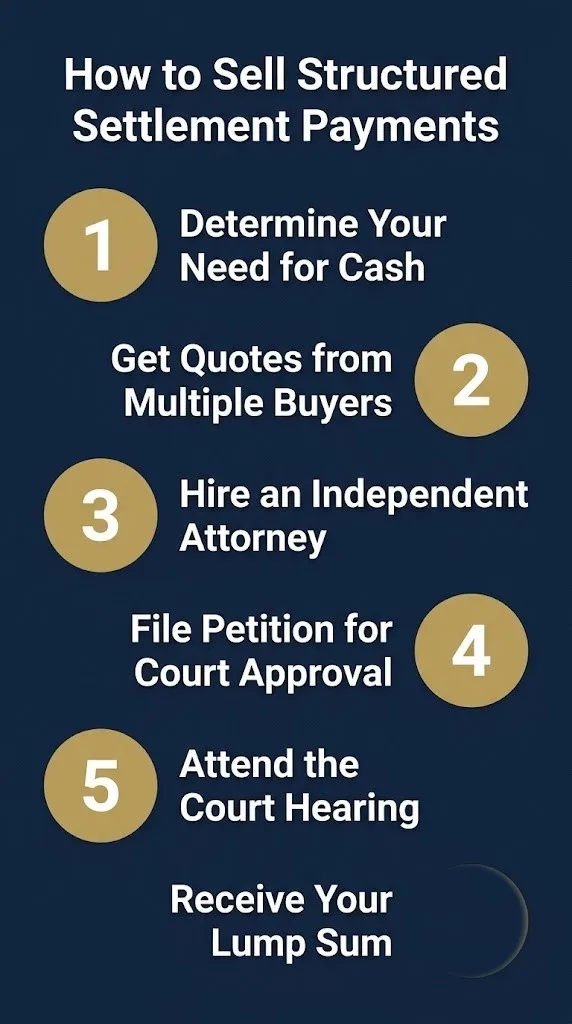
- Determine why you need the cash. A medical emergency, a home purchase, or debt payoff can be valid reasons. A vacation or a shopping spree is not.
- Contact multiple factoring companies. Get at least three quotes. Discount rates vary significantly between buyers.
- Review each offer carefully. Look at the total cash you will receive compared to the total payments you are giving up. Calculate the effective discount rate.
- Do not sign anything on the first call. High-pressure sales tactics are a red flag.
- Hire an independent attorney. This is not optional. The factoring company’s lawyer does not represent you. Your lawyer reviews the offer, negotiates if appropriate, and represents you at the court hearing.
- File a petition for court approval in the appropriate state court. Your lawyer handles this.
- Attend the hearing. The judge will ask you why you want to sell. The judge will verify that you understand what you are giving up. The judge will consider whether the transaction is in your best interest.
- If approved, sign the transfer agreement. The factoring company sends the cash, typically within a few weeks of court approval.
- The factoring company begins receiving the payments you sold.
The entire process typically takes 60 to 90 days from initial contact to receiving cash. Court scheduling is the biggest variable.
Key Takeaway: Selling a structured settlement requires court approval, independent legal advice, and a realistic expectation that you will receive less than the full value of your payments. Shop around. Get multiple quotes. Use an independent attorney.
Is Selling a Structured Settlement a Good Idea?
Sometimes yes. Often no. The transaction costs are high, and the long-term cost of lost payments compounds over time.
Selling is most justifiable when you face a genuine financial emergency. Medical bills not covered by insurance, foreclosure on a home, or a disability that requires an immediate home modification are situations where the cash may be worth the discount. Selling is also defensible when the cash can be invested in something with a higher return than the discount rate, like starting a business with strong prospects or buying a home in a market where you are currently paying rising rent.
Selling is least justifiable when a factoring company solicits you with an unsolicited offer. If you were not looking to sell, you probably do not need to sell. Companies that cold-call structured settlement payees are often the ones offering the steepest discounts. Selling to fund discretionary spending, a car purchase, a vacation, or gifts to family is almost always a bad financial decision.
Consider alternatives before selling. A bank loan or home equity line of credit may have a lower effective interest rate than the discount rate on a structured settlement sale. Family assistance, government benefits, or negotiating a payment plan with creditors may bridge a short-term need. Selling your structured settlement should be the last option, not the first.
What Are Structured Settlement Protection Laws?
Federal law and nearly every state have laws designed to regulate the sale of structured settlement payments. These laws exist because the factoring industry has a history of predatory practices.
The federal Structured Settlement Protection Act, enacted in 2002 as part of the Internal Revenue Code, imposes a 40% excise tax on any factoring transaction that does not receive court approval. This effectively mandates court oversight. The law also requires disclosure of the discount rate and other material terms.
State structured settlement protection acts add additional requirements. Most states require the factoring company to disclose the amounts and due dates of the payments being sold, the aggregate amount of the payments, the discounted present value of the payments, the amount being paid to the seller, and the effective discount rate. Some states impose waiting periods, require independent professional advice, or give the seller a right to cancel within a certain number of days after the court hearing.
Some states go further. A handful of states have banned or severely restricted structured settlement factoring altogether. Others require a finding of a “qualified hardship” before a judge can approve a sale. The trend in 2026 is toward stronger protections, not weaker ones. The Consumer Financial Protection Bureau has signaled interest in regulating factoring transactions more aggressively, though no formal rulemaking has been announced.
What Companies Buy Structured Settlements?
The secondary market is dominated by a relatively small number of large factoring companies. Names you will encounter include J.G. Wentworth, Peachtree Financial Solutions, Oasis Financial, and DRB Capital. These companies advertise heavily, particularly on daytime television and online.
There are also smaller regional players and brokers who shop your payment stream to multiple buyers. A broker can help you get competing offers, though the broker takes a commission that reduces your net proceeds.
Before accepting any offer, check the company’s record with your state’s attorney general and insurance department. Complaints about deceptive practices, undisclosed fees, and high-pressure sales tactics are common in this industry. A company with a clean record is not a guarantee of a fair offer, but a company with a long complaint history is a warning sign you should not ignore.
Frequently Asked Questions
What is a structured settlement?
It is a financial arrangement where lawsuit compensation is paid in regular installments instead of one lump sum.
The payments are typically funded by an annuity from a highly rated life insurance company.
Are structured settlement payments taxable?
No. Payments are 100% tax-free at the federal and state level under Internal Revenue Code Section 104(a)(2).
The tax exemption applies to the full payment, including the implicit interest and earnings.
Can I sell my structured settlement?
Yes, but you need court approval under state and federal law.
You will receive less than the full value of your future payments. An independent attorney is required.
How long does it take to cash out a structured settlement?
The process typically takes 60 to 90 days from initial contact to receiving cash.
Court scheduling is the main variable. Rush offers that promise faster payment may be scams.
What is a structured settlement annuity?
It is the insurance product that funds the payments.
The defendant or its insurer buys the annuity from a life insurance company, which then makes the payments to you.
Is it better to take a lump sum or a structured settlement?
It depends on your age, injury, financial discipline, and specific needs.
A lump sum offers control. A structure offers guaranteed, tax-free income and protection from overspending.
What companies buy structured settlements?
Major factoring companies include J.G. Wentworth, Peachtree Financial Solutions, and Oasis Financial.
Shop multiple buyers. Discount rates and offers vary significantly.
Can creditors take my structured settlement payments?
Generally not. Most state laws protect structured settlement payments from creditors.
The protection is not absolute. A bankruptcy court or certain government creditors may be able to reach payments.
A structured settlement is a tool. It trades flexibility for security, control for tax savings, and immediate cash for long-term income. For many injury victims, that tradeoff makes sense. For others, a lump sum is the better path. The worst choice is making the decision without understanding the numbers.
If you are negotiating a settlement, consult a financial professional who understands structured settlements, not just a lawyer. If you are receiving payments and considering selling, get multiple quotes and use an independent attorney. The legal protections exist because too many sellers have been taken advantage of. Use them.