Equity Compensation Plans 2026: How They Work, What They Pay, and Legal Risks You Should Know
Quick Answer
- Equity compensation plans are real arrangements where companies grant stock, options, or units to employees.
- Payouts depend on vesting schedules, company valuation, and whether you hold or sell at the right time.
- The most important deadline in 2026 is the tax filing date for reporting any equity income you received.
Equity compensation plans are not a lawsuit, a settlement, or a government payout. They are employment arrangements where companies give workers a stake in the business through stock options, restricted stock units, or similar awards. The point is to align employee incentives with company performance and to pay people in future value, not just salary. If you received an equity grant, you hold a contract, not a guarantee.
The people most affected are startup employees, tech workers, and executives who accepted lower base pay in exchange for equity. The number that matters most in 2026 is your vesting schedule, because that determines when shares become legally yours. Tax reporting deadlines follow, and they are unforgiving.
This article explains what equity compensation is, how the main types differ, what they pay, what can go wrong, and how the legal process treats equity disputes. One surprising verified fact: most startup equity is worth zero because most startups fail or never reach a liquidity event.
| The Facts | |
|---|---|
| Case | No single case; applies to employment and compensation law |
| Status | Standard practice, with updated 2026 reporting rules |
| Fund Size | Varies by company, grant size, and valuation |
| Est. Per Person | Depends on vesting, dilution, and exit outcome |
| Claim Deadline | Tax deadlines apply, not settlement deadlines |
| Administrator | Company plan administrator, not a court appointee |
| Proof Needed | Grant agreement, vesting schedule, tax forms |
What Is Equity Compensation?
Equity compensation is a way for employers to pay workers with company ownership instead of only cash salary. The most common types are stock options, restricted stock units, and employee stock purchase plans. Each gives the recipient a financial stake tied to the company’s value. If the company grows, the equity may become valuable. If it stalls or fails, the equity may be worth nothing.
This is different from a bonus. A bonus is cash paid now. Equity is a promise of future value, subject to conditions. You usually must stay with the company for a set period called a vesting schedule. Only after equity vests do you have any legal claim to the shares or their cash value. Before vesting, it is a hope, not an asset.

Companies use equity because it ties worker pay to company performance. A startup with little cash can offer equity instead of a high salary. The tradeoff is risk. Cash is guaranteed until it is spent. Equity can multiply or disappear. Understanding that risk is the first step in evaluating any equity offer.
Key Takeaway: Equity compensation is pay in the form of company ownership, and its value depends on vesting and company performance, not a fixed dollar amount.
How Much Is Equity Compensation Worth?
The worth of equity compensation depends on the company’s value, the type of award, the number of shares or units, the vesting schedule, and whether the company ever goes public or gets acquired. At a public company, equity value is visible because shares trade on an exchange. At a private company, valuation is an estimate, and your shares may be illiquid for years.
A startup employee might receive options with a strike price of $1 per share. If the company later goes public at $20 per share, those options are worth the difference, minus taxes. If the company fails, the options expire worthless. The same logic applies to restricted stock units. If the stock price rises, the units gain value. If it falls, the value drops.
| Company Stage | Typical Equity Outcome |
|---|---|
| Public company | Liquid, price visible daily |
| Late-stage private startup | Valued on secondary markets, often illiquid |
| Early-stage startup | High risk, most end worth zero |
| Failed company | Equity worthless, options underwater |
No one can tell you in advance what your equity will pay. The honest answer is that most private company equity never produces a payout. That is not cynicism. It is the statistical reality of startup failure rates.
Key Takeaway: Equity value ranges from zero to life-changing, and at most private companies the most likely outcome is zero.
What Are the Main Types of Equity Compensation?
The main types of equity compensation are incentive stock options, non-qualified stock options, restricted stock units, and employee stock purchase plans. Each has different tax treatment, different risk profiles, and different rules for when you can sell or exercise. Knowing which type you have matters more than knowing the dollar amount.
Incentive stock options, called ISOs, receive favorable tax treatment if you meet holding requirements. Non-qualified stock options, called NSOs, are taxed as ordinary income when exercised. Restricted stock units, called RSUs, are promises to deliver shares when vesting conditions are met. Employee stock purchase plans let you buy company stock at a discount through payroll deductions.
| Type | How It Works | Tax Treatment |
|---|---|---|
| Incentive stock options | Right to buy at set price, tax-favored | Capital gains if holding rules met |
| Non-qualified stock options | Right to buy at set price | Ordinary income on exercise |
| Restricted stock units | Shares delivered at vesting | Ordinary income at vesting |
| Employee stock purchase plan | Buy stock at a discount | Discount taxed as income |
The paperwork for each grant is legally binding. The grant agreement states the number of shares, the vesting schedule, the exercise price for options, and what happens if you leave the company. Read it before you sign.
Key Takeaway: The four main equity types are ISOs, NSOs, RSUs, and ESPPs, and each carries different tax and risk rules.
What Is an Equity Compensation Plan?
An equity compensation plan is the formal company document that creates and governs equity awards. It sets the total number of shares available for grants, the types of awards permitted, the eligible employees, and the rules for vesting, forfeiture, and administration. Public companies must have shareholder-approved plans.
The plan is the legal framework. Your individual grant agreement sits inside that framework. If the plan says awards are forfeited when you leave before a certain date, that rule applies to you. If the plan has a change of control provision, that determines what happens to your equity if the company is acquired.
Plans are administered by a committee, usually the board or a compensation committee. The committee decides who gets grants, how large they are, and when they vest. That discretion is broad but not unlimited. Courts have reviewed plan administration for breaches of fiduciary duty, especially when executives enrich themselves at the expense of employees or shareholders.
Key Takeaway: The plan document is the legal backbone of every equity grant, and its terms control your rights more than any verbal promise.
What Is the Difference Between Equity Compensation and Salary?
Salary is guaranteed cash paid on a regular schedule. Equity compensation is a contingent grant of company ownership that may or may not produce cash later. Salary is taxed as ordinary income when paid. Equity is taxed at different times depending on the type and when you exercise or sell. Salary stops when you leave. Equity may vest or forfeit when you leave.
The practical difference is risk. Salary is money you can budget. Equity is a bet on the company’s future. A job offer with a $150,000 salary and no equity is not the same as a $120,000 salary plus $30,000 in stock options. The first is $150,000 of certain income. The second is $120,000 of certain income plus a lottery ticket with a strike price and a vesting schedule.
Some workers prefer cash. Others prefer equity because the upside can exceed any salary. There is no objectively right answer. The right answer depends on your risk tolerance, your cash needs, and your honest assessment of the company’s prospects.
Key Takeaway: Salary is guaranteed cash now, while equity is deferred and contingent, and comparing them requires adjusting for risk.
How Does Vesting Work in Equity Compensation?
Vesting is the process by which equity awards become legally yours over time. A typical schedule is four years with a one-year cliff. The cliff means nothing vests in the first year. If you leave before 12 months, you get nothing. After the cliff, the remaining shares vest monthly or quarterly until the four-year mark.
Vesting is a retention tool. It rewards staying. If you leave the company before equity vests, you forfeit the unvested portion. Some plans accelerate vesting under certain conditions, such as a change of control or a layoff. Those acceleration clauses are negotiated in advance and written into the grant agreement or employment contract.
The schedule is not a suggestion. It is legally binding. Disputes over vesting are among the most common equity-related legal fights. Employees who believe they were terminated to avoid a vesting date have sued for wrongful termination and breach of contract. Courts look at the written plan documents first.
Key Takeaway: Vesting controls when equity becomes yours, and leaving early can forfeit the entire unvested portion.
What Happens to Equity Compensation When You Leave a Company?
What happens to your equity when you leave depends on the plan terms, the reason for departure, and whether the equity is vested. Vested equity is generally yours, subject to any repurchase rights or exercise windows. Unvested equity is usually forfeited. The details are in the grant agreement, not in a generic rule.
For stock options, leaving often triggers a post-termination exercise window. You may have 90 days to exercise vested options or lose them. Some companies extend that window, especially after layoffs. Missing the window means walking away from money. The exercise price still has to be paid, plus taxes, which can be a shock.
For restricted stock units, vested units are usually settled in shares when you leave. Unvested units disappear. For employee stock purchase plan shares, you already own the stock and keep it. The key move before leaving any company is to read your grant documents and know your deadlines.
Reality Check: No one at your company will chase you down to exercise your options before they expire. The 90-day window is yours to manage. Miss it and the equity is gone, like a plane that leaves without you.
What Are the Legal Risks in Equity Compensation Plans?
The legal risks in equity compensation plans include dilution, unfavorable plan amendments, breach of fiduciary duty, and tax mistakes. Dilution happens when a company issues more shares, reducing the percentage ownership of existing holders. Some plans protect against dilution. Others do not. If your grant does not have anti-dilution protection, your percentage can shrink.
Plan amendments can also hurt. A company may amend its plan to reduce benefits, extend vesting, or add forfeiture conditions. Whether an amendment applies to you depends on the plan language and your grant agreement. Courts have found that certain amendments to vested benefits are improper without consent.
Tax mistakes are the most common individual risk. Employees who exercise options without understanding the alternative minimum tax can face large unexpected bills. RSU holders who forget that vesting triggers ordinary income can underpay and face penalties. Equity compensation creates tax obligations even when no cash changes hands.
Key Takeaway: Legal risk in equity plans comes from dilution, plan changes, fiduciary breaches, and tax obligations that arise before you see cash.
How Are Equity Compensation Disputes Resolved?
Equity compensation disputes are resolved through internal plan procedures, arbitration, or litigation. Many equity plans contain mandatory arbitration clauses. That means you may have agreed to settle disputes through a private arbitrator instead of a court. Arbitration is often faster but limits discovery and appeal rights.
Some disputes go to court, especially when employees allege fraud, breach of fiduciary duty, or violations of securities laws. The forum depends on the plan language and the nature of the claim. A dispute over a $20,000 options grant may be arbitrated. A class action over company-wide plan mismanagement may proceed in federal court.
The statute of limitations matters. Contract claims generally have longer windows than employment claims, but the clock starts when the breach occurs or when you knew about it. If you believe your equity was mishandled, the worst move is waiting. Evidence disappears and deadlines pass.
Key Takeaway: Equity disputes usually go to arbitration first, but larger or systemic claims can reach court, and timing always matters.
How Are Equity Compensation Plans Regulated in 2026?
Equity compensation plans are regulated by securities laws, tax rules, and corporate governance standards. In 2026, new reporting requirements make it harder to ignore equity income. The IRS expects accurate reporting of stock compensation on tax returns, and companies must report equity grants on Form W-2 or related documents. Mistakes trigger penalties and interest.
The Securities and Exchange Commission oversees public company equity plans, including disclosure requirements and insider trading rules. Private companies are subject to less SEC oversight but still must comply with tax rules and state securities laws. The trend in 2026 is toward more transparency, not less.
For employees, the practical impact is that equity income is harder to hide and easier to misreport. If you received RSUs that vested or sold shares, you owe taxes. The IRS matches company filings against individual returns. Discrepancies generate automated notices. The days of overlooking a small equity grant are over.
Key Takeaway: 2026 reporting rules make equity compensation tax obligations more visible to the IRS, and ignoring them invites penalties.
What Should You Do Before Accepting an Equity Compensation Offer?
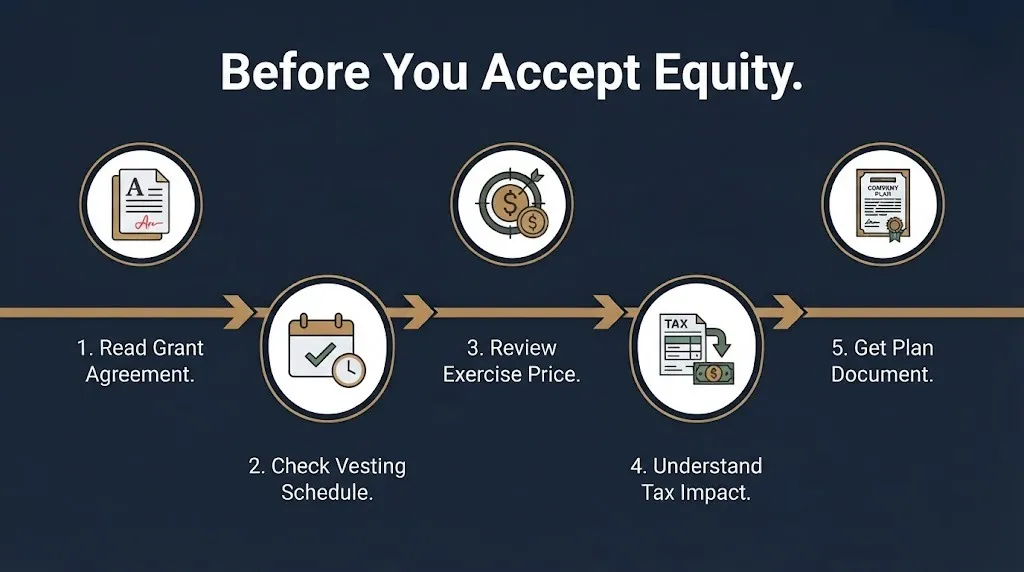
Before accepting an equity compensation offer, read the grant agreement, not just the offer letter. The offer letter may say “100,000 shares.” The grant agreement says what kind of shares, what the strike price is, how long vesting takes, what happens if you leave, and what happens if the company is acquired. Those details determine the value.
Here is a verification checklist:
- Confirm the type of award and whether it fits your tax situation.
- Read the vesting schedule including the cliff and any acceleration clauses.
- Check the exercise price for options and compare it to the current valuation.
- Review post-termination rules so you know your window if you leave.
- Ask about dilution protections and what happens in future funding rounds.
- Get the plan document, not just the grant summary.
- Model the tax consequences with a professional if the grant is large.
The company may not volunteer all of this. Ask for the plan document. If they hesitate, that is information too. Equity is a legal contract, and you should understand it as well as any contract you sign.
Key Takeaway: Read the actual grant agreement and plan document before accepting, because the offer letter rarely tells you what you need to know.
What Happens Next
- Before you sign: Review the grant agreement, vesting schedule, and tax implications.
- At each vesting date: Confirm shares are released and tax withholding is handled.
- If you leave: Note your exercise window and any acceleration clauses.
- At tax time: Report all equity income accurately to avoid IRS matching issues.
- If a dispute arises: Review the plan’s arbitration clause and consult legal counsel.
Frequently Asked Questions
What is equity compensation?
Equity compensation is payment in company ownership, such as stock options or restricted stock units.
Its value depends on vesting and company performance.
How much is my equity worth?
Your equity is worth what someone will pay for it, which may be zero at a private company.
Public company equity has a visible market price.
What is the difference between stock options and RSUs?
Stock options give you the right to buy shares at a set price.
RSUs are promises to deliver shares when they vest, with no purchase required.
Do I owe taxes on equity compensation?
Yes, most equity types trigger tax obligations at vesting or exercise.
The timing and tax rate depend on the award type.
What happens to my equity if I quit?
Vested equity is usually yours, subject to exercise windows.
Unvested equity is normally forfeited.
Can I lose my equity after it vests?
Yes, if you hold vested options and miss the post-termination exercise window.
Vested RSUs already delivered as shares are yours.
Is equity compensation better than salary?
It depends on your risk tolerance and the company’s prospects.
Salary is certain, while equity is contingent on future value.
Where can I get help with an equity dispute?
Review your plan documents and consult an employment or securities attorney.
Many plans require arbitration, so check the dispute resolution clause.
Equity compensation is a legal contract with real money attached, but only if you understand the terms and meet the deadlines. Read the plan document before you sign, track every vesting date, and never assume the company will remind you.