Texas Workers Compensation Attorney 2026: What a Lawyer Does, Costs, and When to Hire One
Quick Answer
- Texas workers compensation attorneys handle claims, appeals, and settlements for injured workers.
- Attorney fees in Texas are capped at 25 percent of your recovery.
- You have one year to report an injury and one year to file a claim in Texas.
Texas is not like other states when it comes to workers compensation. Most states force employers to carry coverage. Texas lets them opt out.
That one fact changes everything for injured workers. If your employer has workers comp, you file a claim and fight the insurance company. If your employer opted out, you may have to sue them directly for negligence.
A Texas workers compensation attorney knows both paths. This article explains what they do, what they cost, and when you should call one.
| The Facts | |
|---|---|
| State | Texas |
| Workers Comp Required | No, optional for most private employers |
| Attorney Fee Cap | 25% of recovery |
| Injury Report Deadline | 30 days to employer, 1 year to Division of Workers’ Compensation |
| Wage Benefits | 70% to 75% of average weekly wage |
| Maximum Weekly Benefit | Set annually by state |
| Non-Subscriber Claims | Direct lawsuit against employer |
Is Hiring a Texas Workers Comp Attorney Worth It?
Yes, hiring a Texas workers compensation attorney is worth it for most serious injuries, denied claims, and all non-subscriber cases.
Texas has a two-track system. Subscriber claims go through the Division of Workers’ Compensation. Non-subscriber claims go through civil court.

An attorney knows which track applies to you and how to maximize recovery in each. Without one, you are negotiating against an insurance adjuster whose job is to pay you as little as possible.
The people who benefit most are those with denied claims, permanent injuries, or employers who do not carry workers comp.
How Much Does a Texas Workers Comp Attorney Cost?
A Texas workers comp attorney costs 25 percent of your recovery, capped by state law.
You pay nothing upfront. The fee comes out of your settlement or award only if you win.
| Recovery Type | Attorney Fee |
|---|---|
| Workers comp settlement | 25% maximum |
| Non-subscriber lawsuit | Usually 33% to 40% |
| Upfront fee | None |
| Case expenses | Deducted from recovery |
The fee structure is contingency-based. No recovery, no attorney fee.
Key Takeaway: Texas caps workers comp attorney fees at 25 percent, and you pay nothing unless you win.
When Should You Hire a Texas Workers Compensation Lawyer?
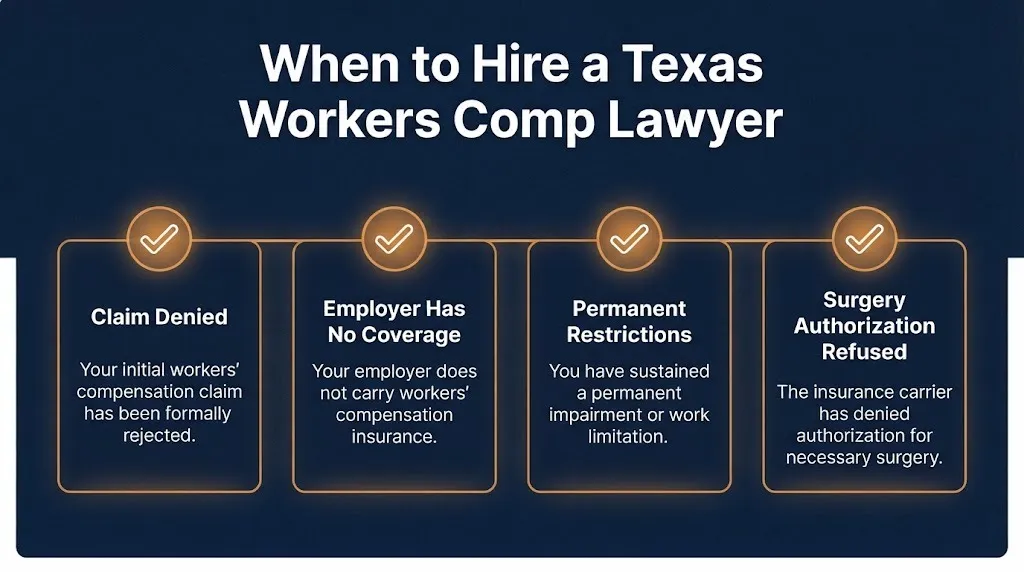
You should hire a Texas workers compensation lawyer the moment your claim hits resistance or your employer lacks coverage.
Specific triggers include:
- Your claim is denied
- Your benefits are delayed or cut off
- Your employer says they do not have workers comp
- You need surgery and the insurer refuses authorization
- You have permanent restrictions
- Your employer retaliates after you file
Waiting costs you evidence, leverage, and time. The deadlines in Texas are short.
What Does a Texas Workers Comp Attorney Do?
A Texas workers comp attorney investigates your case, files claims, negotiates with insurers, and represents you at benefit review conferences and contested case hearings.
The Texas system has multiple levels: benefit review conference, contested case hearing, and appeals panel. Each level has procedural traps.
Your attorney handles:
- Filing the claim correctly
- Gathering medical evidence
- Negotiating impairment ratings
- Representing you at hearings
- Appealing adverse decisions
- Structuring settlements
Without representation, you face an insurance company with lawyers on staff.
What Is the Difference Between a Subscriber and Non-Subscriber in Texas?
A subscriber is an employer that carries workers compensation insurance. A non-subscriber is an employer that opted out.
This distinction drives everything in Texas.
| Factor | Subscriber | Non-Subscriber |
|---|---|---|
| Workers comp benefits | Yes | No |
| Employee can sue employer | No, generally | Yes |
| Fault required | No | Yes |
| Damages available | Limited by statute | Full tort damages |
| Attorney fee cap | 25% | No cap, usually higher |
Non-subscriber employees can sue for pain and suffering, which workers comp does not pay. That makes non-subscriber cases potentially more valuable but harder to win.
Key Takeaway: Texas employers choose whether to carry workers comp, and that choice determines whether you file a claim or a lawsuit.
What Are the Texas Workers Comp Deadlines in 2026?
Texas deadlines are strict. You have 30 days to report an injury to your employer and one year to file a claim with the Division of Workers’ Compensation.
Missing the 30-day report deadline does not kill your claim if you file within one year. But it gives the insurer a defense.
| Deadline | Timeframe |
|---|---|
| Report to employer | 30 days |
| File claim with DWC | 1 year |
| Dispute benefit decision | 20 days |
| Appeal DWC decision | Varies |
These deadlines are not suggestions. They are jurisdictional bars. Miss them and your claim is dead.
How Do Texas Wage Benefits Work?
Texas wage benefits pay 70 to 75 percent of your average weekly wage, subject to a state maximum.
The exact percentage depends on your earnings level. Lower-wage workers receive a higher percentage of their pre-injury wage.
| Benefit Type | Rate |
|---|---|
| Temporary income benefits | 70% to 75% of average weekly wage |
| Impairment income benefits | 70% of average weekly wage |
| Supplemental income benefits | Based on earnings loss |
| Lifetime income benefits | For catastrophic injuries |
The maximum weekly benefit adjusts each year. For 2026, the exact figure is set by the Division of Workers’ Compensation and published on its website.
What Is the Texas Workers Comp Dispute Process?
The Texas dispute process starts with a benefit review conference and escalates to a contested case hearing.
If the insurer denies your claim, you request a benefit review conference. A benefit review officer tries to mediate a resolution.
If mediation fails, the case proceeds to a contested case hearing before an administrative law judge. The judge issues a decision that either side can appeal.
| Stage | What Happens |
|---|---|
| Benefit review conference | Informal mediation |
| Contested case hearing | Formal hearing with evidence |
| Appeals panel | Reviews judge’s decision |
| Judicial review | Rare, in district court |
An attorney can navigate each stage and protect your procedural rights.
Key Takeaway: The Texas dispute process is layered and procedural; an attorney who knows the system is your best asset.
What Happens If Your Employer Is a Non-Subscriber?
If your employer is a non-subscriber, you can sue them directly for negligence, and you may recover damages workers comp does not pay.
Non-subscriber lawsuits require proof that your employer was at fault. That is a higher bar than the no-fault workers comp standard.
But the rewards are higher too. You can claim:
- Full lost wages
- Medical expenses
- Pain and suffering
- Mental anguish
- Punitive damages in gross negligence cases
Non-subscriber employers lose certain defenses in Texas. They cannot argue contributory negligence or assumption of risk as complete bars.
Reality Check: Non-subscriber cases are not automatic wins. You must prove fault, and your employer will have insurance defense lawyers fighting you.
How to Choose a Texas Workers Comp Attorney
Choose a Texas workers comp attorney with experience in both DWC claims and non-subscriber lawsuits.
Not all personal injury lawyers understand the Texas workers comp system. Ask specific questions:
- How many DWC contested case hearings have you handled?
- Have you tried non-subscriber cases to verdict?
- What is your fee structure for each track?
- Will you handle the case personally or delegate it?
| Quality | Why It Matters |
|---|---|
| DWC experience | The system is procedural and unforgiving |
| Non-subscriber trial experience | These cases are civil lawsuits |
| Clear fee structure | Avoid surprises at settlement |
| Responsive communication | You need updates on your claim |
The right attorney changes your outcome. The wrong one just takes a fee.
What Are the Most Common Texas Workers Comp Mistakes?
The most common Texas workers comp mistakes are late reporting, missing DWC deadlines, and accepting a low settlement without understanding it.
Late reporting gives the insurer a defense. Missing the one-year filing deadline kills the claim entirely.
| Mistake | Consequence |
|---|---|
| No written injury report | Insurer disputes notice |
| Missing DWC filing deadline | Claim barred |
| Accepting first settlement offer | You waive future benefits |
| Not documenting restrictions | Insurer says you can work |
Do not sign anything from the insurer without legal review. The fine print waives rights you may not know you have.
What Is the Role of the Division of Workers’ Compensation?
The Division of Workers’ Compensation, part of the Texas Department of Insurance, oversees the state’s workers comp system.
The DWC sets benefit rates, processes claim filings, and administers the dispute resolution process. It also regulates workers comp insurers and monitors compliance.
Injured workers interact with the DWC through:
- Claim filing
- Benefit review conferences
- Contested case hearings
- Appeals
The DWC is not your advocate. It is the referee. Your attorney is your advocate.
Key Takeaway: The DWC runs the system but does not represent you; only an attorney fills that role.
How Does a Texas Workers Comp Settlement Work?
A Texas workers comp settlement can resolve medical benefits, income benefits, or both.
Most settlements are structured as a compromise and release agreement, which closes out future benefits in exchange for a lump sum. These require DWC approval.
| Settlement Type | What It Resolves |
|---|---|
| Income benefit settlement | Wage replacement only |
| Medical benefit settlement | Future medical care |
| Full and final settlement | Both |
Never accept a full and final settlement without understanding your future medical needs. Once signed, it is nearly impossible to reopen.
What Happens Next With Texas Workers Comp
Texas workers comp faces ongoing debate about whether coverage should become mandatory. For now, the opt-out system remains.
- Current: Texas remains the only state with optional workers comp
- Late 2026: Legislative study on non-subscriber outcomes expected
- Expected 2027: Possible bills to mandate coverage
- Watch for: Court rulings on non-subscriber defenses
These are not confirmed dates. They reflect a system in slow motion toward potential reform.
Frequently Asked Questions
Do I need a workers comp attorney in Texas?
You need one if your claim is denied or your employer lacks coverage.
Simple accepted claims may not require representation.
How much does a Texas workers comp lawyer cost?
The fee is capped at 25 percent of your recovery.
You pay nothing upfront and nothing if you lose.
What if my employer does not have workers comp in Texas?
You can sue your employer directly for negligence.
Non-subscriber cases may pay more but require proving fault.
How long do I have to file a workers comp claim in Texas?
You have one year from the injury date to file with the DWC.
Report the injury to your employer within 30 days.
Can I get pain and suffering in Texas workers comp?
No, workers comp does not pay pain and suffering.
Non-subscriber lawsuits may include pain and suffering damages.
What is the maximum weekly workers comp benefit in Texas?
The maximum adjusts annually and is published by the DWC.
Check the current rate on the DWC website.
The Bottom Line
Texas workers compensation is unique because it is optional for employers. That single fact makes attorney involvement more important, not less.
If you are hurt, report the injury now. File the claim now. Talk to a Texas workers comp attorney this week. The deadlines are short, and the system does not forgive missed dates.
The single most important deadline is one year from your injury date to file with the DWC. Miss it and your claim is gone.