VA Compensation Rates 2026: The Confirmed Pay Chart and What Changed
Quick Answer
- The 2026 VA compensation rate increase is real and confirmed, based on a 2.8% Cost-of-Living Adjustment.
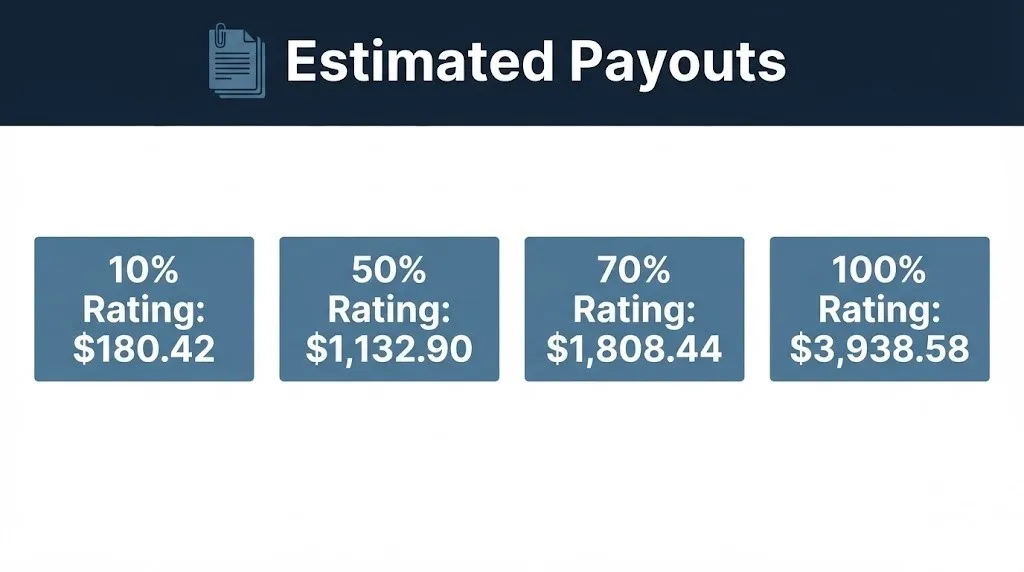
- A veteran rated 100% with no dependents now receives $3,938.58 a month, up from $3,831.30 in 2025.
- No deadline applies. The increase happened automatically starting with the December 2025 payment, no action required.
If you’re checking whether your VA disability check actually went up in 2026, it did. The Department of Veterans Affairs confirmed a 2.8% Cost-of-Living Adjustment, applied automatically to every disability rating of 10% or higher.
This affects millions of veterans nationwide, from a $180.42 monthly payment at the 10% rating up to $3,938.58 at 100%. The one number that matters most: this increase required no forms, no phone calls, and no reapplication.
This article breaks down the full 2026 pay chart by rating and dependent status, how PACT Act presumptive conditions fit into the same rate table, and one detail worth knowing: veterans rated only 10% or 20% get a flat rate with no extra pay for dependents, no matter how large their family is.
The Facts
| Case | 2026 VA Disability Compensation Rate Update (annual COLA adjustment) |
| Status | Confirmed and currently in effect |
| Fund Size | Not applicable. This is a federal benefit rate adjustment, not a lawsuit settlement fund |
| Est. Per Person | $180.42 to $3,938.58 monthly, based on disability rating and dependents |
| Claim Deadline | None. The increase applies automatically to existing ratings of 10% or higher |
| Administrator | U.S. Department of Veterans Affairs |
| Proof Needed | An existing VA disability rating of 10% or higher. No new application required |
Are the 2026 VA Compensation Rates Real?
Yes. The 2026 VA disability compensation rates are official and confirmed, based on a 2.8% Cost-of-Living Adjustment.
The Social Security Administration announced the 2.8% COLA on October 24, 2025, and the VA confirmed the matching adjustment to disability pay rates on December 1, 2025. These rates remain effective through December 2026.
This isn’t a proposal or a projection anymore. The rates are published, confirmed, and already reflected in veterans’ bank accounts. If your payment doesn’t match the confirmed 2026 chart, that’s worth checking against your VA award letter directly.
Is the 2026 VA Rate Increase Confirmed or Still a Projection?
The 2026 VA rate increase is fully confirmed, not a projection. Earlier estimates in 2025 ranged from 2.5% to 3.0% before the final 2.8% figure was locked in.
Some articles published before October 2025 still reference projected ranges. Those are now outdated. The confirmed, final number is 2.8%, applied uniformly across every disability rating and dependency tier.
Key Takeaway: The 2.8% COLA increase for 2026 is a confirmed, finalized rate, not an estimate, and it’s already reflected in veterans’ monthly payments.
VA Disability Compensation Rates 2026: How Much Will You Get
Your 2026 VA disability compensation depends on your combined disability rating and whether you have dependents, ranging from $180.42 to $3,938.58 monthly for a veteran alone.
Ratings of 10% and 20% receive a flat rate regardless of family status. Starting at 30%, veterans become eligible for additional compensation tied to a spouse, children, or dependent parents.
2026 Monthly Rates, Veteran Alone (No Dependents)
| Rating | Monthly Amount |
|---|---|
| 10% | $180.42 |
| 20% | $356.66 |
| 30% | $552.47 |
| 40% | $795.84 |
| 50% | $1,132.90 |
| 60% | $1,435.01 |
| 70% | $1,808.44 |
| 80% | $2,102.14 |
| 90% | $2,362.30 |
| 100% | $3,938.57 |
Not yet determined: exact Special Monthly Compensation (SMC) amounts for individual severe-disability categories, since those vary widely by specific condition and should be confirmed directly through VA.gov.
VA Compensation Pay Chart: Full Rates by Rating and Dependents
The full 2026 VA compensation pay chart adds extra monthly amounts for a spouse, children, and dependent parents at ratings of 30% and above.
2026 Monthly Rates With Dependents (Selected Tiers)
| Rating | Veteran Alone | With Spouse | Spouse + 2 Parents |
|---|---|---|---|
| 40% | $795.84 | $883.30 | Varies by combination |
| 50% | $1,132.90 | $1,242.48 | Varies by combination |
| 60% | $1,435.01 | $1,566.73 | Varies by combination |
| 70% | $1,808.44 | $1,961.23 | $2,207.80 |
| 80% | $2,102.14 | $2,277.06 | $2,557.34 |
| 90% | $2,362.30 | $2,559.34 | $2,875.45 |
| 100% | $3,938.57 | $4,158.16 | $4,510.65 |
At 100%, adding a spouse increases monthly pay by $219.59. An additional child under 18 adds $109.11, and a school-age child between 18 and 23 adds $352.45. Ratings of 10% and 20% never include dependent additions, by law.
Key Takeaway: Dependent pay only starts at the 30% rating, so two veterans with the same disability rating but different family status can receive very different monthly totals.
VA Compensation Calculator: How to Estimate Your Payout
A VA compensation calculator estimates your monthly payment by combining your disability rating with your dependent status using the official 2026 rate tables.
Follow these steps to estimate your own payout:
- Confirm your current combined disability rating from your VA award letter.
- Identify your dependent status: alone, with spouse, with children, or with dependent parents.
- Match your rating and dependent status against the official 2026 rate chart.
- Add any Special Monthly Compensation category if it applies to your case.
- Cross-check the total against your actual December 2025 or later deposit.
- Contact VA directly if your deposit doesn’t match the chart for your rating.
If you have multiple service-connected conditions, don’t simply add the percentages together. The VA uses a “whole person” combined ratings formula defined in federal regulation, which almost always produces a lower total than straight addition.
How to Check Your VA Disability Rate Update
Checking your VA disability rate update means comparing your most recent deposit against your award letter and the official 2026 rate chart.
- Log into your VA.gov account to view your current award letter.
- Confirm your listed combined disability rating.
- Compare your December 31, 2025 deposit against the confirmed 2026 chart for your rating and dependents.
- Check whether any dependent additions are missing if your family status changed in 2025.
- Call the VA benefits hotline if your payment doesn’t match the confirmed rate.
- Keep documentation of any discrepancy before requesting a correction.
Key Takeaway: Your award letter on VA.gov, not a third-party calculator, is the authoritative source for confirming your exact current rating and payment.
Reality Check
No one needs to pay a company or a “VA benefits consultant” upfront money just to receive the automatic 2026 COLA increase. If you already have a disability rating of 10% or higher, the increase applied to your payment automatically, with no forms and no fees. Be cautious of anyone promising to “unlock” a higher automatic COLA payment for a fee, since that increase already happens for everyone eligible without cost.
VA Disability Compensation Rates 2026 Update Today
As of the most recent confirmed reporting, the 2.8% COLA increase remains fully in effect through December 2026, when the 2027 rates will take over.
This is the largest COLA percentage since 2023’s 3.2% adjustment, though smaller than the sharp 8.7% increase veterans saw in 2022. It’s above the roughly 2.6% average increase seen over the past decade, according to veterans service organization reporting.
The increase applies uniformly to standard disability compensation, Total Disability Individual Unemployability (TDIU) payments, Special Monthly Compensation, Dependency and Indemnity Compensation (DIC), and VA Pension benefits.
When Did the 2026 VA Compensation Increase Take Effect?
The 2026 VA compensation increase took effect December 1, 2025, with the first payment reflecting the new rate deposited December 31, 2025.
Because January 1 fell on a federal holiday and the VA pays benefits in arrears, the first visibly higher deposit landed at the very end of December 2025 rather than in January. That timing confused some veterans who expected to see the increase in a January payment date instead.
- December 1, 2025: New 2026 rates officially take effect.
- December 31, 2025: First deposit reflecting the increase hits veteran accounts.
- Through December 2026: These rates remain in effect until the 2027 adjustment.
Key Takeaway: If your December 31, 2025 deposit looked higher than expected, that increase was correct and reflects the confirmed 2026 rate, not an error.
VA Hearing Loss Compensation Tables Explained
VA hearing loss compensation uses the same standard 0% to 100% disability rate table as every other condition, based on audiometric test results rather than a separate pay scale.
Hearing loss is rated under Diagnostic Code 6100, using puretone threshold averages and Maryland CNC speech discrimination scores cross-referenced in federal rating tables. Most veterans with hearing loss actually receive a 0% (non-compensable) rating, which provides access to VA hearing aids but no monthly payment.
Tinnitus, the most frequently claimed VA disability nationwide, is rated separately under Diagnostic Code 6260 at a fixed 10% regardless of severity, worth $180.42 a month at the 2026 rate. Veterans can have hearing loss and tinnitus rated independently, and both can combine into a higher overall disability percentage.
PACT Act Compensation Percentage: How Ratings Work
There is no separate “PACT Act percentage.” PACT Act presumptive conditions are rated using the same 0% to 100% disability schedule as any other service-connected condition.
The PACT Act simplifies proving your condition is connected to military toxic exposure, such as burn pits, but it does not change how much you’re paid once a rating is assigned. Since 2022, the VA has added 23 new presumptive cancer conditions and roughly 20 additional non-cancer conditions tied to toxic exposure.
More than 1 million PACT Act disability claims have been approved so far, carrying an approval rate of about 74.9 percent. Veterans filing PACT Act claims in 2026 have generally seen faster decisions than traditional claims, since the presumptive framework removes much of the need to independently prove service connection.
Military Disability Compensation vs. VA Disability Compensation
Military disability compensation and VA disability compensation are related but distinct benefits, and veterans sometimes receive both.
VA disability compensation comes from the Department of Veterans Affairs and is based on your combined disability rating after separation from service. Military disability retirement pay, by contrast, comes from the Department of Defense and applies to service members medically retired while still on active duty.
Veterans with Combat-Related Special Compensation (CRSC) or Concurrent Retirement and Disability Pay (CRDP) can potentially receive both military retirement pay and VA disability compensation without the usual dollar-for-dollar offset that historically reduced one when receiving the other.
PTSD Compensation Chart: What Veterans Receive
PTSD compensation follows the standard VA disability rate chart, with most veterans rated between 30% and 70% depending on symptom severity and functional impairment.
There’s no separate “PTSD-only” pay scale. A veteran rated 50% for PTSD alone with no dependents would receive $1,132.90 monthly at the 2026 rate, while a veteran rated 70% would receive $1,808.44.
- Mild, intermittent symptoms with minimal work impact: often rated around 30%.
- Occupational and social impairment with reduced reliability: often rated 50%.
- Deficiencies in most areas of life, including work and family relationships: often rated 70%.
- Total occupational and social impairment: potentially rated 100%.
Veterans appealing an initial PTSD rating for a 50% to 70% increase see a notably higher success rate than initial service-connection claims, according to recent claims-tracking data, though individual outcomes always depend on documented evidence.
What Is Disability Compensation and Who Qualifies?
VA disability compensation is a tax-free monthly benefit paid to veterans with an illness or injury connected to their military service.
You generally qualify if you have a current diagnosed condition, evidence of an in-service event or exposure, and a medical link connecting the two, known as a nexus. Presumptive conditions under laws like the PACT Act remove much of that burden of proof for veterans who served in specific locations and time periods.
Compensation is not reported as taxable income and applies automatically once a rating of 10% or higher is confirmed. No separate application is needed to receive annual COLA increases once you already have an approved rating.
What Happens Next
December 1, 2025 (confirmed): The 2.8% COLA officially took effect for all VA disability compensation programs.
December 31, 2025 (confirmed): First deposit reflecting the new 2026 rates was paid to veterans.
Through December 2026 (confirmed): Current 2026 rates remain in effect for the full calendar year.
Expected, October 2026: The Social Security Administration is expected to announce the COLA percentage for 2027.
Expected, December 2026: The VA is expected to confirm and apply the 2027 rate adjustment.
Frequently Asked Questions
What is the 2026 VA disability pay increase?
The 2026 VA disability pay increase is a confirmed 2.8% Cost-of-Living Adjustment.
It applies automatically to every disability rating of 10% or higher.
No application or paperwork is required to receive it.
How much does a 100% disabled veteran get in 2026?
A veteran rated 100% with no dependents receives $3,938.57 monthly in 2026.
Adding a spouse increases that to $4,158.16 monthly.
The exact amount depends on your specific dependent situation.
When did the 2026 VA rate increase start?
The new rates took effect December 1, 2025.
The first deposit reflecting the increase was paid December 31, 2025.
This is because the VA pays in arrears and January 1 fell on a federal holiday.
Do veterans with a 10% or 20% rating get extra pay for dependents?
No, ratings of 10% and 20% receive a flat rate regardless of family status.
Additional compensation for a spouse, children, or dependent parents only begins at the 30% rating.
This rule has not changed for 2026.
How is the VA hearing loss rating calculated?
VA hearing loss ratings are calculated using audiometric test results, not subjective symptom reports.
Puretone threshold averages and speech discrimination scores are cross-referenced in federal rating tables.
Most veterans with hearing loss receive a 0% rating, though this still provides access to VA hearing aids.
Does the PACT Act pay a different compensation rate?
No, PACT Act presumptive conditions use the same standard 0% to 100% disability rate chart as any other condition.
The PACT Act mainly simplifies proving your condition is connected to military toxic exposure.
It does not create a separate, higher pay scale.
Do I need to file anything to get the 2026 COLA increase?
No, the increase applies automatically to any existing VA disability rating of 10% or higher.
You do not need to submit a new claim or contact the VA to receive it.
If your payment doesn’t match the confirmed chart, contact VA directly to review your award letter.
If you’re unsure whether your payment reflects the correct 2026 rate, the fastest step is pulling up your current award letter on VA.gov and comparing it against your specific rating and dependent status. The one confirmed fact to remember: the 2.8% COLA increase took effect December 1, 2025, and stays in place through December 2026.