Medical Lawsuit Lawyers 2026: Costs, Deadlines, and What Your Malpractice Case Could Really Be Worth
Quick Answer
- Medical lawsuit lawyers are legitimate professionals who work on contingency, meaning most take no fee unless you win or settle.
- The commonly cited national average paid claim is about $420,000 to $425,000, but nearly 4 in 5 filed claims pay nothing at all.
- Your filing deadline depends entirely on your state, and several states shortened or extended theirs between 2024 and 2026, so check your state’s rule before you wait.
If you think a doctor, nurse, hospital, or clinic hurt you through negligence, you’re probably searching two things right now: is this worth pursuing, and who do I call. This guide answers both with sourced numbers instead of guesswork.
Roughly 17,000 medical malpractice lawsuits get filed across the country every year, and the rules governing them (deadlines, damage caps, required paperwork) shift by state and change almost every legislative session. One detail worth knowing up front: nearly 80 percent of filed claims end with no payment at all, which is exactly why the lawyer you pick, and how fast you act, matters more than most people realize.
This article covers what medical malpractice lawyers actually do, what cases are worth, how to find one, and the exact deadlines and caps in play for 2026. One surprising verified detail: physicians over 55 face nearly a 1-in-2 chance of being sued at some point in their career, according to 2026 AMA data.
The Facts
| Topic | Medical malpractice lawsuits and legal representation, general U.S. process (not one specific case) |
| Filed claims per year | About 17,000 nationally |
| Claims that pay nothing | Roughly 4 out of 5, per New England Journal of Medicine research |
| Average paid claim | About $420,000 to $425,000 (NPDB benchmark, 2023 to 2026 estimate) |
| Total paid out (2024) | $5.02 billion, per NPDB |
| States with damage caps | 28 states cap some or all malpractice damages as of 2026 |
| Typical lawyer fee structure | Contingency, no upfront cost, fee only if you recover money |
| Filing deadline | Varies by state, ranges from roughly 1 to 6 years, check your state below |
Not every number above applies to every case. Treat these as national benchmarks, not a prediction of what you’ll receive.
Are Medical Lawsuit Lawyers Legit?
Yes, medical lawsuit lawyers are a real and regulated part of the civil justice system, not a scam industry.
They’re licensed attorneys who specialize in proving a health care provider breached the accepted standard of care and caused you harm. Nothing about hiring one requires paying money upfront in a typical arrangement.

The confusion usually comes from advertising. Firms that spend heavily on TV and search ads aren’t automatically better or worse than smaller local firms, they’re just better funded marketers. What actually matters is trial experience in cases like yours, access to qualified medical experts, and a track record you can verify through your state bar association.
Key Takeaway: A legitimate medical malpractice lawyer evaluates your case for free and only gets paid if you do, so there’s no financial reason to avoid a consultation.
How Much Do Medical Malpractice Lawyers Cost?
Medical malpractice lawyers almost always work on a contingency fee, meaning you pay nothing out of pocket and the lawyer takes an agreed percentage only if your case settles or wins.
If the case doesn’t result in a payout, you typically owe no attorney fee at all under this model. You may still be responsible for hard case costs like expert witness fees or court filing costs in some agreements, so ask specifically what happens if you lose.
Before signing anything:
- Ask what percentage the firm takes and whether it changes if the case goes to trial.
- Ask who pays for expert witnesses upfront.
- Ask what costs, if any, you owe if the case is unsuccessful.
- Get the fee agreement in writing before signing.
Reality Check: No legitimate law firm asks you to pay a fee before reviewing your case, and no one texts or emails you out of the blue offering a malpractice payout. If a “claims helper” asks for money upfront to connect you with a lawyer, that’s a red flag, not a shortcut.
How Much Is a Medical Malpractice Lawsuit Worth in 2026?
There’s no fixed dollar amount, but the most defensible national benchmark is the NPDB’s average paid claim of roughly $420,000, trending toward an estimated $423,000 to $425,000 in 2026 reporting.
That average hides enormous range. Cases involving death average around $380,000, cases with catastrophic or permanent injury commonly land between $280,000 and $430,000, and the highest-value catastrophic cases have averaged $19.5 million to $27.5 million. Minor injury cases can settle for far less, sometimes under $50,000.
| Case Type | Typical Range |
|---|---|
| Minor, recoverable injury | Under $100,000 |
| Death | Around $380,000 average |
| Severe, permanent injury | $280,000 to $430,000+ |
| Catastrophic (brain injury, birth injury) | Can exceed several million |
Diagnostic errors, including missed or delayed diagnosis, drive the largest share of payout dollars, accounting for roughly a third of all claim money paid nationally.
What Determines Your Malpractice Settlement Amount?
Your settlement amount is shaped primarily by injury severity, your state’s damage caps, the strength of expert testimony, and whether the case settles or goes before a jury.
Insurers and defense attorneys build their offer around documented economic losses first: medical bills, lost wages, and future care costs. Pain and suffering, called non-economic damages, is where states diverge sharply, since 28 states cap that category while 22 states have no cap at all.
Factors that typically raise case value:
- Permanent disability or lifelong care needs
- Younger victim age (longer projected future losses)
- Clear documentation and strong expert support
- No applicable damage cap in your state
Factors that typically lower it:
- A state damage cap on non-economic damages
- Disputed or unclear causation
- Comparative fault findings against the patient
- Cases that settle quickly for certainty rather than going to trial
Key Takeaway: Two patients with identical injuries can receive very different payouts depending only on which state they live in, because damage caps override case facts.
How to Find and Hire a Medical Malpractice Lawyer
You can find a qualified medical malpractice lawyer by checking your state bar association’s referral service, verifying trial experience, and getting a free consultation before signing anything.
- Search your state bar association’s lawyer directory or referral service.
- Confirm the firm handles malpractice specifically, not just general injury cases.
- Ask how many malpractice cases they’ve tried, not just settled.
- Ask if they’ve handled cases in your specific specialty area (surgery, birth injury, diagnostic error).
- Request the fee agreement in writing.
- Ask about their process for hiring medical experts.
- Confirm who covers costs if the case doesn’t succeed.
- Trust your gut on communication, you’ll need this relationship for months or years.
Most firms offer a free initial case review. Use it to ask direct questions rather than just describing what happened.
What to Do First After Suspected Medical Malpractice
The first step is requesting your complete medical records in writing, since your case depends entirely on what those records show.
Write down everything you remember about the treatment while it’s fresh, including names, dates, and what you were told. Avoid discussing details of a potential lawsuit on social media, since defense attorneys can and do review public posts.
Early steps that protect your case:
- Request your full medical record, including nursing notes and imaging
- Keep every bill, receipt, and piece of correspondence
- Write a timeline while memory is fresh
- Avoid signing anything from the provider’s insurer without legal review
- Consult a lawyer before your state’s filing deadline, not after
How to File a Medical Malpractice Lawsuit Step by Step
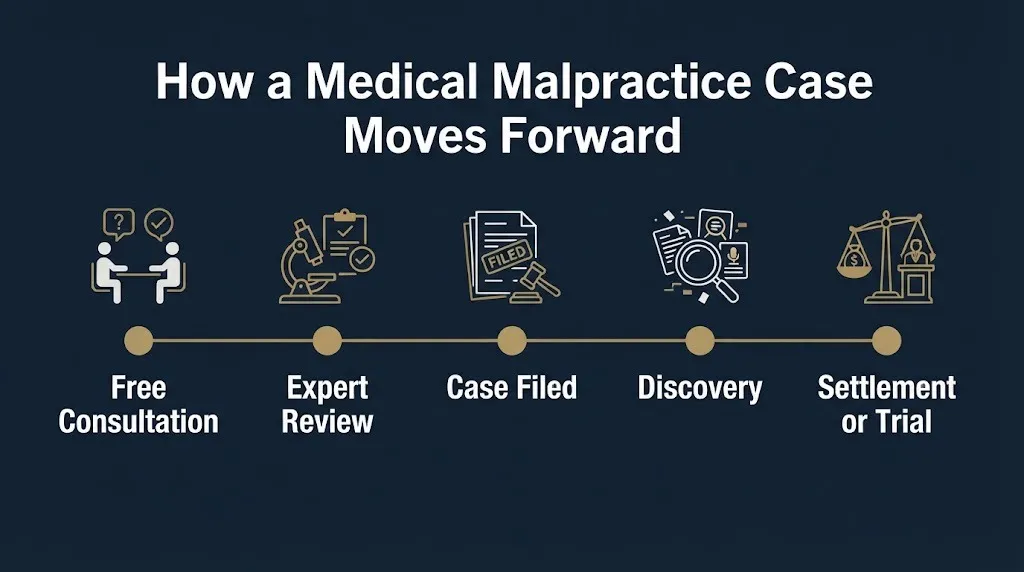
Filing a medical malpractice lawsuit generally means securing an expert review, filing a formal complaint in court, and proceeding through discovery before any settlement or trial.
- Consult a malpractice attorney for a free case evaluation.
- Attorney obtains and reviews your full medical record.
- An independent medical expert reviews the case for merit.
- Many states require a certificate of merit or affidavit before filing.
- The lawsuit is formally filed in the appropriate court.
- Discovery begins: depositions, expert reports, document exchange.
- Settlement negotiations often begin during or after discovery.
- If no settlement, the case proceeds to trial.
Roughly 96 out of 100 malpractice cases that result in any payment end in a negotiated settlement rather than a jury verdict, which is one reason a lawyer’s negotiating track record matters as much as their courtroom record.
What Is the Statute of Limitations for Medical Malpractice by State?
Your statute of limitations is the legal deadline to file, and it ranges roughly from one to six years depending on your state, with several states changing their rule in 2024 and 2025.
Recent confirmed changes:
- Louisiana: extended from 1 year to 2 years, effective July 1, 2024 (Act 423).
- Utah: extended from 2 years to 4 years after discovery, with an 8-year statute of repose, effective May 7, 2025 (HB 288).
- Nevada: restructured to 4 years from injury or 2 years from discovery, effective 2024 (AB 404).
- Minnesota: shortened from 4 years to 2 years, effective August 1, 2025 (SF 3489).
- Missouri: shortened from 5 years to 2 years, effective August 28, 2025 (HB 68).
- Oklahoma: a bill (HB 4176) proposing a 3-year discovery-based deadline for cases arising on or after November 1, 2026, was introduced this session; not yet confirmed as final law.
Most states also apply a “discovery rule,” which starts the clock when you reasonably should have discovered the injury and its cause, not necessarily the date treatment happened. California caps its discovery window at one year after discovery, with a three-year outer limit. South Dakota does not recognize a discovery rule at all.
Key Takeaway: Deadlines are state-specific and have moved in six or more states in the past two years, so verify your state’s current rule directly with a licensed attorney rather than relying on older articles.
How Long Does a Medical Malpractice Lawsuit Take?
Most medical malpractice lawsuits take one to three years from filing to resolution, though complex or trial-bound cases can run longer.
Cases that settle during discovery typically resolve faster than cases that proceed to trial, since trial scheduling alone can add months or years depending on the court’s docket. Think of it the way you’d think of a delayed tax refund tied to a complicated return: the more documentation and disputed facts involved, the longer it realistically takes.
Typical phases and rough duration:
| Phase | Typical Length |
|---|---|
| Investigation and expert review | 2 to 6 months |
| Filing through discovery | 6 to 18 months |
| Settlement negotiation | Can overlap with discovery |
| Trial (if needed) | Adds 6 months to 2+ years |
What States Cap Medical Malpractice Damages in 2026?
As of 2026, 28 states maintain some form of statutory cap on medical malpractice damages, while 22 states have no cap or have had their caps struck down as unconstitutional.
Caps most often apply to non-economic damages (pain and suffering) rather than economic losses like medical bills or lost wages, though a handful of states cap total damages. Courts in states including Alabama and Florida have ruled prior cap laws unconstitutional, which is part of why the list keeps shifting.
One concrete 2026 example: North Carolina’s cap on non-economic damages rose to $712,847 as of January 1, 2026, under its annual inflation adjustment. New Mexico also enacted tiered punitive damage caps in 2026 under HB 99, ranging from $1 million for independent providers up to $15 million for large hospital systems, alongside a higher evidentiary standard for punitive claims.
Because this changes by legislative session, confirm your state’s current cap with a licensed attorney rather than a general article, even this one.
What Counts as Medical Malpractice?
Medical malpractice means a health care provider deviated from the accepted standard of care and that deviation directly caused you harm, not simply that treatment had a bad outcome.
A bad result alone isn’t malpractice. Courts require proof of a breach of duty and direct causation, usually established through independent medical expert testimony.
Common categories include:
- Diagnostic errors (missed, delayed, or wrong diagnosis)
- Surgical errors
- Medication errors
- Birth injuries
- Anesthesia errors
- Failure to obtain informed consent
Diagnostic errors remain the single largest driver of paid claim dollars nationally, accounting for roughly one in three payout dollars according to NPDB-based analysis.
Do Most Malpractice Lawsuits Settle or Go to Trial?
Most medical malpractice cases that result in any payment settle out of court, and only a small share proceed all the way to a jury verdict.
Industry analysis puts the split at roughly 96.5 percent settlement versus 3.5 percent judgment among cases that pay. That doesn’t mean settling is automatic or easy: insurers often contest claims aggressively, and the nearly 80 percent of filed claims that pay nothing reflects how hard these cases are to win, not that most claims lack merit.
Key Takeaway: A high settlement rate among paid claims doesn’t mean most filed cases succeed, it means most cases that do succeed avoid trial.
New Medical Malpractice Laws Changing in 2026
Several states passed or introduced new malpractice legislation in 2026, generally shifting either filing deadlines or damage cap structures.
Confirmed and pending changes this year include New Mexico’s HB 99 tiered punitive damage caps (signed), Virginia’s SB 99 addressing limitation on recovery for young patients (introduced, continued to next session as of February 2026), and Oklahoma’s HB 4176 proposing a new 3-year discovery-based deadline for claims arising after November 1, 2026 (introduced, not yet enacted). North Carolina’s annual inflation adjustment also pushed its non-economic damage cap to $712,847 effective January 1, 2026.
Because bills move through committees and sessions differently by state, treat any bill listed as “introduced” as not yet confirmed law until it’s signed and in effect.
What if You Can’t Afford a Lawyer?
You generally don’t need money upfront, since most medical malpractice lawyers work entirely on contingency and advance case costs themselves.
If a firm you contact declines your case (many decline cases that seem low-value relative to litigation cost) you can seek a second opinion, since case value assessments vary between firms. Legal aid organizations rarely handle malpractice litigation directly, but they can often refer you to a private attorney willing to take contingency cases.
What Happens Next: Typical Case Timeline
Within days to weeks: You request medical records and consult a malpractice attorney for a free case evaluation.
Within 1 to 3 months: An independent medical expert reviews whether the case has merit and meets your state’s certificate-of-merit requirement, if applicable.
Within 3 to 12 months: The lawsuit is formally filed and discovery begins, including depositions and expert reports.
Expected, timing varies by case: Settlement negotiations open, often resolving the case without trial.
If unresolved: The case proceeds toward a scheduled trial date, which can add a year or more depending on court backlog.
Frequently Asked Questions
Do medical malpractice lawyers really work for free upfront?
Yes, the standard arrangement is contingency fee, meaning no payment is owed unless you recover money.
Some agreements still require you to cover hard costs like expert fees if the case fails.
Always get this in writing before signing.
What’s the average payout for a medical malpractice lawsuit?
The most cited national benchmark is around $420,000 to $425,000 per paid claim.
That figure is skewed upward by a small number of catastrophic cases, and nearly 80 percent of filed claims pay nothing.
Your actual case value depends on injury severity and your state’s damage caps.
How long do I have to file a medical malpractice lawsuit?
It depends entirely on your state, and several states changed their deadlines between 2024 and 2026.
Ranges commonly run from about 1 to 6 years, often starting when you discovered the injury rather than when it happened.
Confirm your exact deadline with a licensed attorney in your state immediately.
Is it worth suing for medical malpractice?
It depends on injury severity, available evidence, and your state’s damage caps, which a free consultation can help clarify.
Cases with clear documentation and permanent injury are generally stronger candidates.
A lawyer can tell you honestly whether litigation costs make sense relative to likely recovery.
What states have no cap on malpractice damages?
Twenty-two states currently have no statutory cap, either because none was enacted or because courts struck prior caps down as unconstitutional.
Alabama and Florida are among states where caps were ruled unconstitutional.
The remaining 28 states cap some category of damages as of 2026.
Can I still sue if I signed a consent form?
A signed consent form doesn’t automatically block a malpractice claim.
Consent covers known risks that were properly disclosed, not negligent care itself.
A lawyer can review whether the consent process itself met legal standards.
How do I know if my case is strong enough to pursue?
A free consultation with a malpractice attorney, followed by independent expert review, is the standard way to assess case strength.
Strong cases typically have clear documentation, a identifiable breach of care, and measurable harm.
Weak documentation or unclear causation are the most common reasons firms decline cases.
What’s the difference between malpractice and a bad medical outcome?
A bad outcome alone isn’t malpractice unless it resulted from a provider deviating from the accepted standard of care.
Courts require expert testimony establishing both the breach and direct causation.
This is why early expert review matters before filing.
Bottom Line
There’s no single national malpractice “settlement” to track here, only state-by-state rules that shift often and a process that rewards acting early. Confirm your state’s current filing deadline and damage cap before anything else, and remember consultations are typically free.