Medical Error Lawsuit in 2026: Settlements, Deadlines, and What You Need to Prove
Quick Answer
- Medical malpractice occurs when a provider’s care falls below the accepted standard and causes harm.
- The average settlement falls between $250,000 and $500,000, but caps vary widely by state.
- Most states give you two years from the injury or discovery date to file a lawsuit.
If you or a loved one suffered harm during medical treatment, the question is simple: was it negligence, or just a bad outcome? The law draws a sharp line between the two. You must prove a provider breached the standard of care and that breach caused your injury.
This article breaks down how medical error lawsuits work in 2026, verified settlement ranges, the evidence you need, and the filing deadlines that vary dramatically by state. You’ll also see why expert testimony often determines whether a case survives.
The Facts
| Case Type | Individual medical malpractice claim (no class action) |
| Status | Claims proceed through civil litigation; some states require pre-suit review panels |
| Fund Size | No centralized fund; each claim resolved separately |
| Est. Per Person | $250,000 to $500,000 average settlement; caps apply |
| Claim Deadline | Typically 2 years from injury or discovery; varies by state |
| Administrator | State court system or arbitration panel |
| Proof Needed | Medical records, expert testimony, causation evidence |
Is a Medical Error Lawsuit Legit?
A medical error lawsuit is a legitimate civil claim when a healthcare provider’s negligence causes injury. Not every bad outcome qualifies. You must prove four elements: duty, breach, causation, and damages.
The provider must have owed you a duty of care. That duty starts when a doctor agrees to treat you. The provider must then breach that duty by failing to meet accepted medical standards. That breach must directly cause your injury. And your injury must produce measurable damages like medical bills, lost wages, or pain and suffering.
Common Types of Medical Errors:
- Diagnosis errors (misdiagnosis, delayed diagnosis, failure to diagnose): approximately 26.6% of paid claims
- Surgery errors (wrong-site surgery, retained instruments, nerve damage): approximately 26.9%
- Treatment errors (medication mistakes, wrong treatment): approximately 24.5%
Misdiagnosis alone affects an estimated 12 million Americans per year in outpatient settings .
Reality Check: No one will text you offering medical malpractice settlement money. Filing a claim is free. If someone contacts you demanding payment to “process” a malpractice claim, it’s a scam. Legitimate malpractice attorneys work on contingency and offer free consultations.
How Much Is a Medical Error Lawsuit Settlement?
The average medical malpractice settlement falls between $250,000 and $500,000, but this figure varies widely based on injury severity and state law . The average payout for malpractice cases resulting in death is approximately $380,300 .
Medical Malpractice Settlement Ranges:
| Injury Severity | Typical Settlement Range |
|---|---|
| Moderate (extended recovery, some lasting impact) | $250,000 to $500,000 |
| Severe (permanent disability, lifelong care) | $500,000 to $1,000,000+ |
| Wrongful death | $380,300 average; higher in no-cap states |
| Cases with strong liability and catastrophic injury | $1,000,000+ |
The median settlement often better reflects typical payouts than the average, which can be skewed by extremely large verdicts .
Key Takeaway: Damage caps in at least 31 states limit noneconomic recovery, meaning your actual payout may be lower than the total damages proven at trial.
What Factors Increase Medical Malpractice Settlement Value?
Several verified factors push settlement values higher. The severity of your injury and the strength of your causation evidence matter most.
Top Factors That Raise Settlement Value:
- Permanent disability or disfigurement. Life-care plans and future medical costs add significant value.
- Clear liability evidence. Retained surgical instruments, wrong-site surgery, and medication overdoses are nearly indefensible.
- Strong expert testimony. Experts who practice in the same specialty as the defendant carry more weight.
- Documented economic losses. Medical bills, lost wages, and diminished earning capacity are fully recoverable.
- State without damage caps. California, Maryland, and other capped states limit noneconomic damages, while states without caps allow higher awards.
State Damage Cap Examples (2026):
| State | Noneconomic Damage Cap |
|---|---|
| Maryland | $890,000 (2024 negligence); $1,150,000 wrongful death (2026) |
| California | $350,000+ (varies by year) |
| New Mexico | Tiered punitive caps: $1M to $15M |
| Virginia | $6 million starting July 2027 |
Who May Qualify to File a Medical Malpractice Claim?
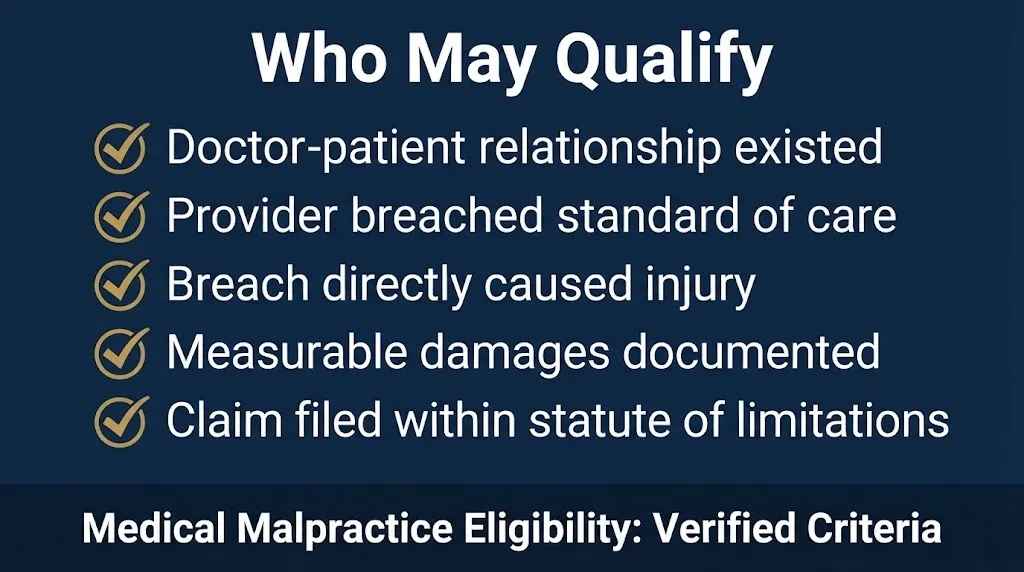
You may qualify to file if a healthcare provider’s negligence caused you injury, and you can prove the four legal elements. You don’t need to have a perfect outcome to have a claim. You need evidence that care fell below accepted standards.
Eligibility Criteria:
- A doctor-patient relationship existed
- The provider breached the standard of care
- The breach directly caused your injury
- You suffered measurable damages
Specialties facing the most claims include surgeons (90% career rate), OB/GYN (85%), and orthopedic surgeons (82%) .
How Do You File a Medical Malpractice Lawsuit?
Filing a malpractice lawsuit means gathering records, consulting experts, and meeting strict procedural requirements before you file. Many states require a certificate of merit signed by a qualified medical expert.
Steps to File:
- Request complete medical records from all providers involved in your care.
- Consult a malpractice attorney who can evaluate whether your case meets the legal standard.
- Obtain expert review. A qualified medical expert must confirm reasonable grounds exist for the claim.
- Send pre-suit notice if your state requires it. Many states mandate notification before filing.
- File the complaint in the appropriate court within the statute of limitations.
- Participate in discovery, including exchanging records and answering interrogatories.
- Attend mediation or trial if the case doesn’t settle during discovery.
Expert costs range from $500 to over $1,000 per hour, making expert testimony one of the most expensive aspects of malpractice litigation .
What Evidence Do You Need to Prove Medical Malpractice?
You need four types of evidence to prove malpractice: medical records, expert testimony, causation evidence, and damage documentation. Medical records alone rarely establish negligence without expert interpretation .
Evidence That Strengthens Your Case:
- Complete medical records: Provider notes, test results, medication lists, surgical logs
- Expert medical testimony: A qualified specialist who can explain how care deviated from accepted standards
- Causation evidence: Imaging, lab trends, symptom timelines showing the injury wouldn’t have occurred without negligence
- Damage documentation: Medical bills, lost wage statements, life-care plans
Evidence That Does Not Win Malpractice Cases:
- A poor medical outcome alone
- Patient dissatisfaction with care
- Internet research
- Belief that care “should have been better”
What Is the Statute of Limitations for Medical Malpractice?
Most states give you two years from the date of injury or discovery to file a malpractice lawsuit, but the range varies from one to six years . The discovery rule extends deadlines when you couldn’t have known about the negligence immediately.
State Filing Deadlines (2026):
| State | Deadline | Discovery Rule |
|---|---|---|
| New York | 2.5 years | Yes, from discovery |
| Florida | 2 years | Yes, with exceptions |
| Texas | 2 years | Yes, limited exceptions |
| California | 3 years | Yes, from discovery |
| West Virginia | 2 years | Yes, 10-year maximum |
Recent legislative changes: Louisiana extended its deadline from 1 to 2 years effective July 1, 2024. Utah extended from 2 to 4 years effective May 7, 2025. Missouri reduced its deadline from 5 to 2 years effective August 28, 2025 .
What Happens Next in a Medical Malpractice Case
Immediately: Request complete medical records and preserve all documentation.
Within weeks: Consult a malpractice attorney for case evaluation.
Within months: Obtain expert review and send pre-suit notice if required.
Before deadline: File the complaint within your state’s statute of limitations.
Discovery phase: Exchange records and participate in depositions.
Resolution: Settlement negotiations or trial.
Frequently Asked Questions
How much is the average medical malpractice settlement?
The average settlement falls between $250,000 and $500,000.
Cases involving death average approximately $380,300.
Severe injuries with permanent disability can settle for $1 million or more.
Can I sue a doctor for a bad outcome?
No, a bad outcome alone is not grounds for a lawsuit.
You must prove the doctor breached the standard of care and that breach caused your injury.
Medicine involves inherent risks, and unfortunate results can occur even with proper care.
What is the statute of limitations for medical malpractice?
Most states give you two years from the injury or discovery date.
Some states allow up to six years, while others have shorter deadlines.
The discovery rule may extend your deadline if you couldn’t have known about the negligence.
Do I need an expert witness to prove malpractice?
Yes, most states require expert testimony to establish the standard of care and causation.
The expert must typically practice in the same specialty as the defendant.
Expert costs range from $500 to over $1,000 per hour.
What evidence do I need to win a medical malpractice case?
Complete medical records, expert testimony, and proof of causation are essential.
You also need documentation of damages like medical bills and lost wages.
Evidence showing the injury wouldn’t have occurred without negligence strengthens your case.
Can I sue a hospital for malpractice?
Yes, hospitals can be held liable for their staff’s negligence.
You can sue individual providers, the hospital, or both depending on the circumstances.
Hospitals are responsible for staff training, supervision, and policy compliance.
What are the most common medical malpractice claims?
Diagnosis errors account for approximately 26.6% of paid claims.
Surgery errors account for approximately 26.9%.
Treatment errors account for approximately 24.5%.
What You Should Do Now
If you believe you suffered harm from medical negligence, request your complete medical records immediately. Records can be altered or become harder to obtain as time passes. Consult a malpractice attorney for a free evaluation before your state’s filing deadline expires.
Most states give you two years, but evidence fades and witnesses move. The strongest cases are built early. A free consultation costs nothing and tells you whether you have a claim worth pursuing.