Workers Compensation Forms 2026: Deadlines, Filing Steps and Traps
Quick Answer
- Workers compensation forms are free government documents. No agency charges you to file one.
- The form itself pays nothing. It opens the claim that triggers medical and wage benefits.
- Deadlines vary by state. Texas gives one year. New York gives two.
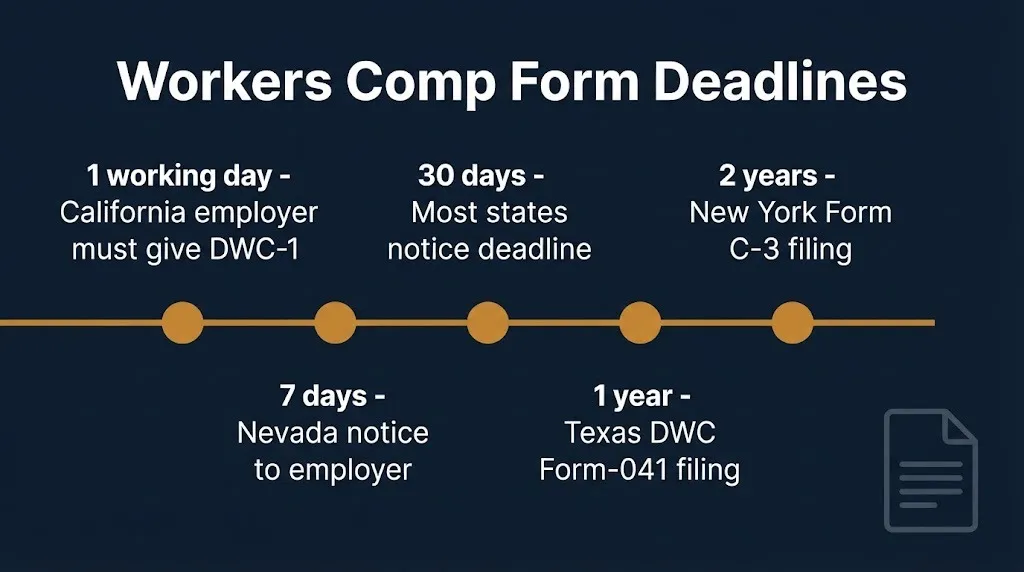
A workers compensation form is the document that officially opens your claim with your employer’s insurer or your state board. In California, filing the DWC-1 starts the process, and Labor Code 5401 requires your employer to hand you one within one working day of learning about your injury.
This matters to anyone hurt at work who was told to “fill out some paperwork.” Miss the wrong deadline and benefits can vanish, no matter how serious the injury.
Below you’ll find the form names by state, the real deadlines, the filing steps, and the mistakes that sink claims. One detail most guides skip: in Florida, the employer files the first report, not you.
The Facts
| What it is | The employee claim form that opens a workers’ compensation case |
| Common names | DWC-1 (California), C-3 (New York), DWC Form-041 (Texas), CA-1 and CA-2 (federal employees) |
| Cost to file | Free |
| Filing deadline | Varies by state. California one year, Texas one year, New York two years, federal three years |
| Reporting deadline | Often 30 days from injury. Nevada requires 7 days |
| Who reviews it | The employer’s claims administrator or the state board |
| Proof needed | Injury details, date, body parts, employer information, medical records |
Are workers compensation forms real, or is someone scamming you?
The forms are real and they come from government agencies. Every state runs a workers’ compensation division that publishes its own official forms.
New York’s Workers’ Compensation Board publishes Form C-3, the Employee Claim, and accepts it online or on paper. Texas publishes DWC Form-041 through the Department of Insurance, Division of Workers’ Compensation.
Here’s where scams creep in. Third-party sites repackage free government PDFs behind a paywall or a “free trial” that bills you later.
Watch for these signs:
- A site charging a fee to download or “fill out” a state form
- A subscription prompt before you can print
- A domain that is not your state agency or your employer’s carrier
- Any request for payment to “submit” your claim
Compare it to renewing a passport. The official fee goes to the government, and anyone charging extra to hand you the same form is selling convenience, not access.
Is the form your employer handed you the right one?
Often yes, but not always, and the wrong form costs you time.
California employers must provide the DWC-1, officially the Employee’s Claim for Workers’ Compensation Benefits. Federal employees use a different system entirely, with Form CA-1 for a traumatic injury and Form CA-2 for occupational disease.
The distinction that trips people up is sudden injury versus gradual injury:
| Injury type | Federal form | What it covers |
|---|---|---|
| Single event in one shift | CA-1 | Fall, lifting injury, accident |
| Developed over time | CA-2 | Repetitive strain, exposure illness |
Using the wrong form does not automatically destroy a valid claim, but it can create questions or delays.
If your employer hands you something labeled “incident report” only, ask directly for the state claim form. An internal incident report is not the same document.
Do you have to pay to get a workers compensation form?
No. Filing a workers’ compensation claim form is free in every state.
State agencies publish their forms at no cost. New York tells injured workers the fastest route is completing the online Employee Claim through the Board’s website.
Federal employees file through ECOMP, the Employees’ Compensation Operations and Management Portal, and the Department of Labor confirms employees do not need supervisor approval to initiate a FECA claim.
What is genuinely free:
- Downloading the form from your state agency
- Filing it with the board or your employer
- Asking the state agency staff how to complete it
- Getting a stamped copy at a field office
Texas DWC staff answer form questions by phone at no charge. Florida runs an Employee Assistance and Ombudsman Office for the same reason.
Key Takeaway: The claim form is a free government document, and anyone charging you to access or submit it is selling something you already have a right to.
How much is a workers comp claim worth in 2026?
Not determined by the form. Your benefit amount depends on your wages, your medical findings, and your state’s rate schedule.
California’s Department of Industrial Relations announced 2026 temporary disability rates ranging from $264.61 to $1,764.11 per week, effective January 1, 2026. That range shows how wide the spread is between a part-time worker and a high earner.
| What drives your amount | Why it matters |
|---|---|
| Average weekly wage | Most states pay roughly two-thirds of it |
| State minimum and maximum | Caps apply regardless of your wage |
| Time out of work | Temporary disability runs while you recover |
| Permanent impairment rating | Decided later, after maximum medical improvement |
California requires the employer to authorize up to $10,000 in medical treatment while the claim is being investigated.
No one can tell you your number from the form alone. Anyone quoting a figure before your wage records and medical evidence are in is guessing.
Does filing the form guarantee you get paid?
No. Filing opens the claim. The insurer still decides whether to accept or deny it.
In California, the claims administrator has 90 days after the DWC-1 is filed to accept or deny, under Labor Code 5402. Nevada gives the third-party administrator 30 calendar days from receipt of the C-4 form for accident claims.
Denials are common. When the insurer says no, you get a written denial with the reason, and the dispute moves to the state’s hearing process.
What filing actually does for you:
- Creates a dated record that you reported the injury
- Starts the insurer’s response clock
- Triggers interim medical treatment rules in some states
- Preserves your right to a hearing if benefits are refused
- Generates a claim number you’ll use for every future call
Think of it like a warranty claim. Submitting the paperwork gets the file opened, but the company still inspects before it agrees to pay.
Reality Check: No state agency will text you asking for a fee to process your workers’ comp claim. Filing is free, the forms are free, and state ombudsman offices answer questions for free. Any website charging you to download a state claim form is reselling a public document.
Who may qualify to file a workers compensation form?
You may qualify if you were injured or became ill because of your job, and your employer carries coverage.
California covers most employees from their first day on the job, regardless of immigration status or length of employment. Coverage rules vary sharply elsewhere. Texas employers can legally opt out of workers’ compensation entirely.
Common qualifying situations:
- A single-event injury during a shift
- A repetitive strain condition that built up over months
- An occupational disease tied to workplace exposure
- A pre-existing condition made worse by work duties
Workers’ compensation is a no-fault system. Benefits are paid regardless of who caused the accident.
Filing the DWC claim form is a claim for benefits, not a lawsuit against your employer. That distinction stops a lot of people from filing who should.
If your employer has no coverage, New York routes claims through the Uninsured Employers Fund. Check your own state’s equivalent before assuming you have no path.
Key Takeaway: Filing starts a clock on the insurer, but acceptance depends on medical evidence and your state’s rules, not on the paperwork alone.
How do you fill out a workers compensation form step by step?
Complete the employee section accurately, sign it, date it, and keep a copy before anything leaves your hands.
Here’s the sequence most states follow:
- Report the injury to your supervisor, in writing, as soon as possible.
- Ask your employer for the state claim form the same day.
- Fill in your name, the date, the place, and how the injury happened.
- List every body part affected, not just the worst one.
- Sign and date the employee section only.
- Give it to your employer and request a dated copy back.
- Keep that copy as your receipt.
California guidance is blunt on the body-parts point: include all parts you feel may be hurt or affected. A shoulder problem that surfaces two weeks after a back injury is harder to add later.
Write plainly. “I was lifting a 50-pound box from the floor to a shelf when I felt sharp pain in my lower back” beats “hurt my back at work.”
Under California law, your employer has 24 hours to return the completed form to you.
Which workers compensation form does your state use?
The name changes at every state line, and so does who files it.
| State | Employee form | Filing deadline |
|---|---|---|
| California | DWC-1, Employee’s Claim | 1 year to file with the appeals board |
| New York | C-3, Employee Claim | 2 years from the accident |
| Texas | DWC Form-041 | 1 year from the date of injury |
| Florida | Employer files the DWC-1 First Report | 2 years for a Petition for Benefits |
| Nevada | C-4 through the treating physician | 90 days to seek treatment |
New York requires Form C-3.3, a Limited Release of Health Information, if you previously injured the same body part or had a similar injury.
Florida works differently from the rest. The employer and carrier complete the First Report of Injury or Illness, and you generally file nothing with the division unless the claim is denied.
Pennsylvania runs claims through WCAIS, its automation system, where a First Report of Injury establishes the claim record before other forms can be attached.
The form names above are verified. Deadlines for states not listed here are not confirmed in this article, so check your state board directly.
What forms do federal employees file?
Federal workers file with the Office of Workers’ Compensation Programs, not a state board, and the form set is different.
| Form | Purpose |
|---|---|
| CA-1 | Traumatic injury from a single day or shift |
| CA-2 | Occupational disease developed over time |
| CA-7 | Wage-loss compensation after continuation of pay ends |
| CA-7a | Time analysis for intermittent lost time |
| CA-16 | Authorization for medical treatment |
Forms are submitted electronically through ECOMP, and your agency completes its portion before the packet reaches OWCP.
Two separate clocks run. FECA carries a three-year limit to file the claim itself, while Form CA-1 must go to your agency within 30 days to preserve continuation of pay.
Missing the 30-day mark can cost you continuation of pay without costing you the claim. File anyway.
For a CA-2, review the matching CA-35 checklist showing what evidence that type of occupational disease requires.
Key Takeaway: Your state decides the form name and the clock, and federal employees run on an entirely separate ECOMP track with its own deadlines.
What is the deadline to file a workers compensation form?
There are usually two deadlines, and people confuse them constantly.
The first is the notice deadline for telling your employer. The second is the filing deadline for the formal claim.
| State | Tell your employer | File the claim |
|---|---|---|
| California | 30 days (Labor Code 5400) | 1 year (Labor Code 5405) |
| New York | 30 days (WCL Section 18) | 2 years (WCL Section 28) |
| Texas | 30 days | 1 year |
| Florida | 30 days (Statute 440.185) | 2 years |
| Nevada | 7 calendar days (NRS 616C.015) | Treatment within 90 days |
| Federal (FECA) | 30 days for continuation of pay | 3 years |
For injuries that build slowly, the clock often starts later. New York measures from when you knew or should have known a condition came from your work.
Florida applies the same logic to repetitive trauma and occupational disease, running the two years from when you knew or reasonably should have known.
Texas allows a late filing where “good cause” exists, but appeals decisions show that argument frequently fails.
Where do you send the completed form?
Send it to whoever your state designates, which is usually your employer, the carrier, or the board directly.
In California, you return the DWC-1 to your employer, who completes their section and forwards it to the insurance company.
New York works the other way. You file Form C-3 with the Workers’ Compensation Board yourself, online or on paper, because that is how you notify the Board of your injury.
Texas requires you to send DWC Form-041 to the Division within one year, even if your employer already reported the injury.
Your options in most states:
- Hand delivery to a field office, with a stamped copy for your records
- The state’s online filing portal
- Certified mail, keeping the receipt
- Fax, where the agency still accepts it
Filing at a local DWC office in Texas gets you a stamped copy, which later serves as proof you filed inside the statute of limitations.
What happens after you file the form?
The insurer investigates, then accepts or denies within a window your state sets.
California gives the claims administrator 90 days. If nothing happens in that time, the claim is presumed compensable in most circumstances.
Nevada’s third-party administrators get 30 calendar days for accident claims and 30 working days for occupational disease claims.
What typically happens during the investigation:
- The carrier reviews your medical records and injury report.
- An adjuster may interview you or your supervisor.
- Interim medical treatment may be authorized.
- Wage records get pulled to calculate your benefit rate.
- A written acceptance or denial is issued.
Texas carriers generally have about 15 days to begin paying benefits or dispute the claim.
Keep the claim number the agency assigns you. Every phone call and follow-up form will need it.
Key Takeaway: Two clocks govern your claim, the notice clock and the filing clock, and blowing either one can end the case before the medical facts are ever reviewed.
How do you check the status of your workers comp claim?
Use your state’s electronic case system or call the adjuster assigned to your file.
New York offers eCase, the Board’s electronic case folder, where you can see what the Board received and check your claim status.
Pennsylvania claims live in WCAIS, where forms are uploaded to the individual claim’s Actions tab. Federal claims are tracked through ECOMP, where OWCP assigns and posts your claim number.
Steps that work in most states:
- Find your claim number on the acknowledgment letter.
- Register for your state’s online case portal.
- Call the adjuster listed on your carrier correspondence.
- Contact the state ombudsman office if the adjuster goes silent.
- Request a written status update, not a verbal one.
Florida’s Employee Assistance and Ombudsman Office answers injured-worker questions by phone and email.
Texas DWC runs a dedicated line for claim questions. Use the agency before you assume your claim disappeared.
What if your employer refuses to give you a form?
A missing form should never stop you. You can obtain and file one yourself.
California guidance is direct on this point: if your employer does not hand you a form, download one and file it directly.
New York goes further by letting you file Form C-3 with the Board without your employer’s involvement at all.
Federal employees face the same protection. The Department of Labor confirms employees do not need approval from a supervisor or agency official to start a FECA claim.
If your employer stalls:
- Download the form from the state agency yourself
- File it with the board or carrier directly
- Send written notice of your injury and keep a copy
- Contact your state ombudsman or field office
Texas law addresses a related problem. Where an employer fails to report the injury to the carrier as required, the one-year filing period is tolled until the report is made.
What if your claim gets denied after you file?
A denial is not the end. Each state has a formal dispute path, and it starts with another form.
California uses an Application for Adjudication of Claim, filed with the Workers’ Compensation Appeals Board when the claim is disputed, subject to the one-year deadline in Labor Code 5405.
Florida disputes go to the Office of Judges of Compensation Claims through a Petition for Benefits, generally within two years of the injury or one year of the last payment, whichever falls later.
Nevada allows hearings and appeals within 70 calendar days under NRS 616C.315.
What to gather before disputing:
- The written denial and its stated reason
- All medical records linking the condition to work
- Your dated copy of the original claim form
- Wage records from every employer
- Witness names and contact details
Federal denials run through OWCP’s own reconsideration and appeal process rather than a state board.
Key Takeaway: A denial moves the case to a hearing track with its own separate form and its own separate deadline.
What is a workers compensation form, and what does it actually do?
It is the document that converts a workplace injury into an open legal claim with deadlines attached.
Once you complete the employee section and give it to your employer, your California claim is legally opened. That date starts the clock on several other deadlines.
Workers’ compensation exists to pay medical care and partial wage replacement without the delay and expense of a traditional lawsuit. New York describes the benefit set the same way: health care for the injury plus a lost-wage benefit.
What the form is not:
- A lawsuit against your employer
- A guarantee of payment
- A substitute for telling your supervisor
- A document you should ever submit unsigned
The form is closer to filing a police report than winning a case. It creates the official record everything else gets measured against.
Which mistakes on the form sink claims most often?
Incomplete injury descriptions and late reporting cause the most preventable damage.
New York flags the risk plainly. Failure to file within two years of the injury date may result in denial.
Four errors that repeatedly cost people benefits:
- Listing one body part. Add every area affected, even minor ones.
- Vague injury descriptions. Name the task, the object, and the motion.
- Delaying the report. Most states use a 30-day notice rule, and Nevada uses 7 days.
- Keeping no copy. Without a dated copy, proving you filed gets hard.
Blank fields slow processing. New York’s own guidance stresses completing every required item.
Inconsistent statements between your form, your doctor, and your supervisor undermine credibility at a hearing later.
What happens next
Within 1 working day of your report: In California, your employer must give you the DWC-1 claim form.
Within 7 to 30 days: Most states require written notice to your employer. Nevada requires 7 calendar days.
Within 15 to 90 days of filing: The carrier accepts or denies. California allows up to 90 days.
Expected within 1 to 2 years: Your state’s filing deadline expires. Texas and California give one year, New York and Florida give two.
Expected 3 years for federal workers: The general FECA filing limit runs out.
Frequently Asked Questions
What is the workers compensation form called?
It depends on your state.
California uses the DWC-1, New York uses Form C-3, and Texas uses DWC Form-041.
Federal employees use CA-1 or CA-2 through ECOMP.
Can I file a workers comp form myself?
Yes, in most states.
California guidance says you can download and file the form yourself if your employer does not provide one.
New York accepts Form C-3 from employees directly.
How long do I have to file a workers compensation form?
Deadlines vary by state.
Texas and California generally allow one year, while New York and Florida generally allow two.
Federal employees generally have three years under FECA.
Do I have to report the injury before filing the form?
Usually yes.
Most states require notice to your employer within 30 days, and Nevada requires 7 calendar days.
Late notice can cost benefits absent good cause.
Does filing a workers comp form mean I am suing my employer?
No.
Filing a claim form requests benefits under a no-fault system.
It is not a lawsuit against your employer.
What if my injury developed slowly over time?
Different rules often apply to the deadline clock.
New York and Florida generally start the period when you knew or should have known the condition was work-related.
Federal workers use Form CA-2 instead of CA-1.
Can I be charged for a workers comp form?
No agency charges you.
State forms are published free by the workers’ compensation division.
Paid form sites are reselling public documents.
What happens if the insurer never responds?
State law sets a response window.
California allows the claims administrator 90 days to accept or deny.
Contact your state ombudsman office if that window passes.
Download the claim form straight from your state’s workers’ compensation agency, not a third-party site, and file it the same week you report the injury.
Put two dates on your calendar: your state’s notice deadline and its filing deadline. In Texas, that filing deadline is one year from the date of injury.