IUL Lawsuit 2026: Settlement Payouts, Who Qualifies, and How to File a Claim
Quick Answer
- What this is: Lawsuits against life insurers alleging indexed universal life policies were sold with misleading illustrations and hidden costs.
- How much: Individual settlements range from $5,000 for short-term policyholders to $500,000+ for long-term holders who suffered major losses.
- Deadline: No universal deadline; most states give 2 to 6 years from when you discovered the harm, not from the policy purchase date.
You bought an indexed universal life policy that was pitched as a tax-free retirement plan. Years later, the cash value is nowhere near what the illustration promised, and the fees keep eating away at what’s left. You’re not alone, and you may have legal options.
IUL lawsuits are accelerating in 2026, with multiple settlements reached and several cases still active. The legal theories center on misrepresentation, hidden costs, and illustrations that showed unrealistic projections. This guide covers what policyholders have recovered, who may qualify, and the exact steps to file a claim. One detail that catches people off guard: your deadline may start when you discovered the problem, not when you bought the policy, which means older policies might still have viable claims.
The Facts
| Case | Individual lawsuits and class actions against multiple IUL carriers (Pacific Life, Aegon, Lincoln National, National Life, Transamerica) |
|---|---|
| Status | Active litigation and settlements; Aegon and Lincoln National settled in 2026 |
| Fund Size | Varies by case; Aegon settlements fully provisioned, Lincoln National settled May 2026 |
| Est. Per Person | $5,000 to $500,000+ depending on policy duration and losses |
| Claim Deadline | Varies by state; generally 2 to 6 years from discovery of harm |
| Administrator | Varies by settlement; check court notices |
| Proof Needed | Original policy illustration, policy statements, premium records, agent communications |
Key Takeaway: IUL lawsuits are not one case. They are many cases against different carriers, and your options depend on which company sold you the policy and when.
Is the IUL Lawsuit Legit or a Scam?
IUL lawsuits are legitimate and actively litigated, not internet rumors or scams. Multiple federal courts have handled these cases, and several insurers have settled. The Aegon subsidiary settlements received preliminary approval in 2026, and Lincoln National settled three universal life cases in May 2026.
Scammers sometimes exploit confusion around IUL litigation by promising “guaranteed payouts” for upfront fees. That’s not how this works. Legitimate claims go through attorneys on contingency, meaning you pay nothing unless the case resolves in your favor. Filing a complaint with your state insurance department is free.
If someone contacts you demanding payment to “release” settlement funds, it’s a scam. Real settlements come through court-approved administrators or plaintiff attorneys, not cold calls.
How Much Can You Get From an IUL Lawsuit Settlement?
IUL settlement amounts vary widely based on how long you held the policy, the documented losses, and whether the case settles individually or through a class action. Unlike pharmaceutical mass torts with standardized payouts, IUL harm is individualized because each policy performs differently.
Here are estimated ranges based on publicly reported settlements and attorney disclosures:
| Claimant Category | Estimated Settlement Range |
|---|---|
| Short-term policyholders (2 to 5 years) | $5,000 to $25,000 |
| Mid-term policyholders (6 to 15 years) | $25,000 to $100,000 |
| Long-term policyholders (16+ years) | $100,000 to $500,000+ |
| Policyholders who experienced total lapse | Higher end plus potential punitive damages |
| Class action per-person distribution | $1,500 to $15,000 (varies by class size) |
These figures are estimates. Your actual recovery depends on specific facts, the carrier, and whether you pursue an individual claim or participate in a class action.
Key Takeaway: Individual lawsuits typically produce higher per-person recoveries than class action distributions, but they cost more to pursue and carry more risk. Many cases that start as individual claims become part of broader class actions.
Reality Check: What IUL Lawsuit Marketing Gets Wrong
Reality Check: Not every IUL policyholder has a viable lawsuit. If your policy performed reasonably close to its illustration, or if you’re outside your state’s statute of limitations, you may not have a claim. Some attorneys aggressively market IUL lawsuits to anyone who ever bought a policy, then reject most cases after review. A legitimate evaluation looks at your specific documents, not just the fact that you own an IUL.
Who Qualifies for an IUL Lawsuit in 2026?
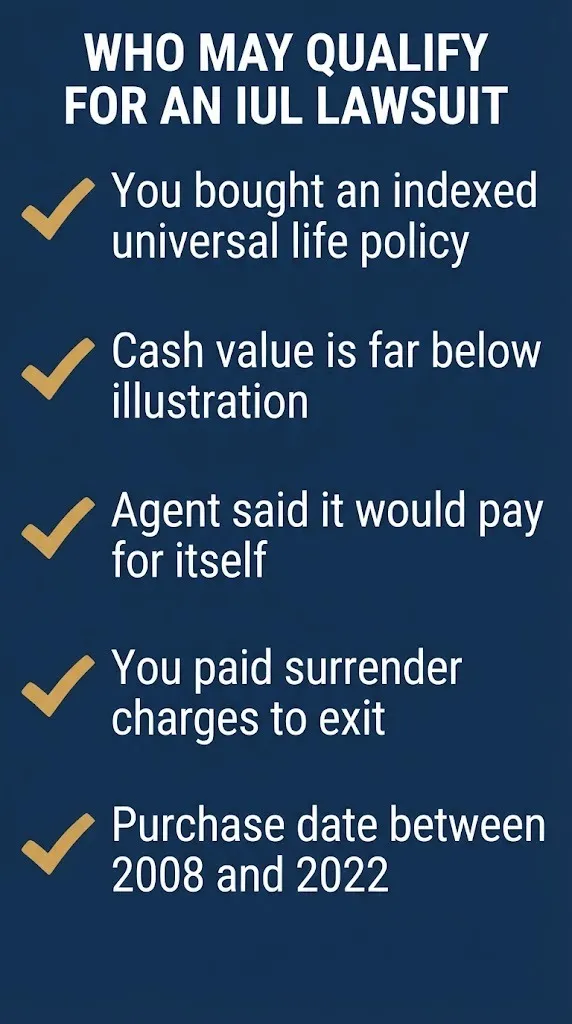
You may qualify for an IUL lawsuit if you purchased a policy and experienced documented harm tied to misrepresentation, hidden costs, or significant underperformance compared to what you were shown. Active, lapsed, and surrendered policies can all qualify depending on the facts.
General eligibility factors include:
- Policy type: Indexed universal life specifically
- Purchase date: Most claims cover policies purchased from 2008 to 2022
- Policy status: Active, lapsed, or surrendered
- Financial harm: Cash value significantly below what was illustrated
- Evidence: Copy of original illustration or sales documents available
You may have a stronger claim if any of these apply:
- Your agent said the policy would “pay for itself” within a set number of years
- You replaced another policy with the IUL based on agent recommendation
- Your cash value is 40% or more below the original illustration at the same policy year
- Your insurer raised cost-of-insurance charges and threatened policy lapse
- You paid surrender charges to exit a policy you were told you could access freely
How Do You File an IUL Lawsuit or Join a Class Action?
Filing an IUL lawsuit starts with gathering your policy documents and connecting with a plaintiff attorney who handles insurance misrepresentation cases. Most IUL cases are handled on contingency, meaning you pay nothing unless the case wins or settles.
Here are the steps:
- Gather your original policy illustration from the sale date and all annual statements
- Request your complete policy file from the insurance company in writing
- Compare actual cash value to illustrated cash value at the same policy year
- Document all communications with your agent or insurer about performance or costs
- File a complaint with your state insurance department (free and creates an official record)
- Contact a plaintiff attorney handling IUL or insurance misrepresentation cases
- Complete a free case evaluation (most firms offer this at no cost)
- Sign a contingency agreement if accepted and let the attorney file the claim
The most critical documents you need are the original illustration, your policy contract, annual statements, and any written communications from your insurer about cap rate or cost-of-insurance changes.
What Are the Common IUL Lawsuit Allegations?
Common allegations include misleading illustrations, hidden costs, unexpected premium increases, and agent misrepresentation. The lawsuits claim insurers prioritized commissions over policyholder interests.
Misleading illustrations are the core allegation in most cases. Agents showed projections based on back-tested historical performance that didn’t reflect real-world returns. Kyle Busch’s lawsuit against Pacific Life alleged the policies were marketed as “tax-free retirement plans” using speculative projections that failed to disclose true risks and costs.
Hidden costs include cost-of-insurance charges, rider fees, and administrative expenses that erode cash value. The Performance Plus rider in some Pacific Life products charged 4.98% to 7.12% annually on top of base policy costs, according to one analysis.
Unexpected premium increases happen when insurers raise cost-of-insurance rates, forcing policyholders to pay more or watch their policies lapse. Aegon settled litigation over increases in monthly deduction rates on universal life products, with the settlement paid to the class administrator.
Agent misrepresentation includes claims that agents said policies would “pay for themselves” or that buyers could “always access their money” without disclosing surrender charge timelines.
What Happened in the Kyle Busch Pacific Life IUL Lawsuit?
Kyle and Samantha Busch settled their $8.5 million lawsuit against Pacific Life in February 2026, with confidential terms. The case was one of the most high-profile IUL lawsuits and highlighted common allegations.
The Busches sued in October 2025, claiming they paid over $10.4 million in premiums based on misleading illustrations and false promises of guaranteed returns. They alleged Pacific Life and an agent marketed the policies as “tax-free retirement plans” without fully explaining risks and costs.
Pacific Life denied the allegations and sought dismissal, arguing the Busches signed documents acknowledging the terms, failed to fully fund the policies, and filed after North Carolina’s three-year statute of limitations expired. The case settled before trial.
The settlement terms remain confidential. Pacific Life said both sides “worked constructively to achieve a confidential result that is mutually acceptable”.
What Is the Aegon IUL Settlement in 2026?
Aegon reached two settlements in 2026 involving US subsidiaries and universal life policies. One settlement resolved claims over increased monthly deduction rates, and the other resolved bonus payment claims. Both received preliminary court approval.
In March 2026, the court granted preliminary approval in litigation over increases in monthly deduction rates on universal life products. The fully provisioned settlement amount was paid to the class administrator, and the related provision was released.
In August 2026, the court granted preliminary approval in a putative class action alleging that a US-based Aegon subsidiary improperly failed to pay bonuses to policy owners on a certain block of universal life policies. That settlement remains subject to final court approval.
These settlements show that IUL and universal life carriers are resolving claims, but they also confirm that each case is carrier-specific. If your policy is with a different company, you need to check that company’s litigation status separately.
What Happens If Your IUL Case Goes to Trial?
Most IUL cases settle before trial, but some defendants have won at the summary judgment stage. A Vermont judge sided with National Life in January 2026, awarding summary judgment on breach of contract, deception, and racketeering claims.
The plaintiff in that case alleged her IUL policy returned 0% and that National Life’s sales practices violated RICO. Judge Christina Reiss found the plaintiff “failed to state a valid claim that she was deceived” and rejected the RICO claim because the complaint didn’t identify specific communications or actions in furtherance of a fraudulent scheme.
That ruling doesn’t mean all IUL cases fail. It means the pleadings must be specific. Cases with detailed documentation of misrepresentation, clear evidence of illustration discrepancies, and proper legal theories can survive dismissal.
What Happens Next: Timeline for IUL Litigation
Now to 2026 end: Gather documents, file state insurance complaints, and contact plaintiff attorneys.
2027: More settlements expected as cases progress through discovery and mediation.
Ongoing: Class action notices may arrive by mail or email if you’re included in a settlement class.
If you file individually: Expect 1 to 3 years from filing to resolution, depending on the court and carrier.
Statute of limitations: Check your state’s discovery rule deadline immediately, as some windows are closing.
Frequently Asked Questions
How do I know if I have an IUL lawsuit?
You may have a claim if your policy performed far below its illustration, you were told it would “pay for itself,” or you paid surrender charges to exit. An attorney can review your documents for free.
What is the average IUL lawsuit settlement?
There is no single average. Individual settlements range from $5,000 to $500,000+ based on policy duration, documented losses, and the specific carrier.
Can I join a class action if one exists for my insurer?
If a class action settles and you’re included, you’ll receive a court-issued notice. You may be automatically included unless you opt out. Check the notice carefully for deadlines.
Do I need to pay upfront to file an IUL lawsuit?
No. Most plaintiff firms handle IUL cases on contingency, meaning you pay nothing unless the case wins or settles.
What documents do I need for an IUL claim?
The original policy illustration, policy contract, annual statements, premium payment records, and any written communications with your agent or insurer about performance or costs.
How long do I have to file an IUL lawsuit?
It varies by state, generally 2 to 6 years from when you discovered the harm, not from the policy purchase date. Check your state’s discovery rule deadline.
Can I file a claim if my policy is still active?
Yes. Active policies can qualify if the cash value is significantly below illustration or you’ve experienced unexpected cost increases.
What if my IUL carrier isn’t named in any lawsuit?
Carriers not currently facing litigation may still be subject to individual claims. A plaintiff attorney can evaluate your case regardless of whether a class action exists.